
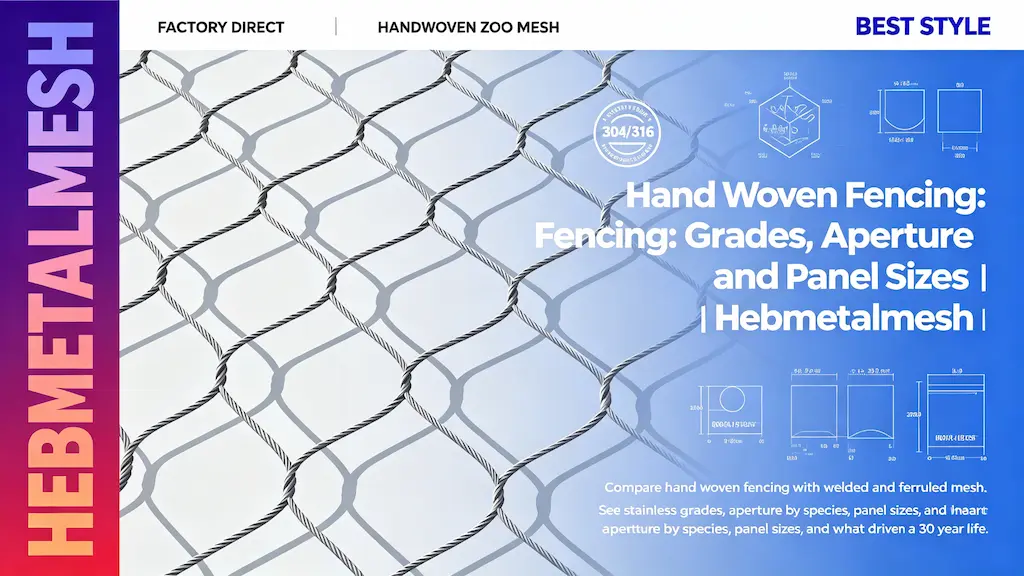
Two quotes for the same cable fence can differ by 40%, and the cheap one is rarely cheap because the supplier is efficient. It is cheap because somewhere in the specification something was reduced: the alloy, the strand count in the rope, the panel size, or the steel per square metre. None of those show in a photograph, and all of them decide whether the enclosure is standing in year twenty.
This is a buying guide rather than a product page: where the money goes in a stainless rope cable fencing system, how to read the three numbers that matter, and how to tell a mill from a trading company before you transfer a deposit. Buyers who work through it usually pay less in total, mostly by avoiding the re-order that follows a bargain.
Executive Summary
Cable fence price is driven by one quantity above all: kilograms of stainless steel per square metre. That is set by rope diameter and aperture, which is why 3.2 mm at 38 mm costs several times what 1.2 mm at 20 mm does. Alloy grade is the second lever and where the damaging substitutions happen — 201 looks identical to 304 and rusts within a couple of years outdoors. The third is panel size: mesh woven to the exhibit wastes almost nothing, while mesh cut from stock leaves offcuts you paid for. Lock six lines before ordering — alloy, rope diameter, aperture, panel dimensions, edge treatment, fittings — and require a mill test report against the first. A credible cable fence manufacturer produces one without being asked twice; the animal fence mesh page is the reference range.
Quick Answer:
How much does a stainless cable fence cost per square metre? Hand-woven stainless rope mesh runs roughly 10–22 per square metre** for aviary and small-mammal specifications and **20–38 per square metre for large-carnivore work at 3.2 mm. The spread inside each band is almost entirely steel weight: 3.2 mm rope at 38 mm weighs about 2 kg/m², while 1.2 mm at 20 mm weighs well under 0.7 kg/m². Frame, doors, and installation are additional.
Key Takeaways
- Steel weight per square metre is the price. Quote comparisons that ignore rope diameter and aperture are meaningless.
- 7×7 strand rope is the hand-weaving standard. It balances flexibility and strength; stiffer constructions cannot be woven into a diamond without fighting the tool.
- Insist on a mill test report. Alloy substitution is the single most common way a cheap quote is made cheap.
- Woven-to-size beats cut-from-roll. Zero offcut means you are not paying for steel that ends up in a bin.
- Vet the supplier before the deposit, not after. A sample panel and an independent inspection cost a fraction of a bad container.
Where the Money Goes
Four variables account for nearly all variation between quotes, and only one is negotiable without changing performance.
| Variable | Effect on price | Effect on performance |
| Rope diameter | High — weight scales with diameter squared | Sets fatigue life and chew resistance |
| Aperture | High — smaller opening, more rope per m² | Sets containment and visibility |
| Alloy grade | Moderate — 316 carries a premium | Sets corrosion life on coastal sites |
| Panel size | Low to moderate | Sets seam count and labour |
The fourth row surprises people. Large panels are not proportionally dearer to weave, but they remove the horizontal joints that animals work at and that corrode first. A single piece up to 9 m by 18 m removes one of the two most common failure points in an enclosure; the other is the door.
Surface finish is absent from that table for a reason: black oxide is a cosmetic and anti-glare treatment, not a corrosion barrier, and it should not move the price of a cable fence for zoos.
The Rope: 7×7 Strand Construction
Nearly all hand-woven zoo mesh is built from 7×7 strand stainless wire rope: seven strands of seven wires, forty-nine in total. It is limber enough to be worked around a weaving jig by hand while still carrying useful load. The direction and pitch of the twist is the cable lay, and a consistent lay is what makes a panel lie flat.
Stiffer constructions exist — 1×19 is a single strand of nineteen wires — and are stronger in pure tension for the same diameter, but they are close to rigid, which is why they belong in balustrade and rigging work rather than woven mesh. If a supplier proposes anything other than 7×7, ask to see a sample woven from it.
Breaking load follows diameter: 3.2 mm rope is around 7 kN and 2.4 mm around 4.4 kN. Both far exceed what any bird or small mammal applies, but they are what an engineer wants on the drawing and what a mill test report should corroborate.
Alloy: 304, 316, and the 201 Substitution
Cable fence grade selection is a site decision, and it has two honest options.
- SS304 — roughly 18% chromium and 8% nickel; correct for inland, indoor, and most temperate sites.
- SS316 — adds molybdenum, typically 2–3%, which resists chloride pitting; correct for coastal sites, tropical humidity, and chlorinated washdown.
The dishonest option is 201. It is a low-nickel, high-manganese alloy that costs substantially less and looks the same to the eye and to a magnet test. Outdoors it stains and then pits, usually within two to four years. It is the easiest substitution to make and the hardest to spot afterwards, which is why it accounts for a disproportionate share of early-failure reports.
The defence is documentation. A mill test report — the EN 10204 3.1 certificate that travels with the heat of steel — states the wire’s actual chemistry. Ask for it with the quotation rather than the shipment, and read the nickel and molybdenum figures rather than the grade name. The choice between the two legitimate grades is set out in our 304 vs 316 mesh comparison.
Panels, Waste and Tolerance
Cable fencing is woven to order, the main advantage of buying direct. A panel made to your dimensions carries no offcut: the rope that enters it is the rope you own. Cutting from stock leaves a border and offcuts you discard — real money on a large enclosure, and one reason a mill beats a stockist on the same specification.
Two other manufacturing details are worth asking about:
- Panel tolerance — what deviation from the stated dimensions is acceptable, and in which direction. A panel woven 50 mm short will not fit a frame built to nominal size.
- Weave pattern — the diamond should hold its geometry across the whole face. Panels that flare at the edges were woven unevenly and will not hang flat.
Both are easy to check on a sample panel and nearly impossible to check once a container ships.
Vetting a Cable Fence Supplier
Most buyers deal with a trading company rather than the mill, which may not control production. That is not automatically bad — a good trader adds logistics and communication value — but the price should reflect it.
Four checks separate them, none costly:
- Ask a technical question you already know the answer to. A mill answers from the production side — lay length, strand count, jig size. A trader quotes a catalogue.
- Request a mill test report for a recent order. Redacted customer names are fine; redacted chemistry is not.
- Order a sample panel before the run. Check the weave pattern, the aperture with a gauge, and the rope diameter with a micrometer.
- Commission a third party inspection pre-shipment. On a container order an inspector costs a fraction of the cargo value and is the only check that happens while you still hold the balance.
Institutional buyers go further and require traceability; the accreditation standards published by the Association of Zoos and Aquariums show what a well-run facility expects suppliers to evidence. A cable fence manufacturer that weaves in-house can also describe its jig capacity and maximum panel size, since those are shop-floor constraints.
The Six-Line Specification
A complete cable fence specification fits on six lines. Send all six and you get a comparable quote; send three and you get three interpretations.
- Alloy — SS304 or SS316, with a mill test report requested.
- Rope diameter — 1.2, 1.6, 2.0, 2.4, or 3.2 mm; this is the cable fence gauge line.
- Aperture — 20, 25, 38, 51, 76, or 102 mm; this is the cable fence aperture line, chosen from the animal rather than the budget.
- Panel dimensions — height and width of each face, plus whether it can hang as one piece.
- Edge treatment — selvage, rope border, or prepared for a tensioning cable.
- Fittings — alloy of the ferrules, eye bolts, and turnbuckles, which should match the mesh.
Where cable fence design work has been done by an architect or zoo planner, send the drawings rather than a summary. Panel-by-panel dimensions let the mill nest the weave and quote accurately.
Budget Bands and What Moves Them
Plan on 10–22 per square metre** for aviary and small-mammal specifications and **20–38 per square metre for large-carnivore work at 3.2 mm. Frame, doors, shelter, and installation typically exceed the mesh line, particularly where the frame is new structural steel.
Four things push a quote away from those bands, and it is worth knowing which of them are legitimate:
- Small total area — setup and jig time are fixed; a 40 m² order costs more per square metre than a 400 m² one.
- SS316 — a genuine material premium, worth paying on a coastal site.
- Unusual panel shapes — curves, tapers, and cut-outs around trees add weaving hours.
- Rush scheduling — slots are booked in sequence; jumping the queue has a price.
What should not move the price is branding: two panels of identical gauge, aperture, and alloy perform the same, and the bigger marketing budget is not the better buy.
Lead Time, Packing and Shipping
Lead time for a woven-to-order cable fence is two to four weeks after sign-off, plus two to six weeks in transit. Plan the order around the build.
Mesh ships rolled or folded, and packing density depends on gauge. A 20-foot container carries several thousand square metres of aviary-grade mesh and less at 3.2 mm, where the container load is limited by weight. Confirm the figure for your code.
Freight, insurance, and duties are usually quoted separately. Make sure the quotation states the Incoterm — an EXW price and a CIF price are not the same number with a different label.
Tension, Service Life and Upkeep
A cable fence system is only as good as its perimeter. Cable fence tension is set against a frame or perimeter cable, targeting a face that deflects under a firm push and returns flat. Slack mesh sags into a pocket an animal can climb; over-tensioned mesh preloads the rope and stops absorbing impact.
Re-tensioning once in the first year is normal and should be budgeted. After that, cable fence maintenance is close to nothing: wash the panel once or twice a year with fresh water — more often on coastal sites — and walk the perimeter annually to check fittings.
Expected cable fence lifespan in zoo service is twenty-five to thirty years and beyond, because austenitic stainless relies on no coating that can wear off. That is the economic argument: a galvanized barrier is replaced several times inside the life of one stainless panel, and every replacement carries escape risk. Our galvanized vs stainless comparison sets out the arithmetic.
Frequently Asked Questions
Reduce both to steel weight per square metre by comparing rope diameter and aperture, then check the alloy: a quote 30% cheaper at the same nominal specification is usually lighter, a different grade, or both.
Yes, in most inland and temperate locations. Move to 316 near the sea, in tropical humidity, or where the enclosure is washed with chlorinated water.
7×7 strand stainless wire rope. It is limber enough to hand-weave into a diamond while carrying useful load, and it is what the standard HM codes are built from.
Often yes — panels are woven up to 9 m by 18 m in a single piece. Send the face dimensions and the mill will confirm whether your size is achievable at that gauge.
Request a mill test report with the quotation and read the nickel and molybdenum figures; for a full container, add a third party inspection before the balance is released.
The Bottom Line
Buy the steel, not the story. Specify alloy, rope diameter, and aperture first, ask for the mill test report before the discount, and compare quotes on weight per square metre rather than the headline number. Do that and a cheap quote either survives scrutiny or reveals itself, usually at the alloy line. Our hand woven fencing guide explains why the interlace outlasts a weld or a crimp, the zoo containment barrier guide covers public-side geometry, and the full animal fence mesh range lists every code.
Ready to compare specifications? Contact our team with the two quotes you have in hand.