
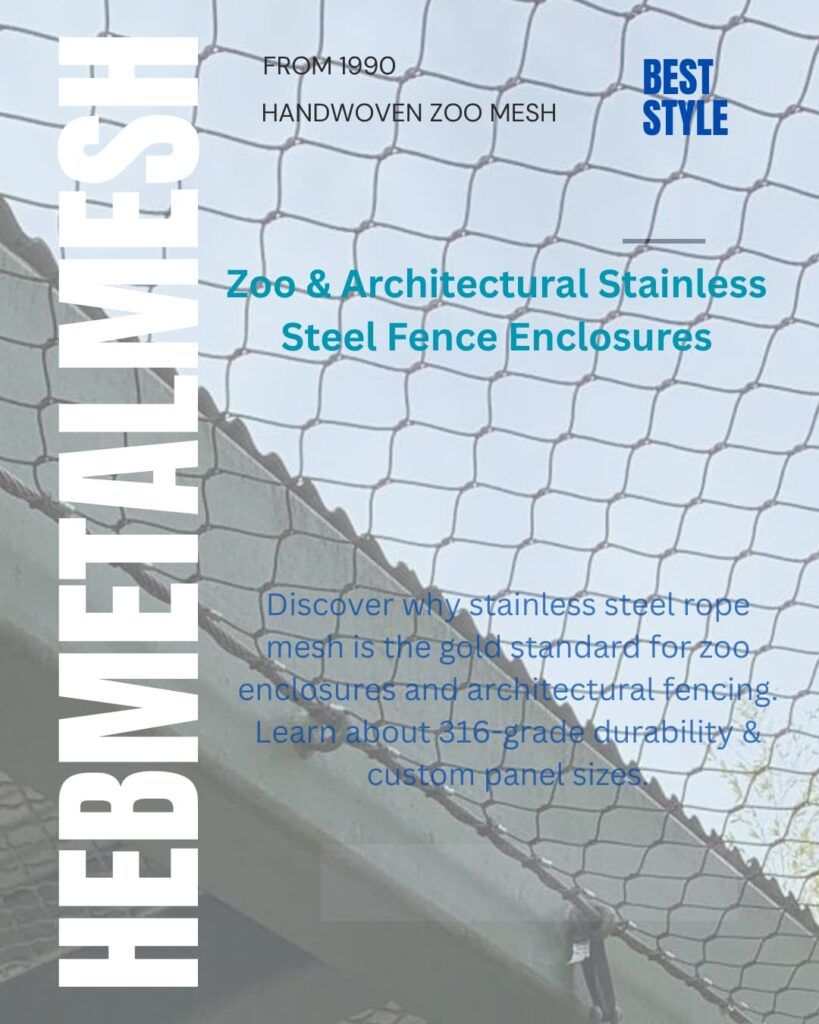
A stainless steel fence enclosure is bought to contain an animal or to screen a building, and it does that work with geometry rather than mass. Sound is the opposite problem: it yields to mass, to distance and to an unbroken solid obstacle, and a woven panel offers none of the three. Enclosure acoustics begins with that mismatch. The panel that stops a tiger is, acoustically, barely present – a visitor standing a meter away hears the animal as though the mesh were open air, and the animal hears the road the same way. Everything that can be done about noise therefore happens before the mesh is ordered: in the siting of the enclosure, in the mass placed between source and listener, and in the distance the brief is willing to accept.
Executive Summary
A hand-woven stainless steel rope mesh panel is 88 to 94 percent open and carries an areal density of one to three kilograms per square meter, which makes it close to transparent to sound in both directions. What it does do is avoid the fault that solid screens create: with almost nothing there to reflect from, a mesh enclosure produces no flutter echo and no hard reflection that throws noise back onto the occupant, which is why a mesh wall is often the quieter choice when the source is inside the enclosure rather than outside it. Real attenuation is bought with mass, distance and interruption: a solid structure, an earth bund, a planted buffer of genuine depth, or a longer distance to the boundary. Panels up to 9 by 18 meters, cable diameters from 1.2 to 3.2 millimeters and apertures from 20 to 102 millimeters are all available, and none of those choices moves the acoustic result. The reference specification is the animal enclosure mesh product page.
Quick Answer:
What does a stainless steel mesh enclosure do to sound? Almost nothing. A woven rope panel is 88 to 94 percent open and weighs one to three kilograms per square meter, so it neither absorbs nor blocks sound, and the animal, the keeper and the neighbors hear straight through it. Lowering the level at a particular listener is done with distance, mass and a continuous solid obstacle. The one acoustic advantage mesh has is that it does not reflect, so it creates none of the echo a sheet-metal or glazed screen would.
Key Takeaways
- A woven mesh panel is acoustically transparent: 88 to 94 percent open area, one to three kilograms per square meter, no useful attenuation.
- Mesh does not block sound, but it also does not reflect it, which makes it the quieter choice when the noise source is inside the enclosure.
- The material decision is a separate line item from the acoustic one. Choosing 304 or 316, or the molybdenum content that resists chlorides, changes the enclosure’s corrosion life and changes nothing about its sound level.
- Distance is the cheapest attenuator on the list: a point source loses roughly 6 decibels for every doubling of distance.
- Never write an acoustic requirement as a product name. Write it as a level at a named position and let the design carry it.
What a Woven Panel Actually Stops
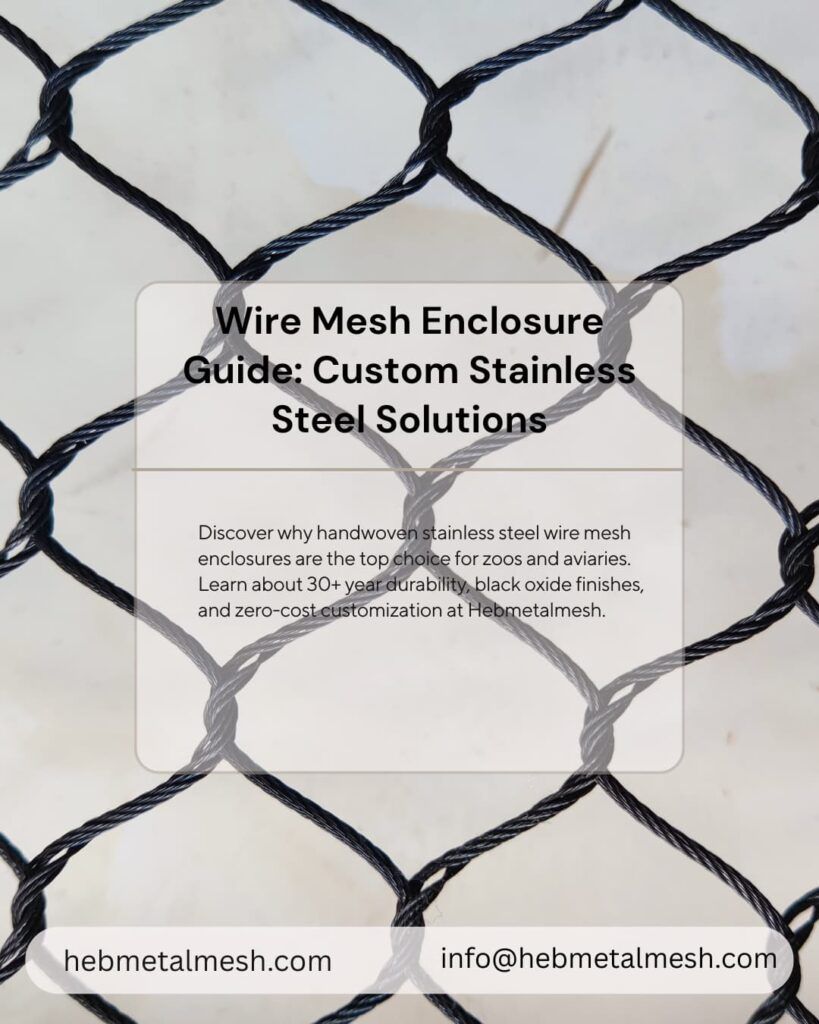
A woven rope panel stops an animal because its aperture is smaller than the body it has to hold, and it stops remarkably little else. The geometry that makes it strong in tension and light enough to hang by hand makes it acoustically close to absent: between 88 and 94 percent of its surface is air, and the metal that remains works out at one to three kilograms per square meter. Sound is not stopped by strength. It is stopped by mass and by the absence of a path around the obstacle, and a panel with those numbers supplies neither. Nothing in the range is chosen for acoustic reasons – not HM32102 at 3.2 millimeters over a 102 millimeter aperture, not HM3276, HM2076, HM1625 or HM1220 at 1.2 over 20. Read as a sound transmission mesh, the panel passes nearly all the energy that reaches it, and calling it a noise reduction barrier is the costliest specification error in this market, because it postpones the measures that would have worked until after the structure is built.
Three Sound Sources, and Only One of Them Is the Animal
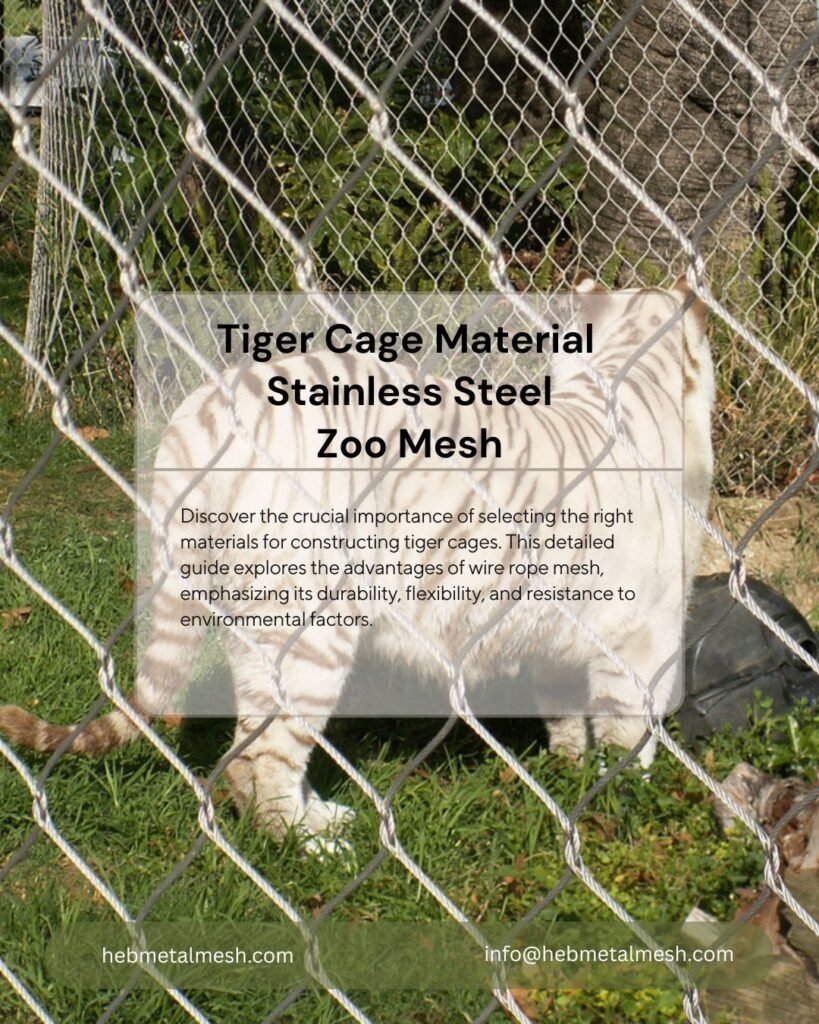
Noise reaches an enclosure from three directions, and the mesh sits upstream of none of them. The first is the animal itself: a big cat calling at dusk, a macaw’s contact call, a hoofstock group drumming against a gate. The second is the site: pumps, delivery vehicles, mowers, pressure washers, ventilation plant. The third is the public, and it is the most underrated: forty visitors talking at once is a continuous broadband source of 70 to 80 decibels that lasts all day. Traffic noise is usually the dominant source at an urban site and the least tractable, since it belongs to no one on the project. Any plan for this has to begin as a survey rather than a catalog decision: name every source and put a meter on the level at the boundary and at the animal’s resting place.
he Material Question Is Not the Sound Question
A brief that has to satisfy an engineer and an acoustic consultant tends to blur two independent decisions. The material decision is about corrosion. Type 304 stainless, at roughly 18 percent chromium and 8 percent nickel, is right for inland sites; type 316 adds around 2 percent molybdenum for coastal air and for the chlorides that arrive with salt spray, and that chemistry decides whether the enclosure is still sound in thirty years. None of it decides whether the enclosure is quiet tomorrow. The International Molybdenum Association sets out the role of molybdenum in resisting pitting and crevice corrosion in chloride solutions, and the quantity that matters there is a percentage in the alloy, not a decibel. Our grade-by-grade comparison of 304 and 316 cable mesh walks through that choice in detail. Keep the two questions as separate line items and neither one gets settled by accident.
Why Mesh Does Not Block Sound
Three comparisons settle the acoustic behavior of a woven panel. The first is the plain one: mesh does not block sound, and no amount of tension or double layering changes that, because blocking sound requires mass in the path of the wave. The second is the measured one: mesh sound absorption is close to zero, so a panel hung in a reverberant building does not shorten the reverberation time the way a porous absorber does – it simply occupies the wall. The third is the comparison that matters most in a zoo, glass versus mesh acoustics, because a viewing wall in mesh and one in glass are opposite problems. Glass reflects nearly all the energy that reaches it, which is why a glazed exhibit hall is loud inside. Mesh reflects almost none of it, so there is very little echo in an enclosure built from it, and the sound a solid screen would have thrown back at the occupant passes out through the weave and disperses.
What Really Lowers the Level: Distance, Mass and Interruption
Once the panel is ruled out, three levers remain and they rank in a fixed order. Distance is cheapest: a point source loses about 6 decibels for each doubling of distance, so moving an enclosure from ten meters to forty off a boundary recovers roughly 12 decibels at no material cost. Mass comes next, and it is not subtle: useful attenuation at low frequency needs an obstacle weighing tens of kilograms per square meter, which is why earth bunds, masonry walls and solid-roofed service buildings do the work, and why noise buffer planting contributes only once it is deep enough to be a wood rather than a hedge. Interruption is last: one unbroken solid obstacle standing between source and listener, overlapping the line of sight at both ends. Where the source cannot be moved, the practical package is usually sound masking – a water feature or a planted bank that lifts the local background so individual events stop carrying – combined with an acoustic refuge inside the enclosure, a solid-walled shelter the animal can withdraw into. Vibration transmission through the frame is the half nobody measures and the half that explains a hum in a building a hundred meters away. None of these is a mesh product, and the thermal and airflow half of the animal’s comfort belongs with the aviary comfort guide rather than here.
The Animal’s Side: Hearing Range and the Cost of Noise
Animals are not uniformly sensitive, so the first number to establish is the hearing range of the species you are keeping. A species that hears well into the low frequencies will be troubled by plant and traffic a bird ignores; a bird that hears far above human range will be troubled by sources a meter weighted for human hearing never flags. Animal noise stress is not a soft claim – it appears as hiding, reduced feeding, disrupted sleep and elevated stress hormones, and it is worse when the noise is unpredictable than when it is merely loud. The quantity to work with is the sound pressure level at the animal’s resting place, averaged across a full day and night cycle rather than sampled during a quiet hour. That number almost never appears in a specification, because the enclosure is usually on order before anyone stands in the finished space with a meter.

The Neighbor’s Side: What an Enclosure Owes the Boundary
At the site boundary the question stops being about welfare and becomes about planning. Every dwelling, school and office within earshot is a noise sensitive receptor, whether or not it existed when the site opened, and the trigger for a complaint is usually not the roar but the hum of a pump or ventilation unit running through the night. Zoo noise management at this stage is documentation – an acoustic survey of the existing background, a clean statement of the levels the project will add, and a predicted level at the receptor. That package is the acoustic performance specification, and it should be written as a level at a named position: 45 decibels at the boundary at night, or no more than a 5 decibel rise above the existing background. Written that way it survives a change of supplier. How the finished structure is then judged is a separate subject, and the guide to enclosure performance criteria sets out the welfare measures that belong in the same handover file.
Where Mesh Is Genuinely Specified for Noise
Mesh does form part of some noise solutions, and the role it plays is worth stating precisely. A transparent noise barrier beside a rail line or a highway is not a mesh product: the mesh is the structural cage that carries and protects a solid or absorptive core, and the attenuation comes from that core. An absorptive noise barrier works the same way, with a porous face backed by mineral wool, and the mesh keeps the absorber in place and the weather out. The logic scales down for buildings, where an acoustic louvre mesh fronts a plant room or a car park intake, admitting air while keeping noise in and leaving the acoustic work to the louvre blades behind it. Rail noise barrier and highway noise barrier projects both push the mesh back toward its true role: a strong, corrosion-proof, near-invisible frame, with the mass sitting behind the screen. Where the mesh itself is asked to do the absorbing, the design has already stopped working, as the architectural mesh applications guide explains for facade and screen work.
FAQ
No. A woven panel is 88 to 94 percent open and one to three kilograms per square meter, which makes it effectively transparent to sound. It will not lower a measured level at a listener unless a solid obstacle stands between them.
Distance first, at roughly 6 decibels per doubling; then mass, in the form of a solid wall or earth bund; then interruption, one unbroken obstacle overlapping the line of sight.
Acoustically it depends on which way the problem runs. Glass reflects almost everything, so a glazed hall is loud and echoing. Mesh reflects almost nothing, so a mesh enclosure is free of that echo and quieter whenever the source sits inside.
No. Specify a level at a named position and let the acoustic design find the measure. Choose the mesh on containment, corrosion and appearance – the standard animal enclosure mesh is selected on those three, not on decibels.
Ready to specify? Send your enclosure dimensions, the species list and the nearest noise source to our team on the contact page, and we will come back with a panel take-off and a planning-range price.