

A climb proof enclosure is not the one built from the heaviest material. It is the one the animal cannot learn. A primate does not beat a barrier by out-muscling it — it beats it by finding one action that works, repeating that action until it is reliable, and using it whenever nobody is watching. That single fact reorganises the design brief. If the threat is a rehearsed method rather than a maximum load, the question is no longer how much force a panel will take. It is whether the surface ever gives the same answer twice.
Executive Summary
The case for a flexible mesh in a primate enclosure is usually made on strength and on animal welfare. Both arguments are true and neither is decisive. The decisive property is unpredictability. A primate solves an enclosure the way an engineer solves a problem: it tries an action, reads the result, discards what fails and keeps what works. That is a loop, and a loop only closes on a consistent response. A rigid grid — welded wire, vertical bars, anything with a regular repeating pattern — supplies that consistency, because every climb lands on the same rung at the same height. A hand-woven rope mesh supplies the opposite: it deflects under load, rotates at the knots and returns a slightly different shape each time, so there is nothing stable for a habit to attach to. At that point the animal does not fail. It stops. The reference specification is the primate enclosure mesh product page.
Designing for a species that works out the answer? Send us the species, the group size, the height the animal has to be denied and whether the site is inland or coastal, and we will return the aperture, the cable and the fixing as a written specification you can put out to tender.
Talk to our engineers and describe the animal you are containing.
Quick Answer:
A climb-proof enclosure is one that denies the animal a repeatable result. Primates escape by learning — they test a structure, keep the action that produces a consistent outcome and drop the rest — so the barrier that holds them is the one whose response never repeats. A woven rope mesh moves and retakes a new shape under load, so no two attempts land the same way. A rigid grid does the opposite, because every rung and every weld sits at a fixed height and offers the same purchase on every attempt. Three numbers then fix the rest: the aperture, the cable diameter and the alloy.
Key Takeaways
- A primate escapes by rehearsal rather than by force, so the design target is the absence of a repeatable result, not a higher breaking load.
- A stiff panel trains the animal: fixed rungs at fixed heights turn trial and error into a stable, refinable action.
- A flexible mesh does not train it: a woven surface changes shape under load, so no action produces the same outcome twice.
- Every handhold counts — a bar, a weld, a clamping bolt, a cut strand end, or a branch left within reach of the mesh.
- Aperture is set by the smallest body that must not pass; in a breeding group that is an infant, not the adult in front of you.
- 304 stainless steel suits dry inland sites; 316 stainless steel suits coastal air, permanent damp and any washed indoor room.
The Escape Is a Rehearsal, Not an Accident
Ask a keeper how an animal was lost and the answer is rarely one violent event. It is a sequence. The animal tries something, something works, and from that moment the barrier has a known weakness — not a weak point in the metal, a weak point in the routine. Any honest account of how primates escape enclosures has to start there, because it explains why a structure that passes every static test can still fail on a Tuesday afternoon. Research at Gombe has followed the same wild chimpanzee population for more than sixty years, and what it documents is not raw power; it is patience, observation and repetition. The Jane Goodall Institute, which describes its work as long-term animal behaviour research, is the reference a claim about how an ape works out a mechanical problem has to rest on.
That is why a repeatable escape matters more than a probable one. A barrier does not have to be breached often to be breached permanently; it only has to yield the same result twice, because the second time is a lesson. What the animal is hunting for is not a weak spot but a dependable one — an action that produced an outcome once and is therefore worth trying again. Break that loop and the enclosure stops being a puzzle.
Why a Stiff Panel Teaches
A welded wire panel or a run of vertical bars is, from the animal’s side, a teaching aid. The geometry repeats: rung, gap, rung, gap, at a fixed spacing and a fixed height in both directions. That repetition is what converts trial and error into a method. An animal reading the bars as ladder rungs finds the same spacing at every height, so the movement it learns at one metre still works at four. Nothing about the structure changes as it climbs, which is exactly what makes the action worth memorising.
The base material behaves the same way. A rigid grid holds its shape precisely because it is stiff, and stiffness is what makes the ladder effect possible: the panel does not move when it is loaded, so the next foothold sits where the last one did. Thin chain-link is worse than bars, because the interlocking knuckles give a small hand something to close around at every intersection and the wire is fine enough for a full wrap. Weld points and tie wires add a second class of opportunity — parts to pick at when the animal is not climbing at all. The welded wire and rope mesh comparison sets out where that stiffness pays and where it costs.
Why a Woven Surface Does Not Teach
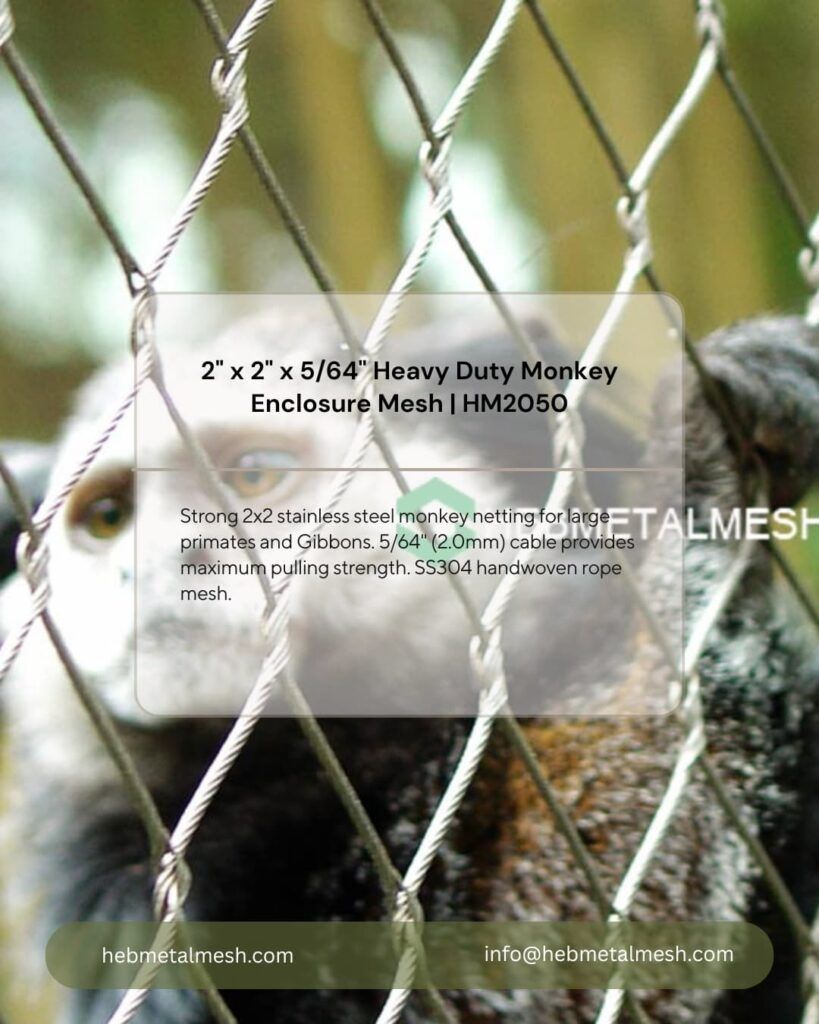
A rope grid is a different object. It is a woven mesh — strands knotted or interwoven at each crossing instead of welded — and it is held in tension between posts and edge cables rather than braced by its own stiffness. Load it and it deforms; release it and it recovers to a shape close to, but not identical to, the one it held before. That difference is the argument, and it is a mechanical argument rather than a slogan about flexibility. A stainless steel rope mesh is flexible cable netting in the strict sense that its geometry is allowed to change under load. A wire rope mesh and a welded panel are not two grades of one product; they are two different systems.
For the animal, a movable surface is a problem with no solution. A climbing surface that shifts cannot be memorised. There is no single height at which a foot lands, no consistent angle at which a strand presents itself and no fixed edge to reach for. The action that worked on the first attempt produces a slightly different result on the second, so there is nothing to refine. A motor habit needs a stable outcome to attach to, and this surface never provides one.
Where the Animal Finds Its Purchase
Removing the ladder does not remove the handholds, and this is where most climb-proof designs quietly fail. A primate does not need a rung; it needs a place where its fingers can close. Those places are small and they are rarely the panel. They are the clamp that grips the cable, the ferrule at a termination, the bolt head standing proud of the frame, the cut end of a strand, the gate hinge, the bracket that ties the mesh back to a post. Each is a step, a lever and an edge at the same time.
The remedy is not a heavier component but a quieter one. Where a fixing must be exposed it should present nothing a finger can close on: a smooth wire, a flush or shrouded head, a bolt that snaps off at torque, no proud edge to hook behind. The aim is a barrier that is handhold free at the scale of a hand rather than one that is featureless. The fittings half of this problem — which components to buy so that there is nothing to turn, hook, re-use or tap out — is worked through separately in the monkey-proof hardware guide.
What the Animal Is Trying to Reach
Design also has to settle what the animal is trying to reach, because that sets the scale of everything else. Primate climbing behaviour is not random; it is aimed. An animal that wants the top rail, a gap at the roof line or a neighbouring tree is solving a route, and the mesh only has to deny the route. That reframing turns two abstract numbers into concrete ones. Aperture size is set by the smallest body that must not pass — in a breeding group, an infant rather than the adult in front of you — and cable diameter is set by the hand and the jaw rather than by body mass, because an animal that grips one strand and hangs from it puts its whole weight on a single wire.
Both numbers are safety numbers, and they pull in opposite directions. Open the aperture too far and a small animal walks through or a hand finds a secure wrap. Close it too far and the risk changes from escape to limb entrapment, because a finger or a forearm can pass a small opening and not come back. The specification has to name a size that does both jobs at once, and it is far easier to defend when it is written down before anyone asks for a price.
Giving Up Is the Specification
Everything above points at one measurable outcome, and it is not a load rating. It is how long the animal keeps trying. Behavioural work on foraging calls this the giving up time — the point at which continued effort stops paying and the animal moves on — and a genuinely climb-proof enclosure is simply one that drives that number down. A structure that rewards the animal even once extends the giving up time, because the animal has learnt that effort sometimes pays. A structure that never rewards it collapses the number quickly.
That is why the escape rehearsal never has to turn violent, and why the design conversation belongs with behaviour as much as with structural engineering. The finish matters here as much as the wire: 304 stainless steel is right for a dry inland house, and 316 stainless steel for coastal air, permanent damp or any room that is washed down, because a climbing animal is in contact with the mesh far more than a grazing one. The indoor half of the same problem — atmosphere, moisture and washdown chemistry — is covered by the great-ape house environment analysis, written as the counterpart to this page. Grade, aperture and cable together are what turn an unlearnable surface into a climb proof enclosure, and the full range is set out on the primate enclosure mesh product page.
FAQ
The absence of a consistent response. An animal keeps an action only if the structure answers it the same way twice. A moving, deflecting surface never does, so the action is never worth repeating.
No. Chain-link is one of the easiest surfaces for a primate to use, because the knuckles are a fixed ladder in both directions and the wire is thin enough to wrap a small hand around completely.
Set the aperture by the smallest body that must not pass and the cable by the hand and jaw rather than by weight. A breeding group needs the infant size, not the adult size, and both numbers belong in the written specification.
Usually, yes. Primate climbing behaviour is aimed at a route, so the top of the enclosure and the line where the mesh meets the ground are part of the same route. A buried return or a floor buffer closes the digging version of it.
Not sure which surface your species will actually use? Send us the species, the group and the site, and we will set the aperture, the cable, the alloy and the fixings as one written specification — the version a tender can be priced against.
Request a specification for your enclosure.