
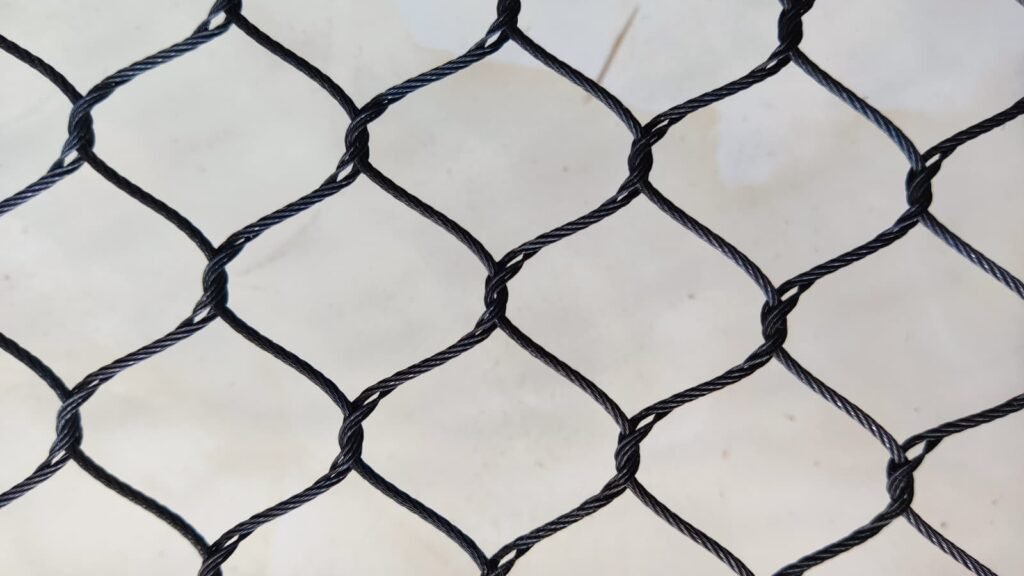
Large barrier projects do not fail in the middle of a panel. They fail at the join. Walk a large aviary a few years after handover and the pattern repeats: the mesh is still sound, while the stitched runs, hog-ringed overlaps and spliced corners have gone slack, fretted or begun to corrode where two materials meet. That is the argument for seamless netting — not a marketing adjective, but a decision taken at the loom, where one continuous piece is woven to the size of the opening instead of assembled on site from smaller rolls. This seamless netting guide is for the people who sign off those orders: engineers, zoo construction managers and buyers who need to know what a factory can actually weave, and what changes when the piece arrives whole.
Executive Summary
Seamless netting is one woven piece across the full opening, with no stitched, spliced or hog-ringed field joints. Every join in a large barrier introduces three liabilities at once: a mechanical discontinuity that behaves differently from the panel around it, an inspection point that must be found and checked for decades, and a place where moisture and chlorides sit undisturbed and initiate crevice corrosion. A handwoven stainless steel panel removes all three, along with the labor of seaming. The order of decisions is fixed: confirm the largest single piece the loom can deliver, set rope diameter and mesh opening from the span and the animal, not the budget, choose 304 stainless inland and 316 stainless wherever chlorides are present, then specify the perimeter hardware that carries the load. The reference specification is the animal fence mesh product page.
Planning a barrier too large to seam on site?
Send the opening dimensions, the species being contained or excluded, and the framework material. We will return the largest single piece we can weave, an aperture and alloy recommendation, and an indicative planning range per square meter.
Request a seamless panel quotationQuick Answer:
Seamless netting is a single woven stainless steel rope mesh panel delivered to the full size of the opening, typically up to 9 m by 18 m in one piece. Specify it when the barrier is large, permanent or hard to reach, because a seam is the first part of any netting structure to fail and the most expensive part to inspect. Fix the aperture from the smallest animal that must be contained, the rope diameter from the span and the load, and the alloy from the site’s exposure to chlorides. Where a barrier can only be built from joined panels, write that constraint into the design rather than discovering it on site.
Key Takeaways
- A join is a mechanical discontinuity, an inspection point and a corrosion trap in one detail; removing it is the largest durability gain in a large barrier.
- Handwoven stainless rope mesh arrives as one piece up to roughly 9 m by 18 m, so most aviary and exhibit openings need no field seam.
- Rope diameter and mesh opening are independent: one sets tensile strength, the other sets containment.
- 304 stainless suits inland, low-chloride sites. 316 stainless belongs wherever salt spray, fertilizer runoff or animal urine reaches the mesh.
- Polymer nets lose strength to UV degradation and shed microplastics as they embrittle; galvanized wire fails where the coating is cut. Neither applies to solid stainless rope.
- Seamless netting installation is faster than seamed assembly, but only if perimeter tensioning is designed before the panel is woven.
Why the Seam Is the First Thing to Fail
A stitched or ringed join concentrates every load path through a few small pieces of hardware. The panel either side carries thousands of strands; the join is a line of pins. Under wind, snow and impact the join moves a fraction more than the field, and that movement repeats for years until the hardware frets and strands work loose. Both ways of building a barrier, welded or woven, are compared in welded vs woven mesh wire fences.
The chemical case is just as clear. Corrosion is the deterioration of a metal through chemical or electrochemical reaction with its environment, and its localized forms — pitting and crevice corrosion — begin at discrete sites, according to AMPP corrosion basics. An overlap where two panels are clamped together is exactly such a site: a geometry that holds moisture against the metal and shelters it from drying. That is why the join rusts first on galvanized wire, and why even in stainless it is the last place to clean and the first to inspect. A splice also changes how the mesh behaves, because the join is stiffer than the field, so deflection under load is no longer uniform — which matters if a ceiling or floor forms part of the enclosure.
What Seamless Netting Means in a Factory Order
Custom seamless netting is a loom constraint before it is a design preference. The honest question is not whether a supplier will promise a seamless panel, but the largest single piece their looms can actually weave, and how it travels.
At our seamless netting factory, handwoven stainless rope mesh is woven in one piece up to approximately 30 ft by 60 ft — 9 m by 18 m — which covers the great majority of aviary roofs, exhibit walls and perimeter runs without a field join. Within that envelope, seamless netting sizes and seamless netting widths follow the same variables as any other order: rope diameter and aperture. Where an opening exceeds the maximum piece, the joint belongs at a frame line, where it can be reached, tensioned and inspected. That is a seamless netting design decision worth taking early — the planning work is described in aviary large construction: choosing the right netting.
Two practical points decide whether a large panel arrives usable. The perimeter must be detailed before weaving: a panel not captured correctly at its edges will pull out of its frame however good the mesh is. And it must be lifted in the orientation it will hang: a 9 m by 18 m sheet of rope mesh is flexible but heavy.
Specifying Seamless Netting: Diameter, Aperture, Span
A seamless netting specification rests on three numbers, chosen in a fixed order.
Aperture is containment. Measure the smallest gap through which the animal — or its head, beak or paw — must not pass, then select a mesh opening below it. Fine birds and small mammals need an opening at or under 25 mm; mid-size primates and small carnivores are typically specified between 25 mm and 51 mm; large hoofstock separation is usually 51 mm and above.
Rope diameter is strength. Rope is supplied from 1.2 mm to 3.2 mm, and tensile strength scales with the cross-section, so a heavier rope is specified where spans are long, where snow or wind load is significant, or where a large animal can apply point impact. A light rope across a wide unsupported span deflects more than the same rope on a tight frame, and deflection is what fatigues perimeter hardware.
Span is the geometry between the last two. The greater the unsupported distance, the more the load path matters, and the more seamless netting spans depend on their perimeter rather than their field. This is where a seamless panel has a real engineering advantage: with no internal join to act as a hinge, load is distributed across the whole sheet and delivered to the frame.
Then confirm the alloy. 304 stainless handles inland, low-chloride sites. 316 stainless adds molybdenum and is correct for coastal air, fertilizer runoff, animal urine and wash-down areas. The same logic governs framing and fittings, the subject of zoo fence with SS304 stainless steel wire rope mesh.
Why Stainless Holds Where Polymer and Galvanized Do Not
Every alternative to seamless protective netting fails in a way traceable to its construction, not its installation.
Polyethylene and nylon nets are cheap and adequate for a seasonal barrier. Their limit is the material itself: sunlight embrittles the fibers, so strength falls away as UV degradation progresses, and a fraying net releases fragments into soil and water. On a large barrier that is both a maintenance liability and an environmental one.
Galvanized wire depends entirely on its coating, interrupted at every cut end, staple, clip and join. The first corrosion is therefore always local and always at a fixing, and once the zinc is consumed there the steel beneath is unprotected.
Solid stainless rope mesh has neither weakness. There is no coating to breach and no polymer to embrittle, so the material at a join behaves as the material in the field, and durability is set by alloy and rope diameter, not by how well a coating survived transport. Factory-direct material comparison is covered in stainless steel rope netting fence: factory sale.
Where Seamless Netting Is Specified
Seamless netting for zoo and bird park work is the largest single use. Walk-through aviaries, domed flight structures and exhibit walls are too tall and too wide for small rolls, and transparency is part of the brief. One woven panel gives uninterrupted visibility from every viewing point, where a seamed roof shows a grid of joins right where visitors look up.
Seamless netting for enclosures follows the same reasoning wherever the barrier is permanent: primate and carnivore exhibits, where a join is an obvious point of attack; farm and safari perimeters, where the run is long and inspection infrequent; and architectural installations, where a seam is a visible defect. Wide seamless netting also serves industrial safety work such as perimeter guarding and fall protection infill, where a joint interrupts the load path as well as the appearance.
In all of these, success is measured the same way: how many components an inspector has to find on a ladder. Seamless construction reduces that number, and with it the number of places an animal can start working at an edge. Large mesh netting and its specification covers the aperture and format side of the same decision.
What Seamless Netting Costs
Seamless netting is priced on the same two variables as any handwoven stainless rope mesh: rope diameter and aperture. Ask a seamless netting supplier for a quotation: panel size should not attract a premium for being custom. As a planning range, aviary-grade material generally falls between US10 and US22 per square meter, and carnivore-grade material between US20 and US38 per square meter, the higher figures reflecting heavier rope and tighter apertures, not larger sheets.
The saving that is easy to miss sits on the other side of the ledger. A seamless panel removes the labor and hardware of seaming, the transport of multiple rolls, and the recurring cost of inspecting joins that cannot be reached without access equipment. On a large aviary roof those items often exceed the difference between the two ways of buying the barrier. Budget the perimeter and the installation as separate lines: a well-specified panel installed without perimeter tensioning behaves like a badly specified one.
Ready to specify a barrier with no field seams?
Send us the opening dimensions, the species and the site’s chloride exposure. We will confirm the largest seamless panel we can weave, recommend an aperture and alloy, and quote against the specification rather than the roll size.
Send your dimensionsFAQ
It is woven as one continuous piece across the full opening, so there is no stitched, spliced or ringed joint anywhere in the field. Perimeter edge treatment and fixings still exist, but they sit on the frame line, where they can be reached and tensioned.
Approximately 9 m by 18 m, or 30 ft by 60 ft, in one piece. Most aviary roofs, exhibit walls and perimeter runs fall inside that envelope; larger openings take a designed joint at a frame line rather than site assembly.
No. The two pricing variables are rope diameter and mesh opening. A large panel is not surcharged for being custom, and the labor, hardware and transport saved by eliminating field joints usually offset the difference.
Local damage is repaired with a patch or a replacement section tied into sound strands. That is another reason to keep the perimeter accessible: an edge repair is routine, whereas the same repair in the middle of a seamed roof needs access equipment.
316, as a rule. The added molybdenum improves resistance to pitting and crevice corrosion in chloride-bearing conditions, which is exactly what a coastal aviary or marine exhibit presents. Inland sites away from salt and fertilizer are normally well served by 304.
No. It is common in retrofits, where a seamed barrier is replaced after repeated failures at the joins. If the framework is being reused, confirm the largest piece it can accept before ordering: that answer usually decides whether the replacement is seamless or once again assembled in pieces. The reference specification is the animal fence mesh product page.