
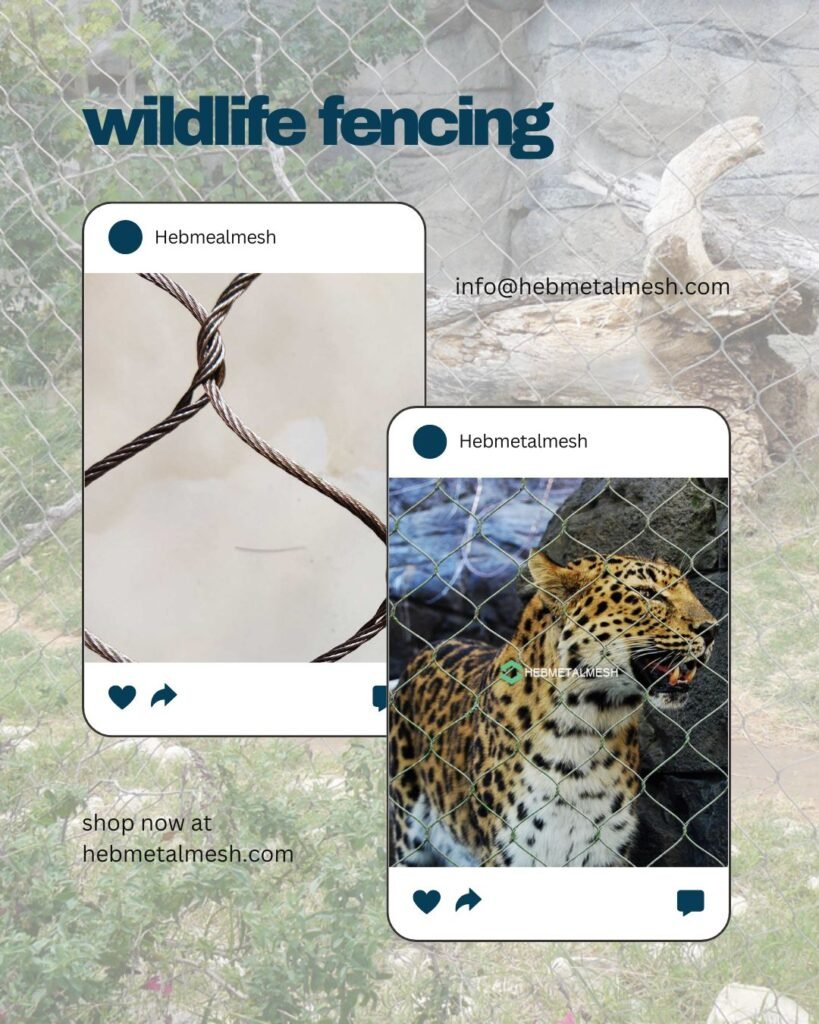
Nearly every failed net was ordered from a species list. Someone wrote “fox” or “hawk” on a form, the form produced a mesh size, and the panel that arrived answered a question nobody had asked. A barrier is not specified by an animal’s name. It is specified by the pressure that animal applies, where on the panel it applies it, and how often. Predator pressure is the only input that survives contact with a real site, because it describes events rather than categories. Read it properly and the rope, the aperture and the fixing follow in that order. Skip it and those three decisions get made by guesswork, which is why so many enclosures are rebuilt at year four with the original steel still sound.
Executive Summary
Predator pressure is the rate and the place at which animals test a barrier, counted rather than described. It arrives from two directions, since a net that keeps something out usually keeps something in, and it is never spread evenly across a panel. It collects at the ground line, at the top edge, and at corners and junctions, and those three places account for most of what fails.
Each of those three sets a number. The base sets the edge detail and the fixing. The top sets whether the panel needs a return or a roof plane. The corners set the panel count and the joint schedule. Rope diameter, from 1.2 mm to 3.2 mm, follows from those three, and so does the hole size, from 20 mm to 102 mm.
The reference specification is the animal fence mesh product page.
If you can describe what is testing your barrier and where, we can price the panel that answers it. Send the site, the species and the exposure.
Quick Answer:
Predator pressure decides three things before anything else: how the panel is held at its edges, how large the openings can be, and how much rope is in the panel. A site with light, occasional contact needs a modest specification and will last. A site with committed, repeated contact needs a heavier rope and a tighter edge detail, and no amount of extra height substitutes for either. The test is not how strong the animal is. It is how often something arrives at that barrier and how much of the panel it can reach when it does.
Key Takeaways
- Predator pressure is a rate and a location, not a species. Count contacts per edge before choosing a mesh.
- It is highest at the base, the top edge and the corners, which is where failures begin.
- A ground-level gap is exploited within hours, so the base detail outranks the rope grade.
- Hole size is set by the smallest thing that must not pass, not by the largest animal present.
- A repaired breach marks a route. The second attempt at the same spot is faster than the first.
What predator pressure means for a net
It helps to be precise about what predator pressure means for a net: a count of contact events per length of edge, not a measure of animal strength. A curious fox that walks a fence line twice a night for a month applies more cumulative load than one committed charge, and the two need different answers. Curiosity bends nothing but finds every gap. Commitment finds the weakest fixing and works it.
Pressure also runs both ways. A net that stops a ground predator reaching a collection animal is doing exclusion work; the same net holding a bird is doing containment work, and the panel takes the load from the inside. A barrier that halts movement across a landscape also fragments it, which is the argument in this wildlife friendly fencing discussion and the reason a perimeter is normally drawn to be permeable to everything except the target.
How to read predator pressure on a site
How to read predator pressure on a site is a survey question before it is a materials question, and it takes four observations, not an instrument. Note what is present, from which direction it arrives, at what hour, and what the ground looks like where it arrives. Tracks pressed into soft soil at the same gap every morning are worth more than a species list, because they show the route rather than the roster.
How to measure pressure without a consultant is that same exercise done in a notebook over a month. Walk the line at dusk and at dawn, photograph every gap and depression, and write down the day each appeared. That record is the specification. How predator pressure changes with the season is the part a single visit always misses: dispersal in autumn, hunger in late winter and nesting defense in spring each shift the frequency and the direction of contact, and a panel sized in a quiet July will be undersized by February.
Where predator pressure concentrates
Where predator pressure concentrates is predictable, and that is the most useful thing in this article. It collects at the ground line, at the top edge, and at every corner or junction where two planes of mesh meet: the places where an animal gains a purchase, where a gap is easiest to open, and where a panel ends.
A 2024 review of predator exclusion fencing in Hawaiʻi puts numbers on the ground line. The authors call the fence skirt “the most vulnerable component,” and cite work showing that 90% of rodents exploited a hole at ground level within six hours of its appearance, with a 99% chance of entry within 24 hours. The lesson transfers: the foot of the net is not a finishing detail but the part of the specification under the most pressure, and the part usually left to whoever builds the frame. A panel detailed around that idea, such as this woven animal enclosure netting, treats the base as structure.
Why the base of a net fails first
Why the base of a net fails first is a question of leverage and soil rather than strength. An animal at ground level is working its whole body against a short lever, and it is working where the panel meets something that moves. Soil softens after rain, erodes under a drip line and piles against the mesh after a storm, so the gap that was 25 mm in June is 80 mm in October without a single strand breaking.
What a predator learns after one attempt is the reason a repair rarely closes the matter. The animal that dug, squeezed or chewed has a route, and it returns to that route because the route worked. That is why the base detail has to be built rather than patched: a return folded outward and pinned, a panel brought down to a hard edge, or a buried apron where soil allows. The fix is not more rope. It is fewer places where the rope ends.
The top edge, the corner and the fixing
Why the top of a net is loaded differently comes down to direction. The base takes a horizontal push and a downward scrape. The top takes uplift, the weight of anything that climbs, and the landing of a bird of prey that has learned the panel is a perch. On a roofed enclosure the top edge is also where a woven panel hands its load to the frame, so a slack top edge is not cosmetic; it is the point where the mesh stops behaving as a membrane.
What pressure does to a fixing almost never shows on the day of installation. A fixing adequate for a static load will stretch, loosen and re-seat itself over a thousand small cycles, and that slow movement is where fatigue begins. A corner combines both loads: two panels meeting means two tension directions, a joint to inspect, and a shape that gives a climbing animal the purchase it needs.
How pressure decides the hole size
How pressure decides the hole size is routinely misunderstood, because buyers size the opening from the animal they can see. The right measure is the smallest thing that must not pass: a nose, a paw, a juvenile body, a beak. The 1 in × 1 in aperture specification, cataloged as HM1625, exists for that reason, and at 1/16 in wire it stops far more than a 4 in mesh does without adding meaningful weight to the frame.
When pressure calls for a heavier rope is a separate decision from the hole, settled by how much of the panel the animal can reach. A predator working at ground level loads one edge. A climbing animal loads a whole plane. That is why 1.2 mm to 2.0 mm covers most aviary and small mammal work while 2.4 mm to 3.2 mm belongs where something arrives with momentum. The two ranges are not a quality ladder, and reading them as one is how sites overpay on walls and under-specify where the pressure actually sits.
Why cheap netting loses to sustained pressure
Why cheap netting loses to sustained pressure comes down to three mechanisms, none of which is a lack of strength on the day it is installed. Polymer mesh embrittles under ultraviolet light and then fractures instead of flexing. Galvanized wire loses its zinc at cut ends and at every scratch, and corrosion runs along the strand rather than staying local. Both then fail at a fixing, because a fixing concentrates stress that a continuous strand would have spread.
The safety cost arrives before the structural one. A strand that has work-hardened and snapped leaves a sharp end inside a space an animal occupies, and the same failure in a coated product leaves a ragged edge. This is the argument made in this animal safe enclosure materials review of sensitive species, and it is why the useful comparison is not price per square meter but the panel in year eight. A wire rope that stays smooth and a mesh that stays tight are the same properties that keep animals unhurt.
What 316 resists that 304 does not
What 316 resists that 304 does not is chloride, and the difference matters most where pressure is already high. Both grades are austenitic stainless; 304 carries roughly 18% chromium and 8% nickel, and 316 adds molybdenum, which stabilizes the passive layer against chlorides. Inland, 304 gives full corrosion resistance for decades. Within a few kilometers of a coast, or where a pen is washed weekly with disinfectant, 316 holds its finish.
How pressure is shared across a panel is what makes the grade decision worth the money. A woven net behaves as a membrane: a load arriving at one point travels along the rope to the boundary, which is why the load path through the panel matters more than the strength of any single strand. What pressure a woven panel takes is therefore not one figure but a curve that depends on span, tension and edge restraint, and panels woven to 9 m by 18 m remove joints rather than merely saving labor. A high security yard is specified exactly this way: restrained at the boundary, tensioned across the field.
Re-reading the record after handover
The pressure record does not stop at handover, because the animals on both sides of the panel keep learning. A barrier that held through its first year is being tested against a population that has now spent a year finding its edges. Re-walking the line with the same four observations, at the same two hours, is the cheapest inspection a site can run, and the only one that produces a comparison rather than an impression.
Set the cadence from the exposure, not from habit. Where the ground is soft, where a route has already been used once, and where the season is turning, the interval between inspections should shorten, because a gap at ground level can be found and used inside a day. Keep one spare panel from the original production run, in the same rope and the same finish, so a repair matches the field instead of standing out as a different shade of black oxide.
Pressure is easier to specify than a species. Send the site plan, the animals on it and the routes you have already seen, and we will return a panel schedule with rope, aperture and fixing set to the pressure you describe.
Frequently asked questions
No. Risk is what might arrive; pressure is what does arrive and how often. A site can carry high risk and low pressure if the barrier sits away from a route, and the opposite is common near a food source.
Height moves pressure rather than removing it. A taller panel pushes contact to the top edge and to the frame, which is why a climbable frame and a slack top edge undo the benefit of extra height.
Start from what reaches the panel and how often. Ground contact on a soft base points to the heavy end of the 1.2 mm to 3.2 mm range; interior panels that take no impact sit at the light end, and the middle covers most collections.
Because the excess is what lets the mesh be restrained and tensioned at the boundary instead of stretched flat across it. A panel cut to the exact opening has nowhere to carry its load.