
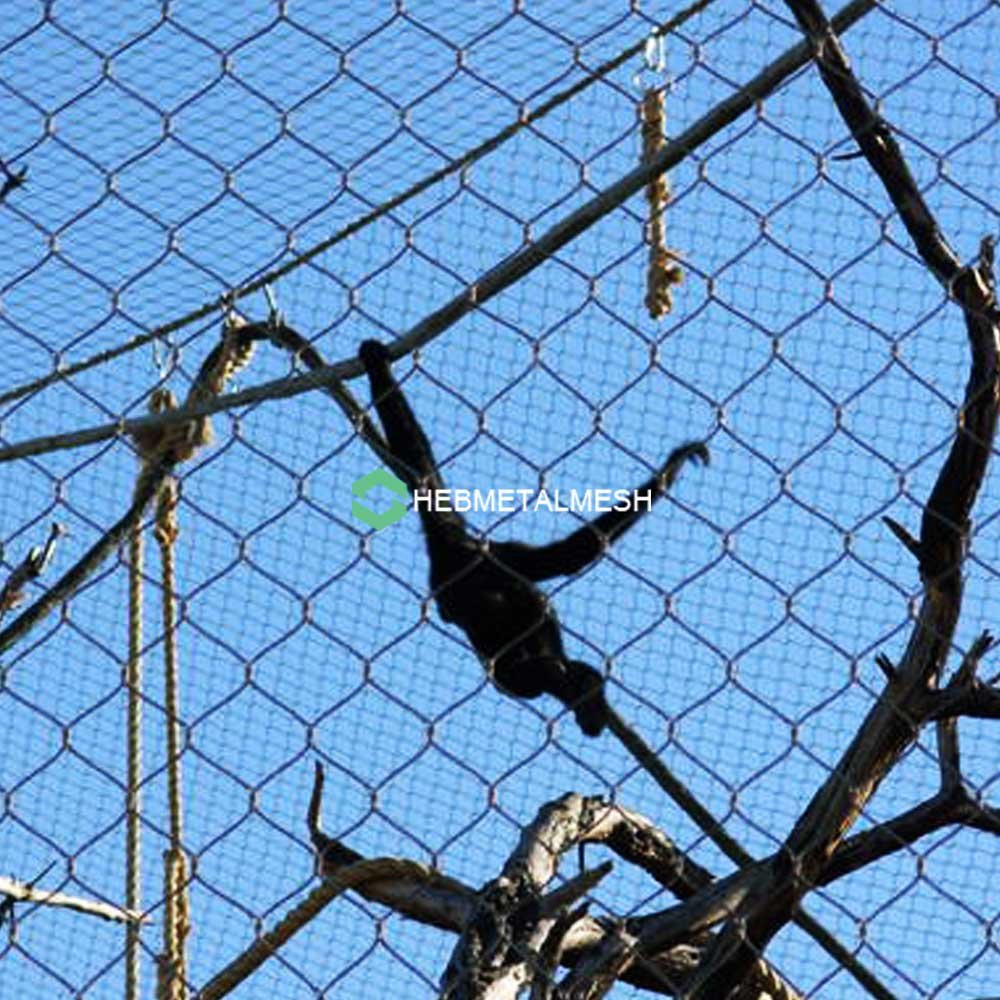
A perimeter net can come through a storm that flattens the panel fence beside it. The usual reading is that netting is simply tougher. The better reading is that the net survived because it moved, and the movement was planned into the posts.
Wind does not pass through an open mesh the way most buyers assume. It passes through, and it also loads the net, and the net hands that load to a few hard points. What separates a run that holds from one that fails is rarely the mesh specification.
Mesh netting for fence work gets judged on its posts, its footings and its terminations, none of which appear on a datasheet. All of them decide whether the fence is standing in year fifteen. Most buyers leave that to whoever shows up with a post driver.
Executive Summary
A net behaves as a fabric under wind, not as a wall. A 50 mm aperture in 2 mm wire leaves roughly 92 percent of the plane open, so pressure on the wire stays low. The load still has to reach the ground, and it travels through the edge cable, the terminations and the posts.
That is why the mesh almost never turns out to be the part that fails first. This article covers what a wind rating on netting actually describes, how post spacing and corner loading follow from a design wind speed, and why footing depth answers to lateral capacity.
It closes on pre-tension, seasonal drift and repair splices, and on what versatile should actually mean on a zoo perimeter.
Quick Answer
Open mesh sheds wind by deflecting, so the load lands on the posts and terminations rather than on the wire. Post spacing, corner anchoring and footing depth decide whether a run survives its design storm, and no mesh spec can stand in for them. Re-check tension twice a year, because stainless moves with temperature.
Key Takeaways
- A net is a fabric: it sheds wind by moving, and that movement is a clearance you must specify.
- Open area above 85 percent keeps drag low, though never to zero.
- No mesh product carries a wind rating. A quoted speed describes the post and anchor schedule behind it.
- A corner post takes about 1.4 times the load of a straight post, and a gate post takes more.
- Footing depth follows lateral capacity in the soil you actually have, not bearing pressure.
- Snow is a retained load, so aperture and pitch matter more than open area.
- A repair splice needs the tension released locally, or the load walks down the run.

The Wind Does Not Pass Through a Net
A net is a plane of wire with holes in it, and the holes dominate the arithmetic. At 50 mm aperture in 2 mm wire the open area ratio of a netting fence sits near 92 percent. At 25 mm in 1.5 mm wire it falls to about 89 percent, and 12.7 mm in 1.0 mm wire stays above 85.
That permeability is why suppliers call netting wind transparent. Transparent is the wrong word. Drag scales with the solid fraction rather than the whole plane, so a net takes a small share of what a solid panel would take, but small is not zero.
At 10 to 12 percent solidity a design gust still becomes a measurable force, and that force has one route to the ground: the perimeter. Aperture and wire combinations for a first run sit at the fence netting mesh guide.
The Deflection Budget
Deflection is a distance, and every run has a limit. What open area buys is that deflection without tearing, which is why a net outlasts a rigid panel in the same exposure.
A net that billows two meters into a service path is a hazard, and one that slaps a roof edge abrades until a wire parts. Treat the wind deflection limit for a mesh fence as a clearance figure, measure from rest to the nearest rigid object, and write it into the order.
What a Wind Rating on Mesh Netting Actually Means
No mesh product carries a wind rating the way a cable or a clamp does. When a supplier quotes a speed, the number usually describes the post and anchor schedule behind the mesh. It is easy to misread, and it is the first thing to pin down when a buyer asks what wind speed a mesh fence is rated for.
The mesh side of that chain sits at our animal fence mesh range. Match the post side against it before the concrete goes in.
What you can specify is the arithmetic behind that number. Start with the basic wind speed in the local code, convert it to velocity pressure, multiply by solidity and a drag coefficient, then apply the result to the tributary area of one bay. Every step is checkable.
| Basic wind speed | Velocity pressure | Effective pressure | Load on a 3 m x 6 m bay | What it implies |
| 90 mph (145 km/h) | 20.7 psf | 2.5 psf | about 480 lb | Standard schedule, 3 m bays |
| 110 mph (177 km/h) | 31.0 psf | 3.7 psf | about 720 lb | Closer bays at corners, deeper footing |
| 130 mph (209 km/h) | 43.3 psf | 5.2 psf | about 1,000 lb | Engineered anchor, uplift checked |
Velocity pressure follows q = 0.00256 V squared in psf with V in mph, and the effective column assumes 12 percent solidity with a drag coefficient near 1.0. Local code governs, and a ridge or coastal site needs an exposure factor on top.
Posts Carry What the Mesh Sheds
A straight post in a tensioned run sees tension from both sides, and those pulls cancel along the line. A corner post sees two runs meeting at an angle, and the tensions add as vectors.
Corner Post Load on a Netting Fence
At 90 degrees the resultant comes to about 1.4 times the tension in either leg, and it points diagonally away from the enclosure. That is why corners fail first. It is also why they get a heavier section or a diagonal brace.
Gate Post Stiffness for Netting
A gate post carries the leaf as well as the net, and it has to stay put. A few millimeters of movement at the head is enough to drop a gate onto its latch. Specify a stiffer section and a deeper footing on both sides, and check the hinge post first, since that one takes the cantilever.
Post spacing for a wind exposed netting run then follows from the table above. The general factors sit at this wire rope fence guide for anyone working through a layout for the first time.
Footings, Anchor Bolts and the Ground Line
Footing depth on a tensioned line usually follows lateral capacity rather than bearing. The post gets pushed sideways at the top, and the soil resists through a wedge near the surface, so depth helps, and so does concrete width.
A workable starting point is a post footing depth for a tensioned mesh fence of about one third of the post height above ground in firm undisturbed soil. Sand, fill and made ground need more. A high water table needs a different detail altogether.
Anchor bolts deserve their own line, because pull-out capacity depends on embedment and concrete quality, not bolt diameter. AZA standards for animal enclosure construction assume a structure holds its shape under load, and a footing has to earn that.
Anchor bolt pull-out on a mesh fence is where a cheap fixing shows up two winters later. A 12 mm bolt set 100 mm into sound concrete beats a 16 mm bolt set 60 mm into poor concrete.
The ground line is the least glamorous failure here. A net that touches gravel or a mown edge rubs at every gust, and ground line abrasion on a netting fence quietly thins the bottom course.
Terminations and Tension
The net hangs from an edge cable, and the cable ends are the weakest point in the assembly. A swaged fitting develops close to full break load, while a mechanical fitting that relies on set screws develops less and creeps under cyclic load.
What the Termination Is Rated For
Ask what the edge cable termination for mesh netting actually is, not just what the cable is rated to. A long run built from several panels needs a lacing pattern at a netting seam that matches the mesh pitch, worked as a continuous spiral rather than separate ties.
Where a run has to be join-free, this seamless panel page explains how a single woven panel changes the seam question entirely.
Pre-tension has a working range. Too little and the net sags, slaps and abrades. Too much and the posts lean, the footings creep, and the first hot week pulls slack out of the wrong end.
Set the pre-tension value for mesh fence netting until mid-span sag drops under the figure you specified, then record the turnbuckle position. That record becomes the baseline for later inspections, and without it seasonal tension drift in netting looks like damage.
Stainless moves with temperature at roughly 16 parts per million per degree Celsius. On a 30 m run, a 40 degree swing moves about 19 mm of wire, which is why turnbuckles need take-up range in reserve.
Expect a netting fence sag after two winters that looks alarming and measures within tolerance. The first year beds the lacing down, and the second year gives the real reading.
Snow Is a Different Load
Snow does not behave like wind, and the difference matters for mesh netting for fence work. Wind is transient and the net sheds it by moving. Snow is retained, and once it bridges across apertures it keeps building.
A net at 90 percent open area can still carry a heavy snow load, because openings stop being openings once they fill. Aperture and pitch therefore matter more than open area. A steep roof panel sheds and a flat one accumulates, which is a geometry decision made at design.
Repair After a Blow
Storm damage concentrates at the terminations and the contact points rather than the middle of a panel. Work through the run in this order:
- Check the corner anchors and their bolts for movement or lifted concrete.
- Inspect the edge cable ends for slipped fittings and broken strands.
- Walk the net where it touches a frame, a roof edge or the ground.
- Read tension at the turnbuckles against the handover baseline.
- Look for a slack bay beside a tight one, which points to a moved anchor.
Guidance on leaving a passable gap at the base is at the wildlife-friendly fencing guidelines. Read it before changing a bottom detail.
Splice Rules
A repair splice in a tensioned netting run has to happen with the tension released locally. Cut in a new section with the run slack, lace it at the original pitch, and bring tension back to the recorded baseline. A splice made under load pulls tension out of the neighboring bays and leaves a soft spot that slaps itself apart.
What Versatile Should Mean on a Zoo Perimeter
Marketing calls netting versatile, and on a zoo perimeter the word means something specific. One mesh specification can serve a perimeter wall, a roof panel and an internal divide. What changes between them is not the mesh but the post schedule, the footing detail and the termination.
- A roof panel carries snow and needs a shorter span.
- A perimeter wall carries wind and needs a corner detail that takes the resultant.
- An internal divide carries almost nothing.
The mesh options that suit all three sit at the animal fence mesh specification.
That is the honest version of durable and versatile. The wire is the easy part; the support is where the engineering lives, and you can still change it before the concrete goes in.
FAQ
The coarsest aperture that still holds the species. Solidity rises as aperture closes, so 12.7 mm mesh loads the posts harder than 50 mm of the same wire. Choose on containment first, then the widest opening that passes.
Yes, faster than most expect. Load rises with area, but overturning moment at the base rises with height squared. A 4 m wall carries twice the load of a 2 m wall and four times the moment.
Expect bedding-in rather than material loss. Lacing settles, wire seats into its fittings and posts move a few millimeters. Plan one re-tension after the first season, then compare against that baseline each spring.
No. A gate needs its own frame on both sides, because the leaf hangs from one post and latches to the other. Hanging it off a netting bay puts a point load where the design assumed a distributed one.
Not measurably. Coating adds a fraction of a millimeter and a few percent to solidity. It does change inspection, because a dark coating hides broken strands, so check with a light behind it.