
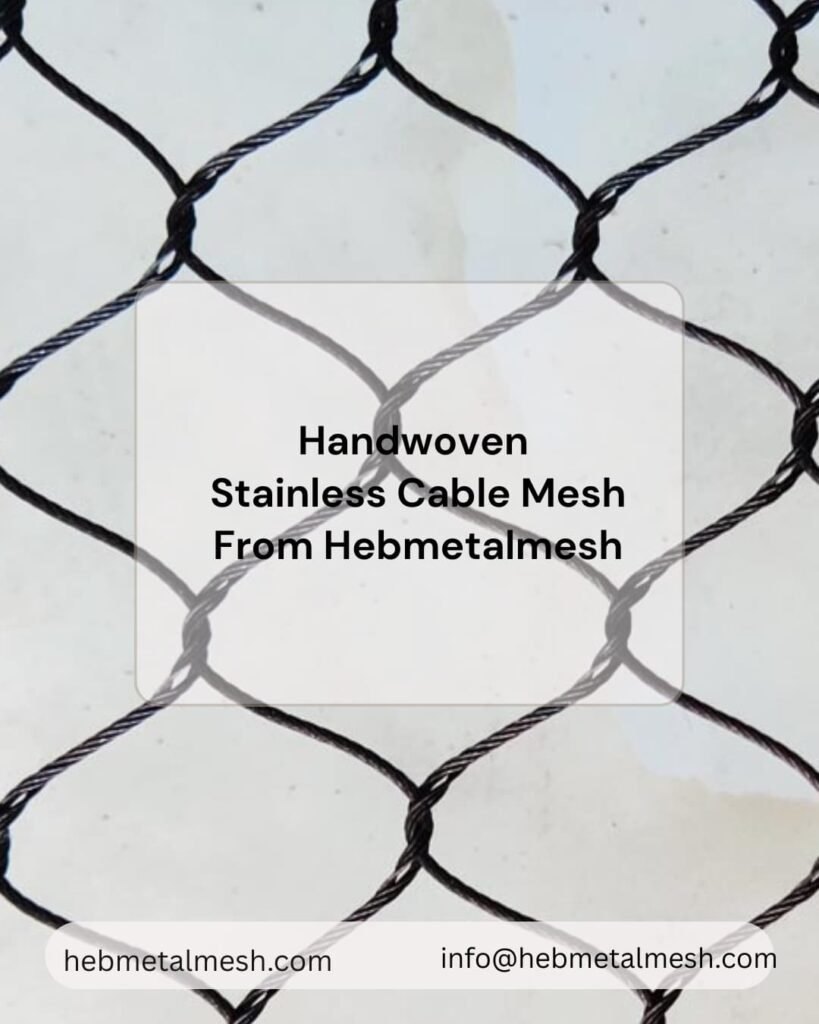
A handwoven panel stops a hit it could never hold as a dead weight, and the reason is not extra metal. Wire in the 300 series yields at roughly 0.11 percent strain, so a nine meter strand has about ten millimeters of elastic travel in it and no more. A panel limited to that would pass the whole load to its posts in one step. It does not, because a rope mesh is a lattice rather than a bundle of straight wires, and a lattice can change shape while every strand keeps its length. That change of shape is where impact toughness lives, and it is the number most quotations leave out.
Executive Summary
A specification that names a wire diameter and an aperture describes half a panel. Impact toughness is the energy the panel takes before it fails, and it is set as much by how far the panel may move as by how much steel is in it. In a handwoven lattice nearly all of that movement is geometric: the cells shear, the strands hold their length, and the impact is spent over a distance instead of at a point. Two figures follow — the energy the panel has to stop, and the deflection it may use stopping it. Halving the second doubles the force the frame must resist. The reference specification is the animal enclosure mesh product page.
Quick Answer:
Impact toughness is the energy a panel absorbs before it breaks, counted in joules rather than newtons, and it is a different measurement from tensile strength. A 304 stainless wire in a handwoven net yields at about 0.11 percent strain, which is ten millimeters across a nine meter span. The panel travels much further because its diamond cells shear and its strands change angle, so the impact is arrested over a distance. At 20 mm aperture and 2.0 mm wire a meter of panel width holds about 202 square millimeters of steel in the load path; at 102 mm and 3.2 mm it holds 108. Both are strong. Only the fine one keeps room to move.
Key Takeaways
- Impact toughness is an area under a curve, not a peak on it, and a panel can be strong in the first sense and poor in the second.
- 300-series wire yields at about 0.11 percent strain, so nine meters of strand offers roughly ten millimeters.
- A diamond cell pulled from square to a 60 degree rhombus grows 22 percent longer with no strain in the wire.
- Ten kilojoules over 100 mm asks the posts for 200 kN; over 300 mm, 67 kN.
- Tensioning locks the crossings and spends the geometric allowance, so the tighter of two identical panels can be the more fragile.
Strength Answers a Different Question
Breaking strength is one number and easy to sell, so it is what buyers ask for. It describes the peak force a strand survives, measured on a short sample pulled slowly in a straight line. Impact toughness describes something else: the total work done on the material before it separates, which is the area under the curve rather than the height of its summit.
For a single strand the two track each other closely enough to hardly matter. For a panel they come apart, because a panel does not carry load the way a strand does, and how the two constructions are made decides most of the rest. A load arriving at one crossing is shared outward through the lattice, and the sharing depends on the panel being able to deform.
Ten Millimeters in Nine Meters
Take a 304 stainless wire with a yield strength near 210 MPa and a Young’s modulus near 193 GPa. Divide one by the other and you get the strain at which it yields: 0.11 percent. That is how far the steel moves before it stops behaving elastically — 9.8 millimeters over a nine meter panel, and the whole of the material’s own contribution to flexibility.
That contribution is small, and gauge makes it smaller faster than it makes strength greater. From 1.2 mm to 3.2 mm the cross section rises 7.1 times and the bending stiffness 50.6 times, because bending resistance goes with the fourth power of diameter while tensile capacity goes with the square. The same alloy at 3.2 mm is a bargain in strength and an expensive one in movement, which is why a loaded, see-through face gets more strands rather than thicker ones. Those strands arrive on a plate of up to 9 m by 18 m, or 162 square meters in one piece, and the panel guide covers the framing that goes with the size.
The Flexibility Is in the Geometry
Any flexibility beyond ten millimeters has to come from the shape of the cells, which is where a lattice earns its keep. A woven lattice is a set of four-sided cells pinned at their crossings, so it behaves as a mechanism rather than a truss: it has almost no resistance to shear until the cells flatten. Pull a square cell along one diagonal and its sides never change length, but the diagonal grows as the cell closes.
Send the span, the load and the space behind the panel
Against the 0.11 percent the steel offers, that is about 200 to one. Almost every millimeter a woven panel gives you comes from a lattice that changes shape, which is why the same panel can be stiff in tension and compliant in a direction it was never asked to hold. Friction at the crossings and restraint at the perimeter spend part of the geometric allowance, so a panel delivers less than the geometry promises — but far more than a wire rope could offer alone.
| Cell angle (degrees) | Diagonal, in cell sides | Extension vs. square |
| 90 | 1.414 | 0 |
| 80 | 1.532 | +8.3% |
| 70 | 1.638 | +15.8% |
| 60 | 1.732 | +22.5% |
An Impact Is Energy, and Energy Is Force Times Distance
Once the panel is understood as an absorber rather than a barrier, the design question changes shape. An impact delivers energy, and a panel stops it by resisting over a distance, so the average force is the energy divided by the travel. For a response that rises roughly in proportion to deflection the peak is twice the average, which gives the relation: force equals twice the energy divided by the deflection you allow.
The consequence is blunt. Ten kilojoules stopped over 100 mm asks the frame for 200 kN. The same ten kilojoules over 300 mm asks for 67 kN, and the panel that absorbed it is unchanged. Every post and every anchor behind the panel is sized by the force the frame has to carry, so a specification that sets deflection at 100 mm instead of 300 mm quietly triples the steel in the ground. The energy a panel absorbs is fixed by the event; the distance it uses is not. Choosing a mesh from the load is a different exercise from choosing one from an aperture.
Why a Fast Load Is the One That Breaks It
A slow pull and a dropped mass are not the same test, and the difference is not a detail. Published materials teaching is direct about it: A metal may possess satisfactory toughness under static loads but may fail under dynamic loads or impact. Ductility falls as the rate of loading rises, so the energy a panel can absorb shrinks exactly when the load arrives faster.
This is the gap between a specification and a site. An animal leaning on a panel is a static load, and a panel with a generous safety factor will hold it for years. An animal that charges is an impact, and the same panel may part well below the figure on its certificate — not because the steel was weaker than advertised, but because the test that produced the figure was slower than the event. The grades we hold from 20 mm to 102 mm, with their strand counts, are set out on the stainless steel animal enclosure mesh page; what a drawing has to add is the rate at which the load will arrive.
The Fine Panel Is Not the Weak One
Coarse mesh looks like the stronger choice and is usually the weaker one, because strength per meter of width depends on how many strands cross the load path. A diamond lattice at 45 degrees sets two rows of strands across the width, each meeting the load at 45 degrees, so a 20 mm panel at 2.0 mm wire carries the equivalent of 64 strands per meter against 13 for a 102 mm panel at 3.2 mm.
| Aperture / wire | Strands per meter | Steel in the path | Break, per meter of width | Mass |
| 20 mm / 2.0 mm | 64 | 202 mm² | 111 kN | 2.26 kg/m² |
| 50 mm / 3.0 mm | 27 | 189 mm² | 104 kN | 2.11 kg/m² |
| 76 mm / 3.0 mm | 18 | 127 mm² | 70 kN | 1.41 kg/m² |
| 102 mm / 3.2 mm | 13 | 108 mm² | 60 kN | 1.21 kg/m² |
The fine panel puts 87 percent more steel into a meter of width for 87 percent more weight, and carries 85 percent more load. It also loses less when a strand goes: one strand out of twenty-seven is under four percent of the section at 50 mm, where one strand out of thirteen is nearly eight percent at 102 mm. The same panel at half the pitch is stronger and more forgiving, and it pays for both in steel rather than in anything the animal notices. The comparison puts the four grades side by side.
Where the Failure Actually Starts
Panels rarely part in the middle of a field. They part where the section changes, and a change of section is a notch. A notch does more than remove area: it converts a simple pull into a stress state working in several directions at once, and a material that absorbs energy under a straight pull can turn brittle under that combination. The list is short and man-made. A welded intersection is a notch with a heat-affected zone around it. A cut strand end left proud is a notch. A drilled hole is a notch in the wire. A handwoven crossing is none of the three.
That difference decides how the two constructions fail. A brittle weld gives no notice: it holds until it does not, and the panel opens along a line. A ductile strand does give notice, because it necks and dulls before it parts, which makes a panel that warns you possible to inspect. The failure that happens first is usually at a fixing rather than in the middle, so the inspection sequence is best aimed at the boundary, and a walk twice a year is worth more than a heavier grade.
What to Put in the Order
Four figures turn a description into a specification. The energy the panel must stop, in kilojoules. The deflection you allow it, in millimeters, which sets the force behind it. The steel in the load path per meter of width, which sets the strength and is not visible from the aperture. The tension at handover, because a panel pulled dead straight has spent the allowance that made it tough. A 162 square meter plate weighs 366 kg at 20 mm by 2.0 mm and 196 kg at 102 mm by 3.2 mm, so handling belongs in the brief.
Alloy is the fifth figure and the easiest to get wrong. A 316 stainless grade with molybdenum resists chloride and wash-down chemistry that a 304 stainless grade will not. Cable netting, rope mesh, wire rope mesh and inox are all names for the same handwoven family; the alloy and the strand count separate one quotation from another.
Send the energy, the allowed deflection and the space behind the panel
FAQ
No. Tensile strength is the peak force a strand survives; impact toughness is the energy absorbed before it separates, the area under the stress-strain curve. A panel can be high in the first and poor in the second.
Enough that the force on the posts stays inside their capacity. Ten kilojoules over 100 mm asks for 200 kN; over 300 mm, 67 kN. The panel is the same in both cases, so the number is set by the space behind the barrier and by the anchors.
Usually the opposite. Strength per meter of width depends on how many strands cross the load path, and a 20 mm panel carries 64 strands per meter against 13 for a 102 mm one. The fine panel also loses less of its section when a strand goes.
Because tension locks the crossings and uses up the geometric allowance. A panel with none left can only respond elastically, and ten millimeters of travel across nine meters will not absorb an impact. A slack panel has its own problem, since a face that flaps fatigues at the crossings, so the target is controlled tension rather than the tightest one.