
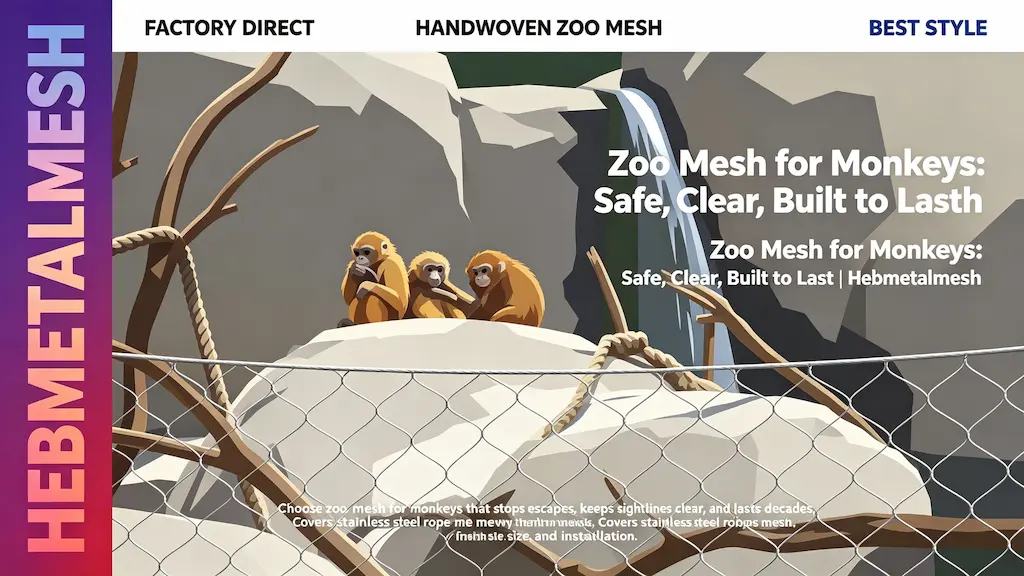
A monkey enclosure lives or fails at the barrier. The best fence mesh for a primate exhibit is hand-woven stainless steel rope netting sized to the species: 1.2-2.0 mm cable at a 25-51 mm aperture for small and mid-size monkeys, stepped to 2.4-3.2 mm for macaques, baboons and mandrills. Welded wire and coated mesh fail on primates because they abrade and rust. Stainless rope netting has no coating to strip and no weld to corrode, so it stays a soft, climbable, escape proof mesh that lasts decades. This guide gives the numbers – which cable matches each species, what aperture keeps a monkey in, and what the monkey pen mesh costs.
Executive Summary
Choosing the best fence mesh for a monkey enclosure comes down to three variables: body size and bite, the aperture that contains the smallest limb, and the cable diameter that survives climbing and chewing. Hand-woven stainless steel rope netting covers all three in one panel, ships cut to your drawing up to 9 m x 18 m, with no coating or weld a primate can destroy. Specify 304 inland and 316 within about 5 km of the coast. The reference specification is the monkey enclosure netting product page.
Quick Answer
Quick Answer: The best fence mesh for a monkey enclosure is hand-woven stainless steel rope netting – 1.6 mm cable at a 38 mm aperture for most monkeys, 2.0 mm at 51 mm for macaques, and 2.4-3.2 mm at 51-76 mm for baboons and mandrills. Aperture follows the smallest limb; cable diameter the strongest bite and longest climb. Plan roughly $14-26 per square metre of mesh.
Key Takeaways
- Aperture contains, cable diameter survives. Set the opening so the smallest monkey cannot pass a hand or foot; set the cable so the strongest primate cannot deform it.
- Stainless beats welded wire on primates. There is no coating to abrade and no weld to rust, so the panel stays a soft, finger safe mesh for the life of the exhibit.
- Species decides the spec. A marmoset needs a 25 mm opening; a mandrill needs 3.2 mm cable and a 76 mm aperture.
- 304 inland, 316 at the coast. The molybdenum in 316 pays for itself where salt or bore water reaches the pen.
- The mesh is made to your drawing. One replacement door panel can be ordered alone years later, which keeps maintenance cheap.
Accredited zoos follow published welfare standards; the Association of Zoos and Aquariums publishes animal care manuals most facilities reference when specifying a primate enclosure, where primate welfare and enclosure complexity requirements start.
Why Monkeys Break Ordinary Fence Mesh
Most retail “monkey fence” is galvanised welded wire or PVC-coated panel, both wrong for an animal that climbs for a living. Welded wire has a rigid grid a primate can lever and a zinc coating it can abrade and swallow – zinc toxicosis is a recognised cause of heavy-metal poisoning in primates. Coated mesh shreds, and a monkey will pull a strand through its gut.
Stainless rope netting removes both failure modes. It is 304 or 316 wire rope crossed at a fixed pitch and joined at every crossing by a pressed ferrule sleeve – no coating, no weld, no zinc. Because the crossings are independent, a damaged cable loads its neighbours, so the panel keeps its mesh redundancy and still contains the animal. That is the default monkey proof mesh in modern zoos: a monkey works a loose strand for years and still cannot escape, with no single weak point.
The same softness serves the animal. A rope net reads as a natural climbing structure mesh – monkeys brachiate and patrol the full height instead of pacing a floor, the cheapest behavioral enrichment and why a well-specified monkey pen netting enclosure looks alive, not captive.
Match the Cable Diameter to the Primate
Cable diameter is a bite-and-climb problem, not a size problem – a small monkey has strong hands and a large one a bite that bends bar. The table maps common species to a starting HM-code specification; aperture is the open square, cable diameter the rope.
| Species | Min. aperture | Cable diameter | HM code | Mesh weight / m² | Planning price / m² |
| Marmoset, tamarin | 25 mm | 1.2 mm | HM1220 | ~0.5 kg | $14-18 |
| Capuchin, squirrel monkey | 25-38 mm | 1.6 mm | HM1625 | ~0.6 kg | $15-20 |
| Macaque | 51 mm | 2.0 mm | HM2076 | ~1.0 kg | $18-24 |
| Baboon, mandrill | 51-76 mm | 2.4-3.2 mm | HM3276 / HM32102 | ~1.2-1.4 kg | $22-28 |
| Gibbon (in a monkey house) | 51 mm | 2.0 mm | HM2076 | ~1.0 kg | $18-24 |
The decisive variable is chewing time, not body weight. A capuchin out eight hours a day lives in 1.6 mm cable; confined for long stretches, step up to 2.0 mm. For the largest Old World monkeys, 2.4 mm at 76 mm (HM3276) is the floor and 3.2 mm at 76-102 mm (HM32102) the safe choice where a mandrill or baboon can reach a fixing. Monkey pen mesh thickness tracks patience more than mass.
Two cautions. A 25 mm aperture is finger safe mesh for a marmoset but will not contain a macaque’s hand, so never down-spec the opening on a mixed-species house. Within about 5 km of the coast, choose 316 – the molybdenum premium is trivial against replacing a sheet in eight years. A stainless monkey pen mesh in 304 inland and 316 at the coast is the full specification; every table combination ships as cut panels from the monkey enclosure netting range.
Aperture: The Containment Question
Monkey pen mesh spacing is aperture x aperture x cable diameter. The aperture half answers containment, the cable half answers the bite. Set the opening so the smallest limb cannot pass, with margin for a juvenile – 25 mm for a marmoset, 51 mm for a macaque. Where the house holds more than one species, specify to the smallest animal and accept the larger cable the bigger one demands.
On finish, a black oxide aviary mesh look is available on primate netting too: the black oxide option cuts glare and reads as less intrusive inside the pen. The coating is integral to the steel, so it cannot be picked off.
The panel is a joint free mesh – the weave is continuous, so there is no seam line a primate can prize. Where a fold is impossible, two edges are seamed on a common rope with ferrules rather than clips, keeping the panel one redundant structure.
Frame, Door and the Details That Ruin a Build
The mesh is the easy half; most home-built primate pens fail at the frame, and at the corners. A monkey pen needs a rigid box with a continuous top rail, because tensioning loads the header first and a header that deflects sags the sheet within a season. A 32-40 mm OD stainless or powder-coated perimeter frame tube is enough up to about 2.4 m span; beyond that, step to 50 mm and add an upright.
Monkey pen mesh door deserves more thought than it gets. Order it pre-hung in its own welded stainless frame with the opening cut and bound by the weaver, and fit two different latches – a capuchin that has watched you open one slide bolt will open it. The door is the panel a primate tests first, so match the wall cable.
Monkey pen mesh corner detail is where installers improvise and lose. Do not cut the sheet and butt two edges – that leaves loose cable ends where a monkey spends its day. Fold the sheet around the corner post, keep the weave continuous, lace the fold through the outer row of apertures. Panels are made to your drawing, so a single replacement corner panel can be ordered alone.
Installation
Monkey pen mesh installation is closer to rigging a sail than assembling a shed. The sheet ships slack – normal, not a defect. Fix the top edge first along the rigid header using panel edge binding, a rope through the top row of apertures clamped to the rail, not individual clips that pull the weave out of square. Tension progressively from width to height, run a perimeter tension cable through the bottom row anchored to the frame, and re-tension after the first week, then re-check annually.
Monkey pen netting weight matters when a pen is roofed or suspended: 1.2 mm at 25 mm is about 0.5 kg/m², 2.0 mm at 51 mm about 1.0 kg/m², 3.2 mm at 76 mm about 1.3 kg/m². Weigh a sample before sizing a frame, since a roofed pen carries real load.
Cost
Monkey pen mesh cost tracks steel weight, which rises with the square of cable diameter, and labour with aperture. At 25 mm there are roughly 1,600 cross points per square metre – two hand passes each – which is why a fine marmoset panel costs more than a coarse baboon panel in twice the cable.
Worked example: a macaque pen 3.0 x 2.0 x 2.2 m has about 25 m² of wall and roof. At $18-24/m² for 2.0 mm cable at 51 mm, mesh alone lands around $460-610, and frame, hardware and fixings typically add as much again. Budget $900-1,200; read any quote far below that as undersized cable.
Monkey pen mesh price varies mainly with cable diameter, so specify the lightest cable the species allows rather than a uniform heavy gauge. Most suppliers sell the mesh loose. A monkey pen mesh for sale as a kit – cut panels, perimeter tension cable, edge rope, ferrules and a bound door panel – costs a little more per square metre and removes the two build mistakes: cutting the sheet yourself and mismatching hardware. A galvanised bolt through a 316 panel is a galvanic cell, so a monkey pen mesh manufacturer with matched alloy hardware is worth the premium.
Indoor, Outdoor and Sanctuary Pens
Monkey pen netting for zoo exhibits is the same product with two changes: alloy and shade. Within about 5 km of the coast specify 316, and cover 30-50% of an outdoor roof with shade cloth because primates overheat faster than they chill. Stainless does not degrade under UV light, so it outlasts knotted nylon, which embrittles in three to five years of sun.
Indoors, the limit is hygiene and ventilation. Keep perches at least 150 mm clear of the mesh and give a branch of untreated hardwood to destroy. Rotate branch and toys fortnightly. Food and water go where they cannot be fouled from above, substrate dry.
Sourcing
A monkey pen netting supplier should give you the mill certificate, not just a price. Ask for rope construction – 7×7 on finer diameters, 7×19 where flexibility matters – and the break load rating per diameter, about 1.8 kN at 1.6 mm and 4.0 kN at 2.4 mm in 304. Then ask for aperture tolerance: a hand-woven sheet is not a machined grid, so allow roughly ±2 mm on pitch. The monkey enclosure mesh ultimate guide walks through that certificate, and the comprehensive insights into monkey enclosure mesh page compares the HM codes.
For dimensions, perches and sightlines, the perfect primate enclosure guide is the companion read, and the best primate cage material guide explains why rope netting beats every rigid alternative for a climbing animal.
Maintenance
Monkey pen mesh maintenance is light because there is nothing to rust or delaminate. Wash the sheet with water to remove dander and urine scale, re-tension the perimeter cable at the annual check, and replace any panel worked to a loose strand – a single ordered piece, not a rebuild, because panels are made to your drawing. Inspect the ferrules and door latches yearly; those are the only moving parts.
FAQ
A 25 mm aperture on 1.2-1.6 mm cable for marmosets and capuchins, 51 mm on 2.0 mm cable for macaques, and 51-76 mm on 2.4-3.2 mm cable for baboons and mandrills. The aperture follows the smallest limb; the cable the strongest bite.
No. The zinc coating is a recognised cause of heavy-metal toxicosis in primates, and a monkey abrades coatings by instinct. Use bare stainless rope netting with matched alloy hardware.
Not in the sense of parting the cable – a 2.4 mm 304 rope carries a break load rating near 4 kN, far above any primate bite. A monkey can work a loose strand, so keep the panel tensioned and edges bound.
A 3.0 x 2.0 x 2.2 m macaque pen needs about 25 m² of netting; at $18-24/m² that is roughly $460-610 in mesh, with frame and hardware adding a similar amount. Plan $14-26/m² for the mesh.
304 inland. Choose 316 within about 5 km of salt water, or anywhere the pen is washed with chloride-laden bore water.
Want a monkey pen mesh specification for your species and pen? Contact us with dimensions and climate for cable diameter, aperture, alloy and a firm planning price.