
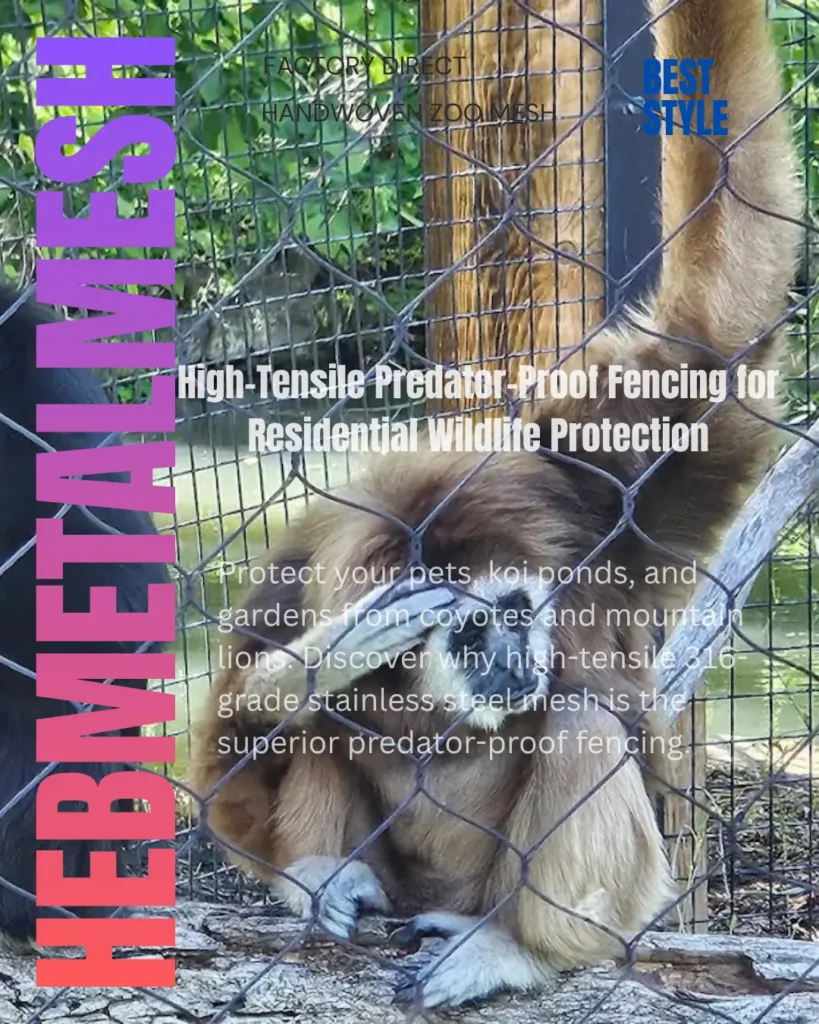
Designing a primate enclosure is a complex architectural and biological puzzle. It requires far more than simply selecting a mesh roll; a successful design must seamlessly integrate heavy-duty support structures, adapt to local climate demands, and comply with strict local and international animal welfare regulations.
Because primates are incredibly intelligent and physically dynamic, unexpected design oversights can lead to project delays or hazardous containment failures. Taking a strategic approach during the initial planning phase ensures that your enclosure is built safely, sustainably, and efficiently the first time—preventing the need for highly disruptive and costly structural modifications down the road.
Start Your Project Right
Avoid costly structural re-engineering. Align your habitat design with expert technical specifications from day one.
Request a Pre-Construction ConsultationThe 3 Pillars of Monkey Enclosure Design
To build an optimized primate habitat, engineers and curators must evaluate three foundational pillars before selecting their construction materials.
1. Species Behavior & The “Activity Budget”
Every primate species interacts with its environment differently. Understanding the specific behavioral traits and daily “activity budget” of your animals dictates your fencing demands:
- High-Energy Jumpers & Climbers: Species like gibbons or langurs exert massive dynamic forces when leaping. The perimeter barrier must absorb these kinetic impacts without losing tension.
- Heavy Chewers: Many macaques and baboons constantly test their barriers with their teeth. The fencing material must be entirely chew-proof and non-toxic to prevent physical degradation or accidental ingestion.
- Tool Users & Problem Solvers: Highly intelligent primates like capuchins or chimpanzees will actively look for structural weaknesses, loose fasteners, or gaps. The containment system must feature smooth, tamper-proof joints and hardware.
2. Site Environment & Spatial Topography
The physical location of your exhibit introduces environmental variables that directly impact the longevity of your infrastructure:
- Climate & Corrosion Risks: High-humidity regions, tropical indoor exhibits, or coastal sanctuaries expose metal fencing to severe rust risks. Your material strategy must account for these elements to prevent premature structural failure.
- Topographical Integration: Building on slopes, incorporating existing mature trees, or navigating natural rock formations requires a flexible containment material. Rigid traditional fencing often fails in irregular spaces, whereas flexible containment mediums can adapt to complex shapes without leaving security gaps.
3. Regulatory & Safety Standards
Compliance is a non-negotiable aspect of modern habitat construction. Enclosures must be engineered to align with local safety codes, national wildlife laws, and professional association guidelines (such as AZA or EAZA standards). These regulations define critical parameters like minimum barrier heights, clear zones to prevent contact with the public, and structural safety margins. Designing with these benchmarks in mind guarantees that your facility passes inspection and operates safely for years to come.
Comparison: Designing for “Containment” vs. “Display”
The design of a primate enclosure often involves a trade-off between absolute structural security and visitor-facing aesthetics. Identifying your project’s primary objective early helps streamline material selection.
Containment-First Focus
In quarantine units, veterinary wards, or specialized breeding facilities, the priority is zero-fail security.
- Security Priority: These designs often incorporate smaller aperture meshes and heavier wire gauges to prevent any possibility of physical interaction with the barrier.
- Visual Impact: Aesthetic “invisibility” is secondary to the functional requirements of animal separation, sanitation, and staff accessibility.
- Hardware: Heavy-duty, tamper-resistant mounting systems are used exclusively, often with dual-perimeter designs for maximum containment.
Display-First Focus
For public-facing zoo exhibits, the goal is to provide an immersive, naturalistic experience for visitors while maintaining safety.
- Aesthetic Transparency: We utilize thin-profile, high-tensile stainless steel mesh that minimizes visual interference, allowing visitors to feel “connected” to the animals.
- Visitor Safety: Design emphasizes “stand-off” distances and barrier heights that ensure public safety while keeping the barrier itself unobtrusive.
- Landscape Integration: The mesh is designed to be draped over or around natural elements like trees and rockwork, creating a seamless boundary that doesn’t feel like a “cage.”
The Planning Checklist (The “Decision Framework”)
Before finalizing your materials or engineering drawings, use this “Needs Assessment” checklist to ensure you have considered the critical variables of your habitat.
Habitat Needs Assessment
| Question | Assessment Focus |
|---|---|
| What is the primary species? | Size, weight, climbing habits, and bite force dictate the required mesh gauge and aperture size. |
| What is the enclosure footprint? | Total square footage and vertical height determine structural support requirements and total material cost. |
| What are the primary threats? | Environmental (corrosion/salt air), biological (predators/pests), or operational (visitor traffic/chewing) risks. |
Quick Planning Questions
- Species Profile: Is your primate highly arboreal (requires ceiling mesh/verticality) or primarily terrestrial?
- Footprint Flexibility: Does the enclosure layout require custom-shaped panels to navigate irregular terrain or existing vegetation?
- Threat Mitigation: Are you in a high-corrosion environment (e.g., coastal area) that necessitates Grade 316 stainless steel, or is Grade 304 sufficient?
- Public Access: How close will visitors be to the barrier? This will influence the requirement for anti-climb guards or secondary safety mesh.
5. Material Strategy: Why Steel is the Foundation
While careful planning addresses the behavioral and environmental needs of your habitat, your choice of material dictates whether that plan succeeds in practice. For modern primate enclosures, high-grade stainless steel is not just a preference; it is the industry standard for creating a secure, durable, and transparent boundary.
Stainless steel functions as the structural foundation of your design because it bridges the gap between competing needs. It offers the extreme tensile strength required for high-energy arboreal species, the non-toxic, bite-resistant qualities needed for curious primates, and the superior corrosion resistance necessary to withstand years of outdoor exposure. By choosing our precision-engineered stainless steel mesh, you ensure that the vision you outlined in your planning phase is backed by a material designed to perform for decades, requiring minimal maintenance and offering maximum safety.
For an in-depth look at material options, cable construction, and supplier selection criteria, explore our gibbon enclosure mesh selection guide.
6. Implementation Roadmap
Moving from a concept to a finished, animal-safe habitat requires a structured approach. We recommend following these four phases to ensure consistency and security:
- Phase 1: Concept Design Define the enclosure’s purpose, footprint, and aesthetic goals. This is the stage where you finalize the habitat’s layout, visitor sightlines, and primary zones for animal enrichment.
- Phase 2: Technical Specification Translate your design into technical requirements. Here, you select the specific mesh gauge, aperture size, and material grade (304 vs. 316) based on your species profile and environmental threats.
- Phase 3: Fabrication & Installation With the specifications finalized, the mesh is custom-manufactured to match your exact dimensions. Professional installation follows, focusing on precise tensioning and the secure mounting of all structural hardware.
- Phase 4: Safety Inspection Before introducing the animals, conduct a comprehensive safety audit. This includes tension checks, verifying the integrity of all attachments, and ensuring that all anti-climb and base-locking details meet regulatory standards.
Ready to Design Your Habitat?
Turn your planning vision into a secure, professional reality. Explore our mesh specifications or reach out for a custom-engineered design consultation.