
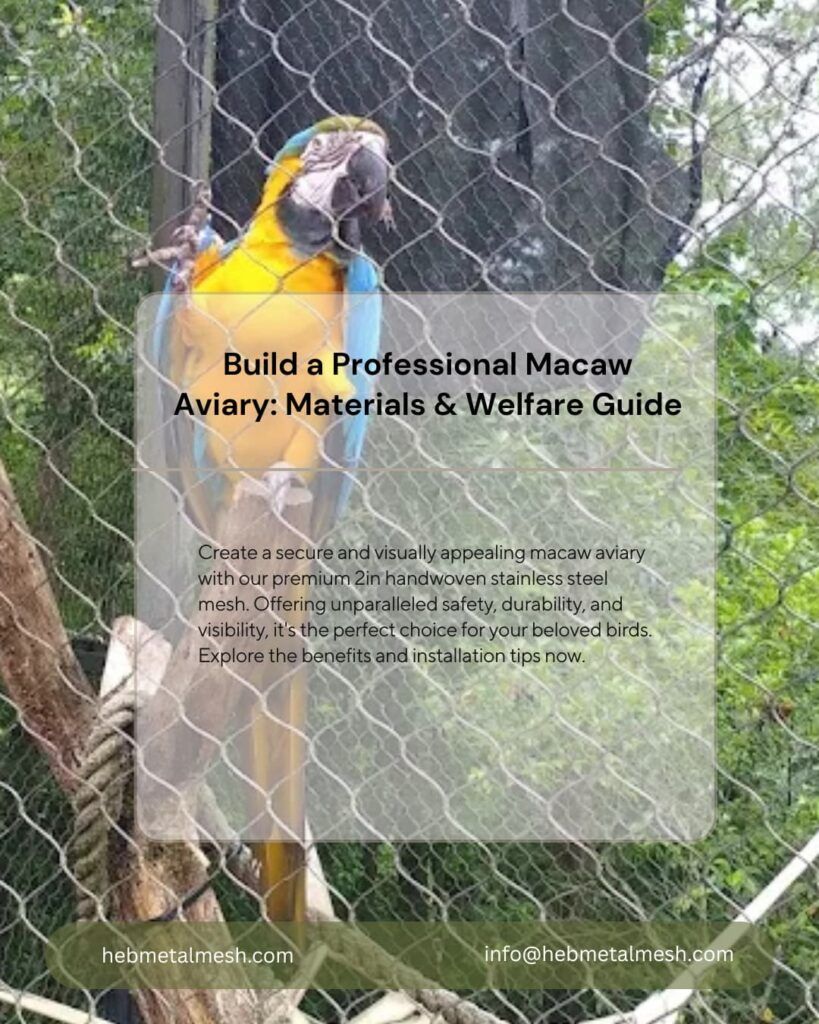
Most people choose a macaw mesh supplier the way they choose a fence contractor: they collect prices per square metre, compare two or three, and take the middle one. That comparison is close to meaningless. The macaw settles most of the specification before any supplier is contacted, and the part of the job a supplier is genuinely good or bad at — the making — stays invisible until the aviary has stood for three years. What you can compare is the order. This page sets out what a macaw fence build has to be written on, and which of those lines the factory owns rather than the buyer.
Executive Summary
A macaw mesh supplier is not selling a stock item, because a macaw removes most of a mesh catalogue before an order even exists: the largest psittacines need a heavier rope, a larger opening and a harder-wearing build than any small-parrot aviary, and the result has to be written down as a build sheet rather than picked off a price list. That is why the documents matter more than the price. A quote is only comparable if it names the alloy, the aperture size, the cable diameter, the panel format and what happens at the edges, and the parts a buyer cannot inspect — the termination, the tensioning detail and the weave — are the parts that decide whether the panel still holds in year five. A bare stainless steel rope mesh carries the least risk on those lines, because it has no coating to strip and no soft zinc layer to lose. The reference specification is the macaw enclosure mesh product page.
Writing a macaw mesh order and want a number that will not move? Send us the bird count and species, the frame span between your fixings, whether the site is inland or coastal, and how you want the edges finished, and we will return the aperture, cable, alloy, panel format and termination for the build.
Quick Answer: What Decides the Order?
Five lines decide it: the bird count, the frame span, the aperture, the cable, and the edge detail. Everything else on a macaw specification is a variation of those five. A supplier who quotes without all of them is guessing, and a buyer who asks for a price without all of them receives a figure that will change.
Key Takeaways
- A macaw order is a build, not a product code — the species removes most of the catalogue before the order starts.
- Five lines carry the whole specification: bird count, frame span, aperture, cable, edge detail.
- The parts a buyer cannot see (termination, tensioning, weave) are the parts that decide service life.
- A quote is comparable only if it names the alloy, the opening, the cable size and the panel format.
- What you can verify yourself is the site measure and a trial panel; everything else is a document.
A Macaw Order Is Not a Stock Item
Set a macaw aviary beside a budgerigar aviary and the differences are not cosmetic. The macaw is the largest of the parrots, and it arrives with a beak that is genuinely a tool for taking things apart. It will work one point on a panel for years if that point is comfortable, which a small parrot will not. Where a small-parrot enclosure can be built from a light roll cut to length, a macaw enclosure is closer to a small engineering job: heavier wire, heavier fixings, and a build that has to survive not one bite but an animal that keeps returning to the same place.
That is what makes a macaw mesh supplier a different kind of supplier. It is not selling metal by the metre. It is converting one species into a panel set, and the conversion is where the quality sits — not in the price per square metre, which is quoted against the same wire by everyone.
What the Bird Deletes Before the Order Starts
Start with the bird rather than the budget. Two macaws are not twice the load of one, because two birds work each other’s edges and use a shared perch differently from a single bird. The first line on any macaw mesh build is therefore not a mesh dimension at all: it is the bird count, plus the species, because a hyacinth macaw and a severe macaw do not threaten the same things.
That one number starts deleting options. Two birds will use the upper corners and the door frame far harder than one, so the zone of heaviest work moves. A tight opening — good exclusion, tidy appearance, cheap — is still available to a macaw, but it has to be hung on heavier rope, and that single change moves the panel weight, the frame, the span and the price at the same time. This is why the conversation is worth having before the quote rather than after it.
The Five Lines an Order Has to Carry
A macaw mesh order can be written on five lines, and four of them are numbers.
The first is the bird count and the species. The second is the frame span — the distance between the supports the panel will be drawn across, which sets the tension the mesh has to hold and therefore the cable it needs. The third is the aperture size, which on a macaw is a compromise rather than a rule: a tight opening gives exclusion and a heavier look, a wide one gives visibility and less material near a toe. The fourth is the cable diameter, which runs from 1.2 mm to 3.2 mm and belongs at the heavy end wherever a macaw can reach. The fifth is not a number at all: it is what happens at the edge.
Everything else — macaw mesh thickness read across the strand bundle, the direction of the weave, the panel size, the alloy — is either derived from those five or is a preference. State all five and a supplier is answering a question. Leave one out and the supplier fills it in, and the buyer spends the rest of the project comparing guesses. The mesh size guidance for bird enclosures takes the aperture decision further, including how to read it off the bird rather than off a chart.
The Invisible Half: Termination and Tension
The parts of a macaw mesh supply that a buyer cannot inspect are the parts that decide whether the aviary is still holding in year five.
The first is the edge termination. A panel is only as strong as the way it is attached, and the wrong attachment recreates in one line the concentration the mesh was chosen to avoid: a clamp that bundles a group of wires into a single hard point, rather than a termination that spreads the load across many wires. On a macaw enclosure that detail carries more load than any strand in the middle of the sheet, and once the panel is up it is invisible from both sides.
The second is the tensioning detail. A flexible cable netting behaves as a membrane only when it is pulled to the right figure and held there. A panel left slack will move under the bird and work at its fixings instead of resisting, which is how a cheap supply is actually cheap: the mesh may be identical and the saving was made in the tensioning. A wire rope mesh that is never properly tensioned is a net, not a barrier.
The third is the weave. A woven mesh made from a continuous strand spreads a local pull outward into neighbouring strands. A grid locked at every crossing delivers the same pull to one joint and stops there. Both are sold as macaw mesh, and the price difference between them is small. The hand-woven macaw enclosure mesh build is the version to specify wherever a macaw can reach.
What You Buy: Sheet, Cut Panel, or a Drawing
A macaw mesh order arrives in one of three forms, and they are priced differently because they are different products.
The simplest is rolls, cut on site. It is cheap and quick and sensible for a small, low-risk enclosure, but it moves the making onto the buyer, who is usually the person who has never terminated a wire rope panel before.
The second is rolls or panels cut to a supplied cutting list. The factory does the cutting, and the buyer still owns the assembly and the tensioning.
The third is made to measure mesh: a set of finished panels to a drawing, with the edges terminated at the factory. This is the version that suits a macaw, because it is the version where the invisible half is done by the people who make the wire. It costs more and takes longer, and that is the honest trade. The other wording is made to order mesh, and it means the same thing — nothing is made until the drawing exists.
The alloy belongs on this line too. A 304 stainless steel build is the right choice for an inland aviary. A 316 stainless steel build is what a coastal site, or any enclosure where chlorides are present in the air, actually needs. Buying the marine grade inland is not an error, only an unnecessary cost. The macaw netting range sets out the formats and the grades together.
What the Quote Should Answer
A macaw mesh quote is a specification document, not a price. If it does not name the alloy, the opening, the cable, the panel format and the edge treatment, it cannot be compared with anything, including the same supplier’s next quote.
The second thing the quote should carry is the maker. On a bespoke build the identity of the factory is part of the specification: who draws the panels, who terminates them and where the wire comes from all change the answer you get for the same money. Here, a macaw mesh manufacturer is not a logo — it is the party that owns the drawing. Ask who that is, and ask what happens to the drawing when you re-order in three years, because a panel set that cannot be repeated is not a repeatable supply.
A supplier page is a procurement document, and the discipline that studies how a bespoke purchase should be written is procurement itself. The Chartered Institute of Procurement & Supply treats the specification, the evaluation of a supplier’s capability and the contract terms as one subject, which is the honest frame for an order that has no catalogue number.
The third thing is the order of events. Made-to-measure mesh reverses the usual sequence: the drawings are approved before anything is cut, which is good, but it also means a change after approval is expensive rather than merely inconvenient. Fixing the five lines before the drawing is approved is what stops that happening.
What the Buyer Can Check Without a Factory
Two of the five lines can be verified by the buyer, and both are worth doing.
The first is the site measure. A supplier works from your numbers, so the frame span is only as good as the measurement behind it; measuring between the real fixings rather than between the posts as drawn is the difference between a panel that tensions and a panel that will not. The second is a trial panel: one finished panel, made to the agreed specification, hung and tensioned before the full order is released. A trial panel is the cheapest way to discover that a termination does not suit your frame, and it is also the point at which a supplier’s claim and a supplier’s work can be compared without argument.
Beyond those two, the practical tool is a buyer checklist. It should carry the five lines, the alloy, the panel format, the termination type and the drawing reference — and it should be attached to the order, not left in an email thread. A specification that exists only in a conversation is not a specification, and that is the standard the macaw enclosure mesh range is supplied against: a drawing, a written specification and a panel that can be remade.
FAQ
Usually, because there is no reseller margin — but the saving survives only if the specification is complete. A direct order with a vague drawing can cost more than a resold one with a proper drawing, because the correction is yours.
It is a compromise rather than a rule. A wide opening gives visibility and keeps material away from a toe; a tight one gives exclusion. For a macaw the working range is 38 mm to 76 mm, hung on the heaviest cable the frame will carry.
Yes, if the build is repeatable — which is why the drawing matters as much as the mesh. A terminated panel made to a saved drawing can be remade to the same specification years later, while a roll cut on site usually cannot be matched.
Send the bird, the span and the exposure — we will send the build. Tell us the macaw species and how many birds, the span between your fixings, the site exposure and how the edges need to finish, and we will return a panel set built to a drawing you can re-order from.