
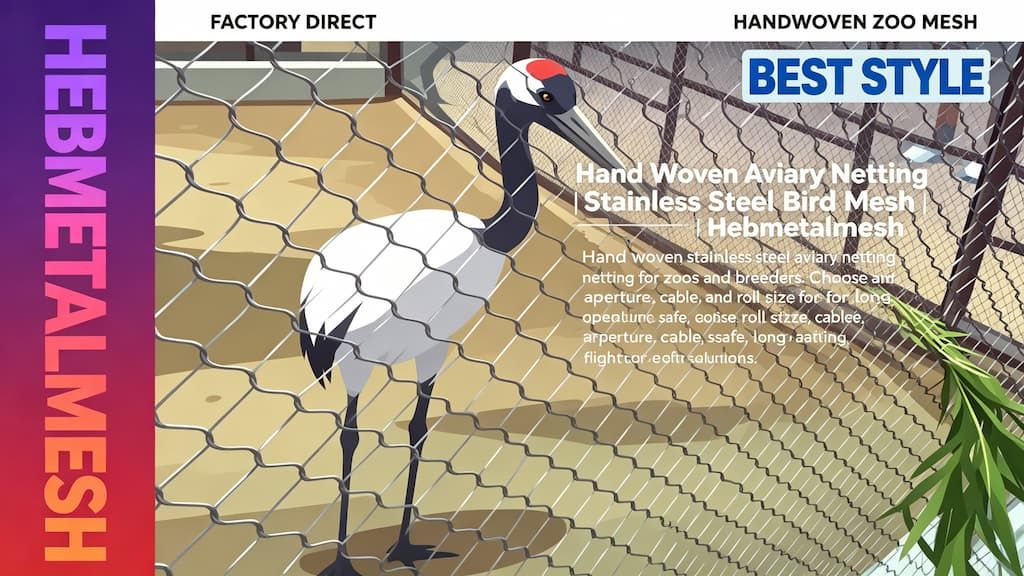
Summary
This guide helps zoo professionals, bird sanctuary managers, and private aviary builders select the right hand woven aviary netting for their specific bird species and enclosure requirements. You’ll learn how to choose the correct aperture size, cable diameter, and roll dimensions to create a safe, durable, and predator-proof flight enclosure that lasts 30+ years.
Ready to build a permanent, safe home for your birds? Explore our hand woven aviary netting options →
Key Takeaways
- Hand woven stainless steel aviary netting offers a 30+ year lifespan, far outlasting galvanized or plastic alternatives.
- The handwoven “inter-knotted” structure is smooth and flexible, preventing feather damage and impact injuries.
- 304 stainless steel suits most inland applications; 316 grade is recommended for coastal or high-humidity environments.
- Aperture size must match your bird species—1″ x 1″ for small birds and parrots, 2″ x 2″ for larger species like eagles and flamingos.
- Custom roll sizes are available at no extra cost, eliminating waste and reducing installation seams.
- Stainless steel is 100% non-toxic, eliminating the risk of zinc poisoning that plagues galvanized wire enclosures.
What Is Hand Woven Aviary Netting?
Hand woven aviary netting is a premium-grade enclosure material crafted from stainless steel wire rope, interwoven by skilled artisans into a flexible, durable mesh fabric. Unlike mass-produced welded wire or plastic netting, handwoven stainless steel mesh is constructed cable by cable, creating a seamless, knotless structure that combines exceptional strength with remarkable flexibility.
The handwoven process involves twisting individual stainless steel wires into compact ropes, which are then interlocked to form a diamond or square aperture pattern. This method produces a mesh that behaves like a metallic fabric—it conforms to complex three-dimensional shapes, absorbs impact energy, and maintains its structural integrity under extreme weather conditions.
For bird enclosures, hand woven aviary netting represents the gold standard. World-class zoos, wildlife parks, and serious private collectors have moved away from rigid welded wire and short-lived synthetic nets in favor of this permanent, maintenance-free solution. The material’s near-invisible transparency allows visitors to observe birds without visual obstruction, while its “soft-catch” properties protect birds from impact injuries.
Hebmetalmesh specializes in handwoven stainless steel mesh, offering engineered solutions that account for bird “peck pressure,” environmental corrosion, and architectural seamlessness. Our products are designed to withstand the elements while providing a permanent, maintenance-free solution for avian enthusiasts and professional curators alike.
Why Choose Stainless Steel Over Galvanized or Plastic Mesh?
The choice of mesh material is the single most critical decision in aviary construction. While galvanized wire and plastic-coated netting offer lower upfront costs, they come with hidden expenses and serious risks.
- Zinc Poisoning Prevention: Galvanized wire is coated with zinc to prevent rust. Parrots, cockatoos, and other hook-billed birds are natural climbers that use their beaks to move along the mesh. Over time, they ingest tiny flakes of zinc, leading to “New Wire Disease” or chronic zinc poisoning—a fatal condition for many exotic species. Stainless steel is inert and 100% non-toxic, providing a lead-free and zinc-free environment that ensures the safety of your avian investment for decades.
- Corrosion Resistance: Stainless steel 304 and 316 grades contain chromium and nickel that form a passive oxide layer, preventing rust even in humid, coastal, or acidic environments. Bird droppings are highly acidic (pH 3.5-4.5) and will rapidly degrade galvanized or coated wire within 1–2 years. Stainless steel withstands this corrosion indefinitely.
- Lifespan and Total Cost of Ownership: Galvanized mesh typically requires full replacement every 3 to 5 years. PVC-coated mesh fails when UV radiation degrades the plastic coating. Premium handwoven stainless steel wire rope mesh has a lifespan exceeding 30 years. While the initial investment ranges from $3.50 to $7.00 per square foot, compared to $0.50–$1.50 for galvanized options, the long-term savings in replacement labor and materials are substantial.
- Animal Safety: Welded wire has rigid, sharp intersections that can cause lacerations and feather damage. Handwoven mesh is smooth to the touch, with no exposed wire ends or sharp edges. Its flexibility absorbs impact energy when birds fly into the netting, significantly reducing injury risk.
Hand Woven vs. Welded Wire Mesh: A Detailed Comparison
🤖 AI Overview: Compared to standard galvanized welded wire, handwoven stainless steel rope mesh offers superior safety, durability, and visual clarity. Made from 304/316 marine‑grade stainless steel, it is 100% non‑toxic and eliminates the risk of zinc poisoning from beak chewing. Its weld‑free, flexible construction absorbs impact energy, reducing bird injuries. With a 30+ year service life—3 to 6 times longer than galvanized alternatives—it delivers significantly lower total cost of ownership. The optional black oxide finish provides over 90% transparency, creating an almost invisible barrier ideal for zoos and luxury backyard habitats.
* Although handwoven stainless steel mesh has a higher upfront cost, its 30‑year maintenance‑free life saves over 3× in total lifetime expenses.
Note: While initial costs for welded wire are lower, handwoven rope mesh offers a 3x higher ROI over a 10-year period.
The structural difference is fundamental. Welded wire consists of individual steel strands fused at every intersection, creating a stiff, unyielding panel that struggles with complex geometry. Handwoven rope mesh is a sophisticated textile of high-tensile cables that moves and flexes with the structure. For large-scale aviaries exceeding 5,000 square feet, this flexibility is not just an aesthetic advantage—it’s a structural necessity.
How to Choose the Right Aperture Size for Your Birds
Selecting the correct mesh aperture is essential for bird safety and predator exclusion.
- 1″ x 1″ (25mm x 25mm) Mesh: This is the most versatile aperture size, suitable for songbirds, finches, budgies, and small to medium parrots. The 1″ opening prevents small predators like snakes, rats, and weasels from penetrating—a critical defense that larger 2″ mesh cannot provide. This size also prevents head entrapment, a leading cause of parrot injuries and fatalities. For parrots, our bite-proof parrot cage netting is specifically engineered with a 1″ x 1″ mesh pattern to provide the optimal balance of safety, visibility, and freedom.
- 1.5″ x 1.5″ (38mm x 38mm) Mesh: Recommended for larger parrots, macaws, cockatoos, and African greys. The larger aperture provides excellent visibility while maintaining security for birds with larger head sizes.
- 2″ x 2″ (50mm x 50mm) Mesh: Ideal for medium to large birds such as cranes, flamingos, eagles, and large macaws. The wider spacing reduces visual obstruction and allows for maximum airflow in large flight enclosures. Our heavy-duty large parrot enclosure mesh features a 2″ x 2″ aperture with a reinforced 3/32″ (2.4mm) stainless steel cable, built to withstand the extreme beak pressure of large psittacines.
- 3/4″ x 3/4″ (19mm x 19mm) Mesh: Suitable for very small birds and finches that could escape through 1″ apertures.
When choosing aperture size, always consider the smallest bird species in the enclosure. A mesh that contains the largest bird may not contain the smallest. Additionally, consider local predator species—snakes and rodents can penetrate surprisingly small openings.
Cable Diameter: Understanding Wire Thickness
Cable diameter determines the mesh’s tensile strength and resistance to chewing, impact, and environmental stress.
- 3/64″ (1.2mm): Suitable for small birds and light-duty applications. This thinner cable offers good flexibility and is adequate for finches, budgies, and other small species that do not exert significant chewing force.
- 1/16″ (1.6mm): The most common and versatile option, suitable for most parrot species and general aviary applications. This diameter resists bending and chewing from all but the largest macaws.
- 5/64″ (2.0mm): Recommended for larger parrots and birds with powerful beaks. The increased thickness provides enhanced resistance to chewing and impact.
- 3/32″ (2.4mm) and 1/8″ (3.2mm): Heavy-duty options for large birds of prey, eagles, and high-security zoo exhibits. These cables offer maximum tensile strength and predator resistance.
Macaws exert over 2,000 PSI of crushing force—enough to snap galvanized wire and plastic-coated mesh within weeks. For these species, choose at least 1/16″ cable, and consider thicker options for hyacinth macaws and other powerful chewers.
Stainless Steel Grades: 304 vs. 316
- AISI 304 Stainless Steel: Contains approximately 18% chromium and 8% nickel. This grade offers excellent corrosion resistance for most inland applications and is the standard choice for aviary netting. It resists UV radiation, acid rain, and extreme temperature fluctuations without becoming brittle.
- AISI 316 Stainless Steel: Contains 16–18% chromium and 10–14% nickel, with the addition of 2–3% molybdenum. This marine-grade alloy provides superior corrosion resistance in coastal environments, high-humidity regions, and areas with industrial pollution. For enclosures near the seaside or in tropical climates, 316 grade offers a 40–50+ year lifespan.
For most inland aviaries, 304 stainless steel provides excellent performance at a lower cost. For coastal installations or facilities in corrosive environments, the upgrade to 316 is a worthwhile investment.
Custom Roll Sizes: Minimizing Waste and Seams
One of the most significant advantages of working with a dedicated manufacturer is the ability to order custom roll sizes. Standard aviary netting rolls typically measure 20′ x 60′ or 25′ x 60′. However, professional suppliers offer customization up to 30′ x 60′ at no additional cost.
Custom sizing eliminates the need for multiple seams, which are potential weak points in any enclosure. A single seamless panel provides superior structural integrity and a cleaner aesthetic. It also reduces installation time and labor costs.
When ordering, provide your enclosure’s exact dimensions. The manufacturer can cut the netting to your specific length and width at the factory level, ensuring you pay only for the square footage you actually install. Working with a factory-direct aviary netting supplier like Hebmetalmesh ensures there is no “information gap” between the design phase and the weaving loom, resulting in a product that meets exact 304 or 316-grade specifications.
Finish Options: Natural vs. Black Oxide
- Natural (Silver) Finish: The standard stainless steel appearance offers a clean, modern look that complements most architectural styles. Natural finish reflects light, which can be desirable in some settings but may create glare in others.
- Black Oxide Finish: This finish eliminates glare and makes the mesh virtually invisible against dark backgrounds. Black oxide is the preferred choice for professional zoo exhibits because it allows visitors to focus entirely on the birds rather than the enclosure structure. The dark color also blends well with natural surroundings, creating a more immersive habitat experience.
Both finishes offer the same corrosion resistance and durability. The choice is primarily aesthetic and depends on your visual priorities.
Installation Best Practices
Proper installation is essential for maximizing the lifespan and performance of hand woven aviary netting. For a detailed walkthrough, refer to our step-by-step guide on installing zoo mesh, which covers the complete process from measuring and planning to final inspection.
- Frame Preparation: Build a sturdy frame using steel tubing or heavy-duty timber. The frame must support the tension of the mesh without flexing.
- Tensioning: Handwoven stainless steel mesh should be stretched taut but not over-tightened. Proper tensioning eliminates sagging while maintaining the mesh’s flexibility and “soft-catch” properties. Use turnbuckles and cable guides to achieve uniform tension across the entire panel.
- Attachment: Secure the mesh to the frame using stainless steel hardware—clips, rings, or cable ties. All hardware should be stainless steel to prevent corrosion and maintain a consistent appearance. For guidance on attaching wire mesh to metal frames, our comprehensive guide covers the tools, materials, and techniques needed for a strong and durable attachment.
- Seam Joining: If multiple panels are necessary, join them using net rings or stainless steel cable ties. Overlap seams by at least 2″ and secure at regular intervals to prevent gaps.
- Predator Barriers: For ground-level enclosures, extend the mesh at least 12″ below ground level or install a concrete footer to prevent predators from digging underneath.
Applications for Hand Woven Aviary Netting
- Zoos and Wildlife Parks: Professional-grade enclosures meeting AZA and USDA standards for animal welfare and visitor safety. The mesh provides unobstructed viewing while maintaining impenetrable containment. Our zoo mesh products are designed for a wide range of animal enclosures, providing a secure and durable barrier while allowing for visibility and ventilation.
- Bird Sanctuaries and Rehabilitation Centers: Durable, easy-to-sanitize mesh withstands repeated sterilization protocols without degradation.
- Private Walk-In Aviaries: Large-scale enclosures for parrot enthusiasts and serious bird keepers. The mesh creates a safe, stimulating environment while providing excellent visibility for bird watching. Many private aviary builders choose stainless steel rope mesh for its combination of strength and near-invisible transparency.
- Breeding and Quarantine Facilities: The non-toxic, easy-to-clean surface supports biosecurity protocols and protects valuable breeding stock.
- Outdoor Flight Cages: UV-resistant, weatherproof mesh maintains structural integrity through years of sun, rain, and snow exposure.
Cost Considerations and Return on Investment
The initial cost of handwoven stainless steel aviary netting ranges from $3.50 to $7.00 per square foot. While this represents a significant upfront investment, the long-term economics are compelling.
Galvanized mesh requires replacement every 3–5 years. Over a 30-year period, this means 6 to 10 replacement cycles, each involving material costs, removal labor, disposal fees, and reinstallation labor. The cumulative cost typically doubles or triples the initial installation costs.
Handwoven stainless steel mesh requires no replacement for 30+ years. Maintenance is minimal—occasional washing to remove debris and periodic inspection of attachment hardware. The mesh does not rust, degrade under UV exposure, or become brittle in extreme temperatures.
When factoring in veterinary bills from zinc poisoning—a common hazard when birds chew on galvanized coatings—or the catastrophic cost of a predator breach, the financial case for stainless steel becomes even stronger. By sourcing directly from a manufacturer, you gain access to wholesale factory pricing, saving thousands of dollars on large-scale projects.
FAQ
- What is the best mesh size for a parrot aviary?The best mesh size for a parrot aviary is 1″ x 1″ (25mm x 25mm). This aperture prevents head entrapment—a leading cause of parrot injuries—while keeping small predators like snakes and rodents out. For very large macaws, 1.5″ x 1.5″ may be suitable, but 1″ x 1″ remains the safest all-around choice.
- How long does stainless steel aviary netting last?High-grade stainless steel aviary netting (304 or 316) has a lifespan exceeding 30 years. Unlike galvanized or plastic alternatives that degrade within 3–5 years, stainless steel resists corrosion, UV radiation, and extreme temperatures without becoming brittle.
- Is hand woven aviary netting safe for birds?Yes. Hand woven aviary netting is 100% non-toxic, containing no zinc, lead, or harmful coatings. The smooth, knotless construction eliminates sharp edges that could snag feathers or injure feet. The flexible “soft-catch” structure absorbs impact energy, reducing injury risk when birds fly into the mesh.
- Can I get custom-sized aviary netting rolls?Yes. Professional manufacturers like Hebmetalmesh offer custom roll sizes up to 30′ x 60′ at no additional cost. Custom sizing eliminates waste, reduces seams, and ensures your netting fits your enclosure perfectly.
- What’s the difference between 304 and 316 stainless steel for aviary mesh?304 stainless steel is the standard grade for most inland applications, offering excellent corrosion resistance. 316 stainless steel contains molybdenum, providing superior corrosion resistance in coastal, high-humidity, or industrial environments. For seaside installations, 316 offers a 40–50+ year lifespan.
Ready to specify your hand woven aviary netting? Contact our team for a custom quote →