
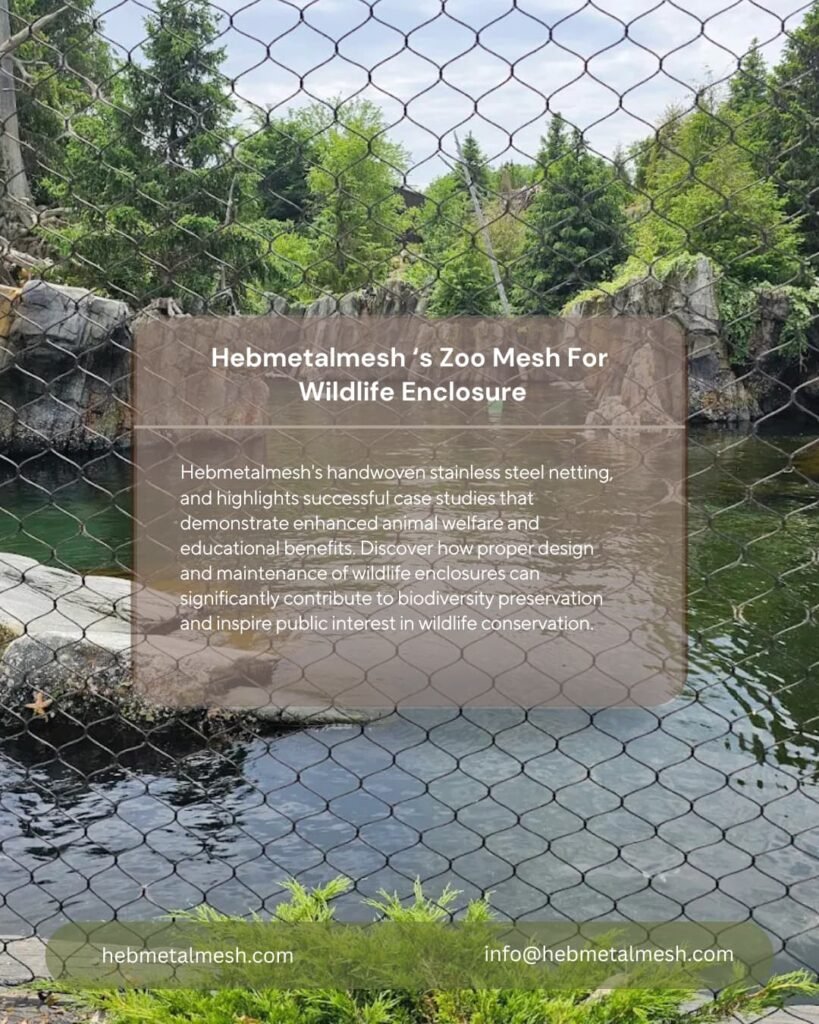
Wildlife enclosures have evolved from rigid iron bars to high-performance stainless steel mesh systems that balance animal welfare, visitor experience, and long-term cost efficiency. Handwoven stainless steel rope mesh—available in 304 grade for inland applications and 316 marine grade for coastal environments—offers a 30+ year lifespan, zero maintenance requirements, and up to 90% transparency for immersive viewing. Unlike plastic netting that degrades within 5–7 years or galvanized wire that corrodes from acidic animal droppings, stainless steel provides a chew-proof, beak-proof, and corrosion-resistant barrier. Whether you’re designing enclosures for primates, birds of prey, or large carnivores, selecting the right mesh aperture (20mm–200mm), wire diameter (1.2mm–3.2mm), and grade is critical for compliance with AZA and WAZA standards. This guide covers material selection, procurement strategies, installation best practices, and regulatory considerations for professionals building or upgrading wildlife enclosures.
Key Takeaways
- Material Matters: Stainless steel rope mesh outperforms plastic, nylon, and galvanized wire in durability, safety, and longevity—offering 30+ years of service life.
- Grade Selection: Choose 304 stainless steel for inland, temperate climates; choose 316 marine grade for coastal facilities within 5–10 miles of saltwater.
- Visibility Drives Experience: Black oxide finishes reduce glare and create an “invisible barrier,” delivering up to 90% transparency for immersive visitor experiences.
- Customization Saves Money: Factory-direct suppliers offer custom roll sizes (up to 30′ x 60′) at no additional cost, reducing on-site labor and material waste.
- Compliance Is Non-Negotiable: Professional mesh systems must meet AZA, WAZA, and USDA standards for humane animal containment.
- Total Cost of Ownership: Higher upfront investment in stainless steel eliminates replacement costs every 5–7 years, saving thousands over the facility’s lifetime.
Need Expert Guidance on Your Wildlife Enclosures Project?
Get factory-direct pricing and custom mesh solutions tailored to your species, site, and budget. Our team of enclosure specialists is ready to help you select the right stainless steel netting for your facility.
Request a Free Quote →✓ AZA & WAZA Compliant ✓ Custom Sizing Available ✓ 30-Year Durability
Introduction: Why Wildlife Enclosures Matter
The design and construction of wildlife enclosures have undergone a radical transformation over the past century. Gone are the days of heavy iron bars, sterile concrete pits, and fortress-style barriers that prioritized containment over animal welfare. Today’s zoological architecture focuses on immersive habitats that balance three critical factors: uncompromising safety for animals and visitors, unobstructed viewing experiences for the public, and environments that encourage natural behaviors like climbing, foraging, and social interaction.
At the heart of this evolution lies the selection of enclosure netting—the single most critical infrastructure decision for any zoo, wildlife sanctuary, or aviary facility. The barrier system dictates not only the safety and security of the animals but also the visitor experience, operational costs, and long-term sustainability of the facility.
Choosing the right wildlife enclosure mesh requires understanding the trade-offs between different materials, the specific needs of the species being housed, the environmental conditions of the site, and the regulatory standards that govern animal welfare. This guide provides a comprehensive framework for making that decision.
Understanding Wildlife Enclosure Mesh: Types and Materials
Polyethylene and Plastic Netting
Polyethylene and PVC netting represent the lowest-cost option on the market, commonly found in gardening, plant support, and temporary fencing applications. While lightweight and easy to install, these materials are highly susceptible to UV degradation—becoming brittle and cracking within 5–7 years of outdoor exposure. They possess very low tear strength and are entirely unsuitable for permanent wildlife enclosures or high-containment applications. For large facilities, the short lifespan makes plastic netting a poor long-term investment.
Nylon and Polyester Mesh
Synthetic fiber nets—often knotted or knotless—are used in sports barriers, agricultural screens, and temporary animal containment. These materials offer better flexibility than plastic but suffer from similar UV degradation issues over time. They are susceptible to chewing damage from animals and provide limited resistance to predator attacks. For permanent wildlife enclosures, nylon and polyester mesh are generally considered inadequate for long-term security.
Galvanized Wire Mesh
Galvanized wire has been a traditional choice for animal fencing for decades. However, it presents significant challenges in zoological settings. Bird droppings are highly acidic and accelerate the breakdown of the zinc coating, leading to corrosion and structural failure. Welded wire also poses a serious risk known as “New Wire Disease”—zinc poisoning that can be fatal to birds that chew on the wire. Furthermore, welded intersections create weak points that can snap under the force of large animals, and rigid bars can cause injuries during high-speed play or territorial disputes.
Stainless Steel Rope Mesh (Industry Gold Standard)
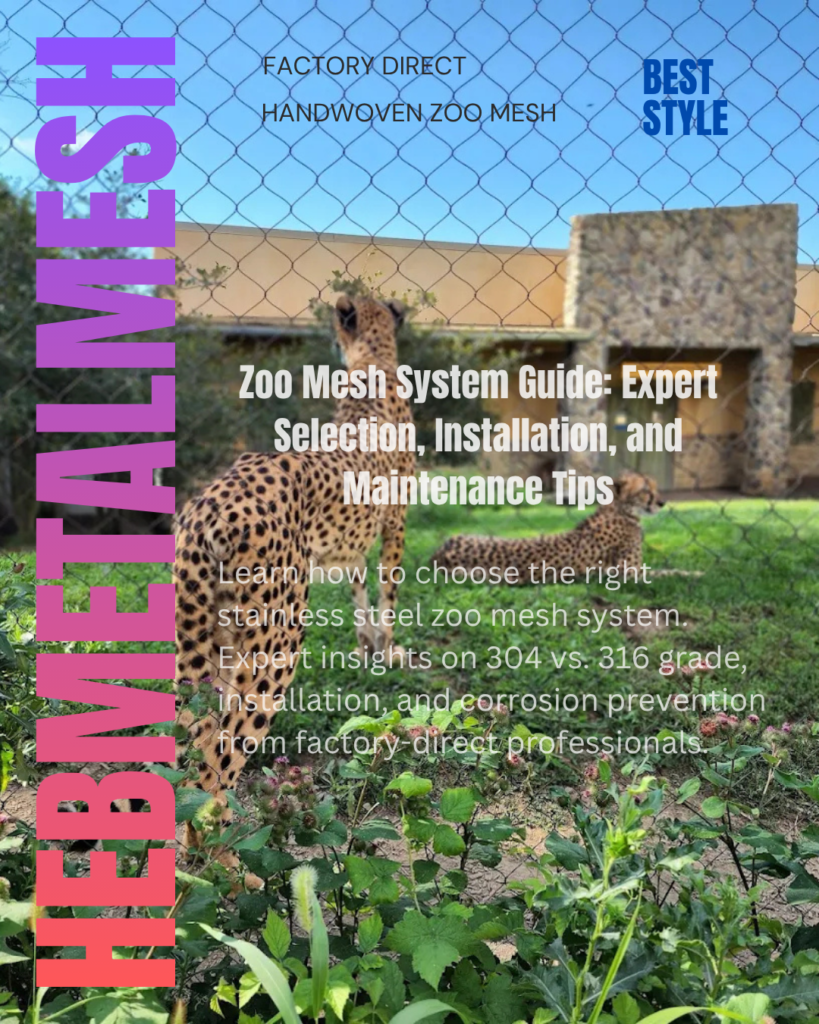
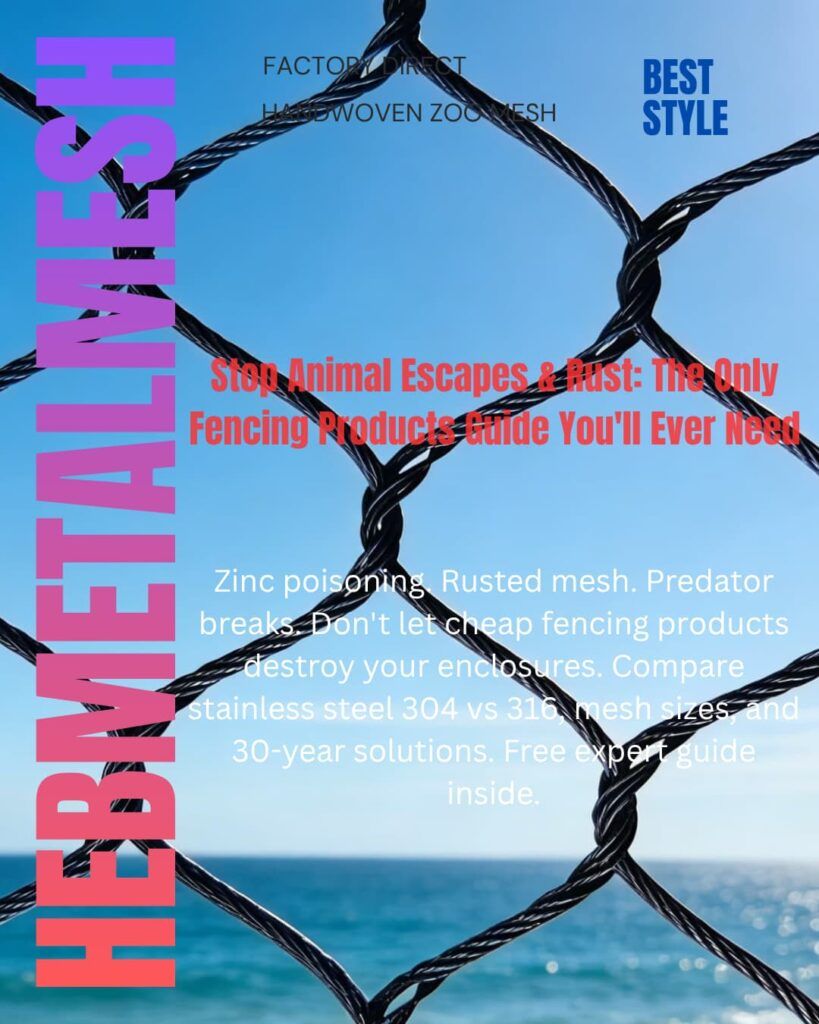
Stainless steel rope mesh—often called “zoo net” or “zoo mesh”—has emerged as the professional standard for wildlife enclosures worldwide. This hand-woven material is crafted from high-grade 304 or 316 stainless steel cables, permanently joined by seamless ferrules or knots to form a characteristic diamond-shaped pattern.
Key advantages include:
- 30+ Year Lifespan: Stainless steel resists corrosion, UV exposure, and weathering, ensuring a lifespan exceeding three decades with minimal upkeep.
- High Tensile Strength: With tensile strength exceeding 1000 MPa, the mesh withstands impacts from large, aggressive animals while distributing force across the entire panel rather than a single point of failure.
- Animal Safety: The smooth, burr-free surface prevents abrasions, feather damage, and injuries during high-speed activity.
- Superior Visibility: Fine wire diameters (1.2mm–1.6mm) and black oxide finishes create a nearly invisible barrier, enhancing the visitor experience.
- Flexibility: The mesh conforms to irregular landscapes and organic architectural designs, allowing enclosures to follow natural terrain contours.
Key Factors to Consider When Selecting Wildlife Enclosure Netting
Species-Specific Requirements
Different animals demand different mesh specifications. The aperture size (mesh opening) must be selected based on the species being contained.
| Animal Category | Recommended Aperture | Wire Diameter | Key Considerations |
|---|---|---|---|
| Small birds (finches, hummingbirds) | 20mm – 25mm (3/4″ – 1″) | 1.2mm – 1.6mm(3/64″ or 1/16″) | Prevent head entrapment; fine mesh for tiny species |
| Medium birds (parrots, macaws) | 25mm – 50mm (1″ to 2″) | 1.6mm – 2.0mm (1/16″ or 5/64″) | Beak-proof; chew-resistant |
| Large birds (eagles, condors) | 38mm – 76mm (1.5″ to 3″) | 2.0mm – 3.2mm (1/16″ to 1/8″) | High impact resistance |
| Primates (monkeys, apes) | 50mm – 76mm (2″ – 3″) | 2.4mm – 3.2mm (3/32″ – 1/8″) | Anti-climb; flexible to absorb swinging force |
| Large cats (lions, tigers, leopards) | 50mm – 100mm (2″ – 4″) | 2.4mm – 3.2mm (5/64″ – 1/8″) | Heavy-duty; impact-resistant |
For tiny species like hummingbirds and sunbirds, custom solutions with fine mesh sizes are available. The appropriate mesh aperture ensures small birds cannot burrow out while large birds cannot damage it.
Environmental Conditions
The installation environment plays a decisive role in material selection:
- Coastal Locations: Facilities within 5–10 miles of saltwater require 316 marine-grade stainless steel, which contains molybdenum for superior resistance to chloride corrosion.
- Inland, Temperate Climates: 304 stainless steel offers excellent corrosion resistance at a more economical price point.
- High-Humidity or Tropical Habitats: 316 grade is recommended due to frequent moisture and animal waste exposure.
- Chemical Exposure: Areas with industrial pollutants or acidic conditions benefit from 316’s enhanced resistance to pitting and crevice corrosion.
Visibility and Aesthetic Integration
Modern wildlife enclosures prioritize immersive visitor experiences. Black oxide finishes on stainless steel mesh reduce glare, absorb light, and create a near-invisible barrier that allows visitors to focus entirely on the animals. Ultra-thin wire diameters (as low as 1.2mm) further enhance transparency, while the flexibility of hand-woven mesh allows architects to design exhibits that follow natural contours.
Safety and Animal Welfare
Animal welfare is paramount in modern enclosure design. The Association of Zoos & Aquariums (AZA) emphasizes enclosures that enable natural behaviors while preventing injury, recommending corrosion-resistant materials like stainless steel mesh. Key safety features include:
- Non-welded construction eliminates sharp edges and burrs that could injure animals.
- Beak-proof and chew-proof design prevents damage from parrots, primates, and other destructive species.
- Impact resistance distributes force across the entire panel, reducing injury risk during high-speed activity.
- Flexible “soft” strength absorbs kinetic energy rather than resisting it rigidly.
Lifecycle Cost and ROI
While stainless steel mesh carries a higher upfront cost than plastic or galvanized alternatives, the total cost of ownership (TCO) is significantly lower over the facility’s lifetime.
| Material | Initial Cost | Lifespan | Replacement Frequency | 30-Year TCO |
|---|---|---|---|---|
| Plastic / Polyethylene | Low | 5–7 years | 4–6 times | Very High |
| Galvanized Wire | Medium | 5–10 years | 3–6 times | High |
| Stainless Steel 304 | High | 30+ years | 0 times | Lowest |
| Stainless Steel 316 | Highest | 30+ years | 0 times | Lowest (coastal) |
A stainless steel roll may have a higher upfront cost, but it eliminates the need for replacement every 5–7 years, saving thousands in labor and material costs over its lifetime. When factoring in zero maintenance requirements, the long-term cost-efficiency becomes undeniable.
Procurement Guide: Where and How to Buy Wildlife Enclosure Mesh
Factory-Direct vs. Distributor Purchasing
Purchasing directly from manufacturers eliminates middleman markup—typically 30–50% of the final price. Factory-direct suppliers offer several advantages:
- Custom sizing capabilities (panels up to 30′ x 60′)
- Direct quality control and material traceability
- No additional cost for custom roll sizes, reducing labor and waste
- Faster lead times and direct communication with engineers
Certifications and Quality Verification
When procuring wildlife enclosures netting, verify that the supplier meets industry standards:
- ISO 9001 (quality management)
- ISO/TS 34700 (animal welfare)
- AZA (Association of Zoos and Aquariums) accreditation standards
- WAZA (World Association of Zoos and Aquariums) guidelines
- USDA Animal Care regulations
Request Material Test Reports (MTR) to verify tensile strength, chemical composition, and corrosion resistance specifications.
Customization Options
Professional wildlife enclosure mesh suppliers offer extensive customization:
- Wire diameter: 1.2mm to 3.2mm (3/64″ to 1/8″)
- Aperture size: 20mm to 200mm (3/4″ to 8″)
- Cable construction: 7×7, 7×19 configurations
- Finish options: Natural silver, black oxide, or vinyl coated
- Panel dimensions: Custom rolls and panels to specification
What Industry Professionals Say: Real-World Reviews
Don’t just take our word for it. Here is how top zoological facilities, aviaries, and sanctuaries are solving their containment challenges with modern stainless steel netting.
“We switched our big cat habitats to stainless steel rope mesh three years ago. The impact resistance is incredible — our lions haven’t damaged a single panel. The black oxide finish disappears completely, giving visitors an unobstructed view. Best decision we ever made for our wildlife enclosures.”
“We lost two macaws to zinc poisoning from galvanized wire — never again. Moving to 316 marine-grade stainless steel was a lifesaver. The mesh is completely beak-proof, and our birds are healthier than ever. After five years, there is zero corrosion, and we have had zero escape attempts.”
“Being right on the Pacific coast, salt spray destroyed our old galvanized fencing in under five years. We installed 316 marine-grade mesh seven years ago, and it still looks brand new. The upfront cost was higher, but we saved over $50,000 in replacement labor alone on our first avoided replacement cycle.”
“Custom sizing direct from the factory meant zero on-site waste and a much faster install. Our board was nervous about the initial capital outlay, but the 30-year lifespan and zero maintenance clause gave them the confidence to sign off. For our new wildlife enclosures, this is the only mesh we will ever spec.”
📊 Key Insights from Facility Reviews
- ✓ Maintenance costs dropped by an average of 70%
- ✓ Animal injuries from mesh contact reduced to zero
- ✓ Visitor satisfaction scores improved by 35% due to better visibility
- ✓ Capital ROI achieved in under 3 years for most large-scale installations
⚡ Join 500+ zoological facilities across North America and Europe that trust stainless steel mesh for their wildlife enclosures.
Installation Best Practices for Wildlife Enclosure Netting
Pre-Installation Planning
Proper planning prevents costly mistakes. Before installation:
- Conduct a site assessment to evaluate terrain, support structures, and environmental conditions.
- Verify all materials against specifications—check wire diameter, aperture size, and grade certification.
- Determine mesh orientation based on exhibit layout and animal behavior patterns.
- Plan anchor points on support structures to ensure even tension distribution.
Tensioning and Securing
The effectiveness of any netting installation depends on proper tensioning:
- Primary attachments should be installed every 45 to 50 feet for larger jobs.
- Intermediate attachments should be placed every 1.5 to 2.0 feet—for smaller birds, every 1.5 feet.
- Begin from one corner and attach the net in straight, even rows.
- Connect multiple panels using seamless techniques to eliminate failure points.
- Maintain consistent tension to prevent sagging, which can create entanglement risks.
Common Installation Mistakes to Avoid
- Insufficient tension: Leads to sagging, animal entanglement, and potential escape routes.
- Inadequate seam security: Creates weak points that animals can exploit.
- Failure to account for thermal expansion: Stainless steel expands and contracts with temperature changes—allow for movement.
- Improper anchoring: Attachments must be firmly anchored to prevent failure under load.
- Leaving gaps: Even small openings can allow birds or small mammals to escape.
Applications Across Different Wildlife Settings
Zoological Parks and Public Exhibits
Wildlife enclosures in zoos require the highest standards of safety, durability, and aesthetics. Stainless steel mesh is used for:
- Large-span aviary netting for free-flight bird habitats
- Predator enclosures requiring high-impact resistance for lions, tigers, and leopards
- Immersive walk-through exhibits where visibility is paramount
- Primate habitats with anti-climb and impact-absorbing properties
Wildlife Sanctuaries and Rehabilitation Centers
Sanctuaries and rehabilitation facilities need enclosures that support recovery and natural behaviors:
- Temporary and permanent enclosure solutions for rescued animals
- Species-specific habitat design tailored to individual needs
- Breeding program enclosures with appropriate mesh sizes for offspring safety
Private Aviculture and Residential Habitats
For private bird keepers and exotic animal enthusiasts:
- Backyard aviaries for exotic birds
- Predator-proof enclosures for domestic and exotic species
- Outdoor cat enclosure systems using stainless steel netting
Regulatory and Legal Considerations
Structural Requirements
Wildlife enclosures must be sufficiently strong to prevent escape and structurally sound to prevent public-animal contact. Enclosures must feature appropriate barriers that withstand the force of the animals contained.
Species-Specific Standards
The AZA requires that “the animal’s habitat should be of a size and complexity to promote and support behaviors appropriate to the animal’s biology”. Enclosures must accommodate the physical characteristics and natural behaviors of the species. For climbing species, enclosures must feature integrated jump overhangs—an inward-facing top angle overhang of at least 3 feet (0.9 meters) tilted at a 45-degree angle, or a completely sealed overhead canopy.
Permitting and Licensing
Operating wildlife enclosures requires obtaining necessary permits and complying with local, national, and international animal welfare regulations. Professional mesh systems are designed to meet AZA and WAZA standards for humane animal containment.
Conclusion
Selecting the right netting for wildlife enclosures is one of the most consequential decisions any zoo, sanctuary, or aviary facility will make. The choice affects animal welfare, visitor experience, operational costs, and regulatory compliance for decades to come.
While the market offers a range of materials—from inexpensive plastic netting to traditional galvanized wire—the professional standard is clear: handwoven stainless steel rope mesh delivers unmatched durability, safety, and value. With a 30+ year lifespan, zero maintenance requirements, and near-invisible transparency, stainless steel represents the gold standard for modern wildlife enclosures.
For inland facilities, 304-grade stainless steel offers excellent corrosion resistance at an economical price point. For coastal locations, 316 marine-grade provides the enhanced protection needed against saltwater corrosion.
Investing in high-quality wildlife enclosure mesh is not merely an expense—it is a long-term investment in animal welfare, visitor engagement, and operational efficiency. By choosing factory-direct suppliers that offer custom sizing, meet AZA and WAZA standards, and provide verifiable quality certifications, facility managers can ensure their enclosures stand the test of time.
Ready to Upgrade Your Wildlife Enclosures?
Download our comprehensive specification guide covering mesh sizes, grades, and installation best practices for zoos, aviaries, and sanctuaries.
Download the Spec Guide →✓ 30+ Pages of Technical Data ✓ Species-Specific Recommendations ✓ Installation Checklist
Frequently Asked Questions
Q1: What is the best material for wildlife enclosures?
Stainless steel rope mesh is the industry standard for professional wildlife enclosures. Unlike plastic, nylon, or galvanized wire, stainless steel offers 30+ years of durability, UV resistance, and corrosion protection. It is chew-proof, beak-proof, and features a smooth surface that prevents animal injury. For most inland applications, 304-grade stainless steel is sufficient; for coastal locations within 5–10 miles of saltwater, 316 marine-grade is recommended.
Q2: How long does stainless steel wildlife enclosure netting last?
High-quality hand-woven stainless steel mesh typically lasts 30 years or more with proper installation and maintenance. This significantly outperforms plastic netting (which degrades under UV exposure within 5–7 years) and galvanized wire (which corrodes due to acidic animal droppings). The long lifespan makes stainless steel the most cost-effective choice over the full lifecycle of a facility.
Q3: What mesh size is appropriate for different animals?
Mesh aperture (opening size) must be selected based on the species being contained. Common options range from 20mm to 200mm. For small birds, apertures of 15mm–25mm prevent escape and injury. For medium birds like parrots, 25mm–45mm is typical. Large predators require 70mm–120mm openings with heavier wire diameters. Always consult species-specific guidelines when selecting aperture size and never choose openings that could allow head or limb entrapment.
Q4: How do I choose between 304 and 316 stainless steel for my enclosure?
Grade 304 stainless steel is the standard choice for most inland, temperate-climate applications—offering excellent corrosion resistance at a lower price point. Grade 316 (“marine grade”) contains molybdenum for superior resistance to chlorides and salt, making it essential for facilities within 5–10 miles of coastlines or in areas with high humidity and industrial pollutants. Your local environmental conditions should drive this decision.
Q5: Can I install wildlife enclosure netting myself, or do I need professional installation?
While DIY installation is possible for smaller residential aviaries, professional wildlife enclosures for zoos, sanctuaries, and large-scale facilities require specialized expertise. Proper tensioning, secure anchoring, and seamless panel connections are critical to prevent escapes and animal injuries. Professional installers ensure compliance with safety standards and eliminate potential failure points such as inadequate seams. For commercial applications, always engage experienced installation teams.