
An aviary can be built exactly to a drawing and still produce birds in poor condition. The panel does not care whether the bird inside it is flighted, fully feathered, or calm, and no specification sheet has ever recorded a bird’s state. Welfare turns up somewhere else — in the plumage, in what the bird does with the space it has been given, and in what the injury log says about the last twelve months.
That ordering is the whole argument of this guide. Most aviary mesh is bought on a tension figure and a price per square meter, both of which describe the panel and neither the bird. Aviary welfare netting is bought the other way round: start from the three things a keeper can genuinely measure, then ask what the hardware has to be for those measurements to come out clean.
Executive Summary
Welfare is a state of the animal, not a property of the enclosure, and a mesh can only influence it through four physical variables: aperture, strand finish, open area, and how far the panel moves when a bird hits it. No datasheet carries the last one. A 30 gram bird crossing an aviary at 8 m/s arrives with 0.96 joules, and that energy has to be absorbed over whatever distance the panel gives; stopped in 3 mm the mean force is 320 N, stopped in 25 mm it is 38 N, a difference of 8.3 times on the same bird at the same speed. Visibility barely changes: across the standard aperture and wire combinations, open area only moves between 88 and 95 percent, so sightline is not what separates one specification from another. The reference specification is the aviary welfare netting product page.
Quick Answer: What Aviary Welfare Netting Has to Deliver
Match the aperture to the smallest body width in the collection, not to the average: 20 to 25 mm for small passerines and softbills, 25 to 38 mm for parakeets and small parrots, 51 to 76 mm for macaws, cockatoos, cranes and hornbills, and 102 mm only where the smallest bird is large enough that a four inch hole is not an entrapment risk. Then add the line most quotations omit: measured deflection at a stated load on the stated span.
Key Takeaways
- Welfare is a state of the bird; the panel is one of the conditions that produces it, never the verdict.
- The standard combinations from 20 mm to 102 mm all sit between 88 and 95 percent open, so sightline is a weak way to choose a mesh.
- Stopping distance sets the impact force: 3 mm versus 25 mm is 8.3 times on a 30 gram bird at 8 m/s.
- The feather condition score is the cheapest welfare evidence an aviary produces and the hardest to argue with.
- Ask for deflection at a stated load, and treat a tensile figure alone as an incomplete answer.
Why Welfare Is Measured on the Bird
The Terrestrial Animal Health Code of WOAH defines animal welfare as “the physical and mental state of an animal in relation to the conditions in which it lives and dies.” A panel is one of those conditions, never the conclusion. Two of the five freedoms WOAH lists — freedom from pain, injury and disease, and freedom to express normal patterns of behavior — can be broken by a mesh alone, and quietly.
The definition turns a marketing adjective into a measurement problem. A welfare compliant aviary is not one built from products labeled compliant; it is one where the birds are unmarked, moving through their normal range, and absent from the injury record. Accept that and the specification writes itself backwards, from readouts to hardware.
A keeper therefore treats the aviary system as conditions rather than a purchase, and chooses the panel last, because it is the only line that answers to the other three.
A Feather Condition Score Is the Cheapest Evidence You Own
An aviary plumage score is a tally of damage by tract — worn, frayed, broken, missing — recorded after handling or after a long look through the panel. Done twice a year in the same month by the same person it becomes a time series. Done once it becomes an anecdote that cannot settle an argument. Aviary feather condition is the readout a keeper can collect for nothing, and it is sensitive because plumage is replaced on a schedule and any departure from that schedule is visible against it.
Plumage abrasion in an aviary has two sources, and they leave different signatures. The first is hardware contact: a cut cable end, a clip, a tie tail, a seam. It produces wear that follows a line at one height across many birds at once, and it is the cheapest defect in the building to correct. The second is persistent contact, because the bird is working at a boundary it can see past but not cross. That shows as plumage wear that follows the bird’s own posture instead of any line in the structure.
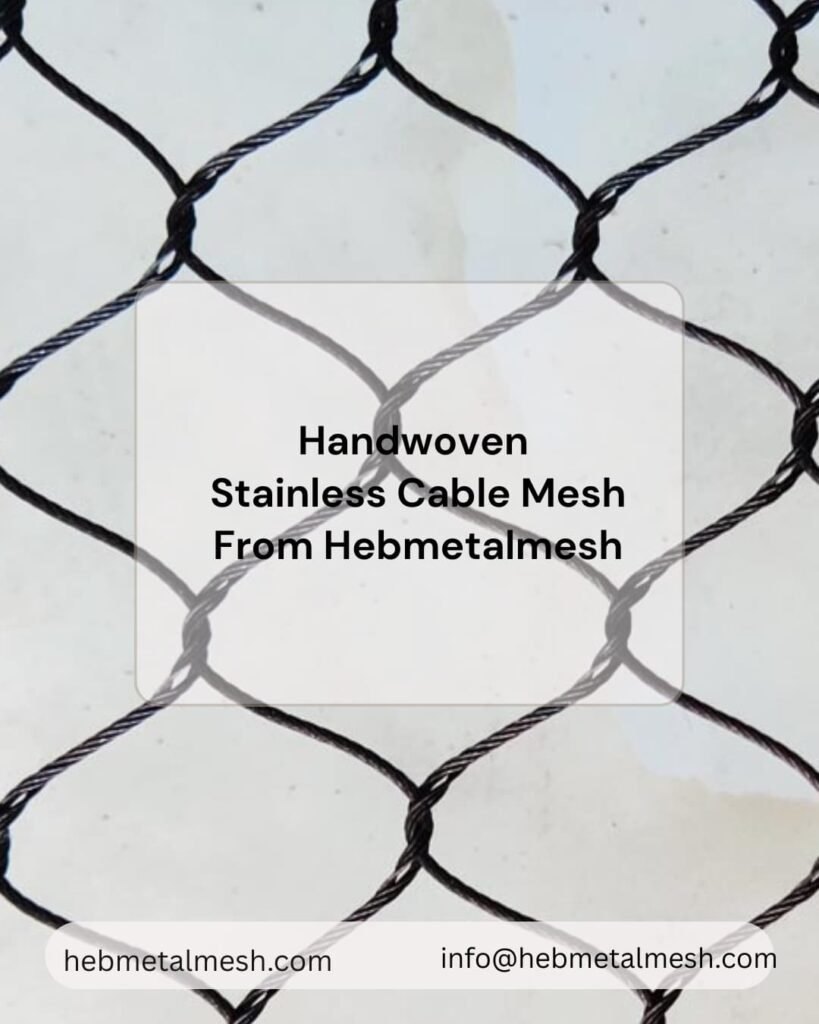
Both sources lead back to the same two specification lines. A hand woven wire mesh in drawn 304 stainless steel offers a smooth round strand with no knots to catch a barb, provided nobody cut it on site and left the end proud; a dark strand in black oxide finish recedes into a shaded background so the panel stops reading as something to push against. Underneath both sits the aperture size question, taken up further down.
If the last two plumage scores are drifting the wrong way, the aperture is the first thing to review rather than the last. Send the species and where the wear sits and we will tell you which strand and which aperture to test first.
Aviary Stress Reduction Is Mostly a Sightline Question
The intuitive argument is that a finer mesh hides the world and stresses the bird. The measurements do not support it. Run the numbers on a square weave and the open fraction is set by aperture against wire, and across the standard combinations the whole useful range sits inside a seven point band.
| Aperture | Wire | Open area | Wires per meter |
| 20 mm | 1.2 mm | 89.0% | 47.2 |
| 25 mm | 1.6 mm | 88.3% | 37.6 |
| 38 mm | 2.0 mm | 90.2% | 25.0 |
| 51 mm | 2.0 mm | 92.6% | 18.9 |
| 76 mm | 2.4 mm | 94.0% | 12.8 |
| 102 mm | 2.4 mm | 95.5% | 9.6 |
Read the last column instead. Between 20 mm and 102 mm the number of strands crossing the bird’s field of view falls by a factor of five, and that, not the open percentage, is what changes how enclosed the space feels. Aviary stress reduction is delivered mostly by that reduction in visual clutter. Aviary natural behavior — flight, sunning, bathing, social spacing — depends on the roof far more than on any wall, because flight and sunning both need vertical clearance, and the specification that supports them is a question about headroom rather than aperture.
Natural Behavior Is Bought in Meters, Not in Millimeters
A bird in an aviary does not fly far, but it flies fast, and the panel is what ends the flight. A 30 gram bird crossing ten meters at 8 m/s carries 0.96 joules. Mean force is that energy divided by the distance over which the panel stops it: 3 mm gives 320 N, 12 mm gives 80 N, 25 mm gives 38 N. Same bird, same speed, a difference of 8.3 times between the stiffest and the softest answer.
No tensile rating captures this. What sets it is span between supports, the tension the installer leaves in the panel, the cable diameter, and whether the mesh deflects as a rope net or resists as a welded grid. The useful question is therefore not how strong the panel is but what it does: ask for the measured deflection at a stated load on a stated span, and a supplier who can answer has tested the product. A stainless steel rope mesh panel is supplied to 9 m by 18 m, 162 square meters in one piece, which lets a nine meter bay run without a horizontal seam at the height where birds actually fly and where seams become catch points.
A Welfare Compliant Aviary Starts With the Aperture
The geometric rule is simple and worth stating exactly, because most of the mistakes live in it. A square aperture of side a passes any rounded body of diameter up to a; its diagonal, though, is 1.41a, so a bird can force a shoulder into a hole it cannot pass through. A 25 mm aperture has a 35 mm diagonal; 102 mm has 144 mm. Aperture is chosen below the smallest body width in the collection, and the diagonal is the number to check against the widest part of that bird.
Three things surprise buyers. Fine mesh is not the heavy option: 20 mm at 1.2 mm strand is 0.85 kg per square meter, lighter than 102 mm at 3.2 mm at 1.21. A 162 square meter panel weighs 137 kg at the fine end and 196 kg at the coarse one. And 102 mm is a four inch hole, not a fine barrier — 76 mm is three inches. The fence panel selection guide sets the tiers out by species body width.
Aviary Welfare Standards Ask for Records, Not Adjectives
An aviary welfare inspection does not begin with a micrometer. It begins with three questions: show me the aviary injury record, tell me when the last plumage score was taken, and tell me what the birds do in the middle of the afternoon. Those three answers are aviary keeper records, and a mesh can only influence them by producing nothing to write down.
This is why aviary welfare standards read as a documentary exercise with a hardware floor underneath. An aviary welfare audit compares your records against the conditions you claim to provide, and a welfare audit for aviaries that turns up an empty injury log with a worn plumage score in the same year is a contradiction an inspector will find in ten minutes. The hardware that passes is not the strongest; it is the one whose welfare outcome can be evidenced — the aperture that produced no entrapments and the strand that left no marks.
Writing the Aviary Welfare Specification
A specification that an inspector, a fabricator and a keeper can all work from fits in five lines, and an aviary welfare specification that cannot be checked on site is a wish. Species, with the smallest body width named. Aperture, with its diagonal. Strand, meaning cable diameter, finish, and a statement that no cut end sits within reach at perch height. Alloy, 304 stainless steel inland and 316 stainless steel wherever chlorides are present, because pitting roughs a strand and a rough strand abrades. And deflection at a stated load on a stated span, which is the line that decides the impact force.
Those five lines travel well. They read the same way for a songbird flight and for the heavier netting technologies used in zoos and aviaries, where the same questions arrive at larger numbers.
Two practical notes close the specification. Aviary-grade panels are commonly quoted in a planning range of $10 to $22 per square meter depending on alloy, strand and aperture, with carnivore-grade work well above that; price the specification against a stated quantity rather than a headline rate. And anything sold simply as bird fence netting should be asked for the same five lines, because a product described only by its width and its price has told you nothing about the bird inside it.
Tell Us the Species and the Span
Send the smallest species’ body width, the bay span and the height, and we can return an aperture, a wire diameter and a deflection figure in one reply. Talk to the mesh team before the structure is drawn, not after.
FAQ
No, and it is often worse. At 20 mm aperture, going from 1.2 mm to 1.6 mm strand takes open area from 89.0 to 85.7 percent and the mass from 0.85 to 1.48 kg per square meter; the stiffer strand also shortens the stopping distance, which raises impact force. Heavier wire buys span and wind load, not welfare.
Twice a year, in the same month, by the same person, on the same birds. The number matters less than the direction of travel between the two readings, and a score taken after a problem is noticed cannot tell you when it started.
Only if the flight line is clear. A ten meter aviary with a five meter obstruction behaves like a five meter aviary, and volume drawn on a plan is not volume a bird can fly through.
Specify to the smallest species for aperture and the largest for wire diameter and span. When the two answers conflict the aperture wins, because entrapment cannot be undone.