
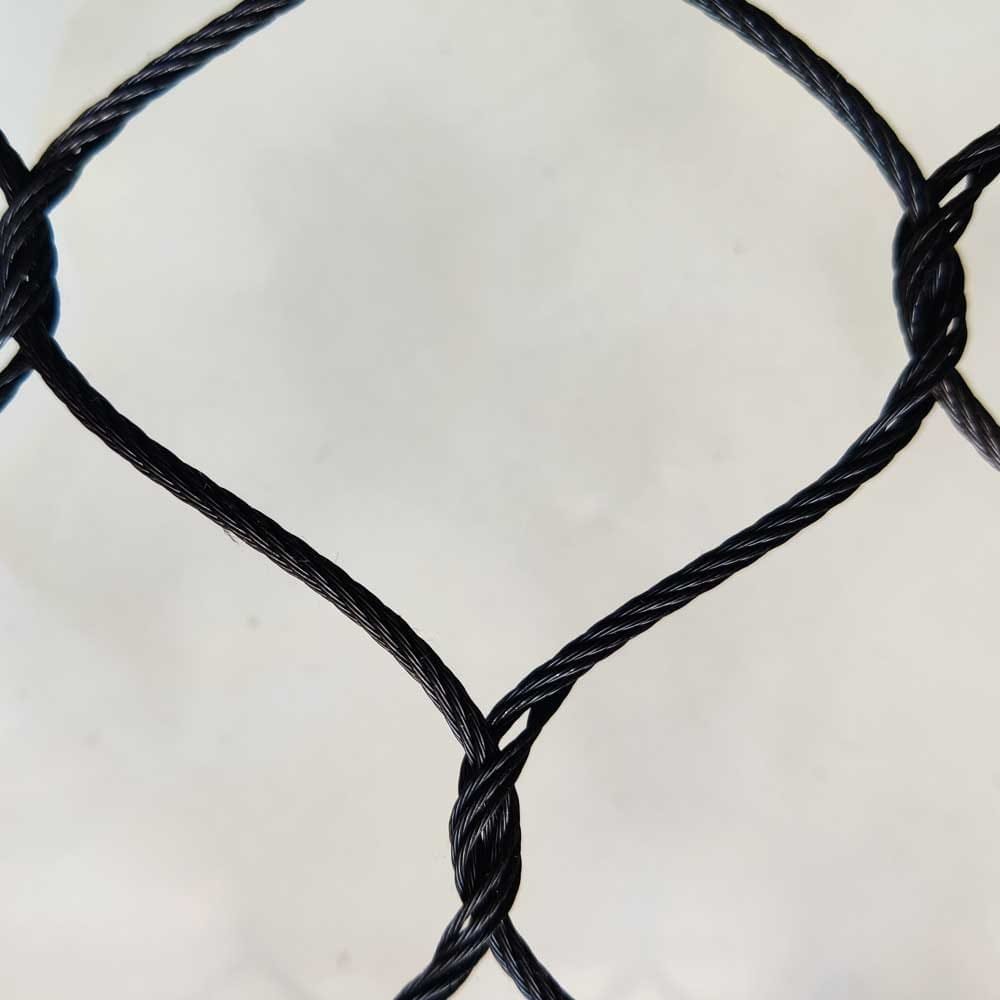
Mesh coating types decide almost everything a buyer notices later: how a panel looks in its first summer, how it looks in its fifteenth, and whether a damaged surface can be repaired at all. Every coated mesh is only as good as the bond between coating and core, and that bond is settled at the factory long before the roll reaches a site. This guide sets out what vinyl, polyethylene, powder coating and a black oxide finish each do to the metal beneath them, and where a handwoven stainless steel panel stops being an upgrade and becomes the only specification that makes sense.
Executive Summary
Mesh coating types divide into two families that behave nothing alike. The first three — vinyl coated mesh over galvanized steel wire, polyethylene netting, and powder coated mesh — all seal a lower-grade core behind a barrier. They are inexpensive and each fails the same way: the barrier is scratched, cut or weathered through, the core is exposed, and the corrosion that follows cannot be hidden. The fourth is not a coating in that sense. A handwoven stainless steel panel in 304 stainless steel or 316 stainless steel carries its corrosion resistance in the alloy itself, and its color comes from a black oxide finish that converts the surface rather than sitting on top of it. That difference sets the practical numbers. Vinyl and plastic screens commonly last three to seven years in full sun, powder coated mesh ten to fifteen, and a correctly specified stainless panel thirty years or more with no recoating — which means mesh coating types price very differently across a service life even when the first invoice looks similar. The reference specification is the animal fence mesh product page.
Comparing coatings before you specify a fence or a screen?
Send the application, the exposure of the site and the number of years the panel has to last. We will reply with the coating or finish that fits, the grade behind it, and a planning range per square meter.
Request a mesh coating comparisonQuick Answer:
Mesh coating types are best judged by what happens when the coating is breached. Vinyl and PVC over galvanized steel wire, and polyethylene netting, are surface layers: they resist weather until they are scratched, cut or degraded by ultraviolet light, after which the metal underneath corrodes and the damage cannot be hidden. Powder coated mesh is a harder, chemically bonded film that resists chipping far better but still exposes metal at a deep scratch. A black oxide finish converts the stainless surface itself, so there is no layer to peel and the panel is cleaned rather than recoated. Choose a coated mesh where the panel is temporary and expected to be replaced; choose handwoven stainless steel where the fence or screen must look the same in year twenty.
Key Takeaways
- Every coated mesh is a core plus a barrier; the barrier only delays corrosion, it does not prevent it once breached.
- Polyethylene netting has no metal core at all, which is why it never rusts and never lasts.
- Powder coating is the best of the applied finishes because it is baked and chemically bonded, not merely dipped.
- A black oxide finish is a conversion of stainless steel, so there is nothing to chip, flake or touch up.
- Price the four families per year of service, not per roll, or the cheapest option will always look correct.
Coating performance is measured rather than claimed. The Powder Coating Institute describes a process in which powder is sprayed electrostatically and cured in an oven, so that the coating “chemically reacts to produce long molecular chains”, and reports that powder coated products “are more resistant to diminished coating quality as a result of impact, moisture, chemicals, ultraviolet light, and other extreme weather conditions.” The Powder Coating Institute explainer on what powder coating is is worth reading beside this section.
What Mesh Coating Types Actually Decide
A coating is not decoration laid over a finished product; on three of the four families it is the entire corrosion strategy. A galvanized core under vinyl has already been given a zinc layer, and the vinyl or PVC above it adds a second, thicker shield against weather and salt. Polyethylene netting has no metal core at all, so its only defense is the ultraviolet stabilizer mixed into the polymer. Powder coating bonds to the metal in an oven after an electrostatic spray, which is why it survives impact that would flake a dipped film. Failure then follows the same route in every case: once the barrier is breached, the material underneath is on its own. Mesh coating types explained honestly always return to that one test. It is also why the core and the way it is joined matter as much as the finish, because a welded versus woven mesh behaves differently under a scratch: a welded mesh grid concentrates stress at its junctions, while a woven panel spreads it along the wire.
Mesh Coating Types Comparison: Four Families Side by Side
Set the four families next to each other and the mesh coating types comparison stops being a matter of taste. A vinyl coated mesh is galvanized steel wire welded into a grid and then dipped or sprayed with PVC; it is the cheapest option on the shelf, sold in 1 inch and 2 inch openings, and it performs well only while the coating stays whole. Polyethylene netting removes the metal entirely — it is knitted from UV-stabilized plastic, weighs almost nothing, and tears or goes brittle after a few seasons. Powder coated mesh is prepared, sprayed with an electrostatically charged powder and baked so the film bonds chemically to the metal; the result is uniform, harder and far more chip-resistant. Mesh woven from 304 stainless steel cable, with its color produced by a black oxide finish, has no layer to scratch, no zinc to deplete and no plastic to embrittle. The mesh coating types pros and cons are therefore short: three families trade a lower first price for a shorter life, and the fourth trades a higher first price for a surface that can be cleaned rather than replaced. The black oxide finish applied to zoo mesh shows what that looks like on a finished panel.
Mesh Coating Types Durability and Lifespan
Durability is not one property but three, and mesh coating types durability should be read as the weakest of them. Mechanical damage — a strimmer, a gate, a torn branch — ends a vinyl coating, because a chip that reaches bare steel starts corrosion that creeps under the intact film, invisible until it is expensive. Ultraviolet exposure is the second route, and it ends polyethylene netting long before the structure fails: the polymer loses its plasticizer, hardens and splits. Chemical and salt attack is the third, and it finishes off a galvanized core once its zinc has been consumed. Mesh coating types lifespan therefore depends on exposure more than on the thickness of the film. Inland, a well-made powder coat holds its appearance for ten to fifteen years, a vinyl-coated panel for three to seven, and a plastic screen for two to four. Move the same products to a coast and the order does not change but the numbers fall. Where a panel has to outlast the building, only 316 stainless steel answers, because its molybdenum resists the pitting that chlorides start — the case set out in the notes on black metal mesh in long-service applications.
Mesh Coating Types for Coastal Areas and Sun Exposure
Two sites punish a coating faster than anywhere else. On mesh coating types for coastal areas the enemy is chloride: salt carried in spray settles on the surface, holds a film of electrolyte against the metal and drives pitting wherever the coating has been breached. A galvanized core there loses its protective zinc at a rate that rises with airborne salinity, and a vinyl film hides the loss until the whole panel is unsightly. Mesh coating types sun exposure is a different problem with a similar outcome. Ultraviolet light attacks the polymer itself, so a polyethylene screen that looks sound in spring can crack across a full panel by autumn, and dark powder coatings age faster because a black surface absorbs more heat. Either exposure is survivable if it is planned for. A mild-climate specification will not do on a beachfront; the alloy has to hold the duty, and the honest way to budget for it is to price replacement rather than repair — the numbers for animal fence and containment netting make that trade visible.
Mesh Coating Types for Fences, Gardens, Screens and Privacy Screens
Application settles the answer more often than budget does. For mesh coating types for fences — the perimeter run that has to hold a line for twenty meters and take the occasional impact — powder coating is the sensible middle, and a stainless panel is the only option that survives a coastal boundary without annual attention. Mesh coating types for gardens are usually a shorter commitment: a trellis, a compost bay or a bird barrier that a sharp tool will reach, so a vinyl-coated grid at a modest cost per square meter is often enough, provided nobody expects it to look new in five years. Mesh coating types for screens and mesh coating types for privacy screens sit in the same family, where the plastic option keeps one genuine advantage: a lightweight polyethylene sheet can be tied over an existing chain link fence in an afternoon. The catch is that it fades, sags and tears along the ties. Mesh coating types maintenance follows from that: a stainless panel wants a rinse and an occasional check on tension, while a coated panel wants the opposite — that nothing ever touches it. The maintenance routine for stainless steel wire rope mesh is shorter than most buyers expect.
Mesh Coating Types Cost, Maintenance and Selection Guide
Mesh coating types cost has to be read as cost per year of service, not cost per roll. On a first invoice the order is predictable: polyethylene netting is cheapest, vinyl over galvanized steel follows, powder coating costs noticeably more, and handwoven stainless steel sits at the top. Across a service life the ranking reverses, because the cheap families are replaced and the expensive one is not. A privacy screen that lasts three summers has to be bought and refitted seven times in twenty-one years. A mesh coating types selection guide that ignores that labor will approve the wrong product every time, so write the duty first — containment, screening, fall protection or decoration — then the exposure, then the number of years the panel must last, and only then price it. The fixings should outlast the panel rather than dictate its replacement, and the finish should never be the only thing standing between the metal and the weather. Handwoven stainless steel answers both at once, which is why it is the animal fence mesh range we build rather than a coating we apply.
Still weighing a coated roll against a stainless panel? Send the application, the site exposure and the years the panel must last, and our engineers will return the coating or finish that fits, with a planning range per square meter — contact the team.
Frequently Asked Questions
Polyethylene netting is the shortest-lived of the four, usually two to four summers, because ultraviolet light attacks the polymer directly. Powder coated mesh holds ten to fifteen years where the film is not cut through. A stainless panel with a black oxide finish outlasts both, because its weather resistance belongs to the alloy.
Only up to the point where it stays unbroken. Coating thickness adds years until the first deep scratch, but once the barrier is cut the corrosion begins from the inside. The grade of the core matters more than the millimeters of coating above it.
Not inland, and not on most town sites. 316 stainless steel earns its price where chlorides are present: coastal air, pool surrounds, seawater splash and roads salted in winter. Away from those, 304 stainless steel gives the same appearance life for less.
Sometimes, though rarely invisibly. A small chip in a powder coat can be touched up with matching paint, which stops the corrosion even though the repair stays visible. Vinyl and PVC behave worse, because the film lifts around the damage and lets water track underneath. A black oxide finish needs no repair of that kind.
Because it replaces the mechanism instead of improving it. The other three families protect a core by sealing it, so their life is set by the integrity of a film. Stainless steel protects itself through a passive layer that reforms in air, and a black oxide finish only changes how the surface looks. Nothing has to stay intact for the panel to keep working.