
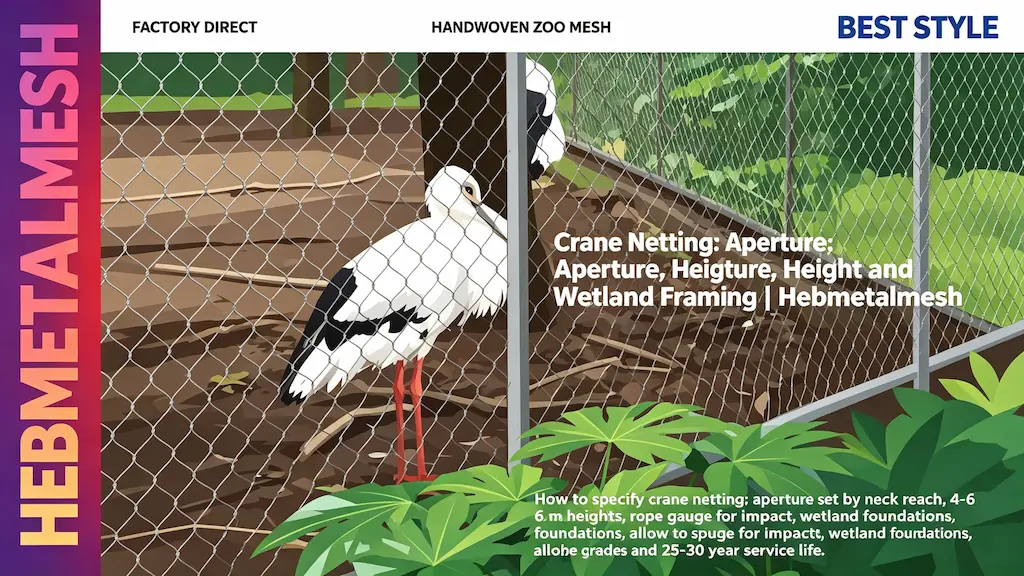
Cranes are the hardest large birds to house well, and the reason is geometry rather than strength. A sarus crane stands close to 1.8 m, carries a 2.4 m wingspan, and ends in a straight bill it uses as a spear — not to break the barrier, but to reach through it. Most failures in zoo crane netting are not tears. They are a bird that learned it could push its neck through an aperture and strike a keeper walking past outside, and a fence specified by body weight when the controlling dimension was neck length.
Executive Summary
Talk to an enclosure engineer before you fix the fence line. Send your species list, plan dimensions, pool layout, and site climate — we will return a marked-up specification with codes, break forces, and a budget price. Contact Hebmetalmesh
Crane netting has three jobs, and only one is containment: keeping the bird in; keeping the bill in, since an aperture that refuses a skull will still pass a neck and a neck ends in a weapon; and absorbing impact, because cranes take off with a run and hit the boundary at speed. A rigid panel returns that energy to the bird; a tensioned hand-woven panel absorbs it.
The specification that satisfies all three is a small aperture at a modest gauge, hung full height in one piece, on a frame built for soft, wet ground.
Quick Answer:
Crane netting — stainless crane netting in practice — is a flexible stainless steel wire rope mesh for tall, open aviaries holding wading birds of the family Gruidae. For most species the working aperture is 38 mm, small enough to refuse a neck and bill and large enough to disappear at viewing distance, on 2.0 mm or 2.4 mm rope in SS304 or SS316. Enclosure height runs 4–6 m so birds can fly, with the top closed or fitted with a 600–900 mm inward overhang. Tensioned correctly, it lasts 25–30 years.
Key Takeaways
- The bill sets the aperture, not the body. A crane does not need to fit through a gap to hurt someone; it needs to fit its neck.
- Height is a welfare requirement. A crane that cannot fly is compromised.
- Impact is the failure mode. Birds hit the net at speed; a flexible panel absorbs what a welded one returns.
- Wetlands move the posts, not the mesh. Soft substrate and frost heave deform a crane aviary.
- Gauge buys stiffness, not strength. Even 2.0 mm rope is stronger than any crane needs.
- Grade is a site decision. SS316 for coastal and chlorinated washdown; SS304 inland.
What a crane actually does to a fence
Fifteen species make up the family Gruidae, ranging from the 90 cm Demoiselle crane to the sarus crane, the tallest flying bird on earth. They share a body plan that dictates the enclosure: a leg span that carries the body clear of shallow water, a long neck, a long straight bill, and large wings on a heavy frame.
The bill is a spear. Cranes stab rather than bite — they lack the hooked, levering beak of a psittacine and drive a straight dagger forward at whatever startles them. A crane at the fence can extend its neck a surprising distance, and the strike lands well outside the barrier line. This is the most under-specified dimension in crane housing: the aperture that stops the skull does not stop the neck.
The wings strike. A startled or territorial crane goes up on its toes and delivers a double wing strike; on a 2.4 m span the tips arrive with real momentum, and the mesh has to give.
They fly badly in a small space. Cranes need a run-up to get airborne. Where an enclosure is too small for one, a startled bird accelerates along the ground and meets the boundary still climbing — a flight startle impact at the point of least control. That is why a wetland exhibit needs volume, not just area.
Aperture: the neck is the controlling dimension
Crane netting aperture is usually quoted as a body-containment figure, which is the wrong starting point. A 38 mm opening will not pass the skull of any adult crane, and that genuinely keeps the bird in. But a crane neck is slender and highly mobile, and a bird that can push its head through to the shoulder reaches 300–400 mm beyond the fence line and strikes.
Aviary for cranes mesh is normally 38 mm: it refuses the skull, limits the bill to a nudge, and reads as almost invisible beyond five or six metres. Enclosure for cranes mesh in holding pens, quarantine, and walk-through exhibits runs tighter at 25 mm, which also blocks the predators that take eggs. Openings of 51 mm and above belong on the outer face of a double-skin system, not as a primary crane aperture.
If the budget allows one change, take the smaller aperture rather than the heavier rope: no rope diameter fixes a neck-length problem.
Rope gauge: buy stiffness, not strength
Crane netting grade and gauge interact, and buyers over-specify the second because they think about strength. A large sarus crane weighs perhaps 8–12 kg, while break loads run roughly 4.4 kN at 2.4 mm rope and 7 kN at 3.2 mm — absurd margin against a 12 kg bird. Tensile failure is not how a crane enclosure fails.
What gauge buys is stiffness over a tall span, abrasion life against bill rubbing, and deflection control under a wing strike. Use 2.0 mm for the smaller Gruidae and 2.4 mm for the large ones; reserve 3.2 mm for mixed exhibits holding primates. Heavier rope darkens the sightline, which is the real cost — 3.2 mm at 38 mm aperture is visibly a fence.
| Species group | Standing height | Aperture | Rope Ø | Code |
| Demoiselle, Blue | 0.9–1.1 m | 25 mm | 1.6 mm | HM1625 |
| Grey crowned, Wattled | 1.0–1.1 m | 25–38 mm | 1.6–2.0 mm | HM1625 / HM2038 |
| Red-crowned, Common, Whooping | 1.4–1.6 m | 38 mm | 2.0 mm | HM2038 |
| Sarus, Siberian, Sandhill | 1.5–1.8 m | 38 mm | 2.4 mm | HM2438 |
| Mixed wetland with primates | — | 38 mm | 3.2 mm | HM3238 |
Every code above appears in the crane aviary mesh range with its break force. Our stainless steel rope mesh for parrot aviaries covers the same trade-off from the opposite direction: parrot work is driven by chew resistance, crane work by reach and impact.
Height and top treatment
Crane netting height is a welfare question before a security one. A crane that cannot fly has compromised muscle, balance, and longevity, so the minimum useful height is set by flight. 4 m is the practical floor for a holding pen; 5–6 m is the norm for display aviaries holding the mid and large Gruidae. Above 6 m is worth it only where the plan allows a real flight path — height without volume just produces a taller wall to hit.
The top is where projects economise wrongly. Either close it with the same mesh, or fit a 600–900 mm inward overhang for pinioned or habituated birds. An open top with no overhang does not work: cranes do not climb, but they launch, and a vertical lip is where a startled bird goes.
Wetlands move the frame, not the mesh
Nearly every crane enclosure is a wetland exhibit, and water is what deforms it. Soft substrate from a wading pool keeps the ground behind the fence line saturated most of the year, and shallow-set posts lean. Frost heave lifts anything with a shallow footing — 20 mm a year is invisible in month one and obvious in year five. Seasonal pool management cycles bearing capacity too.
The mesh is indifferent to all of it: stainless rope does not rot, absorb water, or care about freeze-thaw. What suffers is geometry, and a crane yard mesh panel gone slack develops the pocket a bird catches a leg or wing in. Found the frame below the soft layer, run the fence line outside the wet zone, and re-tension at twelve months.
Inside the net, most of the pool should be a shallow shelf at 100–300 mm over a soft substrate the birds can probe, with one deeper zone at 600–900 mm as a refuge. Set the shelf against the standing height of the species: a crane that can stand is calm, one that has to swim is stressed. Keep deep water away from the perimeter.
Alloy: a site decision
Crane netting grade is chosen on the site, not the species. SS304, roughly 18% chromium and 8% nickel, suits inland and temperate exhibits. SS316 adds molybdenum, typically 2–3%, and resists chloride pitting in coastal sites, tropical humidity, and chlorinated washdown.
Wetland exhibits deserve a second look: standing water is not seawater, but a humid enclosure with a chlorinated top-up and poor air movement is harsher than an open inland paddock, and pitting is section loss rather than a stain. The full comparison is in our 304 vs 316 mesh guide. Avoid galvanized wire outright: cranes pick at the mesh, and zinc is a cumulative toxin in birds.
Panel size and custom weaving
Custom crane netting is the default rather than an upgrade. Panels are woven to the exhibit rather than cut from stock and run up to about 9 m by 18 m in one piece, so a full-height face hangs as a single panel with no horizontal joint. That matters more here than for most birds: a joint at 2 m is a ledge, and a tall bird meets it at chest height.
Crane netting size is therefore quoted as finished panel dimensions rather than roll width, and a panel made to your dimensions carries no offcut — cutting from stock leaves a border and offcuts you paid for. A crane netting specification has six lines, and a crane netting supplier should quote from them without a round of questions: alloy grade, rope diameter, aperture, panel dimensions, edge treatment, and fitting alloy.
Installation and tension
Crane netting installation follows a fixed order. Brace the frame plumb. Hang the field slack — never pull tight on the first pass — then work outward from the centre of each run so the geometry evens up. Tension the perimeter cable, then the field, then re-tension at twelve months.
Crane netting tension is set by feel and by intent. Too slack and the panel sags into a pocket where a wing catches; too tight and you preload the rope until it stops absorbing impact. Aim for a face that deflects under a firm push and returns flat. Fittings must be in the same alloy family as the rope: a stainless panel hung with galvanized clamps has installed a five-year component inside a thirty-year barrier.
Cost and lifespan
Crane netting price tracks kilograms of stainless per square metre, which tracks rope diameter against aperture. A 1.6 mm rope at 25 mm is a light panel; 2.4 mm at 38 mm is roughly double the steel. Planning ranges for avian work land around $10–22 per square metre, with tall crane enclosures mid-band — the aperture is fine but the height means many square metres per linear metre.
Two items belong in the budget and usually are not: the sample panel, and the first-year re-tension. Skipping the first is how a project discovers an aperture problem after installation.
Crane netting lifespan is 25–30 years, and maintenance is washing once or twice a year plus tension checks; there is no coating to renew. Our bird exhibit mesh guide sets out the same arithmetic across the wider collection.
Where cranes sit in a bird collection
Start from the water: fix the pool, shelf depths, and drainage, run the fence line outside the wet zone, then size the net to the neck. That order costs nothing and avoids the two mistakes that are expensive to correct later — a fence that leans, and an aperture that reaches. The crane aviary mesh catalogue lists every code and break force, and the bird netting page covers the rest of the collection.
Frequently Asked Questions
38 mm for most species — it refuses the skull and limits the bill. Use 25 mm where keepers work close to the mesh or where ground-nesting birds share the footprint. The controlling dimension is the neck.
Yes, with a 600–900 mm inward overhang and pinioned birds. Close it for fully winged or predator-exposed stock.
SS304 inland and temperate; SS316 near the coast, in tropical humidity, or with chlorinated washdown. Never galvanized.
Yes. Break loads run roughly 4.4 kN at 2.4 mm and 7 kN at 3.2 mm; against a 12 kg bird the margin is enormous. Impact, reach, and abrasion are the failure modes, not tension.
25–30 years, with washing once or twice a year and periodic re-tensioning. No coating to renew.
Get a marked-up specification for your crane enclosure. Send the species list, plan dimensions, pool layout, and site climate. We will return codes, break forces, panel sizes, and a delivered price — no obligation. Request a quote from Hebmetalmesh
Hebmetalmesh weaves hand-woven stainless steel rope mesh to order for zoos, aviaries, and wildlife facilities. Conservation guidance referenced in institutional specification work is published by the International Union for Conservation of Nature.