
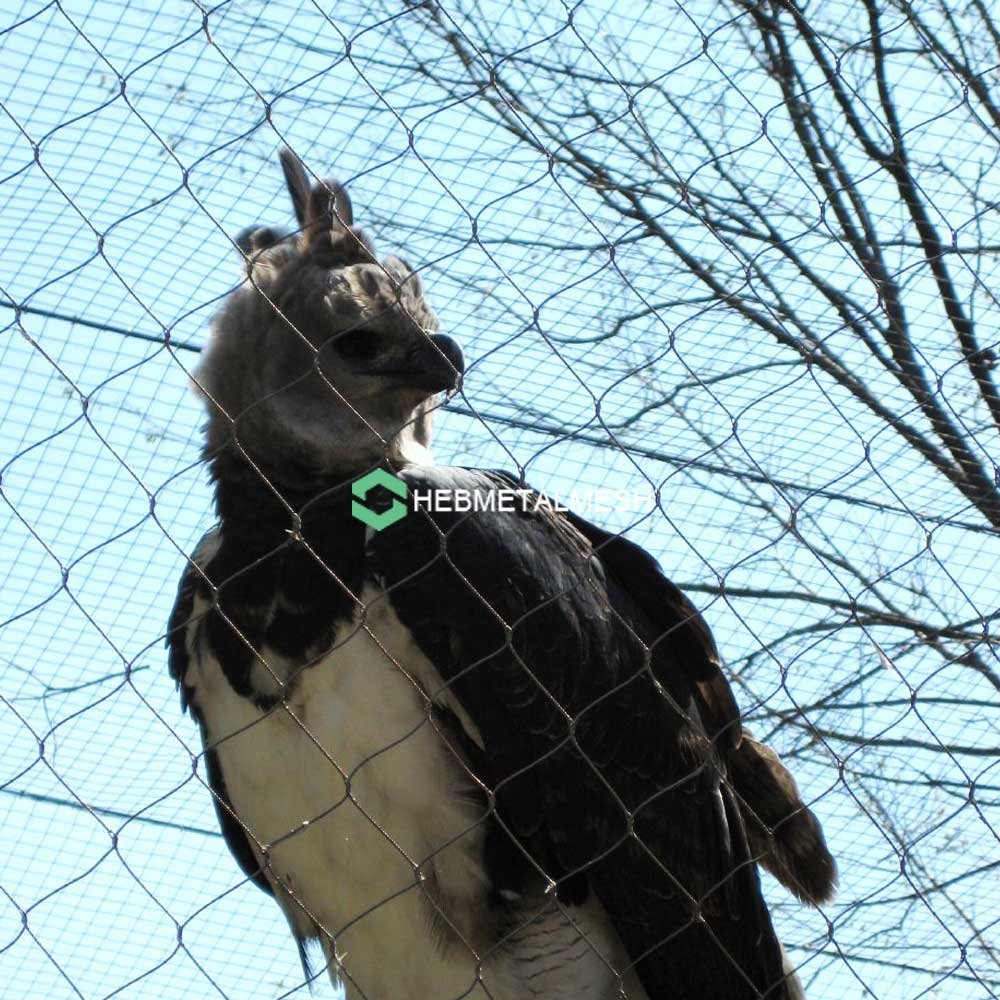
Poultry biosecurity netting is a contact barrier, and that is the whole of its job. A stainless flight net over a range stops a wild bird from physically reaching the flock. It does not sterilize the air, the litter or the feed line. Once that limit is written down, three numbers decide the job: an aperture small enough for the smallest carrier in the district, a rope heavy enough to survive a predator and thirty winters, and a boundary detailed so nothing digs under it. Grade, finish and panel size follow from those three.
Executive Summary
A flight net is bought for two reasons that are usually confused. The first is exclusion, a physical fact: if the opening is smaller than the bird, the bird stays outside. The second is disease separation for flocks, a claim about contact routes, and a net closes only some of them. A mesh roof stops wild birds perching on the feed line and mixing with the flock at ground level, removing the direct route that wild bird disease transmission depends on. It does not stop a dropping falling through the weave from a bird sitting on the net, and it does not stop a person, a feed sack or a puddle carrying the same pathogen in. Specify it as the contact layer of a plan rather than the plan itself: 25 mm aperture to hold out sparrows and starlings, 2.0 mm rope on any span a fox can reach, 316 stainless where litter stays wet. The reference specification is the bird netting product page.
Netting a range and unsure what the mesh must exclude?
Send the birds you keep, the predators you have and the span to cover, and we will return an aperture, a rope diameter and an edge detail that match the job.
Quick Answer:
Does netting a range protect a flock from avian influenza? It removes the physical contact route and nothing else. A 25 mm stainless aperture keeps sparrows, starlings and other small passerines out of the run; waterfowl and gulls are too large to enter but can still land on the net, and their droppings pass through the weave. So a net is the right instrument for wild bird carrier exclusion at the boundary, while a solid roof or a covered feed line answers contamination from above. Specify 25 mm aperture and 2.0 mm rope for a free range flock protection job, 316 grade wherever litter stays wet, and a buried apron against anything that digs.
Key Takeaways
- A net is a contact barrier. It stops birds meeting. It does not stop pathogens traveling on air, water, boots or feed.
- Aperture follows the smallest carrier, not the largest animal. A run sized for a goose is useless against a sparrow if the opening is 50 mm.
- Droppings pass straight through. A bird roosting on the mesh deposits above the flock, so a covered feed line matters as much as the roof.
- Grade follows the litter, not the sky. Ammonia, wet bedding and chlorine disinfectant do more to stainless on a farm than rain will.
- Regulators treat it as one control among several. The European Food Safety Authority assesses avian influenza in poultry as a multi-route problem, which is why a housing order netting requirement is written around separation rather than around one device.
Why Aperture, Not Strength, Decides a Poultry Net
A farm fence answers the question “can the animal get out?” A net over a range answers a different one: “can the wrong animal get in, and what does it leave behind?” A containment mesh that doubles as biosecurity mesh is sized on the animal outside, because the value of the barrier is set by the width of the smallest creature it must refuse. A flock does not need a stronger roof because it is a flock; it needs a tighter one because a sparrow is small.
What Aperture Excludes Which Wild Bird
Aperture is the line on the order that decides whether the net does its job. Standard stainless rope mesh is woven in a diamond pattern with openings from 20 mm to 102 mm.
| Aperture | Field verdict |
| 20 mm | Refuses finches and the smallest passerines |
| 25 mm | The poultry default: holds out sparrows, starlings and pigeons |
| 38 mm | Refuses pigeons and larger perching birds only |
| 50 mm | Down to a hawk screen; no exclusion value against sparrows |
| 76 to 102 mm | Structural duty only |
The trap is that a poultry house netting order is usually written by panel size, because that is what must be lifted onto the frame, and aperture is treated as a detail. A poultry run mesh is bought the same way, and a 50 mm roof ends up over a free range unit because it was in stock.
The Gap Between Contact and Contamination
Disease enters a flock by routes, not by one route, and a net closes exactly one. Direct contact is the route it closes: a wild bird landing on the feed trough, drinking from the same line, or walking through the run. That is the route a net is genuinely good at removing.
The routes it leaves open are the ones a farmer assumes it has handled. A dropping from a bird sitting on the mesh is roughly 10 to 20 mm across, so a 25 mm weave does not catch it. Cover the feed line as well as the run, and treat everything crossing the boundary as a potential carrier. A page on biosecurity for enclosed bird collections works the same logic where the pressure is collection-to-collection contact rather than wild flocks.
Predator Detail: Where Poultry Runs Actually Fail
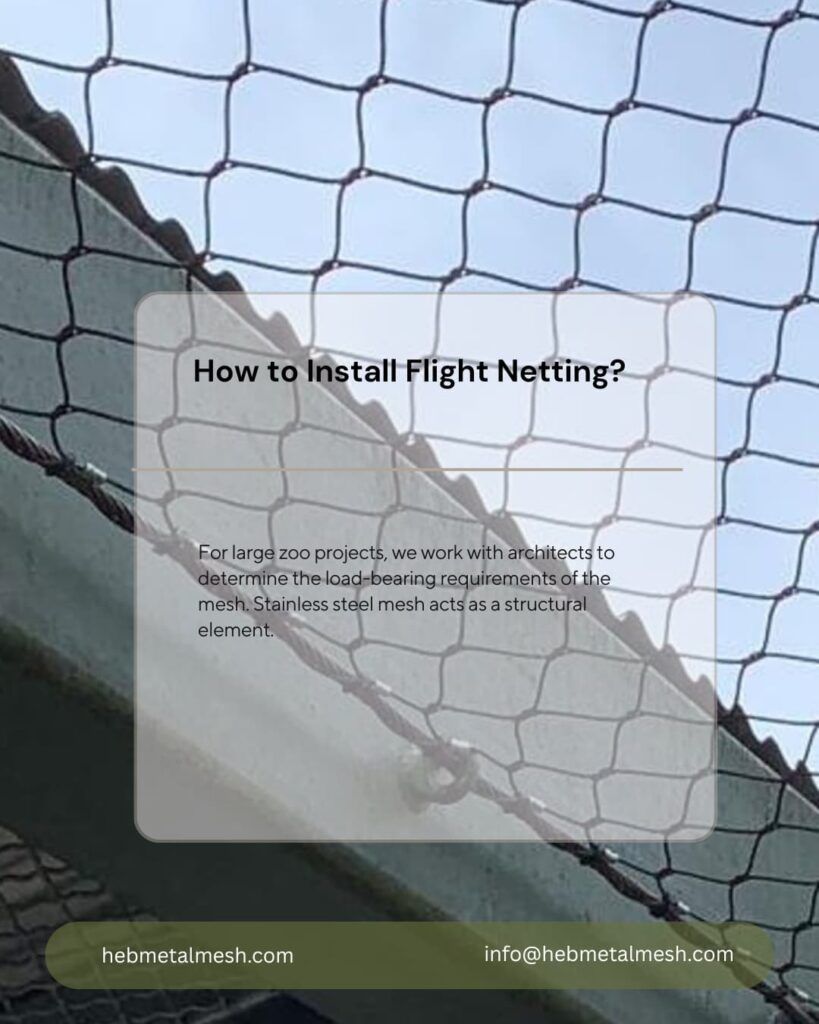
Netting is rarely defeated through the panel. It is defeated at the boundary, and usually below ground. A fox, a badger, a marten or a raccoon tests the base of a run long before it tests the roof. Two details solve that. Extend the mesh 300 mm below grade and backfill, so a dig meets fabric rather than open edge. Or turn 600 mm of mesh outward along the ground and pin it, so the digging starts outside the run.
Above ground the panel survives two kinds of load. A predator pushes and claws at the low band, which is why the bottom 600 mm of a predator proof poultry run is upgraded rather than extended. A hawk or an owl arrives as an impact, which a rigid grid handles badly: the weld concentrates the load at a fused point, while a woven panel lets it travel along the strands to the frame.
Snow, Wind and the Porosity That Saves the Frame
A net roof is not a solid roof, and that is its greatest structural advantage. A woven stainless panel runs 88 to 94 percent open, so wind passes through rather than loading it.
Snow is the counter-case. Dry powder sheds through the weave, but wet snow bridges the openings and then loads the panel as though it were solid. Two numbers settle that at design stage: the snow load assumed for the site, and the pitch of the supports.
The same porosity carries a ventilation argument. A flock under a netted range in summer is still effectively outdoors, so heat and ammonia leave with the air. That is why a net is a legitimate answer to a free range housing order in a warm climate, and a poor one where birds must be held under a solid structure through a notifiable disease event.
Grade and Finish for a Working Farm
Grade 304 stainless contains 18 percent chromium and 8 percent nickel and is the correct default for an inland site with dry litter. The chemistry that attacks stainless on a poultry unit comes from inside: ammonia from litter, and chlorine-releasing disinfectants used at every turnaround. Both attack the passive layer, fastest in the crevices where strands cross.
Grade 316 adds molybdenum and is the right choice within a few kilometers of the coast, on any unit that washes down often, and anywhere litter stays wet.
Finish is a farm decision: natural silver reads as industrial and suits an off-show yard, while black oxide cuts glare and is standard on aviary work. Rope diameter follows span and predator rather than bird: 1.2 mm and 1.6 mm for small covered runs, 2.0 mm as the working diameter for a stocked range, 3.2 mm on long spans and in fox and badger country. Whether that rope should be woven or welded is a separate question, set out in a comparison of welded and woven construction.
Three Flocks, Three Different Nets
The word “poultry” covers three jobs that share almost no specification.
A small flock biosecurity job is a backyard run installed by the owner. Here 25 mm aperture and 1.2 to 1.6 mm rope are enough, and the priority is a panel light enough to lift and an edge detail simple enough to tension by hand. An outdoor poultry enclosure at this size is usually a single panel, and the failure mode is a gap at a corner rather than a torn roof.
A game bird release pen or a breeding unit is a different animal: taller, walked through by staff, and judged on how it holds a bird that flies. Here 2.0 mm rope and 25 to 38 mm aperture are typical, and the boundary must survive both a predator and a bird hitting the far wall. A breeding flock protection job adds a further requirement, because breeding stock is the most valuable animal on the site and the least replaceable after a disease event.
A commercial flock mesh installation is an engineering project. Panels are supplied up to 9 m by 18 m, so a roof is a handful of pieces rather than a hundred, and the support grid, not the mesh, is what the design is really about.
What to Write on the Specification
A netting specification is short, and if the four lines below are complete the panel, the fixings and the frame all follow.
- Aperture, set by the smallest wild carrier rather than the flock: 25 mm is the poultry default.
- Rope diameter, set by span and predator: 2.0 mm minimum on a stocked range, 3.2 mm on long spans or where digging predators are present.
- Grade, set by site chemistry: 304 inland and dry, 316 near salt, under frequent washdown or over wet litter.
- Boundary detail, set by the predator: a 300 mm buried skirt, a 600 mm pinned apron, or both.
Then add support pitch, snow load and the panel’s sag allowance. Standard stock maps onto those lines more often than not: HM1220 covers light runs at 1.2 mm over 20 mm, HM1625 the small-flock case, HM2076 and HM3276 the stocked range and the predator-heavy site, HM32102 the long spans. As a planning range, aviary-grade material runs $10 to $22 per square meter and heavier grades $20 to $38, with fixings and edge cable adding 10 to 20 percent. The reference specification for the material is the bird netting product page.
Frequently Asked Questions
It refuses sparrows, starlings, pigeons and most perching birds, which are the carriers that matter on most units. It is not a barrier against waterfowl or gulls, which cannot enter but can settle on the net itself. If those are the local risk, cover the feed line too.
No, and no single device does. Avian influenza flock protection is a plan with several layers, and the net is the contact layer. It does not remove contaminated droppings from above, aerosol or water. Where a housing order is in force the competent authority decides whether a netted range counts as separation or whether the flock must be under a solid roof.
Not when the aperture suits the bird and the weave is dressed smooth. The failure to avoid is a small flock behind a wide aperture, where a bird pushes its head through and cannot withdraw it. Where birds fly hard into a boundary, a flexible panel is gentler than a rigid grid, because the impact spreads along the strands.
A handwoven stainless panel is measured in decades, is unaffected by ultraviolet light, and cannot be chewed through by rodents. A plastic roof typically needs replacing within a decade, and each replacement is a new boundary to reseal. Sites that also deal with problem birds around buildings use the same rural bird control approach at the yard and at the run.
Planning a net over a range or a run? Send the species, the predators and the area to cover, and we will return the aperture, the rope diameter and the boundary detail. Talk to a specification engineer before you order.