
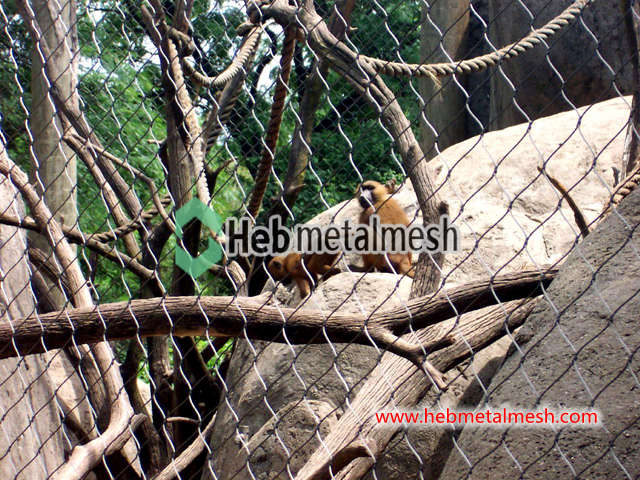
Most animal fence specifications are written from the outside in. They begin with what has to be kept in, add a margin, and finish with a mesh panel. That order answers the containment question properly and the animal’s question not at all, because a barrier that holds an animal perfectly can still leave it in a space where it cannot climb, cannot watch the keeper coming, cannot get out of the afternoon sun, and cannot be cleaned without stripping the fittings off the frame. A species appropriate enclosure is specified the other way round. Describe the resident’s life first and let the mesh follow from it.
Executive Summary
Every enclosure carries two briefs, and most projects only ever write one of them. The containment brief asks what happens if the animal gets out; it sets height, opening size and cable strength, and the industry understands it well. The habitat brief asks what the animal does with the same four walls for the twenty or thirty years it lives there, and it sets a different set of numbers: how much of the panel stays open so the space reads as sky rather than as a wall, where a climbing structure can be fixed, how light and air move through the mesh, and where a keeper can work without entering the compound. Satisfying both briefs costs no more than satisfying one. It simply means reading the resident before reading the threat.
The reference specification is the animal fence mesh product page.
Quick Answer:
A species appropriate enclosure is designed by describing the animal’s day before describing the barrier. List what the resident must climb, perch on, hide behind and move through at speed. Note what it has to see — the keeper, the public, the horizon — and what it should not. Then confirm that air, daylight and wash-down water still pass through the panel. Those answers fix aperture, wire diameter, panel orientation and attachment points far more precisely than a generic heavy-duty specification ever will, and they cost nothing at the drawing stage.
Key Takeaways
- Write the habitat brief and the containment brief as two documents and reconcile them; in practice only the second one exists.
- Aperture and wire diameter are independent variables: the tight aperture comes from the smallest resident, the heavier cable from the largest beak, hand or horn.
- Much of what makes an enclosure suitable is what the panel does not block — open area drives light, air movement and visibility.
- Anything the animal climbs, perches on or hides behind must attach to something, so plan those points before the mesh is ordered.
- The keeper interface decides how well the enclosure can be serviced, and therefore how long the panel really lasts.
Standards published by EAZA, the European association of zoos and aquaria, treat enclosure layout as an animal welfare question first and an engineering question second, which is the order this page follows throughout.
The Habitat Brief: Start With What the Resident Has to Do
Begin with movement. A primate needs a climbing substrate mesh it can grip without slipping, and that means the frame has to carry an animal swinging on it rather than merely leaning against it. A bird needs perching structure netting sized so a foot can close around the wire, plus the vertical clearance for a full wing beat. A browsing herbivore needs browse height set by the tallest reach in the herd, which is a measurement of the animal and not of the fence. A nervous species needs a refuge and retreat enclosure — somewhere it can be out of the public’s sight line and still visible to the keeper. A behavioural needs enclosure is written from this list. None of these items appears on a containment drawing, and every one of them changes what you order.
What the Animal Sees and Breathes
The percentage of a panel that is open is the most underrated figure on any enclosure specification. Mesh with generous open area behaves almost like air: daylight reaches the floor, shadows stay soft rather than striped, and the resident can track movement outside without pressing against the wire. That quality — visual permeability — is what stops a well-built enclosure from reading as a cage to the animal inside it as well as to the visitor outside. Mesh light transmission matters for the same reason, because an enclosure starved of daylight changes behaviour and breeding cycles. Airflow through mesh is the third part of the same argument: a fine, dense panel turns a sunny compound into a still, humid box, and that shifted enclosure microclimate drives respiratory problems in the animals and corrosion in the fittings. Sightline mesh should let the keeper watch the group from a distance. Animal visibility is a two-way requirement, and only one direction usually gets designed.
Matching Design Intent to Mesh Decisions
| Design question | What it decides | Mesh consequence |
| What must the animal do inside? | climbing, perching and browsing structures | attachment points, wire diameter for grip |
| How much sky, light and air? | the sharing of solid and void | aperture and wire diameter together, panel orientation |
| What must the animal see? | keeper approach, public, horizon | visual permeability, glare, standing distance |
| Where does it retreat to? | off-view refuge and cover | dense or solid zone, planting, corner geometry |
| How is it fed and cleaned? | daily access and transfer | service gate width, door height, drainage route |
Enrichment, Complexity and the Substrate the Panel Provides
Environmental enrichment fencing fails when it is treated as furniture added after handover. Complexity has to be hung on something, and the cheapest moment to decide that is while the panel and frame are still on paper. Mark the enrichment mounting points on the elevation: brackets for feeders, anchor plates for ropes and swings, sockets for a removable perch, and a spare fixing zone that lets keepers change the layout in five years without drilling a tensioned panel. That is what habitat complexity mesh means in practice — a structure deliberately built to be added to. A natural behaviour support mesh is then simply the panel that survives being loaded in ways the containment calculation never modelled. A taxon specific enclosure is not only about dimensions; it is about whether the layout allows the animal to behave like its species.
The Keeper Interface and the Longest Service Life
Every welfare decision eventually meets a maintenance decision. Keeper interface design determines whether the enclosure can be inspected, hosed, fed, medicated and cleared without a scaffold or a second person. A welfare led enclosure will have doors that a single keeper can open, a service route that does not cross the animal’s flight path, and inspection points at every corner. Welfare outcome fencing is judged by what the barrier permits over decades, not by its breaking load. Service life follows from that: a fitting that needs a special tool to release gets ignored, and an ignored fitting becomes a tension loss, a loose edge cable or a corroded anchor plate that nobody noticed until the panel moved. Design for the person who will still be servicing the enclosure in year fifteen.
Species Appropriate Housing: The Numbers Still Apply
None of the above replaces the engineering. Species appropriate habitat is described in behaviours, then converted into numbers: aperture from the smallest resident’s smallest part, cable from the heaviest beak, hand or horn, both as separate requirements. Species appropriate housing means a hand woven rope mesh whose strands are ropes rather than single wires, because a strand of 49 wires keeps its capacity when one wire is damaged, whereas a welded grid opens at the point of failure. Grades follow exposure — SS304 inland, SS316 where a salt spray test would fail the fittings — and mixing galvanised hardware into a stainless frame invites galvanic corrosion at the joint an inspector will examine first. Supports at 2.5 to 3.5 m hold deflection to roughly one percent of the span, and fixings, edge cable and tensioners add 10 to 20 percent to a mesh-only figure. The full range is on the animal fence mesh page. Where a habitat led enclosure is being specified for a mixed collection, the escape-mode guide answers the containment half of the brief, the wire selection note covers strand construction and load behaviour, the grade comparison settles 304 against 316, and the enclosure specification walk-through shows the order to settle these decisions in.
FAQ
Security answers what happens if the animal leaves. Suitability answers what the animal does while it stays — climbing, perching, retreating, watching and being watched — and those needs set different numbers on the same panel. A specification that lists only height and aperture covers the first and misses the second.
Not if the cable is sized correctly. Strength comes from wire diameter and strand construction, not from how much steel is visible. A panel with wide open area and a heavier cable is both stronger and better lit than a dense panel with thin wire, which is why aperture and wire diameter have to be chosen as separate decisions.
Mark spare attachment zones and a fixing grid on the elevation, and ask for anchor plates in the same document as the mesh. Unused mounting points cost very little; retro-fitting them onto a tensioned panel in a live enclosure costs a great deal more.
It is the practical choice wherever the barrier is expected to last decades with minimal maintenance and where cleaning chemicals or coastal air are present. Where the exposure is mild and the budget is tight, accounting for recoating or replacement over the same period usually closes the gap.
Public exhibits need a daily visual line check and a detailed annual inspection; a compound holding unsettled animals benefits from twice-daily checks and a written log, with corners, gates and service crossings getting the closest attention.