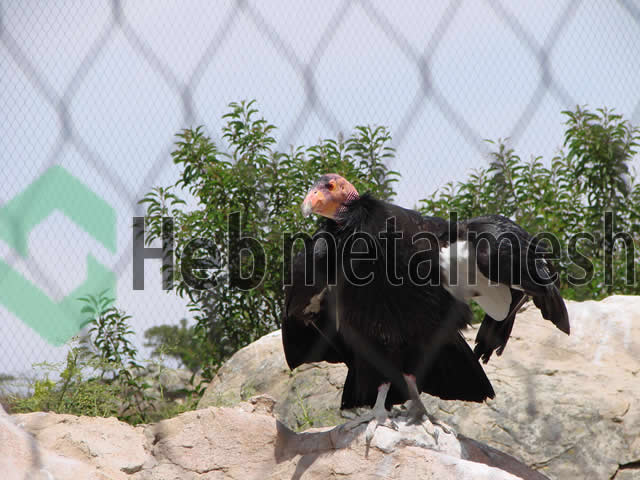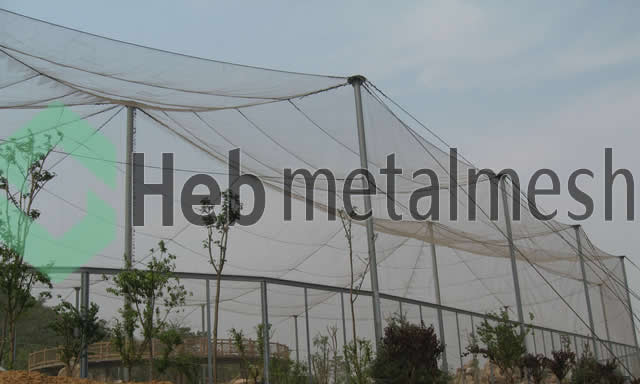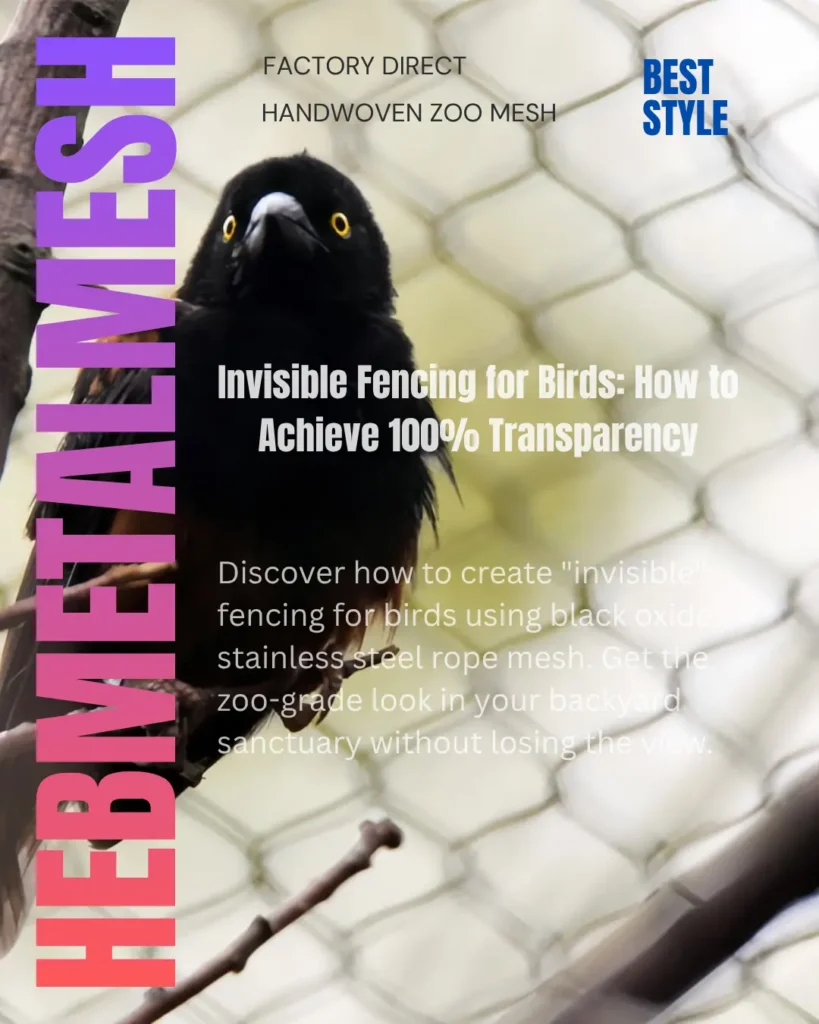
The Secret to “Invisible” Enclosures: Achieving invisible fencing for birds relies on three factors: wire diameter, color choice, and aperture size. By using Black Oxide stainless steel rope mesh, the material absorbs light rather than reflecting it, allowing the human eye to focus on the birds and landscaping inside. This zoo-grade technology provides a 90% open-area ratio, offering the structural strength of steel with the visual lightness of an open-air flight space.
1. The Science of Invisibility: Why the Eye Skips Steel
When most people think of a bird enclosure, they imagine a heavy metal grid that screams “containment.” But the secret to invisible fencing for birds isn’t actually making the material disappear—it’s about tricking the human brain into ignoring it. This is a masterclass in optical science that zoos have used for decades, and it all starts with how we process light and focus.
The Psychological “Aha!” Moment: Selective Focus
Our eyes are naturally drawn to bright, reflective surfaces and thick, solid lines. When you look at a traditional wooden or thick-wire cage, your brain “stops” at the barrier because it represents a significant visual interruption. However, when you utilize ultra-thin, dark-colored stainless steel rope mesh, something magical happens.
Because the wire diameter is so small—often between 1.2mm and 2.0mm—and the diamond aperture is wide, the human eye naturally focuses on the higher-contrast objects behind the mesh, such as a vibrant parrot or a lush green fern. The mesh becomes “visual noise” that the brain simply filters out.
Silver vs. Black Oxide: Choosing the Right Finish
The choice of finish is the most critical factor in achieving invisible fencing for birds. As seen in our Nature vs. Black Oxide comparison, the two finishes perform very differently in a garden setting:
- Natural Silver: While beautiful and modern, the reflective surface of raw stainless steel catches the sunlight. This “glint” tells your eye exactly where the fence is located.
- Black Oxide: This is the gold standard for invisibility. The chemical blackening process creates a matte finish that absorbs light rather than reflecting it. Against the shadows of trees or the darkness of a planted background, the black mesh virtually vanishes, providing a 90% open-area ratio that feels like looking through high-definition glass.
Why Traditional Cages Fail the Test
Traditional “thick-bar” cages or welded wire panels fail because they lack “transparency depth.” Their thick gauge creates a physical wall of color that reflects light from every angle. This creates a “stutter” in your garden’s visual flow.
By switching to a hand-woven Parrot and Macaw enclosure mesh, you replace those bulky bars with high-tensile cables that provide superior strength with a fraction of the visual footprint. You get the security of a steel vault with the aesthetics of an open-air sanctuary.
2. Mesh Specifications: Thinness vs. Tensile Strength
The greatest challenge in designing invisible fencing for birds is the balance between physics and aesthetics. How do you make a barrier thin enough to disappear, yet strong enough to stop a 20lb raccoon or a panicked macaw? The answer lies in the high-tensile engineering of stainless steel wire rope.
The Math of 1.2mm to 2.0mm Wire Rope
In traditional fencing, strength comes from bulk. To make a cage stronger, you usually make the bars thicker. With hebmetalmesh, we reverse this logic.
- The “Invisible” Gauge: For most residential aviaries, a wire diameter of 1.2mm (approx. 3/64″) is the sweet spot. It is thin enough to be nearly invisible from 10 feet away.
- The Strength Multiplier: Despite its thin profile, this isn’t a single wire; it is a 7×7 or 7×19 strand cable. This means 49 individual stainless steel wires are twisted together into a single rope.
- Tensile Capacity: A single 2.0mm stainless steel rope can have a breaking strength exceeding 200kg (440lbs). By distributing this strength across a hand-woven diamond pattern, you create a “safety net” that is exponentially stronger than welded wire of the same thickness.
High “Open Area” vs. Predator Security
The key to invisible fencing for birds is the Open Area Percentage—the amount of space where there is no metal blocking your view.
- The Calculation: By using a 2.0mm wire with a 50mm (2″) diamond opening, you achieve an open area of over 90%.
- The Security Benefit: Predators like hawks or foxes rely on finding a “weak point” to push or chew through. Because the mesh is woven, not welded, it doesn’t have brittle joints that snap under pressure. It provides a flexible, high-tension barrier that absorbs impact, keeping your birds safe without the “walled-in” feeling of heavy-gauge hardware cloth.
Why Stainless Steel is the Only Material for the Job
If you tried to make “invisible” fencing out of plastic or galvanized iron, the project would fail within a year.
- Plastic/Nylon: To get the same strength as steel, plastic netting has to be incredibly thick and bulky, which ruins the transparency. If it is thin enough to be “invisible,” it becomes a “chew-toy” for rodents.
- Galvanized Steel: Standard wire is prone to “zinc rot” and rust. As it corrodes, the wire expands and discolors, becoming an eyesore.
- The Stainless Advantage: Stainless steel bird netting maintains its factory-thin diameter for decades. It doesn’t stretch, it doesn’t sag, and it doesn’t rust. It is the only material that allows you to design for the next 30 years while keeping the visual weight of the enclosure near zero.
3. Framing for Transparency: The “Floating” Aviary
If the mesh is the “invisible fabric” of your sanctuary, the frame is the skeleton. Most traditional enclosures fail the aesthetic test because they rely on heavy, overbuilt wooden structures that create a visual “cage” before the wire is even attached. To achieve true invisible fencing for birds, you must rethink the support system entirely.
Slim-Profile Steel vs. Bulky Timber
Wooden 4×4 posts are the enemy of transparency. They are thick, they weather into a distracting grey or brown, and they require frequent vertical supports to prevent sagging.
- The Steel Advantage: By using high-strength, slim-profile steel pipes or powder-coated black aluminum posts, you can reduce the visual footprint of your frame by up to 70%.
- The “Shadow” Effect: When you use black posts paired with black-oxide hebmetalmesh, the frame mimics the shadows of tree trunks and branches. Instead of seeing a “wall,” the eye perceives the structure as a natural part of the garden’s depth.
The Power of Tension: Creating the “Floating” Look
The secret weapon of professional zoo architects is the tension cable. Unlike rigid welded wire that needs a frame on all four sides to stay upright, stainless steel bird netting is a tensile material.
- Boundary Cables: By running a 6mm or 8mm stainless steel cable between four main corner pillars, you can “hang” the mesh like a high-tech curtain.
- Unobstructed Spans: This allows for massive, open spans—sometimes 20 to 30 feet—without a single middle post blocking your view. It creates a “floating” roof effect where the mesh appears to hover over the habitat, held only by invisible tension.
Integrating with the Landscape, Not Adding to It
The most successful invisible fencing for birds doesn’t sit on the garden; it sits within it.
- Organic Contours: Because the rope mesh is flexible, you don’t have to build a square box. You can curve the boundary cables around existing oak trees or follow the natural slope of a hillside.
- The “Borrowed View”: By minimizing the frame, you “borrow” the background of your neighbor’s trees or distant hills. The enclosure becomes a transparent window rather than a solid barrier.
When you prioritize tension over timber, the structure stops being an “industrial addition” to your yard. It becomes a sculptural sanctuary that lets the light, the air, and your birds take center stage.
4. Application: From Macaws to Songbirds
Achieving the perfect look for invisible fencing for birds isn’t a “one size fits all” process. The key to making a barrier vanish is matching the scale of the mesh to the scale of the bird. If the diamond pattern is too small, it creates a screen-door effect; if it’s too large, your birds (or local predators) move right through it.
Choosing the Right Diamond Size (Aperture)
The “aperture” is the diagonal measurement of the diamond opening. For maximum invisibility, you want the largest aperture possible that still ensures 100% containment.
- Small Songbirds & Finches: A 20mm to 25mm (0.8″ to 1″) aperture is required. Because the wire is ultra-thin (1.2mm), the mesh still maintains high transparency despite the tighter weave.
- Medium Birds (Conures, Doves): A 38mm to 51mm (1.5″ to 2″) aperture offers a significant jump in visibility. From ten feet away, this mesh is almost impossible to photograph—it simply disappears into the background.
- Large Species: For Peacock enclosures or large waterfowl, you can move up to a 60mm to 80mm (2.4″ to 3″) opening, providing the ultimate “open-air” experience.
Standardizing for Large Flight Areas
When designing for power and intelligence, Parrot and Macaw enclosure mesh requires a specific standard: 2.0mm wire with a $50mm$ or 60mm aperture. * The Proportional Secret: In a massive flight space (e.g., 20 feet long or more), the human eye perceives a $2.0mm$ wire as a thin thread.
- Maximum Flight Visibility: This combination allows macaws to reach full flight speed while giving you a crystal-clear view of their plumage. Because hebmetalmesh is hand-woven, the diamonds stay perfectly uniform under tension, preventing the “wavy” visual distortion common with cheaper chain-link or plastic netting.
Seamless Integration: Rockwork and Water
The most breathtaking invisible fencing for birds doesn’t end at a flat dirt floor. To create a “seamless” look, the mesh must interact with the environment:
- The “Rock-In” Technique: Instead of a straight bottom rail, anchor your stainless steel bird netting directly into natural boulders or artificial rockwork using stainless steel eyebolts. This makes it look like the mesh is growing out of the landscape.
- Water Feature Passthroughs: Because 316-grade stainless steel is rust-proof, you can run the mesh directly through the splash zone of a waterfall or over a pond edge.
- Visual Continuity: When the mesh “disappears” into a rock face or a stream, the physical boundaries of the enclosure are blurred. The birds appear to be living in a wild, unconstrained corner of your garden.
5. Durability: Invisibility That Lasts 30+ Years
The most frustrating part of “budget” fencing isn’t just that it breaks—it’s that it gets uglier every day it sits in your yard. True invisible fencing for birds requires a material that maintains its optical clarity for decades. While other materials degrade and become an eyesore, stainless steel rope mesh remains a “ghost” in the landscape.
Why Synthetic Materials Fail the “Invisibility” Test
Plastic and nylon netting are often sold as “discreet,” but they have a short-lived honeymoon phase.
- The “Clouding” Effect: UV rays from the sun cause plastic polymers to break down, turning once-clear or black netting into a chalky, greyish-white mess. Instead of disappearing, the mesh becomes a cloudy “fog” in your garden.
- The Sag Factor: Synthetic materials have “elastic creep.” Over 12–24 months, the netting stretches and sags under its own weight or the weight of debris. This creates ripples and folds that catch the light, making the barrier painfully obvious.
The “Set-it-and-Forget-it” Benefit of 316-grade Steel
When you invest in hebmetalmesh, you are investing in structural permanence. For high-end projects like Peacock enclosures, 316-grade stainless steel is the industry gold standard.
- Zero Maintenance: Unlike wood that rots or plastic that snaps, 316-grade steel is virtually inert. Once tensioned, it stays at that exact tension for the life of the structure.
- Structural Memory: Stainless steel wire rope has “memory.” If a bird hits the mesh or a branch falls on it, the mesh deflects the energy and snaps back to its original flat, invisible plane.
Resistance to UV Damage and “Tea-Staining”
The two biggest enemies of outdoor metal are the sun and salt air.
- UV Immunity: Stainless steel is 100% immune to UV degradation. It will not become brittle or lose its “invisible” thinness, even after 30 years of direct exposure.
- Anti-Corrosion Technology: While cheaper “stainless” products can develop “tea-staining” (brown surface spots), our high-quality 316-grade Parrot and Macaw enclosure mesh is engineered for coastal and high-humidity environments.
- The Black Oxide Advantage: Our chemical blackening process isn’t a paint that flakes off; it is a molecular change to the surface of the steel. This means your “invisible” finish won’t peel, bubble, or require repainting.
True invisibility isn’t just about how it looks on the day you install it—it’s about how it looks 10,000 sunrises later.
6. The Landscape Architect’s Secret: Lighting the Interior
The final “Aha!” moment for invisible fencing for birds happens after sunset. In the dark, a traditional wire cage looks like a black wall. But with a professionally designed hebmetalmesh sanctuary, the enclosure completely disappears, leaving your birds and plants suspended in a glowing “cube” of light.
The Power of “Backlighting” and “Uplighting”
The key to keeping mesh invisible at night is to ensure the light is focused inside the habitat, not on the barrier.
- Uplighting Trees: Place small, shielded LED spotlights at the base of interior trees or rockwork. By illuminating the texture of the bark and leaves from within, the eye “punches through” the mesh to reach the light source.
- Backlighting Features: If you have a waterfall or a stone wall at the back of the enclosure, light it from the front. This creates a bright backdrop that makes the thin strands of stainless steel bird netting functionally transparent to the human eye.
Avoiding the “Glare Trap”
A common rookie mistake is placing garden spotlights outside the enclosure pointing toward the mesh.
- The Reflection Problem: Light hitting the surface of the wire creates a “glare curtain” that makes it impossible to see inside.
- The Black Oxide Advantage: Because our black oxide finish is matte, it is significantly more forgiving than silver mesh. It absorbs stray light rather than bouncing it back into your eyes. For the best result, always keep your light sources “low and internal” to maintain that high-end invisible fencing effect.
Glow Without Disturbance
While we want the sanctuary to look beautiful, the birds’ circadian rhythm is the priority.
- Warm-Spectrum LEDs: Use warm-toned lights (2700K to 3000K) which are less disruptive to avian sleep patterns than “cool” blue lights.
- Moonlight Effect: Mounting a single, dim, downward-facing light at the highest point of the Parrot and Macaw enclosure mesh mimics natural moonlight, providing enough visibility for you to enjoy the view without waking your flock.
Final Project Summary: The “Invisible” Checklist
To achieve 100% success with your invisible fencing for birds, remember the 3-2-1 Rule:
- 316-Grade Steel: For lifelong durability without rust or “clouding.”
- 2.0mm (or less) Wire: Keep it thin to keep it hidden.
- 1 Black Oxide Finish: The only way to eliminate glare and “melt” the mesh into the shadows.
Stop Blocking the View. Start Seeing the Birds.
Don’t let bulky wire ruin your garden’s aesthetic. Our Black Oxide Handwoven Mesh is designed to disappear.
*Zoo-quality transparency for residential sanctuaries. Worldwide shipping available.*
Frequently Asked Questions: Invisible Fencing for Birds
Answer: Absolutely. The term “invisible” refers to the visual transparency, not a lack of physical strength. Our Parrot and Macaw enclosure mesh uses a 7×7 or 7×19 strand stainless steel cable construction. Even at a thin $2.0mm$ diameter, it has a breaking strength of several hundred pounds, making it physically impossible for even the strongest beak to snap.
Answer: It comes down to light reflection. Natural stainless steel has a metallic sheen that reflects sunlight, creating a “glint” that draws the human eye to the fence line. The Black Oxide finish on our hebmetalmesh absorbs light. In a garden setting with shadows and greenery, the black wire “melts” into the background, allowing your eyes to focus entirely on the birds and plants inside.
Answer: No, and that is the primary advantage over plastic. Synthetic netting becomes brittle and “clouds” or turns grey due to UV damage, making it more visible as it ages. Because stainless steel bird netting is immune to UV rays and doesn’t stretch or sag, it maintains its factory-thin, transparent profile for 30+ years.
Answer: While possible, it is much harder. Thick wooden 4×4 posts create a heavy visual “grid” that the brain perceives as a cage. For a truly invisible fencing for birds effect, we recommend a “floating” design using slim-profile black steel posts and high-tension perimeter cables. This allows for wider spans of mesh without vertical interruptions.
Answer: Never. Our Black Oxide is a chemical conversion coating, not a paint or powder coat. It is a molecular change to the surface of the stainless steel itself. It won’t peel, flake, or chip, even in the high-humidity environments of a Peacock enclosure or near a waterfall feature.