
If deer are stripping your orchard, boar are tearing up your fields, or raccoons are raiding your garden every night, the fix is not more repellent or another electric fence. A permanent wildlife control mesh barrier — woven from 1.2–3.2 mm stainless steel rope and sized to the smallest animal you need to exclude — stops wildlife physically, lasts 20+ years, and never harms the animals it holds out. This guide covers the aperture, height, and grade choices that matter, with real HM codes and planning prices.
Executive Summary
Wildlife pressure on farms, orchards, estates, and peri-urban properties keeps growing, and most owners waste money on solutions that fail within two seasons: plastic netting that UV-degrades, welded wire that rusts through, electric lines that ground out in vegetation. The durable alternative is stainless steel wildlife control mesh — a hand-woven rope netting system engineered as a physical exclusion barrier, not a psychological deterrent. Selection comes down to four decisions — mesh aperture (20–102 mm), rope diameter (1.2–3.2 mm), fence height (1.2–3 m), and steel grade (SS304 inland, SS316 coastal). A typical deer-exclusion installation runs $12–24 per square meter in the planning range and, unlike chain link, carries no coating to fail and no weld to corrode. The reference specification is the Animal Fence Mesh product page.
Quick Answer: What Is Wildlife Control Mesh?
Quick Answer: Wildlife control mesh is a woven stainless steel rope netting barrier that physically excludes wild animals — deer, boar, raccoons, rabbits, and birds — from property, orchards, and gardens. The specification depends on the smallest target species: 25 mm stops rabbits and raccoons, 51–76 mm stops deer and boar, and rope diameter scales from 1.2 mm to 3.2 mm for large mammals.
Two things separate real wildlife control mesh from hardware-store fencing: it is woven from wire rope, not welded, so every hand-tied crossing deforms under load and springs back instead of snapping; and it is grade 304 or 316 stainless throughout, with no coating to scratch off and no rust line to fail along.
Key Takeaways
- Match aperture to the smallest pest, not the biggest. Rabbits and raccoons need ≤25 mm; deer and boar are excluded at 51–102 mm.
- Stainless steel beats coated wire on lifespan. SS304 lasts 20+ years inland; grade 316 stainless is mandatory within ~5 km of saltwater.
- Height, not strength, stops deer. A 2.0–2.4 m fence with 76 mm mesh excludes them; they rarely test a barrier they cannot see over.
- Plan $10–24/m² for material — a fraction of repeated repellent, repair, and crop-loss costs.
- Woven rope mesh absorbs impact — a charging boar meets a flexible exclusion barrier, not a brittle weld.
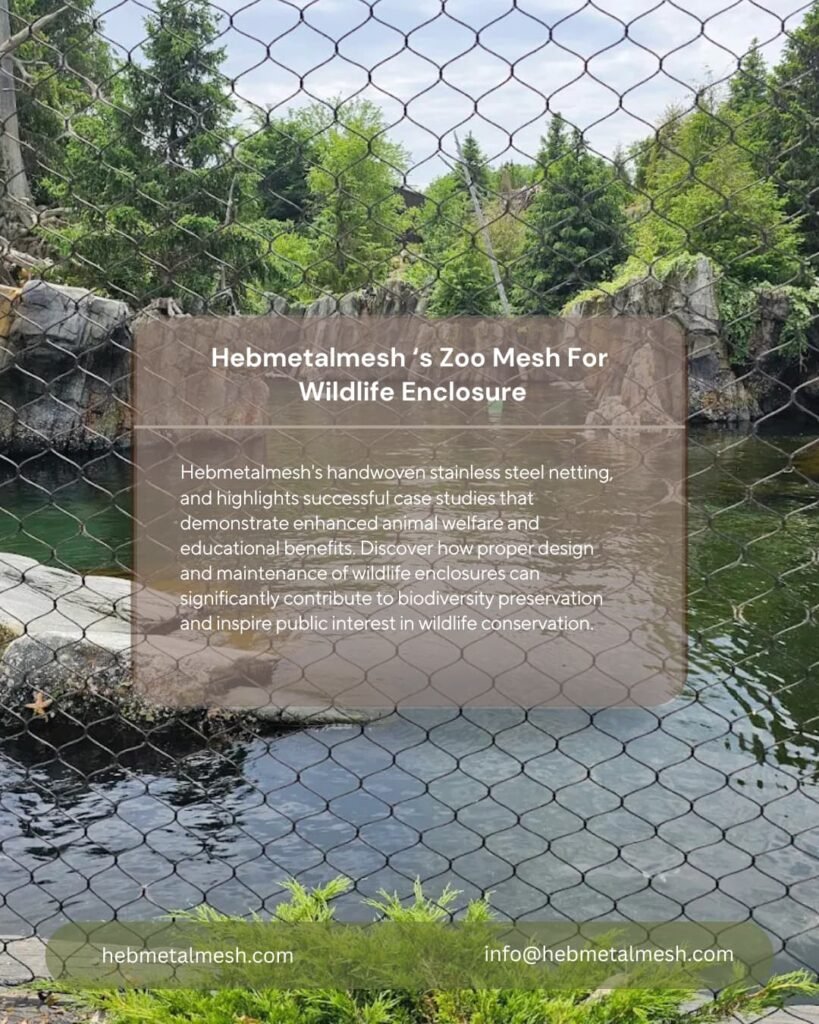
Wildlife fencing sits at the center of modern human wildlife conflict management: the goal is live containment on the animal side of the line, not trapping or harming anything. That humane-exclusion standard is promoted by conservation bodies like the World Wildlife Fund, and it is why woven stainless mesh runs from zoo perimeters to backyard gardens.
Why Property Owners Are Switching to Wildlife Control Mesh
Repellent and electric lines are deterrents — they ask the animal to decide to leave. A physical exclusion barrier does not negotiate. Three structural problems kill conventional fencing on wildlife duty: welded wire fails at the weld (a 120 kg boar concentrates an impact load on a few square centimeters, and one popped weld opens a hole the herd learns to use); galvanized coating is a countdown timer (every scratch exposes bare steel); plastic netting UV-degrades in 2–4 seasons and cannot exclude anything with teeth or hands.
Wildlife Mesh vs Chain Link: The Honest Comparison
The differences matter more for wildlife than for security:
| Factor | Woven Stainless Rope Mesh | Galvanized Chain Link | Plastic/Poly Netting |
| Lifespan | 20–30+ years | 8–15 years (coating-dependent) | 2–4 seasons |
| Impact response | Flexes and recovers | Bends, can tear at ties | Tears permanently |
| Small-animal exclusion | Excellent at 20–25 mm | Poor — raccoons climb it | Poor |
| Rust/UV failure mode | None | Coating scratch → rust | UV brittleness |
| Visual impact | Near-transparent | Opaque industrial look | Visible and saggy |
| Wildlife safety | No snag points, no injury | Sharp cut ends common | Entanglement risk |
| Planning price | $10–24/m² | $8–15/m² | $2–6/m² |
Chain link wins on initial price for flat, open perimeters. It loses wherever animals actually press the fence — handholds for climbing raccoons, cut-wire ends that injure deer — so for property bordering woods or water, the woven option is the lower lifetime cost.
Choosing the Specification: Aperture, Rope Diameter, Grade
The complete wildlife control mesh specifications range covers rope diameters of 1.2–3.2 mm and apertures of 20–102 mm. Every HM code pairs one rope with one aperture — HM2076 is a 2.0 mm rope woven at 76 mm; HM32102 is 3.2 mm at 102 mm. Panels are woven to order up to 9 × 18 m, so a barrier runs post-to-post without splices.
Wildlife Mesh Aperture Sizes by Target Species
The rule: size the mesh aperture to the smallest animal you need to stop, because everything smaller than the gap design simply walks through.
| Target species | Max aperture | Recommended code | Rope Ø |
| Rabbits, squirrels, rats | 20–25 mm | HM1625 (1.6/25) | 1.6 mm |
| Raccoons, opossums, foxes | 25–38 mm | HM2038 (2.0/38) | 2.0 mm |
| Deer, wild boar, coyotes | 51–76 mm | HM2076 (2.0/76) | 2.0 mm |
| Large mammals, high-impact zones | 76–102 mm | HM3276 / HM32102 | 3.2 mm |
| Birds over crops | 20–30 mm | HM1220 (1.2/20) | 1.2 mm |
Two practical notes. Deer and boar are excluded more by height than by aperture — at 76 mm their muzzles cannot bite the mesh, and at 2 m they stop trying. Raccoons test with their hands: at 25 mm one cannot insert a paw and moves on. That is true live containment — the animal is unharmed, just excluded.
Steel Grade: SS304 Inland, SS316 Coastal
- SS304 (18% Cr / 8% Ni): the standard grade for inland farms, orchards, and estates — 20+ years of service in ordinary exposure.
- SS316 (adds 2% molybdenum): required within roughly 5 km of saltwater, and smart wherever fertilizer drift or de-icing salt hits the line — the molybdenum stops chloride pitting.
- Finish: natural mill finish (Nature) for most sites; black oxide finish where the barrier must disappear visually — estate boundaries, golf courses, residential edges. It is a surface treatment on the same steel, not a paint, so it does not chip.
Wildlife Fence Height Guide
Height is where most DIY wildlife fence projects go wrong — species jump, climb, and push differently:
| Species | Minimum height | Notes |
| Rabbits, groundhogs | 1.0–1.2 m | Bury bottom 150 mm or pin to ground; they dig |
| Raccoons, foxes | 1.5 m | They climb — smooth mesh with ≤25 mm aperture denies grip |
| Deer (white-tail) | 2.0–2.4 m | Double-strand top for pressure zones |
| Wild boar | 1.2–1.5 m + buried apron | Push-test the bottom; anchor every 3 m |
| Feral hogs, large mammals | 2.0 m | 3.2 mm rope in the impact zone |
For a mixed-threat perimeter — the common case on farms and estate land — a 2.0 m HM2076 fence with a 300 mm ground apron handles deer, boar, coyotes, and raccoons in one build, an advantage over fences that stack wire, electric line, and plastic netting.
Applications: Deer, Gardens, and Orchards
Wildlife control mesh for deer is the most common property application. Deer cost growers thousands per season, and they are creatures of habit — once a herd learns a route, only a physical barrier breaks it. A 2.0–2.4 m HM2076 installation excludes the entire herd permanently; see the dedicated deer enclosure fence netting page for details.
Wildlife control mesh for gardens usually means 1.2–1.5 m of HM1625 or HM2038 on timber or steel posts — at 25 mm it stops rabbits, raccoons, and voles while remaining nearly invisible. Garden barrier options are compared in our animal barrier garden fence guide.
Wildlife control netting for orchards can mean vertical fence, overhead bird netting, or both: a common layout runs a 1.8 m HM2038 perimeter against deer and raccoons, with HM1220 draped over high-value blocks against birds. On sloped or odd-shaped ground, wildlife exclusion netting panels are woven to the site contour, replacing a patchwork of rolls.
For peri-urban properties, the same mesh doubles as perimeter security: climb-resistant (no handholds at small apertures), hard to cut quickly with hand tools, and acceptable to insurers on greenbelt-backed lots.
Wildlife Control Mesh Installation: What Actually Matters
Installation is straightforward post-and-panel work, but four details decide whether it performs for 20 years or 5:
- Post spacing and strength. 3 m spacing with concreted end posts. Rope mesh is light — an HM2076 panel weighs roughly 1.2 kg/m² — but end posts take the full line load and deserve real footings.
- Ground line. Every digger (rabbits, groundhogs, boar) tests the bottom. Bury a 300 mm apron, pin the bottom rope every 500 mm, or leave a fold-out skirt pinned flat outside.
- Tension, not rigidity. Attach with tensioned edge rope and hog-ring ties on a 200–300 mm grid. The mesh should deflect a hand’s width when pushed — that flexibility absorbs the impact load. Rigid attachment turns a flexible barrier back into a brittle one.
- No gaps at transitions. Gates, corners, and panel joins are where animals learn to enter. Overlap panels 100 mm, tie them together, and close the gap under gates with a drop bar.
A competent fencing crew completes 100–150 linear meters of 2 m fence per day. Handymen handle garden-scale builds; see our farm fencing tips for line-level layout advice.
Wildlife Control Mesh Price and Cost Planning
Budget by area, not by roll. Planning ranges (material only, ex-works):
| Specification | Typical use | Planning price |
| HM1220 (1.2/20) | Bird and vole exclusion | $10–14/m² |
| HM1625 (1.6/25) | Rabbits, raccoons, gardens | $12–16/m² |
| HM2076 (2.0/76) | Deer, boar, mixed perimeter | $14–20/m² |
| HM32102 (3.2/102) | Large-mammal, high-impact | $18–24/m² |
So a 200 m perimeter at 2 m height (400 m² of HM2076) plans around $5,600–8,000 in material. Total wildlife control mesh cost installed typically lands at 1.6–2.2× material with posts, concrete, and labor. A specialist wildlife control mesh supplier quotes by HM code with grade, finish, panel size, and volume priced separately — for a firm wildlife control mesh price, send your layout.
The comparison that matters is lifetime cost: a chain link fence replaced twice and patched annually, plus two seasons of deer loss, exceeds a stainless installation done once.
Wildlife Control Mesh Specifications — Quick Reference
- Rope diameter: 1.2 / 1.6 / 2.0 / 2.4 / 3.2 mm, 7×7 or 7×19 construction
- Mesh aperture: 20–102 mm (typical wildlife codes: 25, 38, 51, 76, 102 mm)
- Material: SS304 (18% Cr/8% Ni) or SS316 (+Mo); Nature or black oxide finish
- Panel size: wildlife control mesh panels are custom-woven up to 9 × 18 m, no mid-panel splices
- Weight: ~0.4–1.6 kg/m² depending on code
- Break force: rope breaking load exceeds 6–16 kN by diameter; the knit distributes load across the panel
- Accessories: tensioned edge rope, hog rings, post brackets, ground pins
Full dimensional tables for every HM code are on the Animal Fence Mesh core page — the same specification family used for zoological enclosures, the best evidence that the mesh holds large, determined animals.
FAQ
No. At 76 mm a deer cannot get its muzzle through to bite the rope, and at 2 m height it stops trying. HM2076/2.0 m installations have held herds out of orchards for over a decade.
Not at ≤25 mm aperture. Their paws cannot insert or grip the small-knit weave, so the mesh denies the climb mechanically.
20–30+ years for SS304 inland, longer for SS316. There is no coating to scratch off, so a scratch is not a failure point.
Yes, with the right bottom detail. Boar push at ground level; a 1.5 m HM2076 wall with a buried 300 mm apron turns the push into ground friction, not a lifting failure.
Between $10 and $24/m² in the planning range, depending on rope diameter, aperture, grade, and finish. Deer-grade HM2076 typically plans at $14–20/m² material.
Yes — garden fences under 50 m are realistic DIY projects with hand tools and hog rings. Installs over 200 m justify professional tensioning gear.
Final Word
Wildlife control is a specification problem, not a battle of wills with the local deer. Pick the aperture for your smallest pest, the height for your largest, the grade for your climate — and the barrier works silently for two decades. Ready to price it? Two lines are enough: perimeter length and target species.