
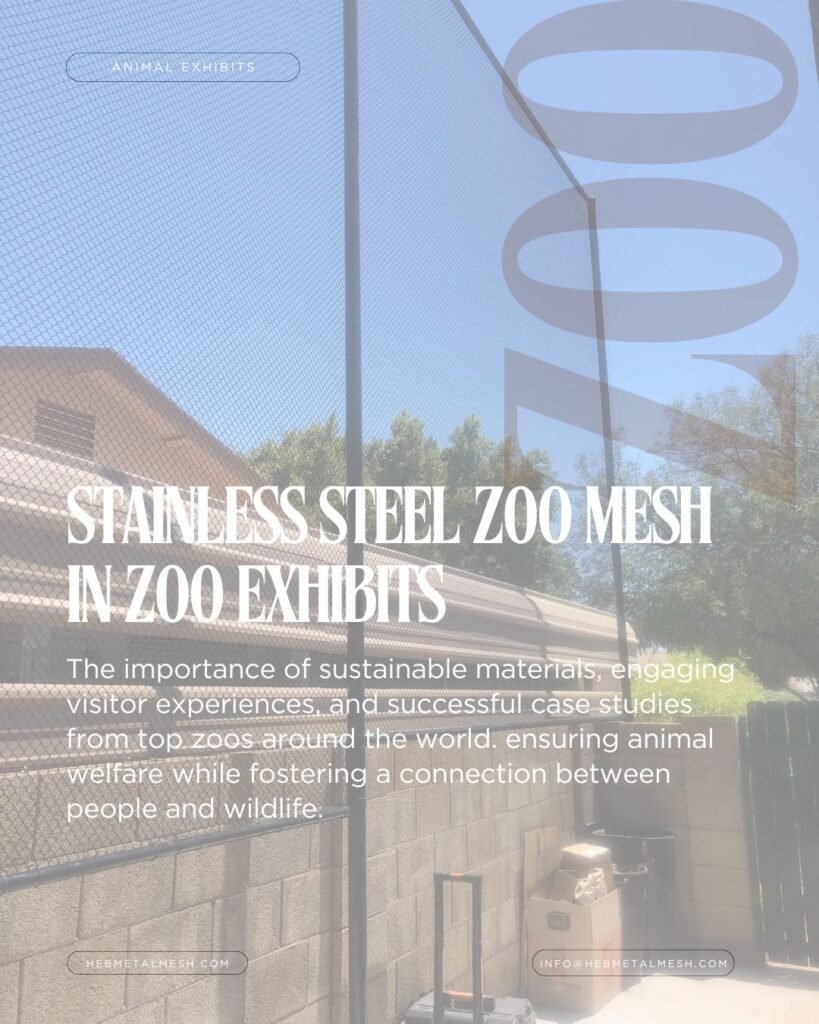
The phrase outdoor enclosure describes three unrelated products. One is a sealed box that keeps rain off an electrical panel. One is a screened room that keeps insects off a patio. The third is a habitat: walls, a roof and a floor that must hold an animal, satisfy a curator and still read as landscape to a quarter of a million visitors a year. Only the third is an enclosure structure in any engineering sense, and that is the subject of this guide. When a zoo, safari park or private reserve specifies mesh, it is not buying a barrier. It is commissioning a load-bearing system whose frame, membrane and fixings share every load the site can produce.
Executive Summary
An enclosure structure is three systems working as one: a frame that carries load to the ground, a tensioned mesh membrane that distributes it, and terminations that transfer it between the two. Wind, animal impact and time all enter at the membrane and leave at the footings, which makes post spacing, pretension and grade selection structural decisions rather than detailing choices. Welded wire fails at its fused intersections under impact; handwoven rope mesh has no fused intersection to fail, so the load spreads across the weave instead. The reference specification is the animal fence mesh product page.
Have a structural drawing or a span to check? Send the panel dimensions, species and site conditions, and our engineers will return post spacing, rope diameter, grade and fixing details.
Request an enclosure structure reviewQuick Answer:
What is an enclosure structure? It is the complete load path of an outdoor enclosure: the posts and rails that stand it up, the rope mesh membrane that spans between them, and the ferrules, anchors and footings that tie the two together. A specification that covers only the mesh has covered perhaps a third of the structure. The other two thirds are steel or timber geometry and the connections between them, and that is where most outdoor enclosures actually fail.
Key Takeaways
- The mesh is a membrane, not the structure. Rope mesh distributes load; the frame collects it; the footings dispose of it. Specify all three together.
- Post spacing is the first structural decision. Bay spacing sets the unsupported span, and span sets pretension, sag and rope diameter as a single package.
- Welded mesh fails at the weld; woven mesh has no weld to fail. A fused intersection shears under a point impact, while a woven joint deforms and carries on.
- Grade selection is structural, not cosmetic. Type 316 earns its premium wherever chlorides concentrate, because corrosion loss is a structural loss.
- Every failure starts at a termination. Ferrule, anchor or footing, the weakest link in the load path is usually a connection rather than the metal.
Why an Enclosure Is a Structure, Not a Product
The International Association for Bridge and Structural Engineering, founded in 1929 and seated in Zurich, defines structural engineering as the science and art of planning, design, construction, operation, monitoring and inspection, maintenance and preservation of structures, and it is explicit that structures include all types built from any structural material. IABSE’s definition of structural engineering is the right frame for a habitat enclosure, because nothing in it exempts a fence; the build details behind a predator-proof outdoor enclosure are the same principle written as a checklist. An enclosure structure for zoos carries the same categories of load as any civil structure: dead load from its own weight, live load from wind pressure and snow, and occasional impact from animals, maintenance equipment and public crowds. What changes is the client mix. A bridge has one owner; a habitat has a curator, a veterinarian, a structural reviewer and half a million visitors a year, each reading the structure differently.
The distinction is not academic. A NEMA-rated electrical box is specified by ingress protection and temperature rise; a screened sunroom by airflow and view. Neither has to survive a large predator launching itself at the barrier, nor a curator who needs to see through it, nor a maintenance crew that will lean ladders against it for thirty years. Containment, visibility and serviceability are what turn a fence into a structural problem.
The Three Elements Every Enclosure Structure Shares
Every sound outdoor enclosure resolves into the same three elements. The enclosure frame is the skeleton: corner posts, intermediate posts, a top rail and, in taller aviaries, a ring beam or header that collects the roof. The membrane is the rope mesh itself, pulled taut between those supports, which behaves as a tensioned structure rather than a rigid panel. The third element is the set of connections, where a cable structure meets its supports through ferrules, brackets and anchors. The three cannot be specified independently. A finer aperture needs a smaller rope, a smaller rope needs a shorter unsupported span, and a shorter span needs more posts. The frame system, the mesh and the fixings are one structural system priced as one, which is why an enclosure structure for aviaries is quoted as a complete assembly rather than a square-meterage of netting. The materials comparison behind durable zoo enclosures shows how quickly a cheap frame erases an expensive membrane.
Load Paths: Wind, Impact and the Crowd
Load does not disappear at the mesh; it travels. Wind pressure arrives as a distributed push across the membrane, converts to tension along the ropes, concentrates at the edges and arrives at the posts as a horizontal pull that the footings must resist. Animal impact is the opposite case: a point load from a climbing primate or a striking predator, which a woven membrane spreads across neighboring ropes while a welded panel concentrates at one fused intersection until it shears. That single difference is the whole enclosure structure comparison between rope mesh and welded wire, and it is why handwoven panels are used where large carnivores and heavy primates share space with the public. A load bearing structure is only as strong as the path it provides, so every element on that path, from the knotted joint at the panel edge to the concrete beneath the post, belongs in the specification. Containment structures built for large animals follow the same logic at greater scale.
Wind deserves a note of its own, because mesh is permeable. A solid wall takes the full wind pressure and passes it to the frame; an open weave takes a fraction of it, but the fraction that remains still has to travel somewhere. Designers who assume the mesh is transparent to wind undersize the footings, and the first stormy season finds the posts leaning.
Sizing the Frame: Span, Bay Spacing and Pretension
The geometry is chosen by span. Between two posts, a tensioned rope settles into a catenary curve, and the amount of sag depends on the pretension applied at installation and the load that follows. A tight pretension looks better and reduces mid-span movement, but every newton of pretension is a newton the posts and footings must carry for the life of the structure. Standard practice is to fix the unsupported span first, then read rope diameter and aperture off it. Handwoven rope mesh is produced with rope diameters from 1.2 to 3.2 mm (1/16 to 1/8 in) and apertures from 20 to 102 mm (3/4 to 4 in), so a 2.0 mm rope in a 76 mm aperture covers a very different span than a 1.2 mm rope in a 20 mm aperture. Bay spacing, diagonal bracing at the corners and the height of the top rail are then tuned to the wind zone. Any credible enclosure structure specification states span, pretension and post spacing together, because changing one invalidates the other two.
The catalog codes make the point concrete: an HM1220 panel pairs a 1.2 mm rope with a 20 mm aperture for small birds and short spans, while an HM32102 pairs a 3.2 mm rope with a 102 mm aperture for large carnivores and long runs. Same weave, two different structures.
Fixings, Terminations and Installation
The cable termination is where a rope mesh enclosure is won or lost. Each rope is woven over a compressed ferrule at the panel edge, and that ferrule is clamped, pinned or bolted to the frame. A termination that slips under load lets the whole panel relax, and a relaxed membrane transmits shock instead of absorbing it. Enclosure structure installation therefore starts with the frame: posts plumb, footings cured, rails level and the mesh framing detailed so that every panel edge lands on a continuous support rather than a floating clip. Tolerances matter more here than in ordinary fencing, because a flexible membrane has no way to correct a frame that is out of line. Mesh framing is a skill in its own right: the panel edge must clamp to a continuous rail or a purpose-made bracket, never to a loose clip or a single screw, and the step-by-step guide to attaching wire mesh to metal frames covers the hardware in detail. Where a panel is tensioned between two posts, the ferrule is drawn tight against the bracket and the rope is checked for uniform seating along its length, because a rope that sits proud of its ferrule will creep under load and quietly relax the whole panel. Where panels meet, the knotted joint is inspected rather than assumed, since the handwoven construction is only as uniform as the weave that produced it.
Grade Selection Is a Structural Decision
Grade is usually sold as a durability feature. It is better understood as a structural one. Type 304 stainless steel, with roughly 18 percent chromium and 8 percent nickel, resists outdoor corrosion through a passive film that reforms when scratched. Type 316 adds about 2 percent molybdenum, which stabilizes that film against chlorides, so coastal sites, salted walkways and cleaning regimes all argue for the marine grade. Corrosion loss is section loss, and section loss is capacity loss: a rope that has thinned carries less, whatever the drawing says. The 304 and 316 cable mesh comparison quantifies where the upgrade pays, and an enclosure structure for animals in a coastal collection is one of the clearest cases for it.
Inspection, Maintenance and Service Life
A well-built enclosure structure is designed for decades, but decades are earned by inspection. The enclosure structure maintenance regime that matters is short: walk the terminations, look for relaxed panels, check post plumb after storms, and record any rope that has thinned at the ferrule. Handwoven stainless rope mesh needs no painting and no rust treatment, so the maintenance burden sits almost entirely in the connections and the frame, exactly where failures begin. Total cost of ownership over a twenty-year horizon tells the same story, because the planning-range price of aviary-grade mesh, roughly 10 to 22 dollars per square meter against 20 to 38 for carnivore-grade rope, is the smallest line in a project that also has to pay for posts, footings and labor. The animal fence mesh product page lists the full grade, rope and aperture range together with the planning-range pricing behind it.
FAQ
It is the complete load path of an outdoor enclosure: the frame, the tensioned mesh membrane, and the terminations and footings that connect them to the ground.
For anything taller than a garden aviary, yes. Post spacing, footing size and pretension are engineering decisions, and most failures trace back to a frame that was sized by eye rather than by load.
Span depends on rope diameter, aperture and pretension together. As a working rule, heavier ropes in wide apertures carry longer unsupported spans, and any span beyond a few meters should be checked against the wind zone. Roughly, a 1.6 mm rope in a 25 mm aperture behaves well over two to three meters, while a 3.2 mm rope in a 76 mm aperture will carry a five-meter run with pretension and continuous edge support. Past that, intermediate posts or a header beam cost less than a heavier rope.
The connections. Ferrules slip, anchors loosen and footings move before the stainless rope itself thins, which is why inspection starts at the terminations rather than the middle of the panel.
Yes, with the right brackets and a continuous edge support. Timber moves with moisture and must be detailed for it, but the membrane itself does not care what carries it as long as the frame stays true.
Planning a habitat, aviary or reserve enclosure? Send the span, species and site conditions, and we will return a complete structural specification with mesh, fixings and grade included.
Request a full enclosure structure specification