
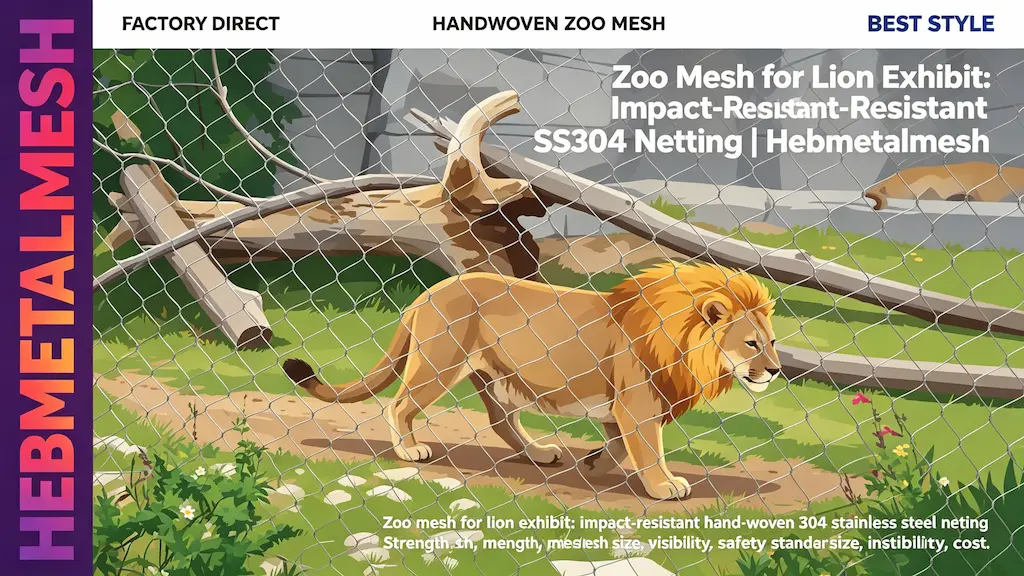
A lion cage fails for one reason that has nothing to do with its size: the barrier cannot survive a lion’s bite and swipe. Lions do not escape by cutting – they escape by deforming, abrading and levering, so the mesh must resist force, not just fill a gap. Lion pen netting – hand-woven stainless steel rope netting – is the material zoos and sanctuaries specify because it answers both problems at once. This guide gives the numbers that decide a safe pen: the aperture and cable diameter set by a lion’s bite force rating, the HM codes that map to each grade, and the honest cost range for a stainless enclosure.
Executive Summary
Lion pen netting is hand-woven stainless steel rope netting made from 304 or 316 wire rope crossed at a fixed pitch and joined at every crossing by a pressed ferrule pressed mesh sleeve. It beats welded and coated wire in a predator application because there is no coating to strip, no weld to corrode, and no zinc in the structure – and because a load bearing mesh panel keeps containing the animal even after one cable is cut, a property called structural redundancy. For an adult African lion, specify 3.2 mm cable at a 75-102 mm aperture; for a holding pen or juvenile, 2.4 mm at 51-76 mm. Carnivore grades plan out at $20-38 per square metre, woven to your drawing up to 9 m by 18 m. The reference specification is the lion enclosure mesh product page.
Quick Answer:
Quick Answer: For an adult African lion, specify 3.2 mm stainless cable at a 75-102 mm aperture (HM3276 or HM32102); for a holding pen or juvenile, drop to 2.4 mm cable at 51-76 mm. Hang the sheet from a rigid top rail, avoid galvanised or coated wire, and budget $20-38 per square metre of mesh.
Key Takeaways
- Force beats size. A lion deforms mesh with its jaws and paws; the cable diameter, not the pen volume, decides safety.
- Aperture contains, cable survives. Set aperture so the skull cannot pass; set cable so the bite and paw swipe force cannot deform it.
- 304 inland, 316 at the coast. Within about 5 km of salt water, the molybdenum in 316 pays for itself.
- One cut does not mean escape. Structural redundancy lets neighbouring cables carry the load of a damaged strand.
- Panels are cut to your drawing, so a single door panel can be reordered years later.
Accredited zoos design against published welfare standards; the World Association of Zoos and Aquariums publishes global animal welfare guidelines that most facilities reference when specifying a predator containment mesh.
Why a Lion Cage Is a Force Problem
The headline number for any lion barrier is the animal’s mouth. A lion’s bite force rating is published around 1,300 PSI (roughly 5,800-6,500 N) at the canine, and a paw swipe force from a striking forelimb sits in the same order of magnitude. Neither figure describes a clean cut – lions do not sever cable. They hook a loose strand, bend a thin bar, and peel an abraded coating. So the spec question is not “can the mesh be cut?” but “can the mesh be deformed or worked loose?” That is why claw resistance and attack load rating matter more than raw sharpness: a lion that can catch a strand and pull will eventually open a thin barrier.
This is also why a lion cage is not a bird cage scaled up. A parrot chews; a lion levers. The predator containment mesh grade that contains a lion is defined by cable diameter first and aperture second, and the cable diameter is set by the attack load rating you want the panel to shrug off, not by the gap you are trying to fill. For help choosing between grades, see which zoo mesh products suit a lion exhibit.
Lion Pen Netting Spec: Aperture and Cable
Lion pen netting aperture is written as aperture x aperture x cable diameter. Aperture is containment – set it so the smallest skull in the pen cannot pass, with margin for a juvenile. Cable diameter is the force answer. The table below maps each grade to an HM code from the mill list.
| Animal | Aperture | Cable | HM code | Weight | Indicative price/m² |
| Lion cub, small female | 51 mm | 2.4 mm | HM2450 / HM2476 | 1.2 kg/m² | $24-32 |
| Adult African lion | 75 mm | 3.2 mm | HM3276 | 1.6 kg/m² | $28-36 |
| Adult lion, male | 102 mm | 3.2 mm | HM32102 | 1.6 kg/m² | $30-38 |
| Holding pen, mixed | 51-76 mm | 2.4-3.2 mm | HM2476 / HM3276 | 1.4-1.6 kg/m² | $26-36 |
Stainless lion pen netting at 3.2 mm carries a break load well above any bite or swipe a lion can deliver, so the failure mode is never the cable parting – it is a loose strand or a badly bound edge. Lion pen netting thickness tracks the cable diameter; thicker is safer but heavier and dearer, so size it to the animal, not to caution. Lion pen netting weight runs about 1.2 kg/m² at 2.4 mm and 1.6 kg/m² at 3.2 mm, which sets the frame and fixing schedule. The full lion enclosure mesh range carries every HM code above.
Why Stainless Rope Beats Welded and Coated Wire
Most retail “lion cage” products are galvanised or powder-coated welded mesh, and both are wrong for an animal that works a barrier for a living. Galvanised wire carries a zinc coating; lead hides in soldered joints and brass clips. Neither is a problem the lion eats – it is a problem the lion abrades and the keepers breathe. Stainless rope has none of it: the sheet is 304 or 316 wire rope, and every crossing is a ferrule pressed mesh join, not a weld. For a closer look at the material itself, see our notes on stainless steel mesh for lion enclosures.
The second advantage is redundancy. Cut one cable in a welded panel and the panel fails at that weld; cut one cable in load bearing mesh rope netting and its neighbours pick up the load. That structural redundancy is the difference between a pen that holds after damage and a pen that spills its animal the moment a strand parts. Coated mesh fails the same way welded mesh does – the coating is exactly what a lion peels.
Lion Pen Netting Design, Corners and Doors
Lion pen netting design starts with the frame, because most home and even contracted pens fail at the corners. The perimeter frame tube should be a rigid box with a continuous top rail – panel tension loads the header first, and a header that deflects sags the sheet within a season. For a lion pen, step up to 50 mm OD stainless or powder-coated tube; bare stainless is safer outdoors. Our comprehensive lion enclosure build guide covers the frame in detail.
Lion pen netting corner detail is where installers improvise and lose. Do not butt two cut edges at a post – that leaves loose cable ends where the lion spends its time. Fold the sheet around the corner post, keep the weave continuous, and lace the fold through the outer row of apertures. Lion pen mesh door deserves more thought than it gets: order it pre-hung in its own welded stainless frame, bound by the weaver, and fit two different latches – a lion that watches one slide bolt open will open it. The door takes the same cable diameter as the walls.
Lion Pen Netting Installation
Lion pen netting installation is closer to rigging a sail than to assembling a cage. The sheet ships slack because the weave is not pre-tensioned – that is normal. Fix the top edge first along the rigid header using panel edge binding – a rope through the top row of apertures clamped to the rail – rather than individual clips, which pull the weave out of square. Then lion pen netting tensioning progresses from width to height a little at a time; a single hard pull is what produces the diamond distortion owners mistake for a fault. A perimeter tension cable through the bottom row stops a lion prising an edge at floor level. Re-tension after the first week, then annually.
Lion Pen Netting Cost
Lion pen mesh cost tracks steel weight, which rises with the square of cable diameter, and labour, which rises as aperture falls. At 3.2 mm the panel is heavy and the cross points are few, so the lion pen netting price lands in the carnivore band rather than the aviary band. Worked example: a lion holding pen 4 m wide, 3 m deep and 2.4 m high needs about 38 m² of wall and roof. At $28-36/m² for 3.2 mm cable, mesh alone is roughly $1,060-1,370; frame tube, door hardware and fixings typically add as much again. A lion pen netting supplier that quotes far below that is almost certainly undersizing the cable – read the HM code, not the headline.
Lion Pen Netting for Zoos and Sanctuaries
Lion pen netting for zoo installations differs from private holdings in three ways: higher visitor sightlines, stricter audit trails, and often a walk-in design where keepers share the space. The mesh grade is the same; what changes is the documentation – a zoo will want the mill certificate for cable diameter and break load, and a recorded lion pen netting maintenance schedule. The lion pen netting supplier you choose should supply both the cut panels and the binding details, not loose roll. The same stainless approach scales to any species through the animal fence mesh catalogue.
Lion Pen Netting Maintenance
Lion pen netting maintenance is a quarterly job. Rinse the sheet with fresh water on a low hose setting – never a pressure washer aimed at ferrules. Walk the fixing line for three things: a raised or cracked ferrule, any single strand lifted from the weave, and corrosion at a dissimilar-metal fixing. Act on a lifted strand immediately; a lion will have it out of the panel in an afternoon. Keep substrate dry and drainage clear so the pen does not pool underneath.
FAQ
75-102 mm aperture on 3.2 mm cable (HM3276 / HM32102). Drop to 51 mm on 2.4 mm cable for a cub or holding pen, because the containment test is the smallest skull in the pen.
No. Zinc and lead are the two hazards keepers worry about, and a lion abrades coatings by instinct. Use bare stainless rope netting and match all hardware to the alloy.
Not in the sense of parting it. A 3.2 mm 304 rope carries a break load far above any bite force rating a lion can produce. What a lion can do is work a loose strand loose – which is why tensioning and corner binding matter more than cable grade.
A 4 x 3 x 2.4 m holding pen needs about 38 m²; at $28-36/m² that is roughly $1,060-1,370 in mesh, with frame and hardware adding a similar amount.
304 inland. Choose 316 within about 5 km of salt water, or where the pen is washed with bore water.
Send us the animal, the pen dimensions and whether it sits indoors or outdoors, and we will return an aperture, a cable diameter and a budget range. Contact our engineering team.