
Executive Summary
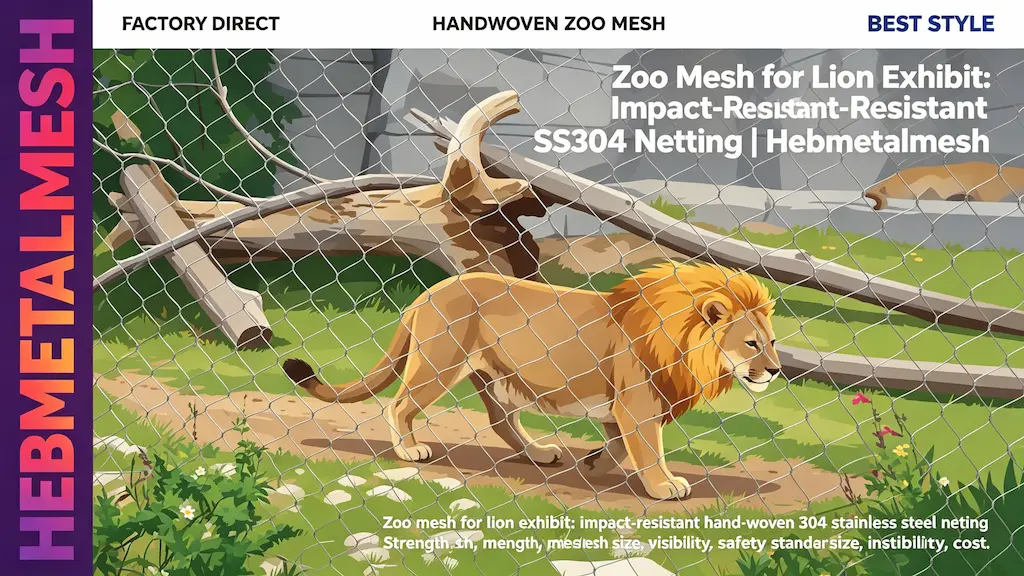
The best zoo mesh for a lion exhibit is hand-woven 304 stainless steel rope mesh. A male lion can weigh up to 190 kg, bite with a force measured in the hundreds of PSI, and test any barrier with claws and body weight — so the mesh must be impact-resistant, unclimbable, and effectively indestructible to the residents. This guide answers the question in the title directly: what material, what mesh size for a lion enclosure, how the mesh balances security with visibility, what safety standards apply, how it supports natural behaviors, and what installation and maintenance actually involve. The answer for any specifier is the heavy-duty lion enclosure netting product page.
Specifying Zoo Mesh for a Lion Exhibit? Get a Free Quote
Send us your lion group size, enclosure dimensions, and climate. We return a mesh grade, aperture, and cable diameter recommendation within 24 hours.
Request My Free Quote →Quick Answer: Which Zoo Mesh Is Best for a Lion Exhibit?
Hand-woven stainless steel rope mesh in 304 grade is the best zoo mesh for a lion exhibit. It is the only construction that combines all five requirements at once: impact resistance for a 190 kg animal that hits the barrier at speed, strength that a lion’s bite and claws cannot damage, transparency that keeps the exhibit open for visitors, an anti-climb surface that defeats scaling, and a service life measured in decades. The specification is a heavy-duty panel — typically 2 x 2 to 3 x 3 inch aperture in 3 mm to 4 mm stainless cable — verified against the actual residents. The lion enclosure netting range is built for exactly this job.
Key Takeaways
- Male lions reach 190 kg with a bite force in the hundreds of PSI; the mesh must survive both.
- Hand-woven stainless steel mesh has no welds, so it has no weld-joint failure mode.
- Aperture and cable diameter are set by the lion’s head, paw, and impact force — not by guesswork.
- Anti-climb design is geometry: smooth strands, small grip points, and a tensioned top edge.
- Transparency and security are set together, not traded against each other.
- Installation tension and border cables determine field performance more than panel price.
- 304 stainless steel suits most sites; 316 is specified for salt-air or coastal locations.
What a Lion Does to a Barrier
The first design fact is the animal. A male lion stands about 1.2 meters at the shoulder, weighs up to 190 kg, and delivers a bite force commonly cited in the hundreds of PSI — strong enough to crush bone. Lions also hit barriers at speed during chases and play, and they scratch, claw, and climb at the perimeter. Any enclosure barrier has to survive that force, applied daily, in the same spots, for decades.
The second design fact is the behavior. Lions are intelligent and persistent; an enclosure that reads as a puzzle will be investigated. They test the ground line, the corners, and the top edge. Welded wire fails at its joints — the weld bead is both the weak point and the gripping edge. Coated products lose their coating to claws and weather, then corrode from the damage site outward. This is why lion exhibit fencing, lion enclosure fencing mesh, and mesh for lion enclosure are specified as structural systems, not as fencing. The same logic applies at every scale, from lion cage mesh in holding areas to full exhibit panels.
Hand-Woven vs Welded vs Coated: The Material Comparison
The selection question is not whether to use mesh, but which construction survives a lion.
| Property | Hand-woven stainless steel mesh | Welded wire mesh | Coated / polymer mesh |
| Impact resistance | High — weave flexes and recovers | Low — rigid, welds fatigue | Low — strands stretch and sag |
| Bite and claw resistance | High — solid strands, no welds | Low — weld joints fail | Low — coating removed, then strands |
| Climb resistance | High — smooth round strands | Low — weld beads are gripping edges | Low — coating marks and tears |
| Corrosion | 304/316 stainless, no coating to lose | Galvanizing wears at contact points | Coating damage exposes core |
| Service life | Decades | Years | Years |
| Transparency | High at viewing distance | Moderate | Moderate |
Stainless steel lion mesh is part of the same technical family as every serious zoo build: solid stainless cable woven into panels, with no welds and no coating to fail. The weave absorbs impact without permanent deformation, and the smooth strand surface gives a lion nothing to grip — an impact-resistant mesh that stays intact for the life of the exhibit. For the broader material logic across zoo builds, our stainless steel rope mesh application guide is the reference.
Lion Enclosure Mesh Size: Aperture, Cable, and Panel Height
Two numbers define the spec: aperture and cable diameter. The lion enclosure mesh size starts with the animal’s head and paw. Aperture must be small enough that a head cannot pass and small enough that a paw cannot grip, while staying large enough to keep sightlines clear. Lion exhibits commonly use apertures in the 2 x 2 to 3 x 3 inch range, verified against the actual residents.
Cable diameter follows lion size and impact. Adult lions need heavy cable because they throw their full weight at the panel; 3 mm to 4 mm stainless cable is the working range for these exhibits. Panel height must clear the lion’s leap — lions are strong jumpers and the top of the enclosure is part of the containment, not a decoration. Lion enclosure mesh panels are specified as a complete envelope: aperture, cable diameter, panel dimensions, and top geometry listed together on one spec sheet. For species-specific dimensions, our lion enclosure mesh specification guide lists the standard options.
Design and Visibility: Transparency Without Risk
A lion exhibit is judged by what visitors see. The mesh must be transparent enough that a lion walking through grass reads as a wild scene, not a pattern of wire. Hand-woven stainless steel panels deliver this: high transparency at viewing distance, no glare, no visual noise. This is a visitor experience decision as much as an engineering one — clear sightlines are what make a lion exhibit memorable and what makes the public care about wildlife conservation.
Transparency and security are set together, not traded. The aperture that keeps a head out is the same aperture that keeps sightlines open; the two requirements are reconciled in the specification process, not by compromise. This balance is also why zoo mesh for lion exhibit — and lion exhibit netting generally — is specified as a complete system with the barrier, the viewing line, and the naturalistic setting designed as one unit.
Safety and Compliance: Lion Exhibit Safety Mesh
Lion exhibit safety mesh is judged by its worst possible contact, and the perimeter is a system. The ground line must be secured so the mesh cannot be pushed up from below; corners need reinforced border cable where two tension directions meet; panel seams need continuous clamps, never clips. The top edge needs a tensioned border cable and, for strong jumpers, an inward overhang or offset barrier. This is the anti-climb design that separates a lion enclosure from ordinary fencing.
For lion enclosure mesh for zoos, the visitor side matters as much as the animal side. Zoos commonly pair the mesh with a moat, a berm, or an offset barrier so the public is never within reach of the barrier itself, and the staff side uses double-door transfer systems that keep keepers out of the exhibit unless transfer gates are locked. Compliance with zoo safety standards is part of the specification, not an add-on. For the full checklist, our lion enclosure mesh safety guide covers the standards that apply.
Supporting Natural Behavior and Enrichment
A lion exhibit is a habitat, and the mesh is the envelope around it. Lions need space to move, patrol, and rest; the exhibit should include terrain variation, shade, and scent-marking points. Lion habitat mesh supports this in two ways: transparent panels let the animals see their environment and the surrounding territory without a visual wall, and the perimeter itself becomes part of the enrichment — lions patrol and scent-mark along the barrier line.
Natural behaviors — patrolling, marking, resting, social interaction — are the point of enrichment in a zoo setting, and they are supported by design rather than left to chance. An enriched exhibit reduces stress and stereotypic behavior, which is animal welfare delivered through structure. For guidance on building these spaces, our lion enclosure build guide walks through the full design, and the lion barrier mesh guide covers the containment system in detail.
Installation and Customization
Lion exhibit mesh installation is a precision job, and the field failures that close exhibits are almost always installation failures: sagging panels and loose edges. Sag appears when panels are not pre-stretched and tensioned to spec; loose edges appear when border cables are undersized or clamps skipped. Both turn a tensioned barrier into a slack net — and a slack net invites testing by the strongest resident.
Installation is a professional job, and lion enclosures add a customization layer: the mesh must follow natural terrain, clear existing trees, and allow future expansion. Panels are fabricated to the site layout rather than forced onto it. The installer works from the same spec sheet that selected the mesh, verifying aperture and tension on site. For the step-by-step procedure, our lion exhibit mesh installation guide covers the process, and the lion enclosure mesh buying guide covers what to check when sourcing panels.
Maintenance and Longevity
Hand-woven stainless steel netting is a low-maintenance system, and low maintenance means inspection, not neglect. The material needs no painting and no chemical treatment, which removes the largest recurring upkeep costs of coated alternatives. The open weave drains and dries quickly, and the panels clean with water and standard sanitizers.
The maintenance discipline is a scheduled perimeter check: tension, seams, clamps, and ground line, monthly as a baseline, with an immediate check after storms or any reported escape attempt. A loose clamp or a stretched border cable is an early warning that costs nothing to fix and a great deal to ignore. For the long-term picture, our lion enclosure mesh maintenance guide covers the routine, and what drives zoo enclosure fencing cost explains how the budget is structured.
Cost and Budget
Zoo mesh for lion exhibit costs more upfront than coated wire or polymer alternatives, and that comparison misses the point. The relevant number is cost per year of safe service: a stainless hand-woven panel that lasts decades without replacement, repainting, or weld repair is routinely the cheapest option over the exhibit’s life — even at a higher initial price.
The budget should also include the system, not just the panels: border cable, clamps, tensioning hardware, and professional installation are part of the containment. A cheaper mesh that requires frequent repair is more expensive in total cost of ownership. For a detailed breakdown, see the lion enclosure mesh cost guide.
FAQ
Hand-woven stainless steel rope mesh in 304 grade. It is impact-resistant, unchewable by a lion’s bite and claws, transparent, anti-climb, and lasts decades without coating or painting.
Apertures in the 2 x 2 to 3 x 3 inch range are common, verified against the head and paw of the actual residents. Cable diameter commonly 3 mm to 4 mm for adult lions. Specify aperture, cable, and panel height together.
No. Stainless steel rope mesh is structurally unbreakable by a lion’s bite, claws, or impact, and the smooth round strands give the animal nothing to grip. Welded and coated products are the ones that fail.
Anti-climb design: smooth strands, an aperture too small to grip, a tensioned top edge, and an inward overhang or offset barrier for strong jumpers. The mesh is the containment medium; the top geometry is the escape prevention system.
Monthly as a baseline — tension, seams, clamps, and ground line — with an immediate check after storms or escape attempts. Daily visual checks of gates and locks are standard keeper practice.
Conclusion
The best zoo mesh for a lion exhibit is the one specified for the animal, and the whole enclosure design follows from that spec: hand-woven 304 stainless steel rope mesh, with aperture and cable diameter set by the residents, anti-climb top geometry, professional installation to tension, and inspection on a schedule. Done that way, the mesh holds a 190 kg predator, disappears from the visitor’s view, and earns its cost across a decades-long service life. For a look at how lion enclosures compare to alternative constructions, our lion enclosure mesh comparison is a useful next read.
If you are ready to spec your build, send us your lion group and dimensions. We will confirm the lion habitat mesh specification that fits your animals, your climate, and your budget.
Ready to Spec Your Lion Exhibit?
Tell us the lion group size, enclosure footprint, and site climate. We reply with a mesh grade, aperture, and cable diameter recommendation within 24 hours.
Talk to a Mesh Specialist →