1. Executive Summary
A mesh barrier fence is a high-performance safety and security boundary designed to provide maximum protection without compromising visibility, airflow, or aesthetics. Unlike traditional solid walls or heavy iron railings, modern mesh systems—specifically stainless steel rope mesh and high-tensile wire—utilize a “strength-through-tension” principle. This allows the barrier to absorb significant kinetic energy, making it ideal for fall protection, animal enclosures, and architectural security.
In 2026, the industry has shifted away from rigid, rust-prone materials toward flexible, 304/316-grade stainless steel systems that offer a 30-year lifespan with zero maintenance. Whether you are securing an industrial mezzanine, a public bridge, or a high-end landscape project, the right mesh barrier balances aperture size (opening) and wire diameter to meet specific safety codes while remaining nearly invisible from a distance.
2. Introduction: Why the Right Barrier Matters
When we think of a “fence,” the mind often jumps to wood pickets or heavy chain links. However, in modern construction and safety management, the requirements have evolved. We no longer just need to “block” an area; we need to protect it intelligently. This is where the mesh barrier fence enters the spotlight as the most versatile tool in a designer’s or safety officer’s kit.
Safety vs. Aesthetics: The Modern Dilemma
For decades, safety came at the cost of beauty. If you wanted a fall-protection barrier on a balcony or a security fence around a luxury facility, you had to settle for bulky metal bars that felt like a cage. This “institutional” look is increasingly unacceptable in modern architecture.
The primary goal of a high-quality mesh barrier is to solve this dilemma. By utilizing thin, high-strength cables woven into a diamond pattern, these fences provide:
- Unobstructed Views: Essential for observation decks and zoos.
- Passive Safety: The mesh “gives” slightly upon impact, reducing injury compared to hitting a solid surface.
- Environmental Integration: It allows plants to climb and air to flow, preventing the “wind sail” effect that topples solid fences during storms.
The Problem with “Standard” Solutions
Many project managers default to cheap plastic netting or basic galvanized chain link. While these work in the short term, they quickly become liabilities. Plastic degrades under UV light within 24 months, and standard galvanization eventually succumbs to “white rust” in humid or coastal environments.
As we explore the different types of mesh in this guide, it is important to look beyond the initial price tag. A barrier is only as good as its weakest link—literally. If the mesh fails under a load or loses its structural integrity due to corrosion, the “barrier” is nothing more than a false sense of security.
3. Types of Mesh Barrier Fence: Choosing the Right Infrastructure
Selecting a mesh barrier fence isn’t a “one-size-fits-all” decision. The architecture of the mesh—how the wires are connected—dictates how the barrier will perform under pressure, how long it will last, and how it will look. To help you navigate the options, we’ve broken down the four primary categories used in modern construction and safety.
3.1 Rigid Welded Wire Mesh
Welded wire mesh is created by laying longitudinal and transverse wires over each other and “spot welding” them at every intersection. This creates a stiff, grid-like panel.
- Best For: Perimeter security, garden fencing, and industrial partitions.
- Pros: High structural rigidity; it doesn’t sag over time.
- Cons: Not suitable for curved surfaces; welds can become points of failure if they rust.
3.2 Chain Link (The Traditional Choice)
Perhaps the most recognizable mesh barrier fence, chain link is made by weaving a continuous wire into a zig-zag pattern.
- Best For: Temporary construction sites, backyards, and sports fields.
- Pros: Low initial cost and widely available.
- Cons: Low aesthetic value; can be easily cut with standard wire cutters; bulky to transport.
3.3 Stainless Steel Rope Mesh (The Premium Alternative)
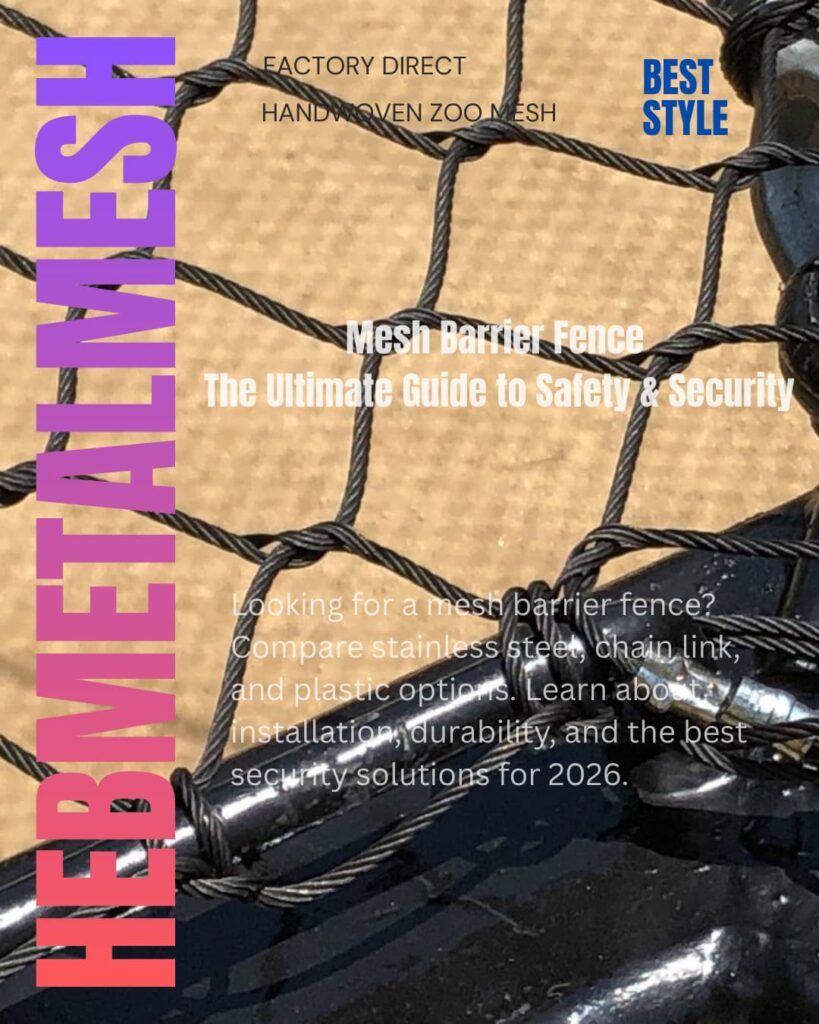
This is the “gold standard” for modern safety and architectural design. Unlike welded mesh, this is a flexible fabric made of high-tensile stainless steel cables. These cables are either knotted together or joined by seamless stainless steel ferrules.
- Best For: Fall protection on bridges, zoo enclosures (aviaries/big cat cages), green walls, and high-end balcony railings.
- Pros: * Elasticity: It can absorb heavy impacts (like a falling person or a lunging animal) without breaking.
- Transparency: From 10 meters away, the mesh becomes virtually invisible.
- Adaptability: It can be stretched over complex 3D shapes or irregular frames.
- Cons: Higher upfront cost than plastic or chain link, but offset by a 30-year lifespan.
3.4 Synthetic & Plastic Safety Netting
Often seen in bright orange at construction sites, synthetic mesh is made from polyethylene or nylon.
- Best For: Temporary debris containment and short-term crowd control.
- Pros: Extremely lightweight and cheap.
- Cons: Rapidly degrades under UV sunlight; low breaking strength; not a permanent security solution.
Comparison Summary: Which one fits your project?
| Feature | Plastic Mesh | Chain Link | Stainless Steel Rope Mesh |
|---|---|---|---|
| Durability | Low (1-2 years) | Medium (5-10 years) | High (30+ years) |
| Aesthetics | Poor / Industrial | Basic / Utility | Premium / Invisible |
| Flexibility | High | Low (Rigid) | Very High (3D Shapes) |
| Maintenance | Frequent Replacement | Painting / Rust Treatment | Zero Maintenance |
| Best Use Case | Temporary Site Safety | General Fencing | Safety, Zoos & Architecture |
4. Key Applications: Where Mesh Barrier Fences Excel
A mesh barrier fence is rarely just a “fence”—it is a specialized engineering component. Because different environments present different stresses (UV radiation, physical impact, or corrosive saltwater), the application determines the mesh specifications.
Below are the four primary sectors where high-performance mesh barriers are replacing traditional materials.
4.1 Industrial Safety & Fall Protection
In warehouses, factories, and construction sites, the “Drop Zone” is a major liability. OSHA and international safety standards require barriers that can catch falling objects or, more importantly, stop a human fall.
- The Solution: High-tensile stainless steel rope mesh is used as a safety net under skylights, along mezzanines, and on helipads.
- Why it works: Unlike rigid steel bars, flexible mesh has elasticity. If a worker falls into the mesh, the barrier deforms slightly to absorb the kinetic energy, reducing the force of impact on the person’s body.
4.2 Architectural Accents & Green Walls
Modern architects use mesh to create “Living Walls” or “Green Facades.” By installing a large-scale mesh barrier across a building’s exterior, designers provide a trellis for climbing plants.
- The Solution: 316-grade stainless steel mesh acts as a permanent, weather-resistant skeleton for vegetation.
- Why it works: It provides a high surface area for plants to grip while remaining lightweight enough that it doesn’t add significant “dead load” to the building’s structural frame.
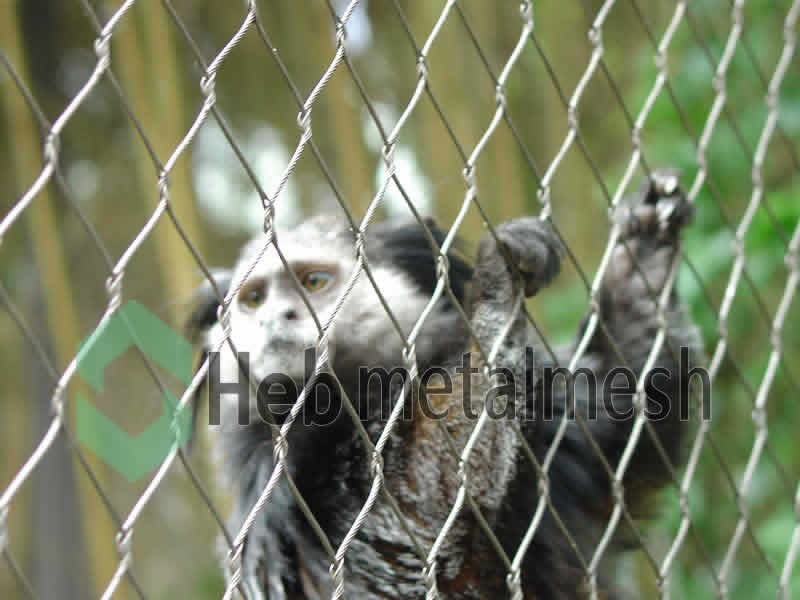
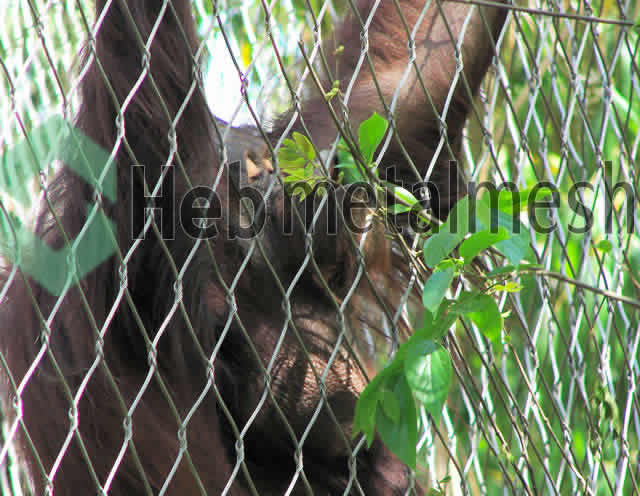
4.3 Zoo & Animal Enclosures (The “Invisible” Cage)
In zoo design, the goal is to keep the animals safe and the public secure while making the barrier “disappear” for a better viewing experience.
- The Solution: Hand-woven or ferrule-type rope mesh with a black oxide finish.
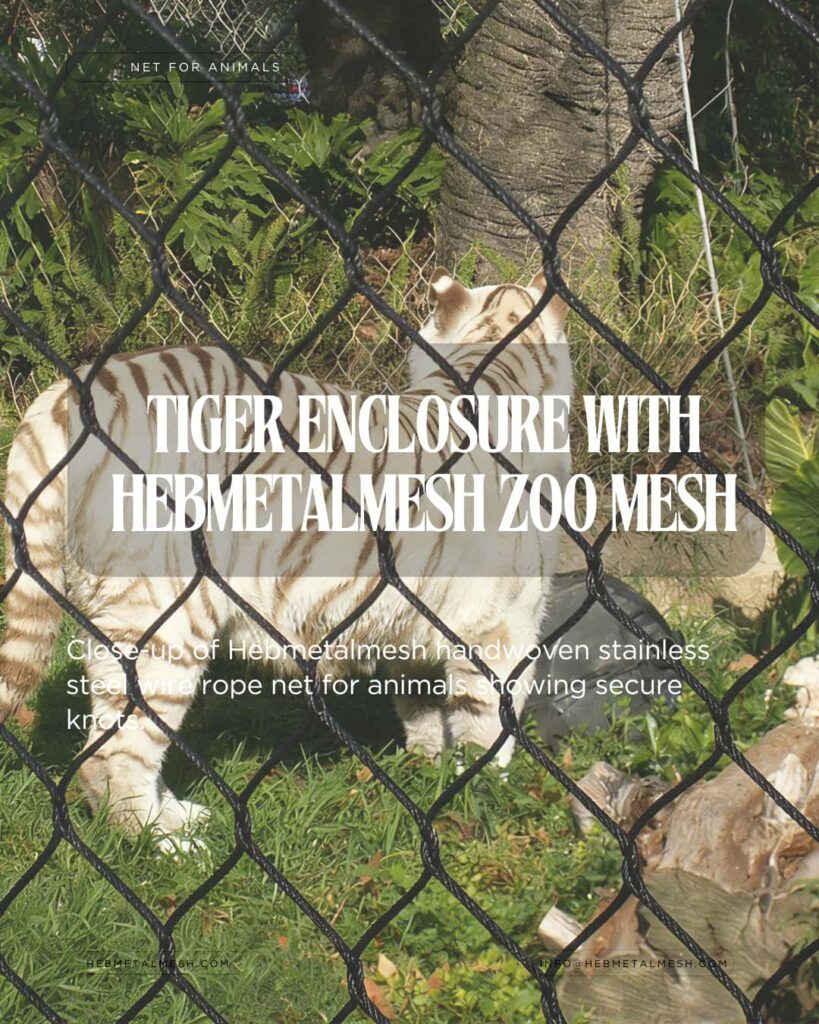
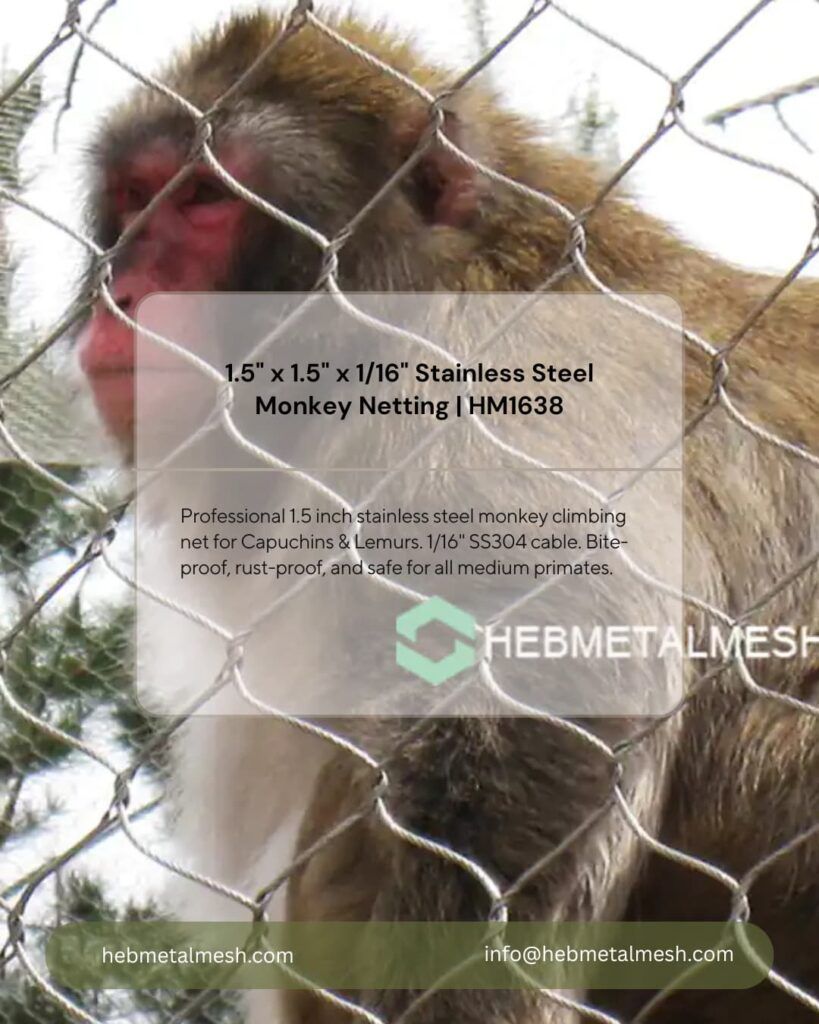
- Why it works: The diamond pattern and thin wire diameters allow for 90% + transparency. When the mesh is finished in matte black, it absorbs light rather than reflecting it, making the fence nearly invisible to the human eye and camera lenses. It is also “monkey-proof”—primates cannot get a grip on the smooth wire to tear it, and it won’t hurt their hands or fur.
4.4 Residential & Public Security
From high-end balcony railings to public bridge suicide prevention barriers, mesh offers a “soft” security look that doesn’t feel oppressive.
- The Solution: Perimeter mesh fencing for luxury homes or public parks.
- Why it works: It provides a climb-resistant surface (the diamond apertures are too small for foot-holds) while allowing the natural landscape to remain visible. It turns a security necessity into a design feature.
5. Material Science: Why Grade 304/316 Stainless Steel Wins
When researching a mesh barrier fence, you will encounter different “Grades” of metal. This is the most critical technical decision you will make, as it determines if your fence will last 3 years or 30 years.
The Anatomy of 316 Stainless Steel
At Hebmetalmesh, we primarily recommend Grade 316 for outdoor applications. But why?
- Molybdenum Content: Grade 316 contains Molybdenum, which Grade 304 does not. This element provides incredible resistance to pitting corrosion, especially in “chloride” environments (near the ocean or roads where de-icing salt is used).
- Tensile Strength: Stainless steel rope is constructed like a miniature bridge cable. A standard 7 x 7 or 7 x 19 strand construction ensures that even if one individual wire is nicked, the overall cable maintains its structural integrity.
The Life-Cycle Cost (LCC)
While a galvanized or plastic mesh might be 50% cheaper today, the Life-Cycle Cost of stainless steel is significantly lower.
LCC = C + M + R
Where:
- C = Initial Cost
- M = Maintenance (Cleaning/Painting)
- R = Replacement Cost
With stainless steel mesh, M and R are effectively zero for several decades. This makes it the most sustainable and cost-effective choice for long-term infrastructure.
6. Installation Deep Dive: How to Tension and Secure Mesh
Installing a mesh barrier fence—specifically a flexible rope mesh—is different from installing a traditional wooden or chain-link fence. Because the strength of the barrier comes from its tension, the framing and the perimeter cables are the most critical components.
6.1 The Perimeter Frame
A flexible mesh cannot stand on its own; it requires a rigid support structure. This is typically a stainless steel tube frame or a series of high-tension perimeter cables anchored into stone, concrete, or steel posts.
- Tube Framing: The mesh is laced directly to a round or square tube. This provides a clean, modern “panel” look.
- Cable Border: A thicker “border cable” is run through the edge of the mesh and tensioned at the corners. This is often used for large-scale bridge safety or zoo aviaries.
6.2 The Lacing Process
To connect the mesh to the frame, we use lacing wire. This involves wrapping a single strand of wire through the mesh apertures and around the frame.
- Alignment: Position the mesh inside the frame, ensuring the diamond pattern is oriented correctly (usually vertical).
- Point Attachment: Use temporary zip-ties to hold the mesh in place at the corners.
- The Spiral Wrap: Thread the lacing wire through every mesh eyelet and around the tube. This ensures the load is distributed evenly across the entire frame.
- Final Tensioning: Using a wire puller or turnbuckles, tighten the perimeter until the mesh is “drum-tight.” A properly tensioned mesh should have very little “give” when pushed by hand.
6.3 Technical Tip: The Opening Angle
The standard opening angle for a diamond mesh barrier is 60° to 90°.
- Narrower angles provide more height but less width.
- Wider angles provide maximum strength but require more material.Achieving the perfect 60° angle ensures the mesh looks symmetrical and performs according to its rated breaking strength.
7. Maintenance & Longevity: The 30-Year Solution
One of the biggest selling points of a high-quality mesh barrier fence—particularly those made from Grade 316 stainless steel—is that they are virtually maintenance-free. However, understanding how to care for them ensures they look brand new for decades.
7.1 Resistance to the Elements
Unlike galvanized steel, which relies on a zinc coating that eventually wears off, stainless steel is “self-healing.” It forms a microscopic chromium-oxide layer on its surface. If the mesh is scratched, this layer reforms instantly in the presence of oxygen, preventing rust from ever taking hold.
7.2 Cleaning Procedures
In most environments, rainfall is enough to keep a mesh barrier clean. However, in high-pollution urban areas or coastal regions with heavy salt spray, a simple cleaning schedule is recommended:
- Frequency: Once every 1–2 years.
- Method: Rinse with pressurized fresh water.
- Detergent: For stubborn dirt, use a mild, pH-neutral soap. Avoid abrasive scrubbers or bleach, which can dull the finish.
7.3 Long-Term Cost Analysis (ROI)
When budgeting for a barrier, you must look at the Total Cost of Ownership (TCO).
| Timeline | Plastic Safety Mesh | Galvanized Chain Link | Hebmetalmesh SS Rope |
|---|---|---|---|
| Year 1 (Initial) | $ (Very Low) | $$ (Moderate) | $$$ (Premium) |
| Year 5 | Full Replacement Needed | Rust Spot Treatment | $0 (Zero Maintenance) |
| Year 15 | 6th Replacement Cycle | Total Structural Failure | $0 (Still Like New) |
| The Verdict | Expensive over time | High labor cost | Best Lifetime ROI |
The Verdict: While the initial investment for a stainless steel mesh barrier fence is higher, it pays for itself by Year 7 through the elimination of replacement and repair costs.
8. The “Invisible” Barrier: Balancing Security with Unobstructed Views
One of the most frequent challenges in modern architecture is the need for a mesh barrier fence that provides maximum safety without creating a “boxed-in” feeling. Traditional fencing materials like wood or chain link create a visual wall, slicing through the landscape and blocking natural light.
High-performance stainless steel rope mesh solves this by functioning as an “invisible barrier.” ### 8.1 The Optical Illusion of Transparency
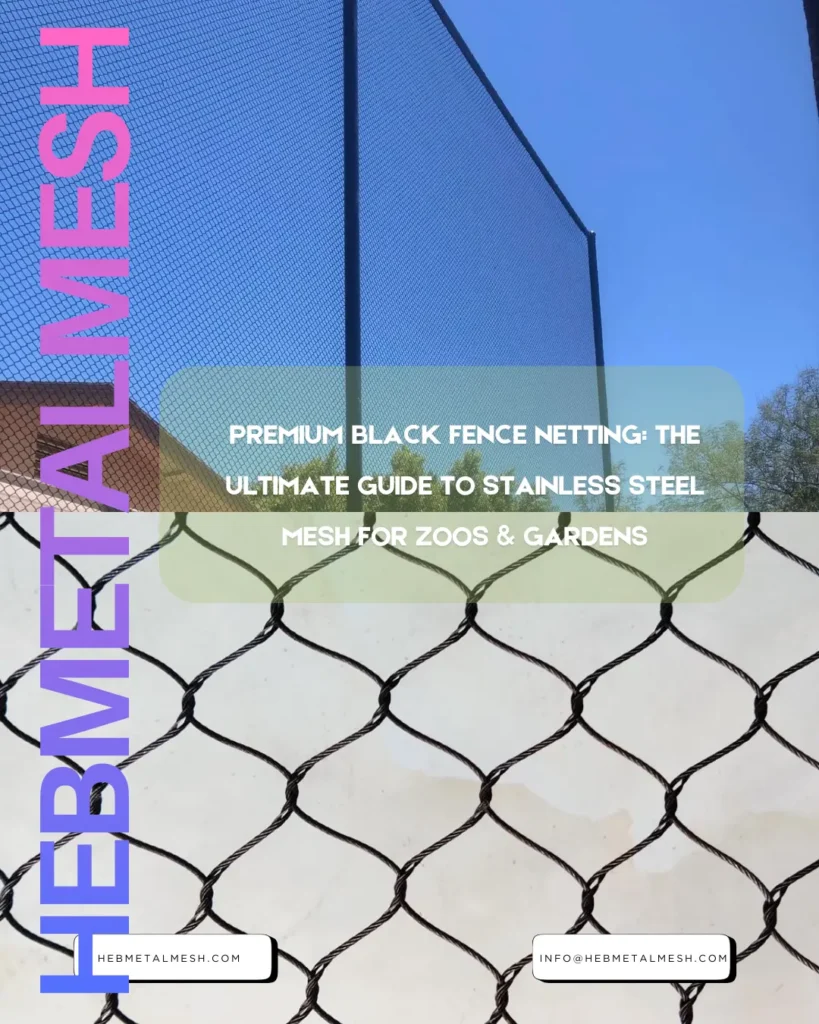
The transparency of a mesh barrier is determined by the ratio of the wire diameter to the aperture (opening) size. At Hebmetalmesh, we often recommend a specific combination—such as a $1.5mm$ wire with a $60mm$ opening—which results in over 95% open area.
From a distance of just a few meters, the human eye focuses on the scenery behind the mesh rather than the wires themselves. This is why it is the preferred choice for:
- Observation Decks: Providing fall protection without ruining the photo opportunity.
- Residential Balconies: Keeping children and pets safe while maintaining a clear view of the garden or city skyline.
- Public Parks: Creating boundaries that don’t disrupt the flow of the natural environment.
8.2 The Black Oxide Finish
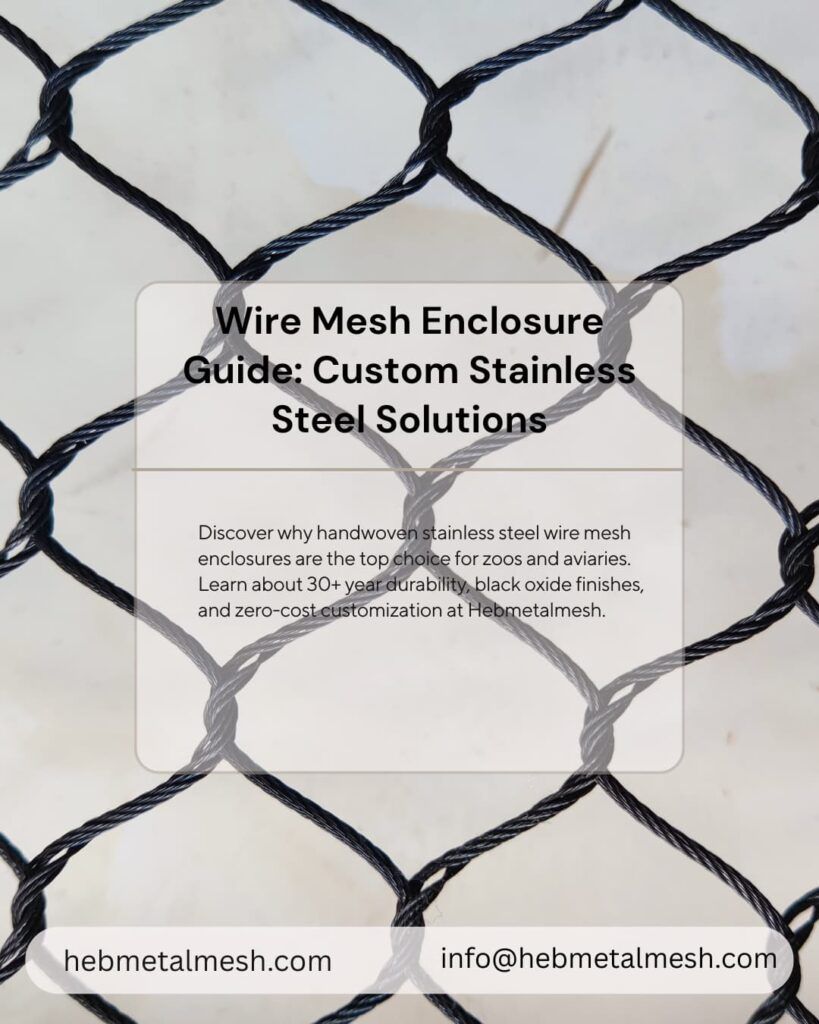
If your goal is total “invisibility,” the finish of the steel matters as much as the thickness. While natural stainless steel has a beautiful metallic sheen, it reflects sunlight. To counter this, many projects utilize a Black Oxide finish.
Design Tip: A matte black mesh barrier absorbs light and shadows. When placed against a background of trees or water, the black wire virtually disappears, providing a seamless transition between the protected area and the horizon.
9. Conclusion: Investing in Long-Term Safety
Choosing a mesh barrier fence is a decision that impacts the safety, aesthetics, and maintenance budget of a project for decades to come. While temporary or low-cost materials like plastic or galvanized wire may seem attractive initially, they often result in higher long-term costs due to weather degradation, rust, and the need for frequent replacement.
By opting for a high-tensile, stainless steel rope mesh system, you are investing in a “set-and-forget” solution. These barriers offer:
- Unmatched Durability: Resistant to UV, salt, and extreme physical impact.
- Design Versatility: Capable of following complex curves and 3D shapes.
- Peace of Mind: Knowing that the barrier meets international safety standards for fall protection and animal containment.
Building Your Project with Hebmetalmesh
At Hebmetalmesh, we have spent years perfecting the art of the flexible mesh barrier. Our focus is on providing high-grade 304 and 316 stainless steel solutions that serve the world’s most demanding architectural and industrial projects.
Whether you are an architect designing a new public space, a zoo director planning a naturalistic habitat, or a homeowner looking for premium balcony safety, our mission is to provide the raw material and the expertise to make your vision a reality.
Ready to see the difference for yourself? Explore our full range of technical specifications and customization options on our main site, or visit our online store to find the perfect mesh for your next project.
10. Frequently Asked Questions (FAQ)
A: While both are high-quality alloys, Grade 316 contains molybdenum, which provides significantly higher resistance to corrosion, especially in “salty” or coastal environments (within 5 miles of the ocean). Grade 304 is an excellent, cost-effective choice for inland or indoor applications where direct exposure to de-icing salts or sea spray is not a concern.
A: This depends entirely on the application. For animal enclosures, the aperture should be small enough that the animal cannot get its head or limbs through. For human fall protection, a wire diameter of $1.5mm$ to $3.0mm$ with a $60mm$ to $80mm$ diamond opening is standard. A smaller aperture increases the breaking strength but also increases the weight and cost of the mesh.
A: One of the greatest advantages of flexible rope mesh is its ability to follow irregular shapes. Unlike rigid welded panels, rope mesh behaves like a metallic fabric. It can be stretched over circular frames, draped across bridge cables, or wrapped around cylindrical structures without losing its structural integrity.
A: Yes. While the natural “silver” metallic look is popular, we also offer a Black Oxide finish. This is not a paint; it is a chemical treatment that darkens the steel. It is highly recommended for zoo exhibits and high-end architecture because it reduces glare and makes the mesh nearly invisible against dark backgrounds.
A: Because a mesh barrier is mostly open space (often over 90% open area), it has an extremely low wind resistance coefficient. This makes it far safer than solid fences or glass barriers in high-wind areas, as the wind passes through the mesh rather than pushing against it. This prevents “structural fatigue” on the posts and framing.