
Ask five homeowners who owns the fence between two houses and you will get five confident answers. Boundary fence ownership is three questions wearing one coat. Whose land does the line run on, how high may the structure stand, and which way does the finished face look? The first two are settled by survey, deed and local ordinance. The third is settled by the panel itself — the only one of the three a supplier can change, because a woven stainless steel mesh panel has no face to turn.
Executive Summary
A boundary fence is a product and a legal object at once, and the legal object comes first. In most cases whoever paid for and erected the fence owns it, even when it sits inside their own line; where it straddles the line it becomes shared property. About two meters of height, a setback and a front-yard rule are the numbers local codes enforce, and a short written agreement between the owners is the cheapest instrument either will ever sign. The good side — the tidy face — is a courtesy invented for solid panels, and it exists because a solid fence looks different from behind. A woven rope mesh panel does not. At 88 to 94 percent open area it reads the same from both sides, takes no daylight and no view, and follows a line that is not straight. The reference specification is the animal fence mesh product page.
Settling the line before you buy the panel?
Send the run length, the height you are allowed and the species or use, and we will come back with an aperture and cable schedule that fits the frame you have.
Quick Answer:
Who owns a boundary fence? Usually whoever erected it, and the property deed plus any party wall agreement settle the rest. Which way should it face? The smooth side traditionally faces the neighbor. Do you need permission? In many places a rear fence below about two meters needs none; front-yard, corner-lot and taller fences usually do. What does mesh change? A transparent woven panel has no smooth side, so the facing question disappears — and so does the loss of light and view that turns most boundary fences into a disagreement.
Key Takeaways
- Ownership follows who built the fence and what the deed records, not which way the rails face.
- The good side is a convention built for solid panels. A mesh panel has no good side and no bad side.
- Height, the front-yard line and the corner sight triangle are the three rules that decide most disputes.
- A boundary that curves or steps with the ground is cheaper to follow in flexible mesh than in rigid panels.
- A fence across a right of way can be ordered down at the owner’s cost, whoever owns it.
Trade bodies such as the American Fence Association treat the fence line and the property boundary as two separate measurements, so a survey is nearly always cheaper than the argument that follows one.
The Property Line and the Fence Line Are Two Different Lines
A surveyor’s boundary marker and your fence posts are rarely in the same place. The property boundary is a legal line fixed by the property deed and re-established by survey. The fence line is where the structure physically stands, normally set a hand’s width inside so that no part of it crosses over. The practical boundary fence rules follow from that gap. Build inside your own line and nobody can touch the fence. Build astride it and you have created shared property by accident. Build past it and you have an encroachment, which can end in a court order to move the structure.
It is also why an adjoining landowner fence cannot be used as a free post. A neighbor may not fix a panel, a trellis or a sign to your fence without permission, and you may not hang the same load on theirs. A netting for fence detail that carries its load into your own posts and ground keeps two structures genuinely independent.
Who Owns a Boundary Fence, and Who Is Responsible for It
Who owns the boundary fence is answered by erection, not by geometry. The owner who paid for and built the fence owns it, even if every rail faces outward, and ownership carries one clear duty: boundary fence maintenance is the owner’s job. A party fence — built astride the line with the consent of both sides — is jointly owned, and neither side may take it down alone. Boundary fence law varies by state, and most of the variation is about cost recovery. Many states keep a partition-fence statute on the books, largely for agricultural land, which lets one owner build a line fence and recover a share of the cost from the adjoining owner.
Two points of fence responsibility surprise owners most often. You cannot force a neighbor to replace a fence that is merely ugly, provided it is safe and whole. And if you own the fence and it later becomes dangerous, the duty to mend it is yours, however long the neighbor has been looking at it.
The Good-Side Convention: Which Way a Solid Fence Faces
The fence good side is the milled, sanded or painted face; rails, posts and fasteners make up the back. The convention that the good side of the fence faces outward, toward the neighbor, exists because a solid panel has two different faces and somebody must look at the poorer one. It carries no legal force in most jurisdictions; where it does bite it is usually a subdivision covenant rather than a statute.
A fence facing neighbor is therefore a courtesy, and a contested one, because the side that receives the tidy face also receives the shade. Where the structure is a true party wall fence — astride the line and jointly owned — neither owner has a claim to the good side, and neither may reverse it alone. On a shared boundary fence the only workable rule is the written one: record which face looks where, and neither owner re-argues it at every sale.
Height, Permission and the Numbers Local Rules Enforce
Height is the rule that generates the paperwork. A rear boundary fence is commonly allowed to about two meters, roughly six and a half feet, without consent, while the same fence in a front yard is often capped far lower so that sight lines along the street stay open. Two limits catch people out. A corner lot carries a sight triangle at the intersection, inside which nothing may be built above about a meter. And a pool or a raised deck beyond a certain depth can pull in a separate barrier code that ignores the fence allowance entirely.
None of this changes the panel; it changes the frame. Set the clear height the code permits, then let the mesh span between posts. Our notes on deer fence height requirements make the same point in a different setting, where the number is set by what the animal can clear rather than by a zoning schedule.
Where a Woven Mesh Panel Changes the Answer
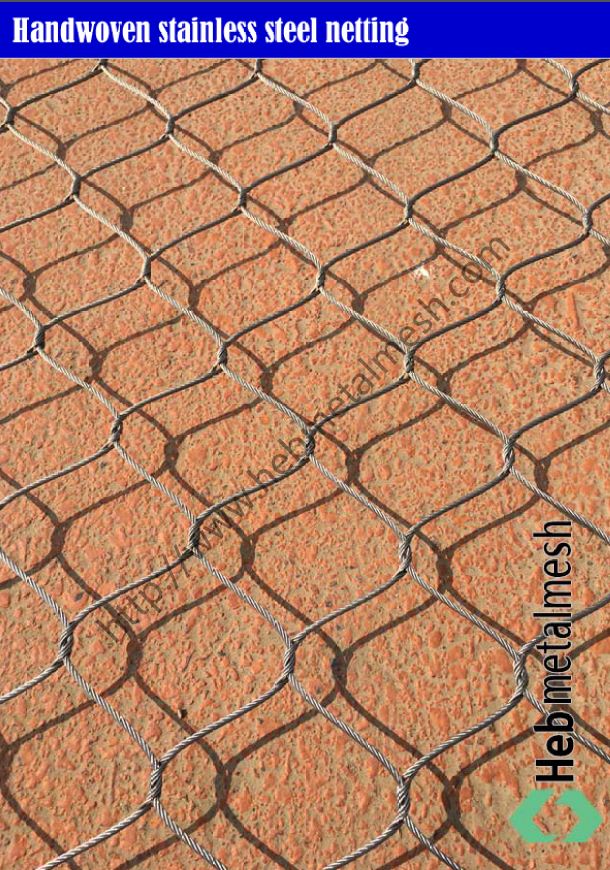
A woven rope panel is the same structure from both sides — no milled face, no rail side, no back — and that alone removes the most common cause of neighborhood friction. Because open area runs from about 88 percent at a tight aperture to 94 percent at a wide one, the panel costs a neighbor almost no daylight and no view, which is what a solid boundary fence is usually argued about.
The material is stainless steel rope from 1.2 mm to 3.2 mm over apertures from 20 mm to 102 mm, in grade 304 inland and grade 316 where salt air is a factor — the molybdenum addition is what buys the coastal years. Panels run up to 9 m by 18 m, so a long run closes with far fewer joints, and the finish is either natural or black oxide for a low-glare boundary that reads as a shadow rather than a structure. Because a handwoven panel is a textile, it takes up a curve and steps with the ground where a rigid panel needs a joint at every turn.
Standard codes run from HM1220, a 1.2 mm rope over a 20 mm aperture, to HM32102, a 3.2 mm rope over 102 mm; HM2076 and HM3276 cover most boundary work. As a planning range, not a quotation, aviary-grade mesh runs about $10 to $22 per square meter and carnivore-grade about $20 to $38, with fixings, edge cable and tensioners adding 10 to 20 percent. A welded grid fails at the fused intersection where weld heat has already weakened the wire. A handwoven panel is built from 7×7 rope — 49 wires to a strand — so one broken wire costs about two percent of that strand’s capacity while the panel stays tensioned. The full aperture and cable schedule sits on the animal fence mesh product page.
Easements, Rights of Way and the Setback Line
An easement is somebody else’s right to cross or use part of your land, and it survives whatever you build over it. A fence easement granted to a utility, a neighbor or a highway authority means the fence across it can be removed at the building owner’s cost, and being there first does not help. A right of way carries the same weight: block it and you invite an order rather than a discussion. The setback line is the related trap. In many subdivisions the distance you must keep from the boundary exceeds the boundary itself, so the true building line sits inside your own ground.
Read the property deed before a post hole is dug. The deed, the recorded plat and any easement document decide where the fence may stand, and they are usually available from the county recorder for the price of a download. A boundary marker, once located and photographed, is the cheapest evidence an owner can hold.
When the Line Is Disputed
Most fence line dispute cases are not about law at all; they are about a fence that has drifted. An old line, re-erected twice on the same posts, can wander half a meter from the surveyed boundary, and a line never marked invites the same drift. A hedge planted a generation ago on the wrong side is the second common cause, and a new build that assumed the neighbor’s fence marked the boundary is the third.
The instrument that ends the argument is a boundary fence agreement — one page carrying a sketch, two names, a date and the position of the line as both owners accept it, signed and filed with the property deed. It costs almost nothing, binds the next buyer as firmly as the current owner, and turns a recurring argument into a document. Where a shared structure is involved, the same discipline applies: consent in writing is what makes it safe to maintain — the point made in a very different setting by our guide to an apartment aviary, where the structure is a volume inside somebody else’s building.
Keeping the Line Maintained Without Trespass
Boundary fence maintenance is a narrow right, not a license to wander. An owner may usually enter a neighbor’s land by prior arrangement to repair a fence they own, having given notice and caused no damage; there is no general right to cross whenever a repair suits. A stainless mesh boundary changes the shape of that problem, not its existence. There is nothing to paint, nothing to stain and no coating to renew, so the annual task list collapses to one walk along the line to check tension, fixings and the ground line — and the ground line is where a metal boundary fails first.
The other half of maintenance is choosing a panel that does not need the visit. The failure order of a boundary fence is a chain of components rather than one material, and wire panels for fence works through where the life of a run ends.
Frequently Asked Questions
Usually whoever erected it, and the property deed plus any party wall agreement settle the rest. Ownership does not follow the direction the rails face.
The smooth side traditionally faces the neighbor — a convention rather than a law in most places. A transparent mesh panel makes the question moot because it has no smooth side.
Often not for a rear fence below about two meters, and often yes for a front-yard fence, a corner lot or anything taller. Check the local ordinance and any covenant before you order.
Yes. It marks the line, is owned the same way and carries the same easement limits. It simply does not block light or view, which is what most solid boundary fences end up being argued about.
Tell us the run length, the height your code allows and what the boundary has to hold, and we will set the aperture and cable diameter for it. Send the details to our team.