
Key Takeaways
- A monkey fence is not just any barrier; it’s a specialized system using handwoven stainless steel mesh that balances animal welfare and safety.
- Hebmetalmesh provides customized fencing solutions that reduce costs and enhance durability, making it the global standard for primate containment.
- Stainless steel mesh is corrosion-resistant, chew-proof, and offers high visibility, ensuring an unobstructed view for visitors while keeping primates safe.
- The selection of wire diameter and aperture size depends on the primate species, ensuring appropriate security and safety in enclosures.
- Hebmetalmesh is virtually maintenance-free, providing significant long-term savings compared to traditional fencing options.
When it comes to primate containment, the stakes are incredibly high. Primates are among the most intelligent, dexterous, and physically powerful animals in any zoological setting. A “monkey fence” is not just a barrier; it is a complex engineering solution that must balance animal welfare, visitor safety, and aesthetic transparency.
As the owners of Hebmetalmesh, we have spent years perfecting the art of handwoven stainless steel rope mesh. In this guide, we will explore why stainless steel mesh has become the global standard for monkey enclosures and how our customized solutions can save your facility time and money.
Unlike disposable nylon barriers, zoo-grade primate enclosure mesh resists chewing, rust and decades of outdoor exposure.
1. What is a Monkey Fence?
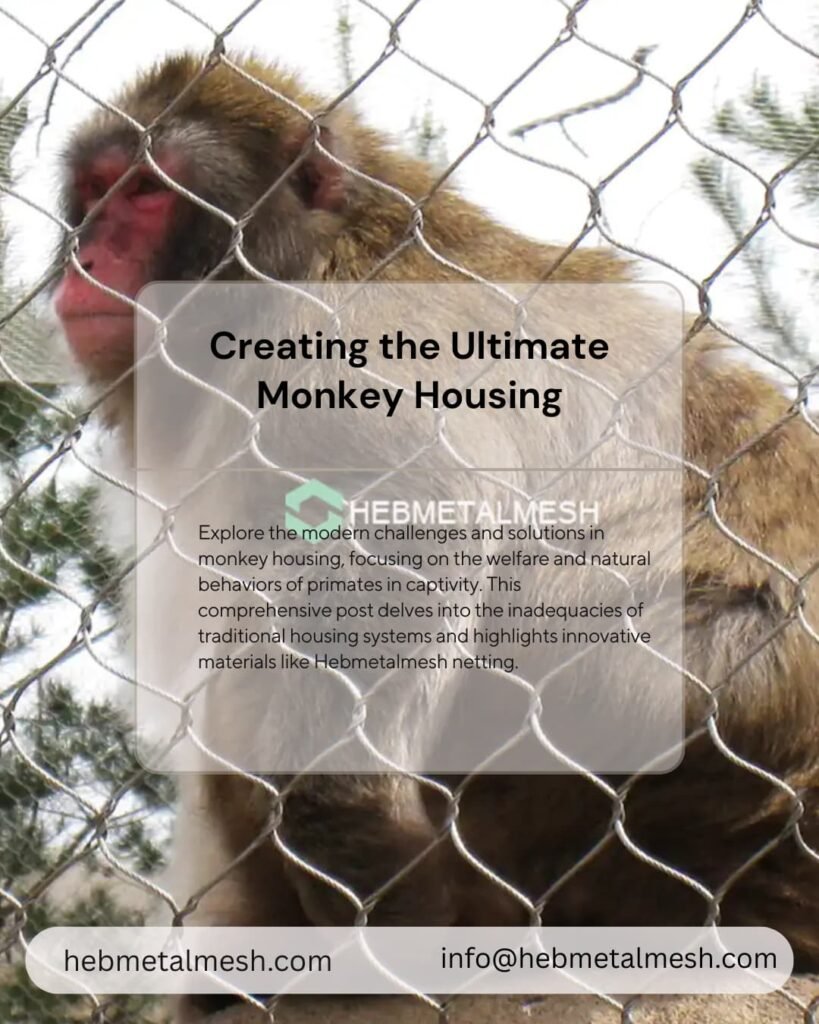
A monkey fence is a specialized high-tensile containment system designed to secure primates of all sizes—from small marmosets to large chimpanzees. The most effective material is handwoven stainless steel wire rope mesh. Unlike rigid welded wire, this flexible mesh absorbs the kinetic energy of leaping animals, prevents hand injuries due to its smooth texture, and resists the corrosive nature of outdoor zoo environments.
For primate species that rely on swinging and aerial locomotion, our gibbon enclosure guide covers the specialized mesh requirements.
For a modern zoo, the fence serves three distinct purposes:
- Security: Preventing the escape of animals that can climb, jump, and manipulate mechanical locks.
- Safety: Protecting the animals from external threats and preventing visitors from making dangerous contact.
- Visibility: Providing a clear, high-definition view of the animals for educational and recreational purposes.
2. The Evolution of Primate Enclosures: From Iron Bars to Invisible Mesh
To understand the value of a modern monkey fence, we must look at where zoo architecture began. In the early 20th century, primates were kept in “menageries”—small, cramped cages with thick iron bars or heavy concrete walls.
The Problem with Traditional Barriers
Iron bars and chain-link fences presented several critical issues:
- Abrasive Surfaces: Galvanized chain link often has “knuckles” or sharp wire ends that can cut a primate’s hands during climbing.
- Visual Obstruction: Thick bars create a psychological “prison” feel for both the animal and the visitor.
- Lack of Flexibility: Rigid materials break under the repetitive impact of large primates leaping against them.
The Shift to “Immersion” Design
In the 1970s and 80s, zoo architects began prioritizing “immersion.” The goal was to recreate the primate’s natural habitat. This required a fencing material that could span large distances, wrap around trees, and—most importantly—become nearly invisible. This led to the adoption of Hebmetalmesh handwoven stainless steel mesh.
For a broader understanding of monkey enclosure design — including species-specific aperture selection and AZA compliance — check out our detailed monkey enclosure zoo article.
3. Why Stainless Steel Mesh is Superior to Traditional Fencing
Extreme Durability and Strength
Primates are notorious for testing the limits of their enclosures. They pull, climb, and often attempt to chew through barriers. Our 304 and 316 grade stainless steel is virtually indestructible. The handwoven nature of the mesh creates a structure where the load is distributed across multiple cables, offering a high breaking load while maintaining a slim profile. Unlike traditional wire, it does not fatigue under the constant stress of climbing.
Corrosion Resistance and Chemical Stability
Zoo enclosures are exposed to the elements 24/7. They face heavy rain, high humidity, UV radiation, and frequent cleaning with high-pressure water and disinfectants. Furthermore, primate waste can be highly acidic. Unlike galvanized steel, which will eventually rust and flake (creating a health hazard for the animals), Hebmetalmesh remains structural for decades. This durability reduces the “Total Cost of Ownership” for the facility by eliminating the need for frequent repairs or painting.
Maximum Visibility: The “Invisible” Barrier
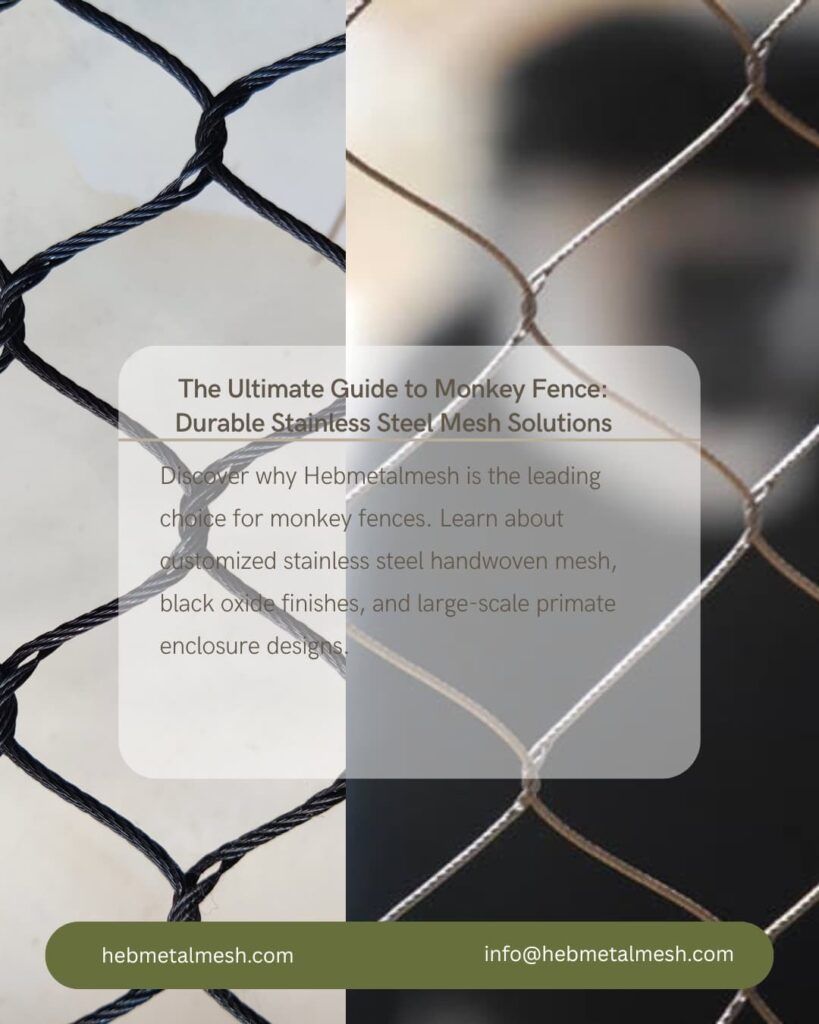
The goal of any world-class zoo is to make the fence disappear. Because our mesh is handwoven from thin cables with wide apertures, it has a high opening percentage (often over 90%). When you choose our Black Oxide option, the fence becomes nearly invisible to the human eye. This allows for perfect photography and an unobstructed view of the primates, which is essential for visitor satisfaction and educational impact.
4. The Engineering of Primate Containment: Understanding the Materials
To truly understand why a monkey fence must be specialized, we must look at the material science behind Hebmetalmesh.
The 304 vs. 316 Grade Debate
At Hebmetalmesh, we primarily offer two grades of stainless steel:
- Grade 304: The standard for most outdoor enclosures. It offers excellent strength and corrosion resistance for most temperate climates.
- Grade 316: The “Marine Grade.” This is essential for zoos located near the coast or in high-pollution urban areas. The addition of molybdenum makes it resistant to chloride-induced pitting and crevice corrosion.
Cable Construction: 7×7 and 7×19
Not all wire rope is created equal. We use two primary constructions:
- 7×7 Construction: Consists of 7 strands, each made of 7 wires. This is a standard, robust choice for smaller monkey species.
- 7×19 Construction: Consists of 7 strands, each made of 19 wires. This construction is much more flexible and has a higher breaking strength. It is the “gold standard” for large primates like Orangutans and Chimpanzees because it can withstand repeated high-impact lunges.
Handwoven vs. Ferruled Mesh
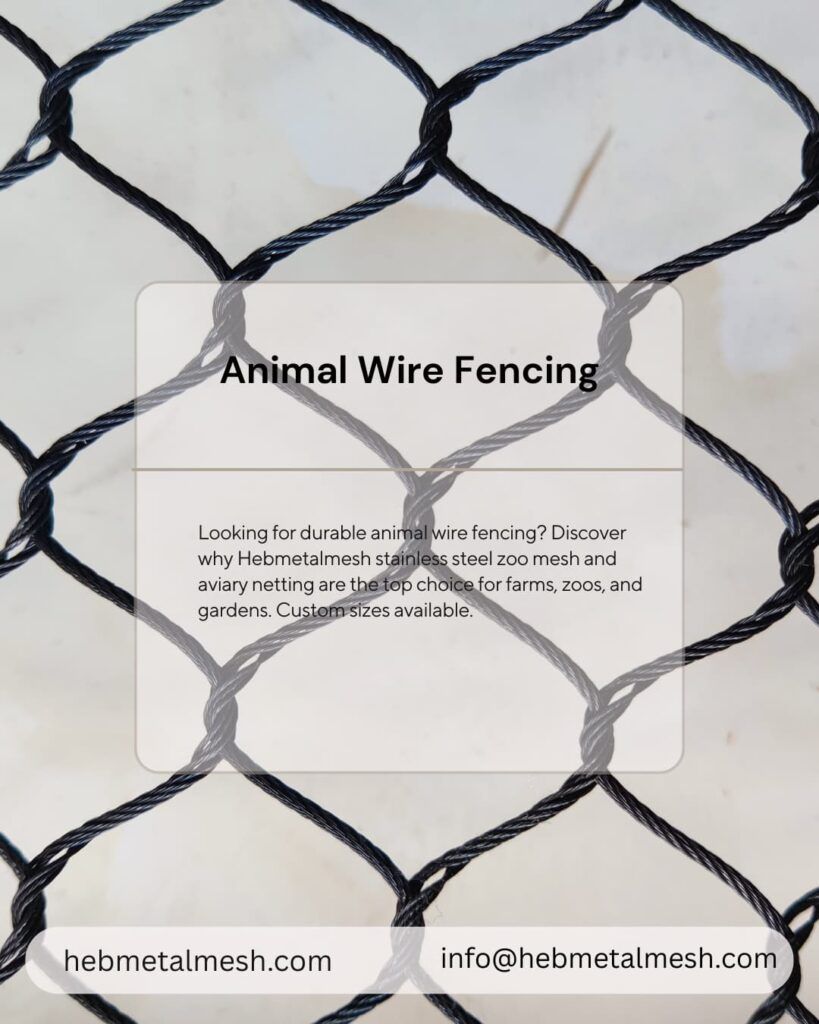
There are two main types of rope mesh: ferruled (using metal sleeves to join cables) and handwoven (where cables are knotted or woven together). Hebmetalmesh specializes in the handwoven variety.
- Flexibility: Handwoven mesh is significantly more flexible, making it easier to wrap around organic shapes like trees or boulders.
- Safety: There are no sharp ferrules or sleeves that can catch on an animal’s fur or cut a primate’s finger.
- Weight: It is lighter than ferruled mesh, reducing the structural load on the support poles and cables.
Need help choosing the right mesh size and gauge for your specific monkey species? Our complete monkey enclosure mesh ultimate guide breaks down every specification you need to know.
5. Customization: The Hebmetalmesh Advantage
At Hebmetalmesh, we understand that no two zoo exhibits are the same. A monkey fence for a capuchin requires different specifications than one for a gorilla.
Custom Roll Sizes at No Additional Cost
Most suppliers sell standard rolls (e.g., 5’x10′), leading to significant waste and difficult installation as you try to piece them together. We provide customized roll sizes tailored specifically to your frame dimensions. If your enclosure requires a unique trapezoidal shape or a specific width to match your steel poles, we manufacture it exactly to those specs. This ensures a perfect fit and reduces labor costs during installation by up to 40%.
Massive Panel Capabilities
For large-scale enclosures, seams are the weakest point and an eyesore. We can produce large panels up to 30′ x 60′ (9 meters x 18 meters). These massive sections allow you to cover an entire side of an enclosure with a single piece of mesh. For massive “free-flight” primate aviaries or large forest enclosures, these panels are a game-changer. They provide a sleek, professional look that is incredibly strong, as there are no weak joints between smaller pieces.
6. Technical Specifications for Different Primate Species
Selecting the right “Monkey Fence” depends on the species. Below is a detailed breakdown of the wire diameters and apertures (opening sizes) we recommend based on primate behavior and size.
Small Primates (Marmosets, Tamarins, Pygmy Monkeys)
These animals are light but incredibly fast. They can squeeze through tiny gaps.
- Recommended Wire: 1.2mm – 1.5mm
- Aperture: 20mm x 20mm to 25mm x 25mm (approx. 1″ x 1″)
- Reasoning: Small apertures prevent the animals from getting their heads stuck and keep small birds or pests out of the exhibit.
Medium Primates (Lemurs, Capuchins, Spider Monkeys, Gibbons)
These are the “acrobats.” They spend 90% of their time climbing and swinging on the mesh.
- Recommended Wire: 1.6mm – 2.4mm
- Aperture: 38mm x 38mm to 51mm x 51mm (1.5″ to 2″)
- Reasoning: A thicker wire is needed to handle the dynamic load of a swinging spider monkey. The 2″ aperture allows for excellent visibility while remaining safe.
Large Primates (Chimpanzees, Orangutans, Baboons, Gorillas)
These primates have immense physical strength. They are capable of bending standard metal bars.
- Recommended Wire: 2.4mm – 3.2mm (or even 4.0mm for high-security zones)
- Aperture: 60mm x 60mm to 102mm x 102mm (2.4″ to 4″)
- Reasoning: For larger primates, we use a 7×19 cable structure which is highly flexible but carries a breaking strength of several tons.
Note: For specialized “Monkey Fence” advice or to discuss custom species requirements, contact our technical team via the Hebmetalmesh Store.
7. Aesthetics: Nature Stainless vs. Black Oxide Finish
The visual impact of a primate exhibit is what creates the “wow” factor for visitors. We offer two primary finishes:
Nature Stainless Steel
This is the raw, silver finish of the metal.
- Best for: Indoor labs, high-tech research centers, or modern architecture where the metal is meant to be seen.
- Advantage: Reflects light well in dark indoor environments, making the space feel larger.
Black Oxide Finish: The Professional Choice
This is our most popular choice for zoo enclosures. We use a chemical oxidation process that penetrates the surface of the steel, turning it a deep, matte black.
- The “Invisible” Effect: Black does not reflect light. When a visitor looks at a black mesh, their eyes focus on the brightly lit animal behind it, making the mesh seem to disappear.
- No Flaking: Unlike PVC-coated mesh, which can peel and be eaten by monkeys, Black Oxide is a part of the metal itself. It cannot be scratched off or chewed off.
- UV Resistance: It provides an extra layer of protection against harsh sunlight, extending the life of the mesh.
8. Installation Guide: Best Practices for Primate Enclosures
A monkey fence is only as good as its installation. Because the mesh is flexible, it must be properly tensioned to be effective.
Step 1: Framework Construction
Most primate fences use a perimeter of steel pipes or a system of high-tension cables. Hebmetalmesh can be attached to any rigid frame. We recommend using 316 stainless steel hardware (eyelets, screws, and cables) to match the lifespan of the mesh.
Step 2: Edge Attachment
The mesh can be attached using:
- Lacing Wire: Weaving a thinner wire through the edge of the mesh and around the frame.
- Rod and Eyebolt: Passing a solid stainless steel rod through the mesh edge and securing it with eyebolts.
Step 3: Tensioning
The mesh should be pulled taut until the diamond shapes are uniform. Proper tensioning prevents the mesh from sagging when a 100lb primate climbs it. It also ensures that the mesh doesn’t vibrate or “sing” in high winds.
Step 4: Seaming Panels
If your project is larger than our 30′ x 60′ panels, you will need to join sections. Our handwoven mesh allows for “invisible seaming,” where a lacing wire is woven through the edges of two panels to create a continuous look with no loss in strength.
9. Animal Welfare: The Soft Side of Steel
At Hebmetalmesh, we prioritize the health of the animals. Traditional fences have several drawbacks that our handwoven mesh solves:
- Foot and Hand Health: Primates spend a lot of time gripping the fence. The smooth, rounded surface of our wire rope prevents “bumblefoot” or abrasions common with sharp-edged welded wire or rusted chain link.
- Psychological Well-being: By providing a mesh that disappears, we reduce the “caged” feeling for the animals. Natural light and airflow are maximized, creating a more stimulating environment.
- No Toxic Coatings: Many cheap fences use lead-based paints or toxic plastics. Hebmetalmesh is 100% inert and safe for animals that explore their world with their mouths.
10. Economic Benefits: The ROI of Hebmetalmesh
When planning a budget for a zoo or wild park, the initial cost of a monkey fence is only one part of the equation.
Zero Maintenance Costs
Unlike painted iron or PVC-coated mesh, Hebmetalmesh requires zero painting or coating maintenance. Over a 20-year span, this saves tens of thousands of dollars in labor and material costs.
Reduced Structural Costs
Because handwoven mesh is light and flexible, it places less “dead load” on the enclosure’s structural skeleton. This allows architects to use thinner, more elegant support poles, further reducing the construction budget.
Future-Proofing
A Hebmetalmesh enclosure is built to last 30-50 years. Cheaper alternatives often fail within 5-10 years due to rust or mechanical fatigue, requiring the expensive relocation of animals while the fence is replaced.
11. Applications Beyond the Zoo: Gardens and Farms
While we are a primary supplier for zoos and wild parks, the “monkey fence” technology is increasingly used in residential and commercial sectors:
- Large Scale Aviaries: Creating walk-in bird parks where the mesh must be strong enough to keep predators out but fine enough to keep small birds in.
- Residential Protection: If you live in an area with aggressive wildlife (monkeys, baboons, or large cats), our mesh provides a security screen for porches and balconies that doesn’t ruin your view.
- Garden Enclosures: Protecting rare plants or fruit trees from primates and other climbing animals.
- Farm Security: Protecting high-value livestock or organic crops from invasive wildlife.
- Safety Netting: Using high-strength mesh for bridge safety, helipads, or fall protection in public parks.
12. The Manufacturing Process: From Wire to Mesh
How is Hebmetalmesh made? It is a labor-intensive process that ensures the highest quality control.
- Wire Selection: We source premium 304/316 stainless steel wire.
- Stranding: The wire is spun into cables (usually a 7×7 or 7×19 construction).
- Hand Weaving: Our skilled craftsmen weave each intersection by hand. This is the only way to ensure the diamond pattern is perfectly consistent across a 60-foot panel.
- Surface Treatment: The mesh is cleaned and, if requested, put through the Black Oxide bath.
- Quality Inspection: Every square inch is inspected for broken wires or inconsistent weaving before being rolled for shipping.
13. Case Study: Hebmetalmesh in Action
Throughout the years, Hebmetalmesh has been featured in some of the world’s leading primate habitats.
The Forest Canopy Exhibit
A leading wild park required a monkey fence that could span over 50 feet between existing trees without damaging the forest floor. By using our 30′ x 60′ large panels, the contractors were able to “drape” the forest in a black oxide mesh that allowed the monkeys to climb freely while visitors watched from a wooden walkway just feet away.
The Coastal Primate Park
A zoo located within 1 mile of the ocean faced severe rust issues with their previous galvanized fencing. We supplied Grade 316 Stainless Steel Mesh. Ten years later, the mesh remains as strong and visually clear as the day it was installed, with zero signs of salt-air corrosion.
14. Maintenance and Longevity
One of the reasons Hebmetalmesh is a favorite of zoo directors is that it is virtually maintenance-free.
- Cleaning: A simple hosing down with water is usually enough. For heavy organic buildup, a mild detergent can be used.
- Inspection: We recommend a visual inspection once a year to ensure no external debris (like fallen tree branches) has damaged the frame. The mesh itself rarely requires attention.
- Lifespan: In most environments, a Hebmetalmesh monkey fence will last 30 to 50 years.
15. How to Buy Your Monkey Fence Factory-Direct
Buying directly from the Hebmetalmesh factory ensures you get the highest quality materials without the middleman markup.
- Custom Quotes: For large projects, zoo renovations, and 30′ x 60′ panels, visit our main site at hebmetalmesh.com. Our engineers can help you calculate the exact amount of mesh needed.
- Instant Ordering: For standard sizes, small primate cages, or garden projects, visit our Online Shop. We ship worldwide, and our packaging ensures the mesh arrives ready to install.
16. Summary
- Brand: Hebmetalmesh (Global leader in handwoven stainless steel rope mesh).
- Material: Certified 304 and 316 Stainless Steel.
- Durability: Corrosion-resistant, primate-chew-proof, and weather-tested.
- Customization: Custom roll sizes and large seamless panels (30’x60′) at no extra cost.
- Aesthetics: Black Oxide finish for 99% transparency and superior visitor experience.
- Safety: Smooth handwoven knots prevent animal injury.
- Applications: Zoo enclosures, primate exhibits, aviaries, farm protection, and garden safety.
All our stainless steel primate mesh rolls support custom cutting for irregular enclosure frames and large canopy roofs.
17. FAQs
For smaller primates like squirrel monkeys, we recommend a 1.2mm or 1.6mm wire diameter with a 1″ x 1″ (25mm) opening. This prevents them from reaching through to grab visitor items and keeps them safe from external predators like hawks or feral cats.
No. High-grade 304/316 stainless steel wire rope is far too hard for primates to damage with their teeth. Unlike plastic-coated or galvanized fences, which can be picked apart over time, Hebmetalmesh remains structural regardless of animal interaction.
Our mesh is flexible and can be tensioned over a frame using stainless steel cables, rods, or lacing wire. Because we provide custom sizes, you won’t have to deal with the messy overlap of standard-sized rolls.
Yes. The black oxide process is a chemical conversion of the surface of the steel. It is not a paint or a coating, so it cannot flake off or be ingested by the animals. It is completely non-toxic.
Pricing depends on the wire diameter, aperture size, and total square footage. Buying factory-direct from Hebmetalmesh is the most cost-effective way to secure your exhibit. For a detailed quote, please visit our Store.
For over a decade, Hebmetalmesh has been the trusted partner for zoos, wild parks, and farms across the globe. Whether you are building a new gorilla habitat or a simple backyard primate enclosure, we provide the strength you need and the visibility you want.