
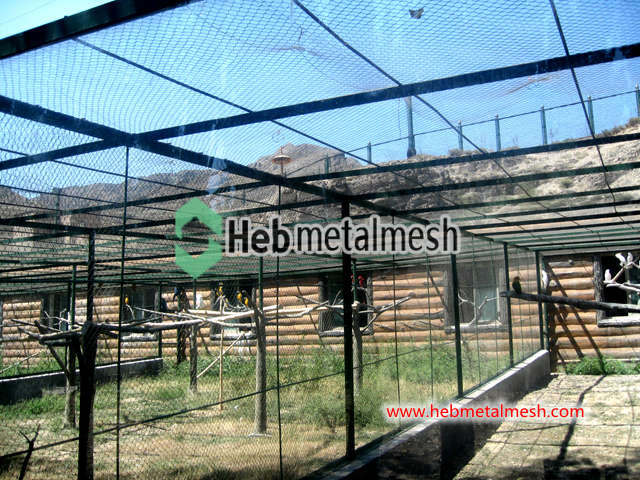
A first time parrot owner usually buys parrot fencing the way they would buy a garden fence: so many metres, so many posts, one gate. Then the bird arrives, and the interesting damage is never in the middle of a panel. It is on a cable tie, a loose strand end, the plastic cap on a bolt, or the mesh immediately beside the perch. A parrot does not attack a fence. It works whatever is closest to its beak, a little at a time, for years — and that habit decides which parts of the structure your money should be spent on.
This page takes the bird’s behaviour as the brief and works out what actually decides whether a home aviary holds, and which parts a keeper should simply expect to replace.
Executive Summary
A parrot’s beak is a tool, not a weapon, and it is used on the nearest small object rather than on the widest part of a barrier, so the same mesh that survives a season in the open can be opened at a corner by a bird that has found a cable tie worth working. What decides the outcome is not the fence’s footprint but three things: the material at the points the bird can reach, the aperture size that keeps toes and heads out of trouble, and the small parts that hold the panel in tension. Because a parrot’s upper beak grows continuously and is worn by chewing, whatever sits within reach has to absorb years of material removal without shedding a coating or a soft outer layer — which is why a bare stainless steel rope mesh outperforms coated and galvanised alternatives in the zones a bird can touch. Budget the mesh inside the reachable envelope and the fittings as consumable parts, and the rest of the aviary can be built to ordinary standards. The reference specification is the parrot enclosure netting product page.
Building a home aviary and unsure what to specify? Send us the species, the aviary’s length, width and height, where the perches and the door sit, and whether the site is inland or coastal, and we will return the aperture, rope diameter and alloy that suit the bird you actually keep.
Quick Answer: Where Should the Money Go?
Mesh first, fittings second, frame last. Parrot fencing for pet owners is usually bought once and then lived with, and the mesh is the only part the bird ever touches. A heavier rope on a smaller opening costs very little more at the outset and a great deal less than replacing a panel after a season of work. Everything inside the bird’s reach should be bare metal it cannot strip, and everything holding that metal in tension should be chosen as a part you will one day swap out rather than a part you will never think about again.
Key Takeaways
- The bird aims at the smallest, newest, most accessible part of the structure, not at the widest panel.
- Beak load arrives through a tiny contact area, so local stress is far higher than the total force suggests.
- Bare stainless has no coating to strip and hardens as it is worked; galvanised wire loses its zinc layer first.
- Aperture size is a welfare decision as much as a visibility one, because it governs toe entrapment.
- Most parrot escapes begin at a fitting, a corner or a tensioning point rather than in the middle of a sheet.

The Bird Is Aiming at Something Smaller Than You Think
Ask what parrots chew and the honest answer is: the nearest thing that yields. A bird in a new enclosure does not carry out a structural survey. It reaches from the perch, the food bowl, the door frame and anything it can brace against, and it tests the first object its beak can hold. That is why the practical question in a home aviary is not how strong the panel is, but which objects sit inside the volume the bird can actually touch — its reachable envelope. Define that volume honestly and the specification almost writes itself.
What the Beak Applies, and Why Area Matters
A parrot’s chewing pressure is concentrated into a very small contact patch. The total force is modest by engineering standards — nothing like a dog’s jaw or a big cat’s pull — but it is delivered through an edge that is, in effect, a chisel, so the stress at that point is high and the effect is local. The consequence for anyone buying mesh is that a beak load does not test a panel as a whole. It tests one strand at one point, thousands of times, and it returns to the same strand for as long as that position stays comfortable.
This is also why a heavier cable rarely loses to a lighter one on this test. More metal means more material for the bird to remove, less purchase on the strand, and more of the strand still there after a bite has taken its share.
The Material Is the Only Part You Buy Twice
Coated wire makes a bad chew target, and the reason is the order of removal. Galvanised wire presents a soft zinc layer; that layer is the easiest thing on the fence to take off, and once it is gone the steel underneath is unprotected and starts to corrode. A PVC coating behaves the same way, except that stripping it is the whole point — the coating becomes the toy. In both cases the bird is invited to damage the part of the structure that protects another part of the structure. A woven mesh of bare stainless offers nothing to strip and no soft surface, and it work-hardens locally as it is worked, so the strand gets slightly harder at the point of contact rather than thinner. Specifying a stainless steel rope mesh rather than a galvanised equivalent is therefore not a luxury upgrade; it changes what the bird’s work does to the material. The galvanised versus stainless comparison sets out the corrosion half of the same decision, and the terminology is worth fixing early: the trade also calls this flexible cable netting, and a wire rope mesh panel and a welded grid are entirely different products even when they share a catalogue photograph.
Wear Is a Rate, Not an Event
Chewing is a slow, local, cumulative process, and the useful way to think about it is as a removal rate — how much material the bird takes off per hour of work — rather than as a risk of sudden failure. Losing a millimetre or two a year from a 2 mm strand is not a story about tomorrow; it is the story about year four, and it is predictable from the rope’s diameter, the species and how much of the day the aviary gets used.
Two things follow. The zone where the bird works should carry more metal than the zone it cannot reach, which is a cheap way to buy time. And the inspection routine should be aimed at the parts with the highest removal rate rather than spread evenly across the structure: the mesh beside the favourite perch, the corners, and the door.
Toes, Gaps, and the Sequence Behind an Escape
The opening is usually chosen for visibility, which is the wrong order. The mesh also has to hold a bird that climbs it, and a climbing bird hooks toes and nails into the openings. Too fine a mesh can wedge a claw; an opening that admits a whole foot can trap it. Sizing the hole around the bird’s foot, rather than around how much you want to see through the panel, is what prevents toe entrapment, and it is the same measurement that keeps heads and bodies out. The sizing logic is set out in the mesh size guidance for bird enclosures, and it is worth reading before the frame is drawn rather than after.
A parrot escape rarely begins with a broken strand in the middle of a sheet. It begins at the edge: a cable tie worked slack, a panel that has lost tension, a clip bent open, a gap that has quietly grown at a corner over a season. An escaped parrot is then found by accident rather than predicted by geometry, which is the argument for walking the perimeter and the door frame on a schedule instead of standing back and admiring the panels.
What You Will Replace, and How to Interrupt the Damage
If one area has already been picked, the answer is not a new aviary. A chew guard — a short sleeve of heavier mesh, or a smooth stainless plate fixed over the area the bird favours — removes the purchase it is using and moves the work elsewhere without touching the rest of the panel. It is a repair, and like every repair it should be planned rather than improvised: stainless hardware, no dissimilar-metal contact, and no fresh edge left for the bird to start on.
Beyond that, be honest in the budget about consumable parts. Ties, clips, tensioning hardware, perch brackets and the mesh immediately around the door are not a one-time purchase; they are the parts of an aviary a keeper replaces. A little more spent on heavier fittings at the start is what stops the door frame becoming the annual project. For anyone planning a first enclosure, the custom aviary build notes carry the same budget thinking through a whole building, and the parrot enclosure netting range is where the mesh itself starts.
Siting the Aviary Around the Bird’s Day
Aviary siting decides how many hours a year the bird actually spends against the mesh, and therefore how much damage it can do. An enclosure that is hot at midday, open to the prevailing wind, or positioned so that the bird can only see the wall of a shed will be used less and will show less wear — which sounds like a benefit and is not, because a bored, confined parrot chews more, not less. Put the aviary where the bird has shade, a view and something to watch, and the same structure will be worked harder in a way that is good for the bird and still absorbable by the mesh.
Numbers Worth Knowing Before You Order
Five figures carry most of the decision. Aperture size runs from 20 mm to 102 mm; small species such as budgerigars and cockatiels sit at the fine end, medium parrots such as African greys and amazons in the middle, and macaws at the wider end, where span and visibility matter more than exclusion. Cable diameter runs from 1.2 mm to 3.2 mm, and the heavier end is the right answer wherever the bird can put its beak to the mesh. The alloy is 304 stainless steel for inland sites and 316 stainless steel where chlorides are present; using the marine grade inland is simply paying for corrosion resistance the room does not need. Panels are made to 9 m by 18 m, which is the figure that decides how many frames, how many tensioning points and how many inspection stops an aviary has. Open area runs from roughly 88 per cent at a 20 mm opening to about 94 per cent at 102 mm, which is the honest answer to the visibility question.
The last number is not on any datasheet. Avian practice treats a bird’s beak as something that grows continuously and is maintained by wear, which is why the Association of Avian Veterinarians and its members treat an overgrown or misaligned beak as a husbandry problem rather than a cosmetic one. A home aviary therefore owes the bird one surface it is genuinely allowed to destroy — and every other surface it must not be able to.
FAQ
For a bird that does not chew, galvanised wire can last. For a parrot, the zinc layer is the first thing removed, and once it is gone the steel underneath is both exposed and, in many cases, ingested by the bird in flakes. Stainless takes that sequence out of the design.
Fine enough that the bird cannot get a foot through it. For budgerigars and similar small species that usually means the 20 mm to 38 mm range, checked against the actual foot rather than the bird’s overall size.
Less than most owners expect. Visibility is governed mainly by how wide the opening is rather than by cable diameter, so a heavy rope at a wide opening is easier to see through than a fine rope at a tight one.
Tell us the bird, not just the budget line. Send us the species, the aviary’s dimensions, where the perches and the door sit and the exposure, and we will return the aperture, rope diameter, alloy and fittings that match how your parrot will actually use the mesh.