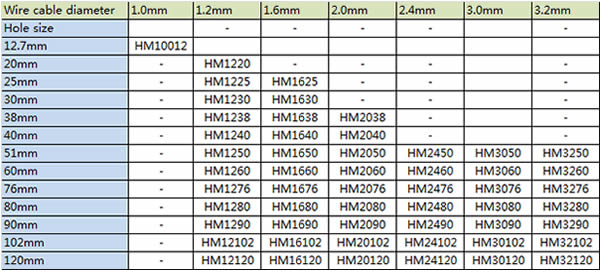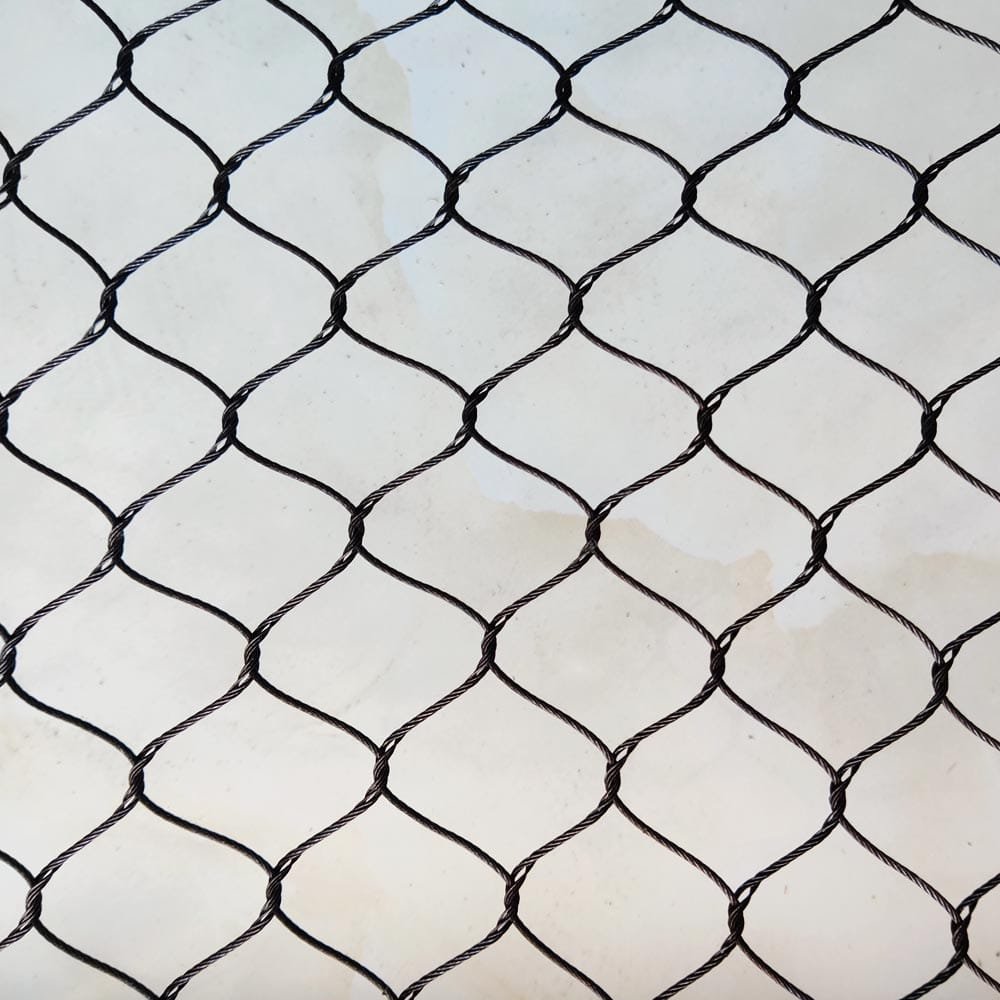
What is perimeter netting? Perimeter netting is a high-strength, flexible barrier system used to secure boundaries in sports, industrial, and safety applications. Unlike rigid fencing, perimeter netting is designed for high impact-absorption, UV-resistance, and maximum transparency. Modern systems utilize 316 Stainless Steel Rope Mesh or UV-stabilized polymers to provide a “soft-touch” yet indestructible boundary that maintains airflow and visibility while preventing trespassing or debris escape.
1. Beyond the Fence: Why “Rigid” is Out and “Flexible” is In
If you’re still thinking about a “perimeter” as a heavy, clunky, silver-colored cage, you’re stuck in 1995. For decades, the default answer to “I need a boundary” was chain-link fencing. It was the “safe” choice—cheap, functional, and ugly. But in 2026, the industrial and architectural worlds have officially moved on.
Why? Because a rigid perimeter is a high-maintenance liability.
The Fundamental Flaw of Chain-Link: Rust, Sagging, and “The Prison Look”
Let’s call chain-link what it really is: a temporary solution that overstays its welcome. Within three years, the galvanized coating starts to fail, leading to that tell-tale orange rust. Within five years, the “memory” of the metal begins to sag. If someone climbs it or a stray vehicle bumps it, the fence stays deformed forever.
But the biggest issue isn’t just the physical breakdown—it’s the psychology of the space. Chain-link creates a “prison look.” It closes off a property, blocks airflow, and kills the aesthetic value of whatever it’s protecting. Whether you’re securing a high-end sports facility or a corporate campus, a rigid fence says “Keep Out” in the ugliest way possible. It’s a barrier that feels like a burden.
The “Aha” Moment: The Elite Shift to High-Tensile Mesh
Have you ever looked at a modern professional baseball stadium or a multi-million dollar cliffside estate and wondered why you can barely see the safety barriers?
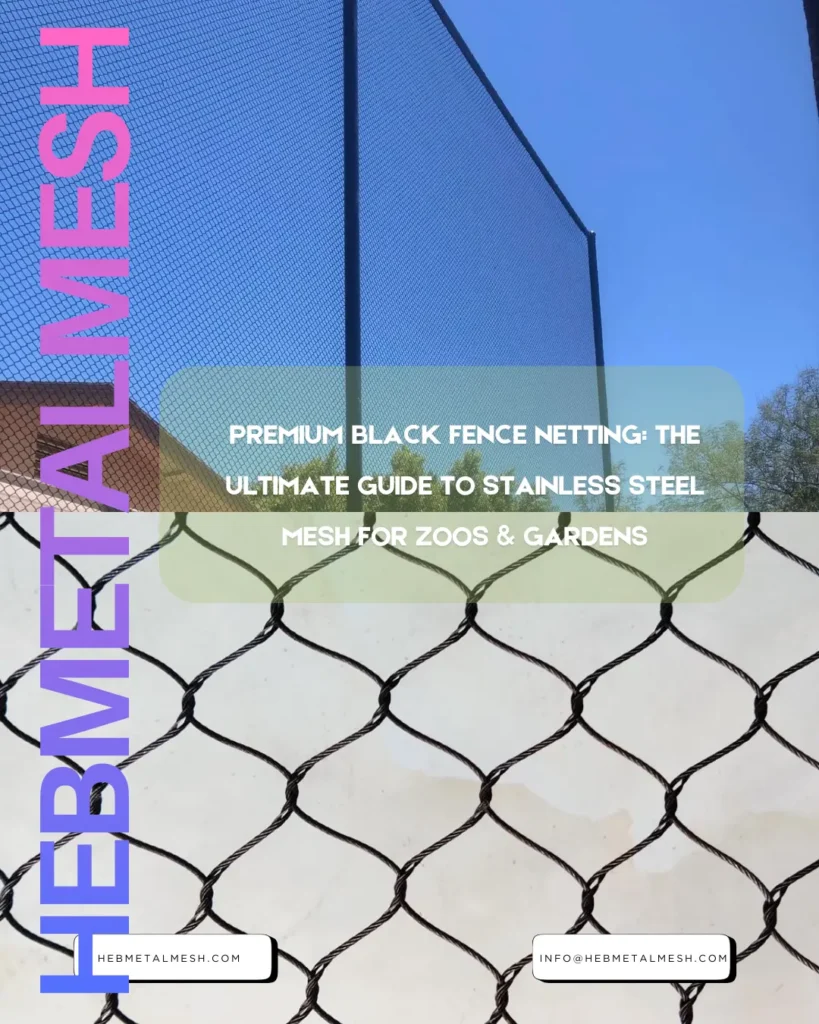
That is the “Aha” Moment. The world’s top architects and facility managers realized they didn’t need bulk; they needed tensile strength. By switching from rigid pipes and heavy links to high-tensile stainless steel perimeter netting, they achieved something thought impossible: Invisible Security.
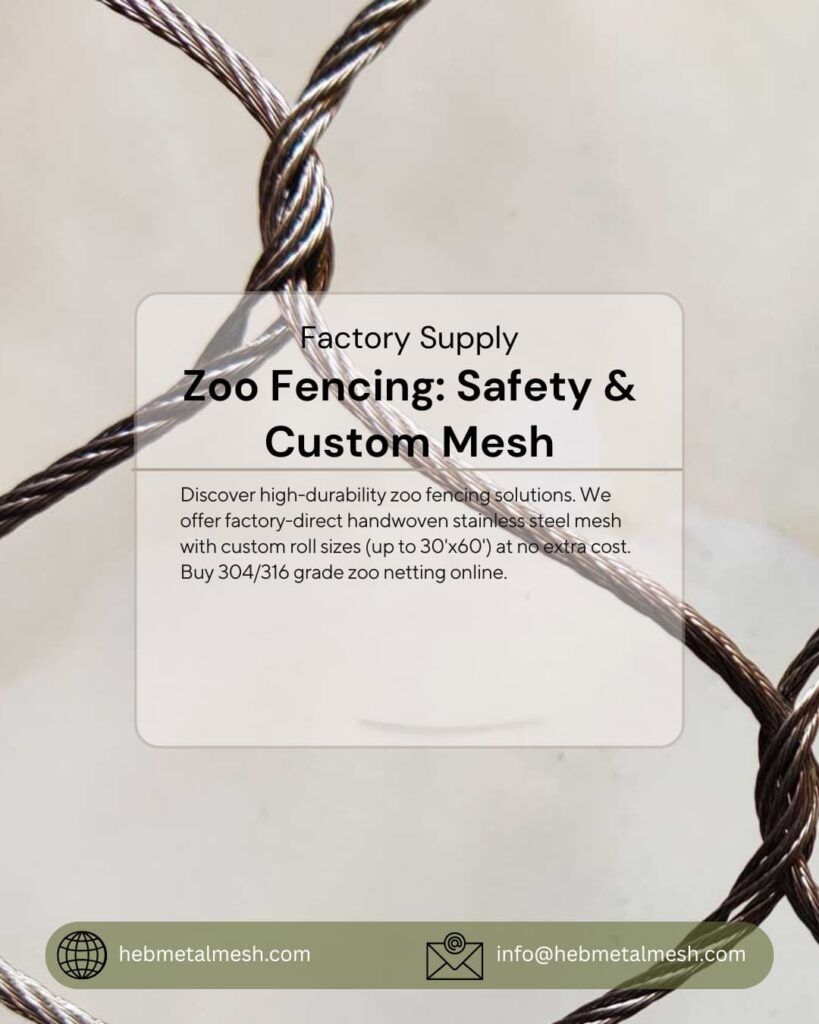
When you use a material like hebmetalmesh stainless steel cable mesh, you’re utilizing a material with a higher strength-to-weight ratio than traditional fencing. It’s the difference between a bulky wooden shield and a modern Kevlar vest. One is heavy and intrusive; the other is light, flexible, and significantly more effective at absorbing energy.
The Psychology of an “Open” Perimeter
There is a massive psychological difference between a solid wall and an open-weave perimeter.
- For Commercial Sites: It maintains a “welcoming” atmosphere while providing a literal steel-cable barrier against intruders or debris.
- For Residential Safety: It provides a child-proof and pet-proof boundary that doesn’t make a backyard feel like a kennel.
High-tensile perimeter netting works because it provides 100% security without the visual claustrophobia. Because the wire diameters are so thin (often between 1.2mm and 2.0mm), the human eye focuses through the mesh rather than on it. You get the airflow, you get the sunlight, and you get the view—but you also get a perimeter that can withstand thousands of pounds of impact force.
In 2026, the goal isn’t just to build a wall. The goal is to define a space. And you can’t define a modern space with a rusty cage.
2. The Science of Impact: Energy Absorption 101
If you want to understand why perimeter netting is replacing steel bars and chain-link, you have to stop thinking about “hardness” and start thinking about “energy.” Most people assume that the harder a surface is, the better it stops an object. In reality, that’s exactly how things break.
Why “Stopping Power” Isn’t About Being Hard
Think about a car crash. Older cars were built like tanks—rigid steel frames that didn’t budge. The result? The car stayed “whole,” but the passengers absorbed 100% of the impact. Modern cars have “crumple zones” designed to flex and absorb energy.
Perimeter netting is the crumple zone for your property. When a high-speed projectile—whether it’s a 95-mph baseball, a falling piece of construction debris, or a heavy animal—hits a rigid fence, the fence either bends permanently or snaps. The energy has nowhere to go. High-tensile mesh, however, uses its flexibility as a superpower. It catches the object, stretches slightly to dissipate the force, and then snaps back to its original shape. That is true “stopping power.”
The Physics of Kinetic Energy Dissipation
To get technical for a second, we have to look at the formula for Kinetic Energy:
The Impact Physics of Perimeter Netting:
In this equation, m is the mass of the object and v is its velocity. Because the velocity is squared, even a small increase in speed creates a massive surge in energy.
When that energy hits a hebmetalmesh stainless steel perimeter, the “flexible weave” allows the force to travel across the entire net rather than staying at the point of impact. The interconnected diamond pattern of the wire rope acts like a massive spring. As the mesh deforms, it converts that kinetic energy into potential energy, slowing the object down safely and over a longer distance (and time) than a rigid wall would. This “time-extension” is what prevents the mesh—and the object hitting it—from being destroyed.
Static Load (Weight) vs. Dynamic Load (Impact)
When you’re shopping for perimeter solutions, you’ll see two types of load ratings. Understanding the difference is the “aha” moment for industrial safety:
- Static Load: This is “dead weight.” Imagine a pile of snow sitting on a horizontal net or a person leaning against a vertical perimeter. The mesh just has to hold the weight without sagging.
- Dynamic Load: This is “live force.” This is a 200-lb intruder trying to climb the net, a soccer ball hitting the mesh at full speed, or a falling tool on a construction site.
The Perimeter Netting Advantage: Standard fencing is often rated for static weight but fails miserably under dynamic impact. Because hebmetalmesh uses 316-grade stainless steel cables with high elastic limits, it excels at Dynamic Loading. It can handle the “shock” of an impact that would snap a weld on a traditional fence or tear a hole in a cheap nylon net.
Pro Tip: If you are spec-ing a project for a public space or a sports arena, always ask for the Impact Joules rating. If a supplier can’t give you that number, they aren’t selling you a “heavy duty” perimeter; they’re selling you a curtain.
3. Material Showdown: When to Use What
In the world of perimeter netting, “heavy duty” is a spectrum. Choosing the wrong material isn’t just a budget mistake; it’s a performance failure waiting to happen. To win the SEO game and the engineering game, you have to match the material to the mission.
Here is the breakdown of the two heavyweight contenders in the perimeter market for 2026.
Stainless Steel Cable Mesh: The “Buy it for Life” Solution
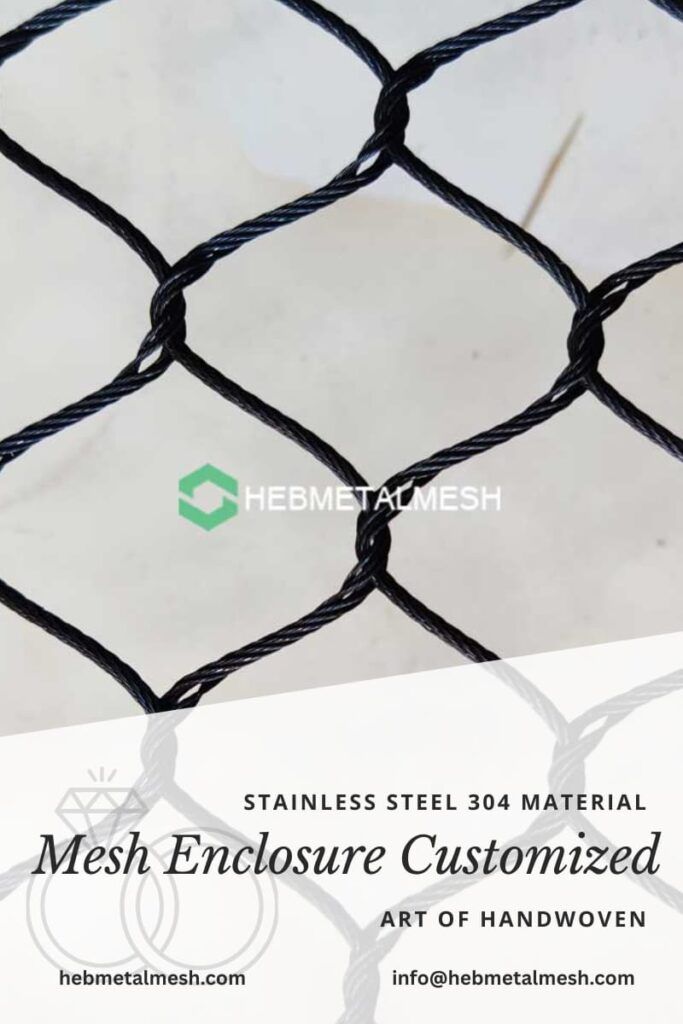
If you are looking for high-security, architectural beauty, or a permanent industrial boundary, there is only one gold standard: AISI 316 Stainless Steel Rope Mesh. This is the material that designers at hebmetalmesh swear by for high-stakes projects. Unlike traditional fencing, this mesh is handwoven from 7×7 or 7×19 construction stainless steel cables.
- Security: It is virtually impossible to cut with standard hand tools (unlike nylon or thin chain-link).
- High-End Architecture: It has a “jewelry-like” finish. Architects use it because it provides a sleek, modern look that complements glass and steel rather than clashing with it.
- Zero Maintenance: It doesn’t rust, it doesn’t need painting, and it doesn’t sag. It is the ultimate “set it and forget it” investment.
Nylon & Polyethylene: The Standard for “Light-Duty” Control
Don’t get me wrong—synthetic nets have their place. If you’re running a seasonal batting cage or a temporary construction debris curtain, you don’t always need a steel fortress.
- Nylon: Great for high-impact sports (like golf or baseball) because it has excellent “give.” However, it absorbs water, which leads to sagging and rot over time.
- Polyethylene (HDPE): Better for outdoor use because it doesn’t absorb water and has better UV resistance than nylon.
- The Catch: Even the best “heavy duty” poly net has a shelf life. After 5–10 years in the sun, the molecular bonds begin to fail. If your perimeter needs to be there in 2040, plastic isn’t the answer.
Comparison Table: High-Tensile Steel vs. Industrial Polymers
This is the data your procurement department needs to see. While the upfront cost of stainless steel is higher, the Total Cost of Ownership (TCO) over ten years is significantly lower.
| Feature | Stainless Steel Rope Mesh | Industrial Polyethylene (HDPE) |
|---|---|---|
| Durability | 30-50+ Years (Permanent) | 5-10 Years (Semi-Permanent) |
| Impact Resistance | Extreme (Dynamic Load Certified) | Moderate to High |
| Maintenance | Zero (Self-Cleaning/Rust-Proof) | Periodic tightening/Replacement |
| UV Resistance | Immune (100% UV Proof) | High (if UV-Stabilized) |
| Primary Drawback | Higher Initial Investment | Subject to UV degradation over time |
The “Aha” Insight: If your perimeter netting is in a location where replacement requires a crane or expensive scaffolding (like a high-rise balcony or a stadium rafter), the “cheap” poly net is actually the most expensive thing you can buy.
4. High-Value Applications for Perimeter Netting
In the SEO game, we talk about “niche authority.” In the real world, perimeter netting is the invisible backbone of modern infrastructure. It’s not just about “keeping things in”; it’s about managing risk, protecting assets, and maintaining aesthetics in high-stakes environments.
Here is where the “aha” moment turns into a “must-have” investment.
Sports Facilities: The “Quiet” Defender
If you’ve ever sat behind home plate at a modern MLB stadium, you’ve seen high-tensile perimeter netting in action.
- The Goal: Stop a 100-mph projectile while ensuring fans can see every stitch on the ball.
- The Solution: Ultra-thin, high-strength stainless steel rope mesh or specialized knotless dyneema. Because these materials have massive breaking strengths, the wire diameter can be kept incredibly small (1.2mm to 1.5mm). This provides a “High Transparency” effect that thick, old-school nylon nets simply can’t match. It’s the difference between watching a game through a screen door and watching it in 4K.
Industrial Safety: The “Dropped-Object” Barrier
On a construction site or an offshore oil rig, a dropped wrench isn’t just a lost tool—it’s a lethal projectile.
- The Application: Horizontal and vertical perimeter netting is used to create “debris cocoons” around high-rise construction.
- Why Metal Wins: While poly nets are common, hebmetalmesh stainless steel is the go-to for permanent industrial safety. It’s non-combustible (vital for welding zones) and doesn’t degrade when exposed to harsh chemicals or abrasive dust. It catches heavy equipment without the “trampoline effect” that can bounce objects back toward workers.
Helipads & Walkways: High-Altitude Infrastructure
When you’re 50 stories up on a helipad or a skywalk, “good enough” netting is a liability suit waiting to happen.
- The Standard: Safety perimeters for helipads require a specific “catch” capacity. The netting must be able to withstand the impact of a person falling at terminal velocity without breaking.
- The Spec: Stainless steel ferruled mesh is the industry favorite here. It resists the intense wind-shear and “downwash” from helicopter rotors that would shred standard synthetic netting in weeks. Plus, it provides a 30-year rust-free life cycle in salty, coastal air.
Modern Residential: The “Invisible” Balcony
The biggest growth market for 2026? High-end residential safety.
- The Problem: You have a $5 million view from your balcony, but you also have a toddler and a 15-lb cat. A glass railing is beautiful but restricts airflow and requires constant cleaning. A traditional railing has gaps that are safety hazards.
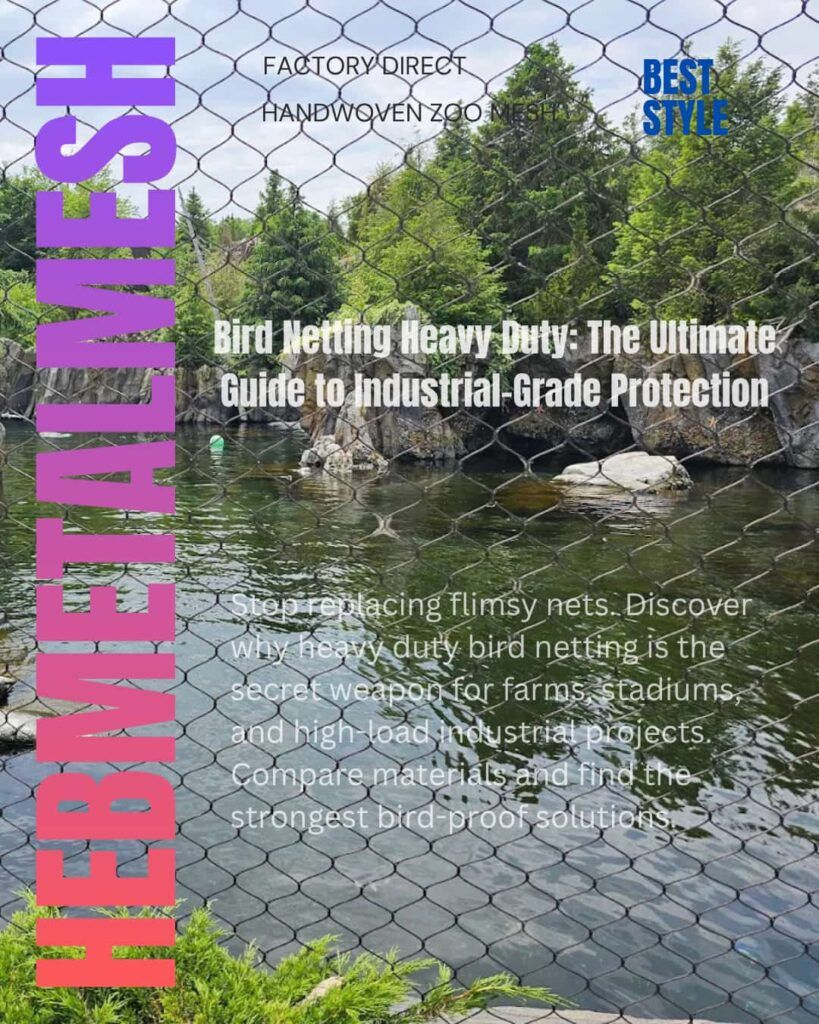
- The “Aha” Moment: Architects are now using perimeter netting as a “fill” for balcony railings. By stretching stainless steel mesh between structural posts, you create a 100% secure, climb-proof barrier that is virtually invisible from inside the house. It’s pet-proof, child-proof, and doesn’t block the summer breeze.
The Professional Edge: In all these applications, the common denominator is Risk Mitigation. Whether it’s a lawsuit from a foul ball or a tragedy on a construction site, the cost of the “premium” perimeter is a fraction of the cost of a single failure.
5. Engineering the Install: The Tension Secret
In the SEO world, “backlinks” are the invisible support system for your rankings. In the world of perimeter netting, the invisible support system is tension. You can buy the most expensive stainless steel mesh on the planet, but if you don’t engineer the installation, it will eventually sag, rattle, and fail.
Here is how the pros at hebmetalmesh ensure a perimeter stays “structural” for 30+ years.
The Role of the Top-Cable System: Fighting Gravity
You never just “hang” a heavy-duty net like a curtain. If you do, gravity wins within six months, and you’re left with a “belly” in the middle of your perimeter.
The secret is the Primary Tension Cable. * The Rig: A high-diameter ($6mm$ to $10mm$) stainless steel wire rope is anchored into the structural posts or walls using heavy-duty turnbuckles.
- The “Stitch”: The perimeter netting is then laced or “ferruled” to this tensioned cable.
- The Result: The cable carries the load, and the netting simply fills the space. This prevents vertical sag and ensures that when an object hits the mesh, the force is distributed across the entire structural frame, not just the top three inches of the net.
Why 316-Grade Hardware is Non-Negotiable
Here is a “pro tip” that separates the veterans from the amateurs: Never mix your metals. I see it all the time—a client spends $5,000 on high-end 316 stainless steel mesh, then tries to save $200 by using galvanized steel bolts or 304-grade clips from a local hardware store.
- The “Bleeding” Effect: Within two years, the inferior hardware begins to corrode. Because the hardware is touching the mesh, the rust “bleeds” onto the expensive netting and down the side of the building.
- The Solution: To avoid these ugly “rust streaks” on your clean architecture, every single component—the turnbuckles, the eye-bolts, the wire rope clips, and the ferrules—must be AISI 316 Stainless Steel. This ensures the entire system has the same lifespan as the mesh itself.
Calculated Aperture: Beating the Wind Load
If you’re installing a large-scale perimeter on a high-rise or a coastal stadium, the wind is your biggest enemy. A solid fence acts like a sail, catching the wind and putting massive “torque” on your anchors.
Calculated Aperture is the “aha” moment for wind-load reduction.
- The Math: By choosing the right mesh opening (aperture), you can achieve high security while maintaining up to 90% open area.
- The Physics: High-velocity wind passes through the mesh rather than pushing against it. This significantly reduces the “Drag Coefficient.”
- Pro Selection: For most perimeter applications, a 2-inch ($50mm$) to 4-inch ($100mm$) diamond aperture is the “sweet spot”—it’s small enough to stop a person or a ball, but open enough to keep the wind from ripping the anchors out of the masonry.
Engineering Note: Before you install, always calculate your “Corner Load.” When you tension a 50-foot run of stainless mesh, the pull on those corner posts can reach thousands of pounds of force. If your posts aren’t braced, they’re going to bow.
6. 2026 Trends: The Rise of “Black Oxide” Mesh
In the SEO world, we talk about “user experience” (UX). In architecture, UX is all about how a space feels. In 2026, the biggest trend in perimeter netting isn’t just about strength—it’s about disappearing. We’re seeing a massive pivot away from shiny, industrial-looking silver mesh toward the sleek, sophisticated “Black Oxide” finish.
Here is why “Black is the new Steel” for high-end boundaries.
The Magic of Physics: Why Black Mesh “Disappears”
It sounds counterintuitive—wouldn’t a black net be more visible? In reality, the opposite is true. This is the ultimate “aha” moment for homeowners and landscape architects.
- The Light Reflection Problem: Standard stainless steel is reflective. When sunlight hits a silver wire, the light bounces off the rounded surface of the cable and straight into your eyes. This creates a “shimmer” that highlights the mesh, making it look like a cage.
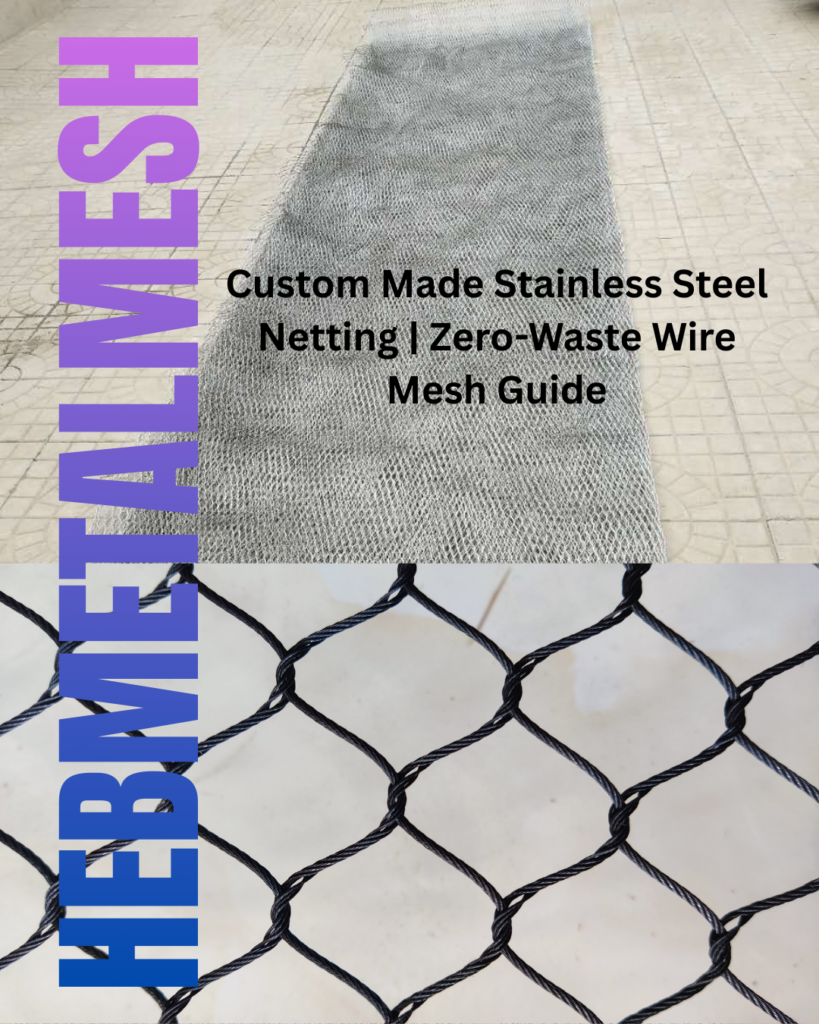
- The Black Oxide Solution: Black oxide is a chemical conversion coating that creates a matte, non-reflective surface. Because it doesn’t reflect light, your eye naturally focuses past the wire and onto the landscape behind it.
- The Result: Whether it’s a vineyard, a mountain-view balcony, or a stadium sideline, black oxide mesh becomes virtually invisible from just a few yards away. It provides all the security of a steel wall with the visual freedom of an open window.
Sustainability & The Green Building Shift
The 2026 market isn’t just looking for durability; it’s looking for a conscience. As LEED certifications and “Green Building” standards become the baseline for commercial construction, the materials we use for perimeters are under the microscope.
The End of Disposable Plastic: For years, “temporary” perimeter netting was made of plastics that eventually broke down into microplastics, leaching into the soil and waterways. In 2026, the “Green Shift” has pushed designers back to metal.
- 100% Recyclable: Unlike polymer-based nets that end up in a landfill after seven years, hebmetalmesh stainless steel is 100% recyclable. It’s an “infinite” material.
- Lower Carbon Footprint: Because you only install it once in 30–50 years, the carbon footprint associated with manufacturing, shipping, and labor for replacements is slashed by over 70% compared to traditional fencing or synthetic netting.
- Eco-Friendly Coating: The black oxide process is a conversion coating, not a heavy paint or plastic dip. It doesn’t flake off into the environment and maintains its integrity even in extreme “salt-spray” coastal conditions.
Trend Forecast: By 2027, we expect “Black Oxide Stainless” to be the mandatory spec for luxury residential developments and eco-tourism resorts. If you’re building for the future, you aren’t building with silver.
7. Cost-Benefit Analysis: The 25-Year Horizon
If you’re the CFO of a stadium or a homeowner looking at a massive balcony project, the quote for stainless steel perimeter netting might give you a momentary case of sticker shock. But as an SEO expert, I look at “Lifetime Value,” not “Entry Cost.”
In the world of infrastructure, there is a massive difference between a Price and a Cost.
The 40% Lower Total Cost of Ownership (TCO)
Let’s look at the “hidden” financial math. When you choose a perimeter solution, you aren’t just paying for the material; you’re paying for the lifecycle.
- Traditional Fencing (Iron/Wood): High initial cost + mandatory repainting every 3 years + rust treatment + eventual structural rot.
- Synthetic Netting (Nylon/Poly): Low initial cost + high labor cost for replacement every 5 years + disposal fees for degraded plastic + UV-failure risk.
- hebmetalmesh Stainless Steel: Higher initial cost + Zero maintenance + Zero replacement for 30–50 years.
By year 12, the stainless steel perimeter has already paid for itself. By year 25, you’ve saved nearly 40% compared to the “cheaper” alternatives because you haven’t touched it once since the day it was tensioned.
The “Aha” ROI: Property Value and Liability
Beyond the material cost, there are two “invisible” returns on investment that most people forget until they need them:
- Liability Protection: In industrial and sports settings, a single failure of a “budget” net can lead to an insurance nightmare. Stainless steel doesn’t have “weak spots” caused by UV rays. It provides the same 500lb+ breaking strength on day 10,000 as it did on day 1.
- Architectural Appraisal: A rusty chain-link fence or a saggy poly net devalues a property. A sleek, black-oxide stainless steel mesh is an architectural feature. It adds modern, high-tech appeal that actually increases the resale value of commercial and residential estates.
Final Expert Verdict: If you are building for the next quarter, buy plastic. If you are building for the next quarter-century, buy hebmetalmesh.
Ready to Define Your Perimeter?
You’ve seen the physics, the materials, and the math. You can keep “renting” your boundary with temporary fixes, or you can own a permanent solution that disappears into the horizon while keeping your assets 100% secure.
The hebmetalmesh online store is where the pros source the world’s most durable perimeter solutions. Whether you need a 100-foot stadium backstop or a 10-foot modern balcony fill, we have the engineering and the inventory to get it done.
Need a Boundary That Doesn’t Block the View?
From stadium backstops to high-security industrial sites, hebmetalmesh provides factory-direct perimeter solutions engineered for the long haul.
- Custom Engineered: Precision mesh sizes for any impact requirement.
- Weather-Proof: AISI 316 Stainless Steel for zero-rust performance.
- Global Shipping: Direct from the factory floor to your job site.