
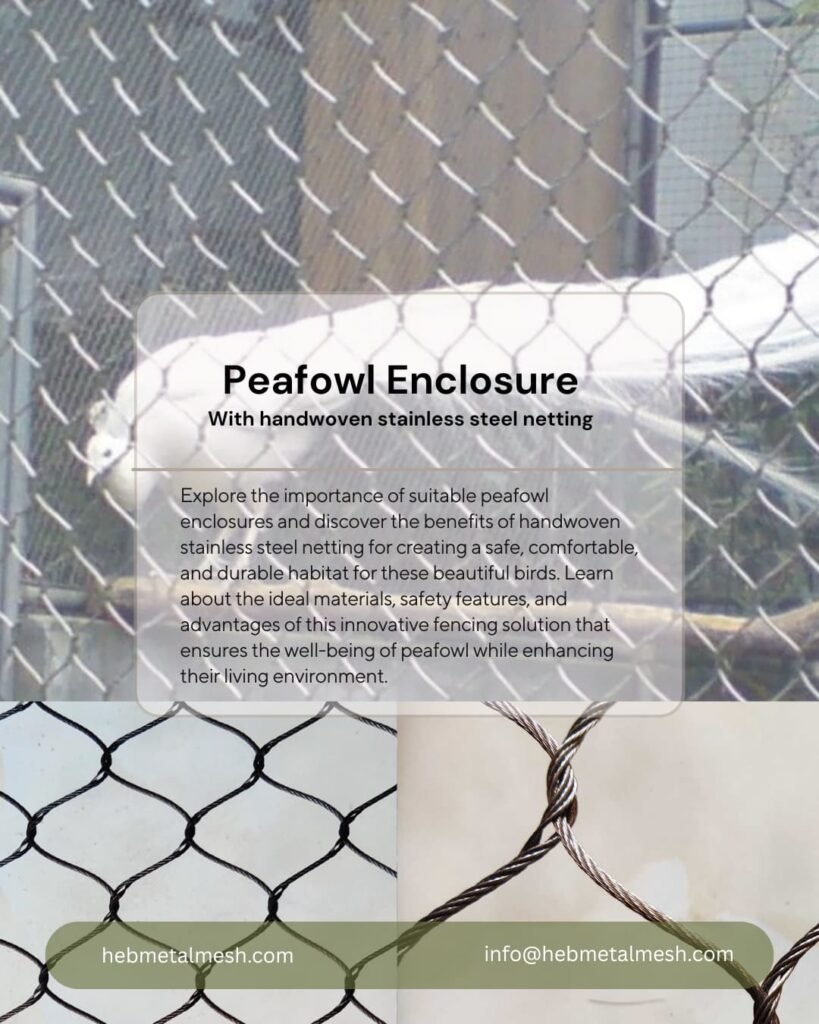
Peafowl are hardy birds that die from small, boring things. Not from cold — from a wet floor. Not from predators — from a gap under a door that a rat uses first and a fox uses second. A peafowl house is not a scaled-up chicken coop; it is a dry, ventilated, predator-tight room with a perch above the litter and a mesh that a peachick cannot walk through.
This guide covers the two halves of that job: the materials that hold up for thirty years, and the management practices that make the difference between a flock that breeds and one that keeps replacing birds. The reference specification is the peacock enclosure mesh product page.
Executive Summary
Design the house before you order the run. Send bird numbers, climate, and site plan. We will return mesh codes, panel sizes, and a budget for the house and run together. Contact Hebmetalmesh
A peafowl house has four non-negotiable properties. It must be dry at floor level in February. It must be ventilated without draught at bird height. It must be tight enough that a rat cannot get in and a peachick cannot get out. And it must be arranged so that a keeper can catch a bird without chasing it around the run.
Everything below — house size, mesh code, frame, perch and litter — is one of those four requirements expressed as a number.
Quick Answer:
A peafowl house should give about 1.5 m² of floor per adult bird, stand 2.4-3.0 m high at the front, and be built on a concrete plinth with a mesh wall of 25 mm aperture at 1.6 mm rope (HM1625) wherever chicks are reared, or 38 mm at 2.0 mm (HM2038) for adult-only housing. The roof is solid; the run is meshed. Perches sit at 1.2-1.8 m with 400 mm clearance from the wall, over a cleanable floor. Ventilation is high-level and adjustable, above head height, with no opening at bird level. That is the peafowl house specification in one paragraph.
Key Takeaways
- Dry beats warm. A damp floor causes more losses than frost. Build on a plinth with the floor above grade.
- Aperture is set by chicks and rats. 25 mm through the bottom zone; 38 mm is adult-only work.
- The perch is a health item. High, wide, and clear of the mesh, over a cleanable litter tray or floor.
- Ventilate above the birds. High-level inlet and outlet, nothing at head height, no draught across the perch.
- Predator-proofing is a ground detail. A pinned predator skirt defeats digging; mesh gauge never will.
- Train birds to the house, not to the tree. Free ranging only works if the night shelter is where food appears.
Housing standards for collection birds, including peafowl and other ground-dwelling species, are published by the Association of Zoos and Aquariums — the same reference points that zoo bird houses are planned against.
Peafowl house design: size, height and layout
Peafowl house size follows bird numbers, not the available space. Indian peafowl run 4-6 kg, and a flock of five adults plus a breeding season’s chicks needs room that a garden shed does not provide.
| Element | Working figure | Notes |
| Floor area, adults | 1.5 m² per bird | 2 m² where birds are confined all winter |
| Floor area, chicks | 0.3 m² per bird to 8 weeks | Then split by sex to prevent bullying |
| Internal height | 2.4-3.0 m at the front | Higher if perches are stacked |
| Door width | 1.2 m | Wide enough for a keeper carrying a crate |
| Run area | 8-10 m² per bird | Minimum for a permanent run |
Peafowl house height is worth the extra timber. At 2.4 m a keeper can stand upright, a bird can make a short flight to the perch, and the air volume keeps the house drier in winter. Below 2.0 m the house becomes a damp box with a low ceiling, and respiratory problems follow.
Sensible peafowl house plans keep one thing in mind: the house is where you catch birds. Fit an internal partition or a catch pen so a bird can be moved without a net in an open run, and put the pop hole on the side facing away from the prevailing wind. Our hand woven fencing guide covers how the run panels are hung and tensioned once the house is up.
Peafowl house materials: mesh, frame, roof and floor
Peafowl house materials are chosen for two jobs: excluding rats and predators, and holding chicks. Everything else is secondary.
Mesh. Peafowl house mesh should be 25 mm at 1.6 mm rope (HM1625) wherever chicks are brooded, because a week-old peachick walks through anything larger. For an adult-only house, 38 mm at 2.0 mm (HM2038) is the standard and is nearly invisible from three metres. Peafowl house netting in stainless rope mesh needs no coating, will not rust at the base where the run is wet, and can be washed down — which matters more here than in a run, because a house accumulates dust and droppings. Both codes are documented on the HM1625 and HM2038 pages.
Frame. A peafowl house frame in stainless or galvanized steel tube outlasts timber, but the decisive detail is the base: set posts on a concrete plinth, never in soil, and keep any timber at least 150 mm above the ground. Rot starts at the bottom of a post, and a post that moves takes the mesh tension with it.
Roof. A peafowl house roof is solid — profiled sheet or shingle — because the house exists to give rain-free, draught-free cover. Mesh over the house is a mistake: it lets driven rain in, and the birds then stand on wet litter. The run is the opposite case, and there the top should be closed with the same mesh used on the walls. Do not confuse the two zones.
Floor. A peafowl house floor should be concrete, or compacted hardcore topped with a deep sand layer. Concrete is the better choice where birds are shut in for weeks: it can be hosed, it does not hold moisture, and it denies rats a burrow. Where birds are brooded on the floor, sand over concrete is warmer and easier to keep dry than shavings alone.
Ventilation, insulation and litter
Peafowl house ventilation is the single most misunderstood item on the drawing. Peafowl produce a lot of moisture and ammonia overnight, and a sealed house is a wet house by morning. The rule is simple: air enters low, leaves high, and never crosses the perch.
- Inlet at eaves level, baffled so wind cannot drive straight in.
- Outlet at the ridge, sized generously — roughly one square metre of opening per 20 m² of floor.
- Nothing at bird height. An opening at head level produces a draught along the perch, and that is how birds get chilled.
- Adjustable. Shut the windward side in a storm and open the leeward side; fixed vents cannot be tuned.
Peafowl house insulation is worth doing in hard-frost climates and largely pointless in mild ones. The birds tolerate cold well; what they do not tolerate is a wet floor under a cold bird, or a perch so close to the roof that a bird’s head touches condensation. Insulate the roof first if you insulate anything, and remember that a dry unheated house beats a damp heated one.
Peafowl house litter should be dry, absorbent, and shallow — sand, or shavings over sand. Deep litter that is never turned is a ammonia source and a parasite reservoir. Peafowl house perch design matters here: put the perch high enough that droppings fall clear, and place a cleanable litter tray or a scraped concrete apron underneath, so the litter the birds dust in stays clean.
Perches, and the practices around them
The perch is the most-used object in the house, so it is worth getting right.
Perch height of 1.2-1.8 m suits adult peafowl, with the top perch higher than the door so a bird leaving it does not fly at head height. Keep 400 mm clear of the wall: a bird on a perch that touches the mesh will abrade its feathers on the same wire every night, and a male with a long train will catch the cover feather at the base of the train on any raised edge.
Use a flat-topped perch 60-80 mm wide rather than a round dowel. Peafowl have broad feet and grip better on a flat surface, which reduces the chance of a bird slipping and injuring a leg in the dark. Provide one perch length per bird plus a spare, and keep a second, lower perch for chicks and for a bullied bird.
A sand bath in the house or under cover in the run is a husbandry tool, not a luxury: dry sand controls lice and mites better than any spray, provided it stays dry. Refresh it monthly, and keep it away from the litter tray.
Managing the year: brooding, moult, free ranging and predators
The house is a fixed asset, but the practices that go with it change through the year.
Brooding. A peachick brooder needs 35°C in the first week, dropping about 3°C per week, with a warm and a cool end so chicks can self-regulate. Brood on a solid floor with a fine mesh surround, not on a mesh floor — a chick’s leg can slip through an aperture that a adult would barely notice. This is the period that sets the mesh code for the whole house.
Moult season. Adult males drop the train in late summer, and for a few weeks they are slower and less able to escape. Keep them shut in at night, keep the house dry so the new feathers do not mildew, and expect a change in behaviour while the birds are out of condition.
Free ranging. Peafowl free range well, but only if they are trained to return. Feed inside the house at dusk for the first month, and shut the pop hole after the last bird enters. Birds that are fed in the open will roost in trees; birds that are fed inside will come home. A night shelter is only useful if the flock actually uses it.
Predators. Foxes dig, rats tunnel, and corvids take eggs and chicks from the run. Build a predator skirt — 300 mm of mesh turned outward and pinned at ground level around both house and run — and check the door gaps every spring. Where corvid predation is heavy, close the run top with the same mesh as the walls rather than relying on netting the birds can see through.
Peafowl house cost, installation and maintenance
Peafowl house cost comes mostly from the structure, not the mesh: a peafowl house mesh and netting package — walls, pop hole, and vents — is a small fraction of the frame, roof, and floor. Budgeting by area helps: the stainless mesh itself sits in a planning range of about $10-22 per square metre, and a typical house-and-run project usually lands between the cost of a good shed and the cost of a small stable.
Installation runs in a fixed order — plinth, frame plumb, mesh slack, working outward from the centre of each panel, then perimeter cable before field tension. Re-tension at twelve months once the frame has settled. House and run mesh should be checked at the same time; a slack panel in a run is how a bird gets out, and a slack panel in a house is how a rat gets in.
Peafowl house materials that need replacing are almost always the ones that were specified cheapest. Stainless rope mesh outlasts the building it is fixed to, needs no coating cycle, and cleans like a kitchen surface — which is the practical argument for putting the money into the mesh and the frame rather than into decoration.
Frequently Asked Questions
About 1.5 m² of floor per adult bird, 2 m² where birds are shut in for the winter, plus 8-10 m² of run per bird.
25 mm at 1.6 mm rope (HM1625) where chicks are reared; 38 mm at 2.0 mm (HM2038) for adult-only housing. Never rely on welded or galvanized garden netting.
No. They need a dry, draught-free house. Insulate the roof in hard-frost climates, and keep the floor above grade with ventilation above head height.
1.2-1.8 m, flat-topped, 60-80 mm wide, and at least 400 mm clear of the mesh so feathers and the train cannot be abraded.
Yes, if they are trained to return to a night shelter by feeding them inside at dusk. Close the pop hole behind the last bird.
A 300 mm mesh predator skirt turned outward and pinned at ground level, tight door gaps, and a house floor that denies burrowing. Gauge alone does not stop digging.
Get a marked-up specification for the house and run. Send bird numbers, internal dimensions, and climate. We will return codes, panel sizes, and a delivered price — no obligation. Request a quote from Hebmetalmesh
Hebmetalmesh weaves stainless rope mesh to order for aviaries, garden collections, and zoological bird houses. Grade selection is covered in our 304 versus 316 guide.