
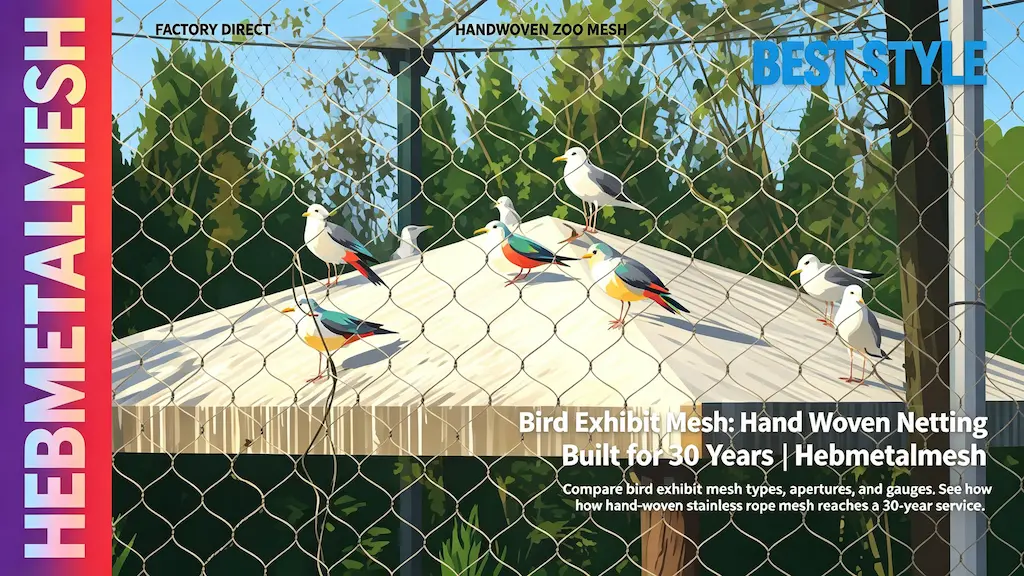
A bird net over an aviary does exactly one thing at the physical level: it decides which bodies pass. Aperture fixes the smallest body that cannot get through, rope diameter fixes the strongest one that cannot break the panel, and everything else the net appears to promise is a claim the mesh cannot honour. Anything that travels without mass — a virus, a mite, dust, a droplet, a midge — goes through a 20 mm opening as if the panel were not there. Understanding that boundary is where aviary biosecurity begins.
Executive Summary
An aviary net is a mass barrier, not an air filter. It holds the collection in, keeps cats, foxes, hawks and owls out, and shelters the flight space from wind and blown debris — all of which are decided by two numbers, the aperture and the rope diameter. It cannot stop a pathogen, a feather mite, a biting midge, a mouse squeezing through a 20 mm opening, or wild bird droppings that land on the roof and wash through the panel with the next rain. Aviary biosecurity is therefore a layered plan in which the net is one line, and a specification that buys only the net leaves every biological route open. The reference specification is the aviary netting product page.
Specifying a flight enclosure? Send the species list with counts, the frame dimensions and the exposure, and we will return an aperture and rope diameter for the tightest bird in the collection together with the panel take-off.
Quick Answer:
What is a bird net for in an aviary? It works as a size gate. Choose the aperture from the smallest bird you keep and the rope diameter from the strongest beak or hand in the collection, and the net will confine the collection while refusing anything larger. It will not stop pathogens, insects, rodents, contaminated water or the keeper’s boots, so pair it with a finer second layer, sealed feed, water that wild birds cannot reach, and a hygiene routine at the door.
Key Takeaways
- The net sorts by mass. Aperture is a size gate measured in millimetres; an influenza virus is measured in nanometres, roughly a hundred thousand times smaller than the smallest aperture this product is made in.
- The four threats that arrive with mass — a hunting hawk, a climbing cat or fox, a bird escaping, a falling branch — are what the mesh is specified for, and each one loads the panel differently.
- The threats that ignore the net are the ones that decide whether a collection stays healthy: wild bird contact, droppings on the roof, shared water, exposed feed, and the keeper.
- Grade and finish govern the net’s life, not its filtration. 316 resists coastal chloride; a black oxide finish changes how the panel reads, not what it stops.
- Disease control beyond the barrier is a published discipline, and the international reference is <a href=”https://www.woah.org/” rel=”nofollow” target=”_blank”>WOAH</a>, the World Organisation for Animal Health, whose avian influenza and biosecurity standards treat the physical barrier and the hygiene routine as one system rather than two.
A Size Gate, Not a Filter
Aperture is a length, so it can only be compared against lengths. This mesh is woven from rope between 1.2 mm and 3.2 mm in diameter with apertures from 20 mm to 102 mm, and the 20 mm panel is the tightest format the process produces. A finch cannot pass a 20 mm opening; a biting midge of 1–3 mm can, a mosquito of 4–6 mm can, and a virus of 0.02–0.3 microns passes as freely as air because it is smaller than that opening by five orders of magnitude. Nothing about a stronger rope changes the arithmetic. Specifying a panel for the smallest resident and then expecting it to exclude what is smaller than the resident is the most common error in an aviary specification, and it is worth reading the aperture sizing guide before any panel is ordered.
The Four Threats the Net Meets Head-On
| Threat | Route it takes | What the panel has to do |
| A hawk or owl hunting the flight | Over the roof, at speed | Cover the whole footprint as one field, and return after impact rather than taking a permanent set |
| A cat, fox, marten or rat | Up the frame, then testing the base | Walls and roof closed, base sealed to the ground, no gap wider than the aperture at the groundline |
| A resident bird leaving | Any opening larger than the smallest bird | One gate sized from the smallest resident, applied consistently at doors and service hatches |
| Wind-blown debris, a falling branch | Onto the roof, as a point load | A roof load case and a fixing detail that survives a local overload without cascading |
The climbing threat is the one that decides how far down the net has to reach, and that detail belongs to the enclosure rather than to the weave: a predator-proof outdoor enclosure solves it with a closed roof plus a buried or outward-turned base, and the mesh only has to survive the attempt. What matters on this page is the boundary — every one of these four threats has mass, and that is exactly why the net is the right instrument for them.
The Routes a Perfectly Good Net Does Not Close
These layers are separate purchases and separate disciplines. Treat them as the second half of the specification.
- Aviary disease prevention is about routes rather than strength, because most introductions into a closed collection arrive on something carried in, not on something that flew in.
- Aviary biosecurity plan — write it down. The barrier is one line of it; the rest is routine, quarantine and record keeping.
- The panel is an aviary disease barrier only against bodies. Against everything else in this list it is a fence with holes in it, which is why the layers below exist.
- Aviary quarantine pen — new arrivals, birds back from a show, and any bird handled by an outside vet pass through a separate enclosure before joining the collection.
- Aviary roof screening — a second, finer layer held above the flight net keeps most of what lands on the roof from reaching the birds below. A pitch of at least 1:12 also stops the ponding that leaves a roof panel permanently wet.
- Aviary roof over feeders and drinkers is the highest-value solid surface in the enclosure, because that is where wild birds congregate.
- Aviary drinking water hygiene — water that wild birds can reach, drink from or defecate into is the shortest route into a collection.
- Aviary feed storage — sealed bins, off the floor, inside a closed room, because spilled feed is a wild bird feeder.
- Aviary keeper hygiene — boots, tools and clothing move between enclosures, and they carry more than the wind does.
- Aviary pest control and aviary insect netting address the size class below the mesh: rodents, at a body width of 25–40 mm, need an opening near 6 mm to be truly excluded, which no practical flight mesh provides.
- Wild bird contact aviary planning has to assume the bird lands on the roof and stays there, because a perched wild bird has already crossed the perimeter.
- Wild bird droppings aviary exposure follows from it: what settles on the panel is washed down through the mesh by the next rain.
Wild Birds Are Both the Threat and the Reservoir
Here is the honest version of the biology. The wild bird that lands on an aviary roof to pick at spilled feed is the same wild bird that can carry highly pathogenic avian influenza, and the mesh keeps its body out while leaving its droppings on the panel above the collection. Waterfowl and other wild birds are the recognised reservoir for the virus, which is why zoos, breeders and conservation collections now write avian influenza aviary protection into operating procedures rather than into purchase orders. That protection is not a mesh specification. It is a hygiene specification with a barrier attached: roof screening, water that cannot be shared, feed that cannot be reached, boots that stop at the door, and a quarantine enclosure for anything new. Where an airborne disease aviary risk has to be managed, the answer is ventilation, stocking density and hygiene, because no aperture this industry makes can filter air. Exclusion at building scale is also a different job from containment at aviary scale, and the humane barrier guide covers what an exclusion installation does when the birds are outside rather than inside.
Sizing the Panel for the Duty It Can Discharge
Two numbers govern a bird panel and they are independent variables: aperture from the smallest resident, rope diameter from the strongest beak, hand, paw or bill. Worked pairs from current production: finches 20 mm aperture on 1.2 mm rope (HM1220), budgerigars 25 / 1.6 (HM1625), conures and ducks 38 / 2.0 (HM2038), Amazons and cockatoos 38 / 2.4, macaws and large raptors 38 / 3.2 (HM3238), pheasants, peafowl, cranes and flamingos 76 / 3.2 (HM3276). A mixed collection is the hard brief, because the tightest aperture and the heaviest beak are rarely on the same bird: take the small aperture and upgrade the rope, or split the collection across two panels. Grade follows the air rather than the bird — 304 (18% chromium, 8% nickel) inland, 316 with molybdenum within roughly 30 miles of salt water. Panels are woven up to 9 m × 18 m, which lets a large flight space close with few panels and few joints, and every joint is a potential gap.
Reading a Quotation for a Bird Net
A bird net quotation is worth reading twice, because the number that matters is not the rate. Ask for five lines: aperture, rope diameter, alloy grade and finish, panel format and sizes, and the fixing detail — the perimeter edge cable, its swage ferrule terminations, and how cable tensioning is carried out on site. Fixings, tensioning hardware, ferrules and anchor plates add 10–20% to a mesh-only figure, and cutting waste adds a further 5–10% on a measured take-off. Cost drivers run in a fixed order — rope diameter first, then aperture, then panel size, with order volume a distant fourth — so the honest way to move a price is to revisit the aperture, not to shop harder. For a hand woven panel, current planning ranges are $10–22/m² for aviary-grade work and $20–38/m² for heavy carnivore-grade formats, quoted as a planning range rather than a fixed price because rope diameter, aperture and the metal market all move it. The custom mesh specification framework sets out the fields a factory can actually quote from, and the full product range sits on the aviary netting product page.
When Mesh Is the Wrong Layer
If the risk you are managing arrives on the air, in water, or on a pair of boots, a better net does not reduce it. Say so before the order rather than after it: a 3.2 mm rope at a 76 mm aperture is the right answer for a crane or a peafowl flight and does nothing about a midge, and a 20 mm panel that excludes a finch is not a biosecurity filter. The mesh earns its place by holding the collection and stopping what has mass — a hand woven rope mesh panel of seven by seven strand construction loses only around 2% of one strand’s breaking load for a single broken wire, and the cross point is what lets it move rather than fail. Treat the panel as the outer line of a system, keep the aperture tolerance written into the order, isolate stainless from galvanised steel at every contact so a galvanic corrosion cell cannot form where nobody inspects, and put the biological layers in a separate budget line.
Frequently Asked Questions
No, not by itself. The net excludes the body of a wild bird, but the virus travels on droppings, in shared water and on equipment, so protection comes from roof screening, water hygiene and quarantine rather than from the weave.
Yes. A wild bird landing on the roof deposits droppings on the panel, and rain washes them into the flight space. Roof screening and a solid surface over feeders and drinkers are what break that route.
Rats and mice need an opening of about 6 mm to be excluded, and no practical flight mesh is that tight, so a 20 mm panel slows them rather than stopping them. A sealed base, sealed feed storage and a pest control routine do the rest.
For a collection under disease pressure, yes, and it is cheapest when the frame is designed for it at the start. A second layer over the roof and around the feed and water points covers most of the exposure for a small share of the total enclosure budget.
Two numbers decide a bird panel: the smallest resident and the strongest beak. Send both with your frame dimensions and we will size the aperture, the rope diameter and the panel layout for the enclosure you are actually building. Start your specification