
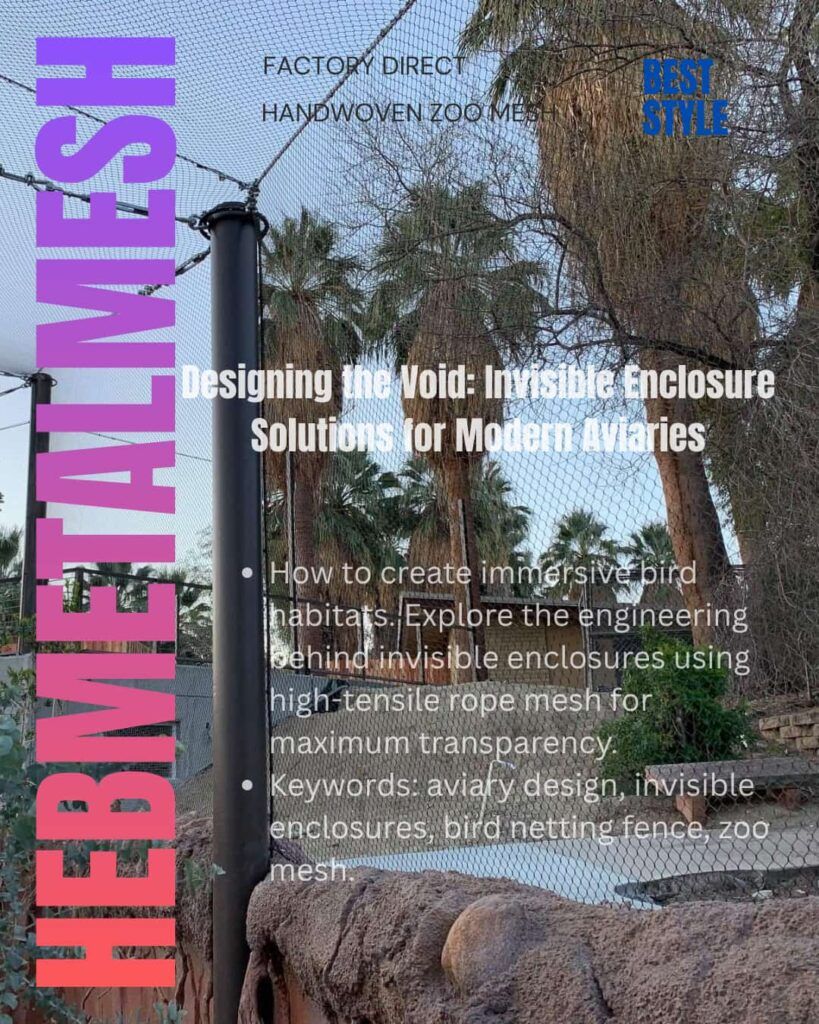
A transparent aviary barrier does not become invisible because a supplier called it invisible. It becomes invisible at a measurable distance from a measurable eye, and beyond that distance the wires fall below the resolving power of ordinary vision, which is what makes the aviary viewing experience a calculation rather than a purchase. For 2.0 mm cable the number is about seven metres. Stand a visitor inside it and they are looking at a net; stand them twelve metres back and the net is gone. Aviary sightline design is the practice of deciding where that crossover falls at every viewing position, and then arranging the path, the planting and the near-view detail so that nobody ends up on the wrong side of it.
Executive Summary
Invisible is a claim about geometry rather than material, and it can be checked with one division: wire diameter divided by viewing distance gives the angle the wire subtends, and once that falls below about one arcminute — roughly 0.9 mm of detail at three metres — a healthy eye stops separating the wires and starts averaging them. That explains most of the argument about aviary transparency. It is why a 3.2 mm rope reads as a veil at three metres and as nothing at twenty. Two of the three governing numbers belong to the birds: the aperture is set by the smallest bird and the cable by the strongest beak. Only the third, the distance at which visitors are allowed to stand, belongs to the designer. Get that number wrong and no amount of stainless steel produces the vanishing barrier the client asked for. The reference specification is the aviary netting product page.
Planning an aviary where the barrier has to disappear? Send us the species list and the viewing distances and we will return the aperture, the cable and the panel layout for each sightline.
Quick Answer: How far away is mesh invisible?
Rope mesh drops below the resolving limit of a normal eye when the wire casts an angle smaller than one minute of arc, which happens at roughly 3,400 times the wire diameter. In round numbers, 1.2 mm cable disappears at about 4.1 m, 2.0 mm at about 6.9 m and 3.2 mm at about 11 m. Inside those distances the wires are visible; outside them they are averaged into a faint grey haze. The practical rule is that a walk-through aviary with visitors at arm’s length never becomes truly invisible, while an exhibit viewed across a moat is invisible before the visitor has finished reading the sign.
Key Takeaways
- Aviary transparency is a viewing distance, not a product grade. The same panel is obvious at two metres and gone at twelve.
- The threshold is one arcminute, the stroke width of a 20/20 letter, which is a little under one millimetre of detail at three metres.
- Aperture and cable diameter are fixed by the birds. Only the visitor’s distance is yours to move.
- Below the threshold the mesh is not deleted, it is averaged into a faint grey veil that thickens as the aperture tightens.
- At close range no viable cable is sub-acuity, so the near view has to be designed with framing, planting and set-back rather than with thinner wire.
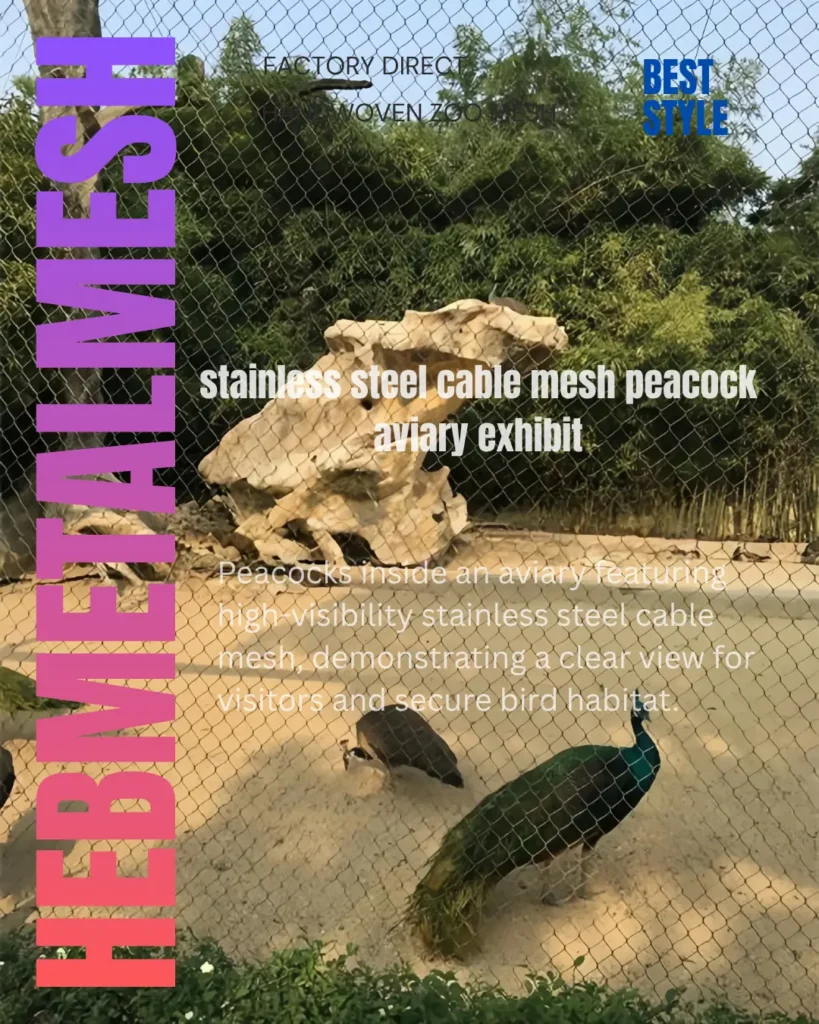
Invisibility Is a Distance, Not a Material
The arithmetic is a single division. The angular width of a wire is its diameter divided by the distance from the eye, and an eye separates two points only when they subtend about one arcminute, or one sixtieth of a degree. A 20/20 letter on a test chart stands five arcminutes tall and the stroke that draws it is one; that stroke is the finest line a healthy eye holds at high contrast, and at three metres it is a little under a millimetre. The same limit underlies normal visual acuity as the American Optometric Association defines it. Everything else in aviary barrier visibility follows from comparing a rope diameter against that one number.
| Rope diameter | Angle at 3 m | Angle at 15 m | Falls below one arcminute at |
| 1.2 mm | 1.4 minutes of arc | 0.27 | about 4.1 m |
| 1.6 mm | 1.8 | 0.37 | about 5.5 m |
| 2.0 mm | 2.3 | 0.46 | about 6.9 m |
| 2.4 mm | 2.8 | 0.55 | about 8.3 m |
| 3.2 mm | 3.7 | 0.73 | about 11.0 m |
Read the last column as a design instruction. Where visitors are held eleven metres from the panel, even the heaviest rope in the range has already vanished.
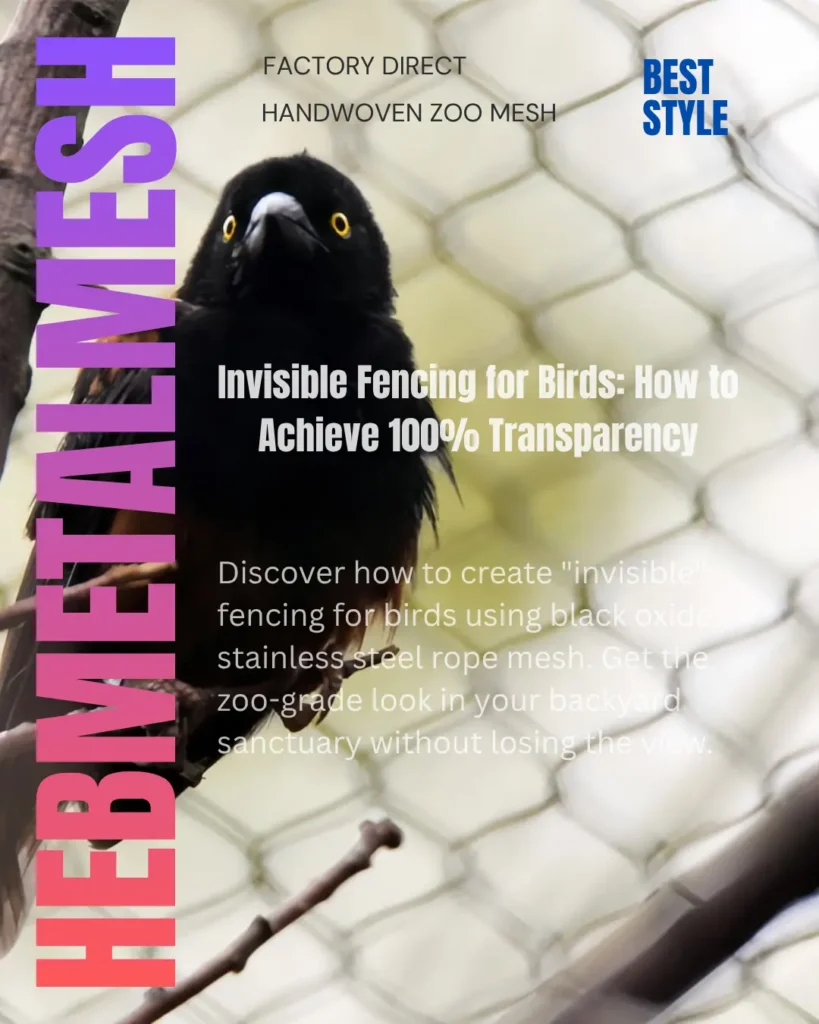
What the Eye Actually Resolves
Two corrections matter, and both cut against the brochure. The first is contrast: one arcminute is a high-contrast figure, and a grey rope in front of grey rock or green foliage offers far less contrast than black ink on white paper, so the working threshold on a real aviary is closer to two arcminutes. The second is movement. A wire that sways in a gust is detected below the resolution limit, because the eye tracks displacement more finely than it resolves shape, so a panel that is genuinely sub-acuity in still air can still flicker on a windy day. That is why mesh visibility at distance is never a clean yes or no.
Below the threshold the wire is not erased, it is integrated. A panel that is six to twelve per cent wire reads as a faint veil over the far side. The open area ratio of a hand woven mesh runs from about 88 per cent at a 20 mm aperture to about 94 per cent at 102 mm, so a tight specification for small birds carries more haze than a wide one, and it is that haze, rather than the wires, that visitors describe when they say they can see the net.
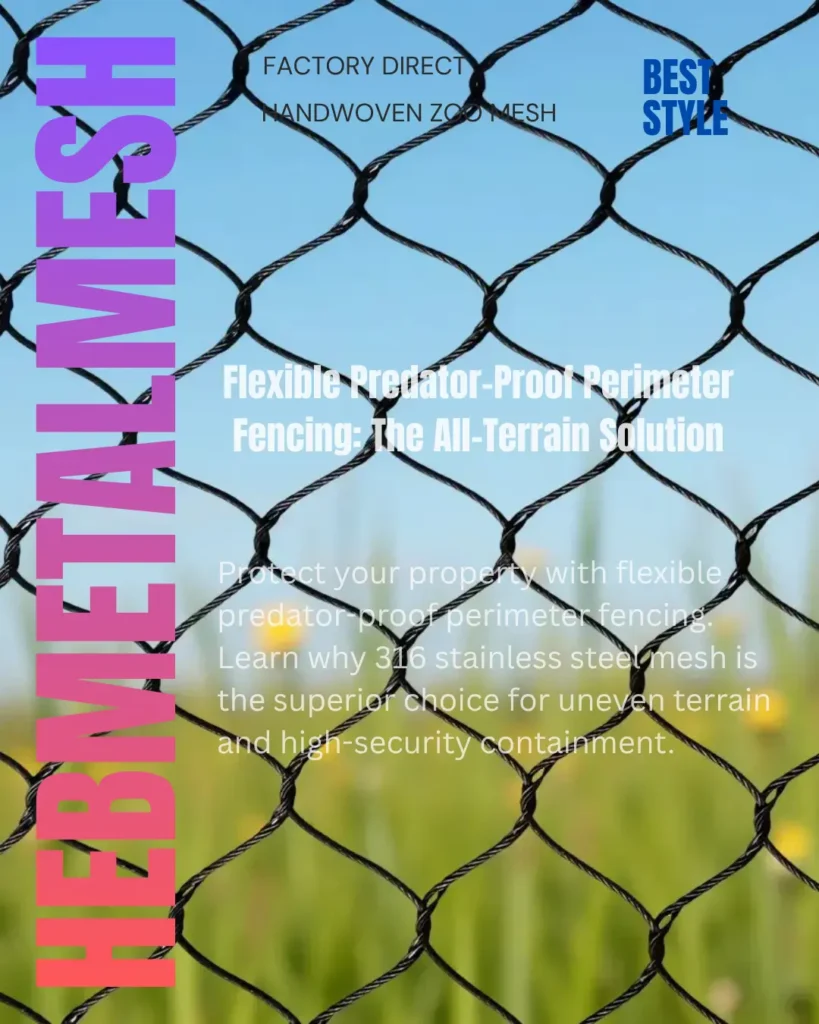
The Numbers That Are Not Yours to Choose
Every aviary reduces to a short list, and only part of it is open for discussion. Aperture size comes from the smallest bird in the collection rather than the largest, because the bird that escapes is the bird that fits through. Cable diameter comes from the strongest beak or hand that will ever reach the panel, because the animal that damages the mesh is rarely the one that looks most impressive on the sign. The two move in opposite directions: a finch collection at a 20 mm aperture and 1.2 mm rope keeps the haze high, while a crane or flamingo aviary at 76 mm and 3.2 mm gets a wide, airy panel that still holds a bird with a metre of reach. Useful aperture and cable pairings for common species are worth reading before the frame is drawn.
The third number is the one that gets forgotten. If the aperture follows the smallest bird and the cable follows the strongest beak, then the aviary viewing distance is the only free variable left, and it is entirely a question of layout — where the bench goes, how wide the moat is, whether the path runs along the panel or across the enclosure. A viewing distance mesh drawing is really a plan of where people stand, so fix it first and derive the visual result from it rather than choosing a cable and hoping visitors stand far enough back.
The Near View Is the Honest Problem
At one metre, staying under one arcminute would require a wire of about 0.29 mm. Nothing that thin can hold a bird, so no panel is invisible to someone standing against it. This is the part of aviary immersion design that brochures leave out: an invisible aviary barrier is invisible from across the enclosure and entirely visible from the walkway.
The response is to design the near view instead of pretending it away. The frame and the top rail are the honest edges of the panel, so they should look deliberate; a clean line reads as architecture while a scatter of brackets reads as fencing. Where a path runs close, the plan can place a planted strip between visitor and panel, push the panel out to the enclosure boundary and let the birds’ own cover do the work, or accept the near view and make its detail worth looking at. A black panel is often chosen for the close view too, though the reason usually given for it — how the mesh changes the light reaching the bird — is a separate question from how a visitor’s eye resolves the wire, and the two are worth keeping apart. That light question is covered in our notes on aviary mesh in black.
Where the Sightline Is Set: Bench, Path and the Eye That Uses Them
A sightline plan is built from the eye of the person who will use it. A standing adult’s eye sits at roughly 1.5 to 1.6 m and a seated adult about 200 mm lower, enough to change what is visible above a low panel or beneath a planted edge. Mark both heights on the drawing, then walk the plan and ask at every stop how far the nearest panel is and what lies behind it. A bay with a bench three metres from the mesh and a bright sky beyond it is the hardest case on the site; the same bay with a shaded backdrop and twelve metres of distance is nearly free. Where a close path and a long view both exist, compose the far view, because it is the only one that can be made to disappear. Our guide to walk-in aviary layout.
The aviary visitor sightline is also cheap to improve with planting. A shrub that blocks the first two metres of panel removes the worst case at no structural cost, and a change of level does the same job by moving the eye off the wire: an aviary barrier at eye level is the worst view on the site, and one step up or down removes it without touching the aviary barrier sightline further along the run.
Containing a Bird With Something You Cannot See
None of this relaxes the containment duty. A thin panel still has to hold a bird that does not want to be held, exclude predators that want in, and survive guano, washing and thirty years of weather. That is why the material is a 7×7 wire rope mesh: a cable netting woven from forty-nine wires in each strand rather than a single drawn filament. One broken wire costs about two per cent of that strand’s breaking load and the panel stays in tension; a single drawn wire of the same diameter would simply be a failure. Uncoated 304 covers inland sites, 316 covers coastal ones, and with no coating there is no film to chip or renew. The same stainless steel rope mesh runs from a 20 mm finch panel to a 102 mm flamingo panel, which is what makes a mixed collection workable.
| Specification item | What to write | Why it matters |
| Aperture | 20, 38, 51, 76 or 102 mm | Set by the smallest bird, not the average |
| Cable | 1.2 to 3.2 mm rope | Set by the strongest beak or hand |
| Alloy | 304 inland, 316 coastal | Chloride pitting, not appearance |
| Finish | Uncoated | No film to fail or renew |
| Panel | Up to 9 m x 18 m | Fewer posts in the sightline |
| Fixings | Add 10 to 20 per cent | Edge cable, tensioners, ferrules, anchors |
A 3.2 mm rope on a 76 mm aperture weighs roughly 1.5 to 2.0 kg per square metre, which allows long spans without a heavy frame in the view. Cost follows cable diameter first, then aperture, then panel size; aviary-grade material is usually quoted in a planning range of 10 to 22 US dollars per square metre before fixings.
FAQ
At the same distance, usually yes. At the same aperture, no. Thinner wire is less visible and less resistant to a beak, so the diameter follows the bird and the view is solved with distance rather than with a lighter rope.
No. One arcminute at one metre is a wire of about 0.29 mm, which is far below anything structural. Treat the near view as a design problem — planting, set-back, a deliberate frame — and keep invisibility for the long view.
They do different jobs. Aperture governs the haze, with the open area ratio running from roughly 88 per cent at 20 mm to about 94 per cent at 102 mm. Cable diameter governs whether the individual wires resolve. A wide aperture with a heavy cable is open and faintly lined; a tight aperture with a light cable is dense and faintly grey.
A dark, textured, unlit one. Bright sky behind a panel is the worst case, because it maximises contrast against the wire; that is why a shaded planting backdrop does more for transparency than an upgrade in cable. Angular resolution belongs to the eye, but contrast belongs to the design.
Send us the viewing distances and we will do the arithmetic. Tell us the species, the aperture you need and how close the public comes, and we will return the cable, the panel layout and the fixing schedule for each sightline.