

The aviary gets built, the birds go in, and within a week the owner notices something odd. The cage is the size the catalog recommended. The birds sit on the perch, hop to the feeder, hop back, and almost never fly.
The reason is usually in the shape, not the size. A 10 by 10 ft cage and a 4 by 25 ft cage hold the same floor area, and only one of them lets a bird complete a wingbeat cycle without braking. Aviary flight space per bird is a length measured along a clear line, and most cages get bought by the square foot.
Then the panels arrive in fixed widths, the frame gets built to suit them, and the flight line is whatever is left over. Reversing that order costs nothing at design stage and a fortune afterwards.
Executive Summary
Aviary flight space per bird comes down to three numbers: the clear flight line, the width a bird needs to turn, and the height it needs to climb and hang. Floor area tells you none of them.
Start with the species. Wingspan sets the minimum flight length, roughly four times the span for level flight. Height follows the way the bird flies, since a budgerigar climbs and a macaw runs a long low line.
Then fit the cage panels to those numbers rather than the reverse. Panels come in modules, so the real choice is how many bays to add, and a bay costs less than a custom panel every time. Get the module count wrong and the aviary is either short of air or short of money.
Quick Answer
Give a bird a clear flight line of at least four times its wingspan, a width of one and a half times the span, and enough height to climb without hitting the roof. Measure that line with perches and feeders in place, then order panels in whole modules that enclose it.
Key Takeaways
- Floor area hides the only dimension a bird uses: the clear flight line.
- Wingspan sets flight length; flight style sets height.
- A long narrow cage flies better than a square one of the same area.
- Panels come in modules, so the design has to land on a module.
- Perch length constrains bird count more often than volume does.
- Tail clearance at the mesh decides whether feathers survive.
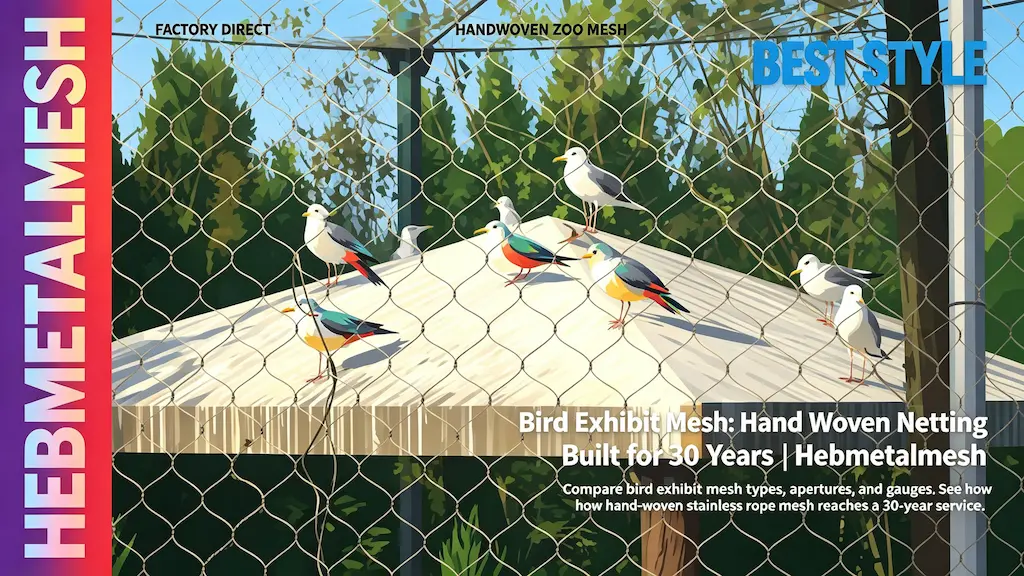
Why Floor Area Is the Wrong Number
A square foot is a unit of ground, and birds do not use ground. They use a line through the air, from one perch to the far end and back, and that line has to be clear of feeders, nest boxes, shelter and the keeper’s shoulders.
Two cages of 100 square feet behave nothing alike. The square one gives a bird about 8 ft of usable run once perches sit at each end. The long one gives 20 ft, and 20 ft is where flight actually happens.
So measure the clear line first. Walk the footprint with a tape and mark the longest unobstructed horizontal path at perch height, not at the floor. Whatever that measures is the number the whole design has to serve.
The panel decision comes after. The aviary netting range is quoted in modules for that reason, and a module schedule only makes sense once the flight line is fixed.
The Three Dimensions That Matter
Length, width and height each answer a different question, and a cage that fails one of them fails even when the other two look generous.
- Length is the flight line. It decides whether the bird can complete two or three wingbeats.
- Width is the turn. It decides whether the bird can reverse without stalling into mesh.
- Height is the climb and the hang. It decides whether a bird can get above the keeper’s head and use the upper air.
Height is where most cages quietly fail. A low cage forces level flight only, which suits finches and stresses species that climb. Vertical flight space for parrots needs to clear the top perch by 4 ft at minimum, and the minimum aviary height for budgerigars that keeps climbing usable works out at the same figure. Building an aviary for parakeets shows how that height rule plays out at small scale.
Flight cage length for finches runs shorter than most people expect, because finches fly in short fast bursts rather than long glides. A 10 ft clear line keeps a small flock working. The same cage would frustrate a cockatiel within a day.
Horizontal flight versus vertical climb is the split that decides the shape. Climbers want height and perches at different levels. Runners want length and perches at each end, with nothing in between.
| Bird | Wingspan | Clear flight line | Clear height | What usually goes wrong |
|---|---|---|---|---|
| Zebra finch | 8 in | 10 ft | 3 ft | Too tall, too short |
| Budgerigar | 7 in | 15 ft | 4 ft | No vertical air |
| Cockatiel | 12 in | 20 ft | 5 ft | Flight line blocked by perches |
| Lorikeet | 12 in | 20 ft | 6 ft | Wet perch placement |
| African gray | 18 in | 18 ft | 6 ft | Width too tight to turn |
| Blue and gold macaw | 41 in | 30 ft | 8 ft | Long tail hitting mesh |
Read the table as a starting point and adjust for the individual bird. A hand-raised macaw that has never flown will not use 30 ft on day one, and a rescue that has will use every inch of it.

Wingspan, Flight Length and the Ratio
The wingspan to aviary width ratio is the least used number in aviary design and the one that prevents most injuries. It also sets the floor on aviary flight space per bird. A bird needs room to turn, and turning takes width, not length.
A working ratio is one and a half times the span for the width, and four times the span for the length. Push the length ratio below three and the bird spends the whole flight braking, which is how primaries get damaged on the end panel.
Flight length for a macaw is the clearest example. A 41 in span puts the minimum near 10 ft and the working number near 14 ft, so a 30 ft cage gives the bird two full cycles and a glide. That is the difference between a bird that flies and a bird that paces.
Measure the span on the actual bird where you can. Wingspan varies with age and condition, and a clipped bird will measure narrower than its skeleton allows for.
Perches, Tail Clearance and the Panel
Perches are the cheapest part of an aviary and they decide whether the expensive part works.
Perch length per bird matters more than most keepers expect. Small passerines need 6 to 8 in of usable perch each, medium parrots 10 to 12 in, and large macaws 18 to 24 in, because a bird on a short perch cannot turn around without stepping on its neighbor.
Then set tail clearance at the mesh panel. Long-tailed species need 12 in between the tail and the panel at rest, or the tail feathers abrade every time the bird turns. Parrots that climb the mesh with their beaks need more, because they hang rather than perch. Aperture matters here too, since a hanging bird puts its claws through the panel, and small-hole mesh for small birds is the usual answer below cockatiel size.
The panel itself takes a load when a bird lands on it, and that load is small but repeated thousands of times. A panel with a slack aperture deforms, the opening widens at the edge, and a bird that explores the gap finds it. Wire diameter and aperture size hold that shape, and a 1 in aperture with a heavier wire resists deformation better than a wide aperture with thin wire.
We weave stainless steel aviary panels to the module the frame needs, which keeps the aperture uniform from corner to corner. The UFAW guidance on animal welfare is a useful check on whether the space you are planning actually lets the bird behave normally.
How Panel Sizes Quantize Your Aviary
Panels come in fixed widths, and that fact shapes every aviary more than most buyers realize. You cannot buy 17.5 ft of panel, so the design lands on 15 or 20 and the flight line moves with it.
Mesh panel width and aviary length are therefore one decision, not two. A 5 ft module repeated four times gives a 20 ft bay, which suits a cockatiel and underserves an African gray. A 10 ft module repeated five times gives 50 ft, which is macaw territory.
Work the sequence in this order:
- Measure the clear flight line the species needs.
- Divide by the module width and round up to a whole number of bays.
- Check the resulting length against the width and height figures.
- Adjust the module count, not the module size, when the numbers miss.
Panel increments for aviary size are why a bay is cheaper than a custom panel. Adding one standard module costs a panel and a set of fittings, which is why the count moves before the width does. Cutting a one-off width costs a setup, a drawing and a longer lead time, and it changes nothing a bird can measure.

Stocking Density and Bird Count
Stocking density birds per cubic meter is the number breeders argue about, and it is the wrong first question. Perch length usually runs out before volume does.
Start with perches. Add up the usable linear perch and divide by the allowance for the species. If a 20 ft aviary carries 40 ft of perch, it holds five medium parrots on perch length alone, whatever the volume suggests.
Then check the volume. A working figure for small passerines is 3 to 4 cubic feet of flight volume per bird, rising to 15 to 25 for medium parrots and considerably more for macaws. Those are planning numbers rather than rules, and a vet or a welfare inspector will apply their own.
Aviary volume for mixed species needs a different method, because the birds compete for the same air. Add the perch allowances for every species, then add a third again for the species that will chase. Mixed flocks work when the flight line is long enough for a chased bird to break away.
Aviary size for a breeding pair follows the same logic with one addition: the pair needs a flight line that lets the hen leave the nest without crossing the cock’s territory. Designing a walk-in aviary for mixed collections covers how that layout works in practice.
Indoor Flight Rooms and Ceiling Height
An indoor room converts cheaply if the ceiling is high enough, and badly if it is not. Bird room ceiling height decides whether the room is a flight room or a cage with furniture in it.
Eight feet is the floor for small birds and 10 ft is where parrots start to use the space properly. Below 8 ft, a climbing bird runs out of air before it runs out of room, and the upper third of the room goes unused.
Indoor flight room volume then has to work with the ventilation, not against it. A sealed room with 20 birds needs air changes that a converted bedroom duct cannot deliver, and the dust from down feathers will find every filter.
Lining the walls with panels rather than building a cage inside the room is usually the cheaper answer. The room becomes the enclosure, the window and door get panel treatment, and the flight line runs the full diagonal. Span and landing loads on aviary mesh matter more here than outdoors, because a ceiling panel carries a bird landing upside down.
FAQ
At least four times its wingspan in clear flight line, one and a half times the span in width, and enough height to climb above the highest perch. A medium parrot usually needs 20 to 30 ft of clear length.
Only for climbers. Budgerigars, lorikeets and most parrots use height, so a tall cage helps them. Finches and ground-feeding species get more from length, and a tall narrow cage wastes the upper air.
Work it from perch length first, then check volume. Small passerines need 6 to 8 in of perch each, medium parrots 10 to 12 in, and a mixed flock needs about a third more than the sum.
Leave 12 in between the tail and the panel for long-tailed species, and more where the bird hangs on the mesh. A perch set tight to the panel abrades tail feathers faster than any other mistake in the build.
Yes, if the frame was designed for it. Leave one bay of structure and one set of fittings in the original build, because adding a bay to a finished frame costs far more than ordering it at the start.
Tell us the bird, the bird count and the space available. We return a module schedule, the clear flight line it produces, and the panel specification that holds its shape under a landing bird. Send your aviary plan