
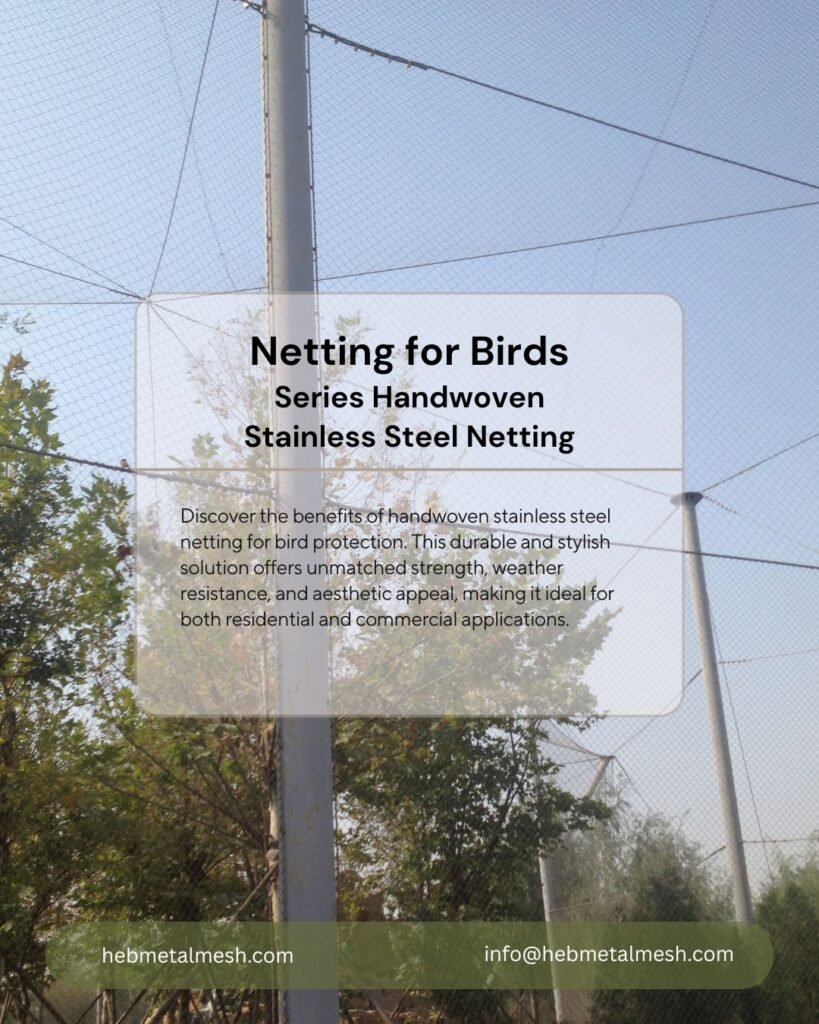
A large aviary is not a small aviary scaled up. The spans are longer, the roof carries more wind and snow, the frame moves further, and much of the barrier sits where nobody can easily reach it. That is why the netting decision on a big flight structure is a durability decision, and why the roll that performs well on a garden cage for three seasons is the wrong answer for a twelve-meter roof you inspect twice a year. This guide is written for the people who sign off that decision: aviary builders, zoo facilities managers and buyers who need durable mesh that is still doing its job when the framework around it is due for its second repaint.
Executive Summary
Mesh is durable when its strength is a property of the material itself rather than of a coating that can be cut. Stainless steel rope mesh passes that test because its corrosion resistance comes from a chromium-rich oxide layer that re-forms in air; galvanized wire depends instead on zinc that is interrupted at every fixing, staple and cut end, while polymer netting loses strength as sunlight drives polymer embrittlement inward. For a large aviary the order of decisions is fixed: set the aperture from the smallest bird that must be contained, the rope cross section from the span and the load, and the alloy from the site’s exposure to chlorides, then detail the perimeter so the panel can be tensioned and reached. Read mesh that lasts as a materials claim rather than a marketing one, and the life-cycle arithmetic answers itself. The reference specification is the aviary netting product page.
Specifying netting for a structure you cannot easily reach?
Send the opening dimensions, the species being contained, and how exposed the site is to salt and weather. We will return a recommended aperture, rope diameter and alloy, with an indicative planning range per square meter.
Request a durable mesh quotationQuick Answer:
Durable mesh for aviaries is handwoven stainless steel rope mesh: apertures commonly between 20 mm and 102 mm, rope diameters from 1.2 mm to 3.2 mm, and single panels up to roughly 9 m by 18 m. As a planning range, aviary-grade material falls between US10 and US22 per square meter. It is durable because there is no coating to breach and no polymer to embrittle, so the metal at a fixing behaves like the metal in the field. Specify it wherever the aviary is large, permanent or expensive to inspect.
Key Takeaways
- Durability is a materials decision, so a durable mesh material check comes before any price comparison.
- Stainless steel resists corrosion through a self-renewing chromium oxide layer, the mechanism called surface passivation, while a single coating integrity failure at one cut end can start a galvanized panel’s long decline.
- Surface passivation also decides grade: 304 stainless suits inland sites, and 316 stainless is the answer where salt spray, fertilizer runoff or animal urine reaches the mesh.
- Aperture, rope diameter and span are independent choices. Aperture sets containment, the rope cross section sets strength, and span decides how much load the perimeter must carry.
- Weathering resistance and UV resistance are separate claims. Polymer netting fails under sunlight and galvanized wire fails where its zinc is consumed; solid stainless fails at neither.
- Inspection access is a drawing-stage decision, not a maintenance problem to be discovered years later.
Why a Large Aviary Fails at the Material
Walk a large aviary a few years after handover and the failure pattern is predictable. The frame is sound, the fixings are sound, and the netting has failed, usually first at a fixing, a fold or a cut end. On a structure of any size, netting is asked to do three jobs at once: contain the bird, exclude the predator, and survive the weather. Only one type of netting does all three without depending on a coating or an additive.
The mechanism matters more than the label. Stainless steel resists corrosion because it forms a passive chromium-rich oxide film on its surface, and it re-forms in air if scratched, the behavior World Stainless describes as self-healing, which prevents rust and corrosion and removes the need for coatings. Where that film is starved of oxygen, inside a tight overlap or under a deposit, moisture retention turns from protection into a corrosion risk, which is the strongest argument for detailing a large barrier so that water drains.
Large aviaries also make failure expensive. A weak panel in a small cage is a weekend repair; the same defect in the roof of a walk-through flight structure is access equipment, a closure plan and a welfare decision. Scale-up work of this kind is covered in heavy-duty bird netting for large-scale aviaries.
What Makes Durable Mesh Durable: Alloy, Rope, Coating
Three variables decide how long a panel lasts, and only one of them is price.
Alloy decides whether the passive film survives the site. 304 stainless is the default for inland aviaries. 316 stainless adds molybdenum, which raises resistance to pitting and crevice attack in chloride-bearing air, and belongs wherever the structure meets salt spray, wash-down chemicals or urine. A durable mesh supplier should be able to name the film-forming grade being quoted, not simply read you the number.
Rope decides strength. Rope diameter runs from 1.2 mm to 3.2 mm, and tensile strength scales with the rope cross section, so a heavier rope belongs where spans are long or where a large bird can apply point impact. Handwoven stainless rope mesh is also weather resistant netting in the literal sense: the material does not care about rain, frost or humidity, and it is not UV sensitive, so UV resistant netting in stainless is a property of the metal rather than a treatment applied to it.
Coating decides how the panel behaves after it is damaged. Galvanized wire performs well until the zinc is cut or consumed, exposing unprotected steel beneath. Polymer netting behaves comparably: polymer embrittlement advances inward as UV exposure accumulates, and a fraying net sheds fragments as it weakens. Neither failure mode exists in solid stainless rope, which is why factory-direct comparisons of the two material families, covered in stainless steel rope netting fence: factory sale, usually finish on service life rather than unit price. A durable mesh factory quoting on diameter and aperture is quoting the whole specification; one quoting on grade alone is not.
A Durable Mesh Specification: Aperture, Rope and Span
A durable mesh specification rests on three numbers, and they are chosen in a fixed order.
Aperture is containment. Measure the smallest opening through which the bird, or its head or beak, must not pass, then select an aperture below it. Small finches and canaries are normally specified at or under 25 mm; mid-size parrots and cockatoos at 25 mm to 51 mm; larger flight structures for heavy species at 51 mm and above. A tighter aperture costs more material per square meter, so the decision should follow the birds rather than the budget.
Rope diameter is strength. A heavier rope carries more load at the same span, and it fatigues more slowly at a fixture under repeated movement.
Span is the geometry that connects the other two. The wider the unsupported run, the more the load path matters, and the more the perimeter rather than the field has to work. Panel format interacts here. Mesh supplied in large rolls reduces the number of field joints, and fewer joints means fewer places for movement to concentrate. Roll formats and their practical limits are set out in aviary mesh roll: the perfect solution for your bird cage.
Choosing Durable Mesh for Birds: Aperture and Species
Durable mesh for birds is not one product. The right specification tracks the animal in front of you: a 2 mm rope at a 25 mm aperture is generous for a canary and inadequate for a macaw, while a 3.2 mm rope at 76 mm would waste material on a finch and suit a large parrot.
Two rules shorten the decision. Size on the escapee, not the average, because the smallest bird in the collection sets the aperture for the whole structure. Treat beak and claw load as a real design case, since psittacines work at fixings and a panel adequate in tension can still be loosened at its edge. Enclosure layout and the mesh order should be settled together, and the planning side is described in design your outdoor bird aviary plans.
Mesh also has to serve the keepers. Cleaning, inspection and repair happen at the perimeter, so the aperture and alloy chosen for the birds should be checked against the maintainer’s routine before ordering.
Durable Mesh for Enclosures Beyond the Aviary
The same reasoning drives durable mesh for enclosures well outside bird keeping. Primate and small carnivore exhibits ask for more load capacity and less tolerance for gaps; hoofstock separation needs wide apertures over long spans; perimeter installations such as guarding and fall-protection infill need the same coating-free material, because a joint or a breach is where a barrier fails.
What unites them is that none of these structures is inspected daily. Durability, in practice, means the barrier degrades slowly enough to be noticed, and that its condition can be read from the ground. Wider and longer panels help on both counts, and the argument against assembling a large barrier in pieces is made in seamless netting: large woven panels with no joins.
Durable Mesh Installation, Inspection and Cost
Durable mesh installation is mostly a perimeter exercise. A panel is not made strong by its field but by the way it is captured at its edges, tensioned, and attached to a frame able to carry the load it collects. Plan the fixing pattern before the panel is woven, leave enough edge to grip, and confirm that the frame resists what the mesh transfers to it.
Then budget for the checking. Inspection access should be designed in: a barrier that can only be examined from a platform will be examined rarely. On a large structure, one annual walk-round at the perimeter finds nearly everything, because that is where the load and weather arrive. Since stainless needs no recoating, repair tends to be local: a patch tied into sound strands rather than a full re-cover.
On durable mesh cost, the honest framing is per year of service rather than per roll. As a planning range, aviary-grade stainless falls between US10 and US22 per square meter, and heavier carnivore-grade material between US20 and US38. The comparison only becomes meaningful when the polymer or galvanized alternative is priced over the same horizon, including replacements and the labor of reaching the barrier each time. Ask your durable mesh supplier for a service-life assumption in writing: a supplier who cannot give one is describing a product, not a specification, and is not selling a long lasting mesh.
Ready to specify mesh by service life instead of by roll?
Send us the span, the species and the site conditions. We will recommend an aperture, rope diameter and stainless grade, confirm the largest panel we can weave, and quote against the specification.
Send your aviary dimensionsFAQ
The material rather than the coating. Handwoven stainless steel rope mesh resists corrosion through a chromium-rich oxide layer that re-forms in air, so a scratch, a cut end or a fixing does not create a permanent weak point.
Galvanized wire is limited by its zinc, interrupted at every cut and fixing. Polymer netting is limited by UV, which embrittles it inward. Solid stainless rope carries neither limit, and is usually replaced because the structure around it changed, not because the mesh failed.
316 stainless, as a rule. The added molybdenum improves resistance to pitting and crevice corrosion in chloride-bearing conditions. Inland sites away from salt and fertilizer runoff are normally well served by 304.
Size on the smallest bird that must be contained. If that is a finch, the whole structure probably needs an aperture at or under 25 mm, even where larger species occupy most of the volume.
No. Rope diameter sets strength and should follow span and load. An over-specified rope on a short span adds weight and cost without adding service life, while a light rope flexing on a wide span fatigues its fixings.
Yes. Local damage is normally patched by tying new strands into sound mesh. That is another reason to keep the perimeter reachable, since edge repairs are routine while a repair in the middle of a roof needs access equipment. The reference specification is the aviary netting product page.