I. Introduction
In the world of professional avian care and landscape architecture, the concept of the aviary outdoor has evolved far beyond the traditional “bird cage.” Today, zoos, conservation centers, and private enthusiasts are moving toward expansive, “bio-park” style environments that prioritize flight space, natural enrichment, and structural transparency. However, moving an aviary into the open elements introduces a complex set of challenges: fluctuating weather, predatory threats, and the relentless march of corrosion.
The success of an outdoor sanctuary depends almost entirely on the integrity of its perimeter. Choosing the right containment material isn’t just a matter of aesthetics—it is a critical decision for bird welfare and long-term investment protection. While traditional galvanized wire or nylon netting may seem cost-effective initially, they often fail under UV exposure or pose toxic risks to hook-billed species.
This is where handwoven stainless steel mesh has revolutionized the industry. As a specialized manufacturer, Hebmetalmesh has spent years perfecting a product that balances “invisible” aesthetics with the rugged durability required for 24/7 outdoor exposure. Whether you are designing a small backyard garden retreat or a massive 30′ x 60′ walk-in zoo enclosure, understanding the technical nuances of your mesh is the first step toward a thriving avian environment.
Key Takeaways: Designing Your Aviary Outdoor
Before diving into the technical specifications, here are the essential points to consider for any outdoor aviary project:
- Material Matters: Grade 304 and 316 stainless steel are the only materials that offer true rust-proof longevity and non-toxic safety (preventing “New Wire Disease”).
- Visibility & Aesthetics: Black oxide finishes are the gold standard for public viewing, as the dark surface absorbs sunlight and becomes nearly invisible to the human eye.
- Customization Saves Labor: Utilizing customized roll sizes—offered by Hebmetalmesh at no additional cost—minimizes onsite cutting and material waste.
- Scale Without Seams: For large-scale projects, look for panels up to 30′ x 60′ to ensure structural strength and a seamless, professional finish.
- Predator Proofing: Handwoven mesh provides a flexible yet impenetrable barrier against climbing and digging predators like raccoons, rats, and snakes.
II. Why Stainless Steel Mesh is the Gold Standard
When designing an aviary outdoor, the selection of containment material is the single most important factor for the longevity of the structure and the health of its inhabitants. While options like plastic netting, nylon, or galvanized wire are available, they often fail to meet the rigorous demands of a permanent outdoor environment.
Stainless steel mesh, particularly the handwoven variety produced by Hebmetalmesh, has emerged as the industry benchmark for zoos and professional breeders worldwide. Here is why it remains the undisputed gold standard.
1. Unmatched Durability vs. Traditional Materials
The “outdoor” in aviary outdoor implies constant battle with the elements. Standard materials often fall short:
- Plastic & Nylon: These are highly susceptible to UV degradation. Over time, the sun makes them brittle, leading to “ghost breaks” where the netting snaps under the slightest pressure from a bird or a predator.
- Galvanized Steel: While stronger than plastic, the zinc coating eventually oxidizes. Once the silver finish turns to white rust, the structural integrity is compromised, and the rough surface can cause feather wear or foot injuries.
Stainless steel (Grade 304 and 316), by contrast, creates its own protective chromium oxide layer. It does not rust, does not scale, and can withstand decades of rain, snow, and intense sunlight without losing a fraction of its tensile strength.
2. Eliminating “New Wire Disease” (Non-Toxicity)
Bird safety is the primary concern for any aviary owner. Many birds, especially parrots and hookbills, use their beaks to climb the mesh.
- The Danger of Zinc: Galvanized wire is coated in zinc. If a bird chews on the wire, they can ingest toxic levels of heavy metals, leading to “New Wire Disease” (Zinc poisoning), which is often fatal.
- The Stainless Solution: Stainless steel is inherently non-toxic and lead-free. It is the only material recommended by avian veterinarians for chew-prone species, ensuring that your aviary outdoor remains a sanctuary, not a hazard.
3. The Strength of the Handwoven Interlock
Unlike welded wire, where a single broken weld can cause a panel to unzip, Hebmetalmesh utilizes a handwoven diamond pattern.
- Impact Resistance: The woven structure acts like a spring. If a large bird flies into the mesh or a predator attempts to pounce, the energy is distributed across the entire panel rather than a single point.
- High Break Strength: Despite its delicate, “silk-like” appearance, the high-tensile stainless steel wire is nearly impossible for even the strongest macaws to cut or bend.
4. Flexibility and Structural Freedom
An aviary outdoor often features irregular shapes, arched roofs, or integrated landscaping.
- The “Fabric” Advantage: Handwoven mesh behaves more like a high-strength fabric than a rigid cage. It can be stretched over complex frames, wrapped around trees, or draped into “tunnel” shapes without kinking.
- Customization: Because we manufacture these rolls to order, we can provide the exact dimensions required for your specific frame, including large-scale panels up to 30′ x 60′, which drastically reduces the need for visible seams.
Comparative Overview: Aviary Materials
| Feature | Handwoven Stainless Steel | Galvanized Welded Wire | Nylon/Plastic Netting |
|---|---|---|---|
| Lifespan | 30+ Years | 3–7 Years | 1–3 Years |
| Toxicity | None (Safe) | High (Zinc Risk) | Low (Microplastic Risk) |
| UV Resistance | Perfect | Excellent | Poor (Becomes brittle) |
| Aesthetics | Premium/Invisible | Industrial/Bulky | Cheap/Sagging |
| Predator Proof | Yes | Yes (until rusted) | No (Easily chewed) |
II. Planning Your Aviary Outdoor: Key Considerations
Building a successful aviary outdoor is a balancing act between architectural design, biological necessity, and environmental resilience. A well-planned enclosure doesn’t just hold birds; it creates a micro-ecosystem where avian life can flourish safely. At Hebmetalmesh, we’ve assisted in the planning of hundreds of enclosures, from backyard sanctuaries to world-class zoo exhibits.
Before you order your handwoven stainless steel mesh, consider these five critical planning pillars.
1. Location and Environmental Factors
The “outdoor” element is your greatest asset and your biggest challenge.
- Sun and Shade: Birds need Vitamin D from natural sunlight, but they also require a “cool zone.” Position your aviary so that at least one-third of the area is shaded during the hottest part of the day.
- Wind Protection: Constant high winds can stress birds and damage feathers. If your location is prone to heavy gusts, consider a solid back wall or a denser mesh weave on the windward side.
- Drainage: To prevent the buildup of bacteria and mold, the floor of your aviary must drain efficiently. Sloped concrete or a deep layer of replaceable gravel/sand is highly recommended.
2. Sizing for Flight and Welfare
An aviary outdoor should provide enough space for horizontal flight.
- The “Rule of Three”: For many species, the width of the enclosure should be at least three times the wingspan of the largest bird.
- Customized Roll Sizes: One of the most common mistakes is ordering standard-sized rolls that leave you with massive amounts of waste. At Hebmetalmesh, we provide customized roll sizes at no additional cost. This allows you to design your frame first and order the exact dimensions of netting required to fit it.
3. Large Panel Integration (The 30′ x 60′ Advantage)
For professional installations and large-scale flight cages, “seams” are the enemy. Every time you join two pieces of mesh, you create a potential point of failure and a visual distraction.
- Seamless Construction: We can manufacture panels as large as 30′ x 60′. These massive sheets allow you to cover entire roofs or long side-walls with a single piece of stainless steel mesh.
- Structural Integrity: Large panels distribute tension more evenly across the frame, reducing the “sagging” often seen in cheaper, smaller-tiled netting systems.
4. Mesh Aperture and Wire Diameter
Choosing the right “hole size” (aperture) is vital for both containment and exclusion.
- The Containment Rule: The mesh must be small enough that the bird cannot stick its head through. If the head fits, the body can get stuck, often with fatal results.
- The Exclusion Rule: An aviary outdoor must keep local wildlife out. To prevent small rodents or snakes from entering, an aperture of 1″ x 1″ (25mm) or smaller is typically required.
- Wire Thickness: For large parrots (Macaws, Cockatoos), a thicker wire diameter (e.g., 2.0mm or 2.4mm) is necessary to withstand their powerful beaks.
5. Safety and Security Features
An outdoor enclosure is only as strong as its weakest point.
- The Safety Porch (Double Door): Always design your entry with a two-door “airlock” system. This prevents birds from escaping when you enter to provide food or maintenance.
- Predator Skirts: Extend your stainless steel mesh at least 12–18 inches into the ground (or attach it to a concrete footer) to prevent foxes, rats, and stray dogs from digging their way in.
Planning Checklist
| Category | Requirement | Why It Matters | |
|---|---|---|---|
| Foundation | Concrete or Buried Mesh | Stops digging predators like foxes, rats, and stray dogs from entering. | |
| Materials | 316 Stainless Steel | Crucial for coastal or humid areas to prevent salt-air corrosion and pitting. | |
| Finishing | Black Oxide | Provides “invisible” transparency for better bird watching and photography. | |
| Entry | Double-door System | A safety “airlock” prevents accidental bird escapes during feeding or cleaning. | |
| Frame | Galvanized Steel or Treated Wood | Provides the necessary rigid skeleton to maintain high mesh tension. |
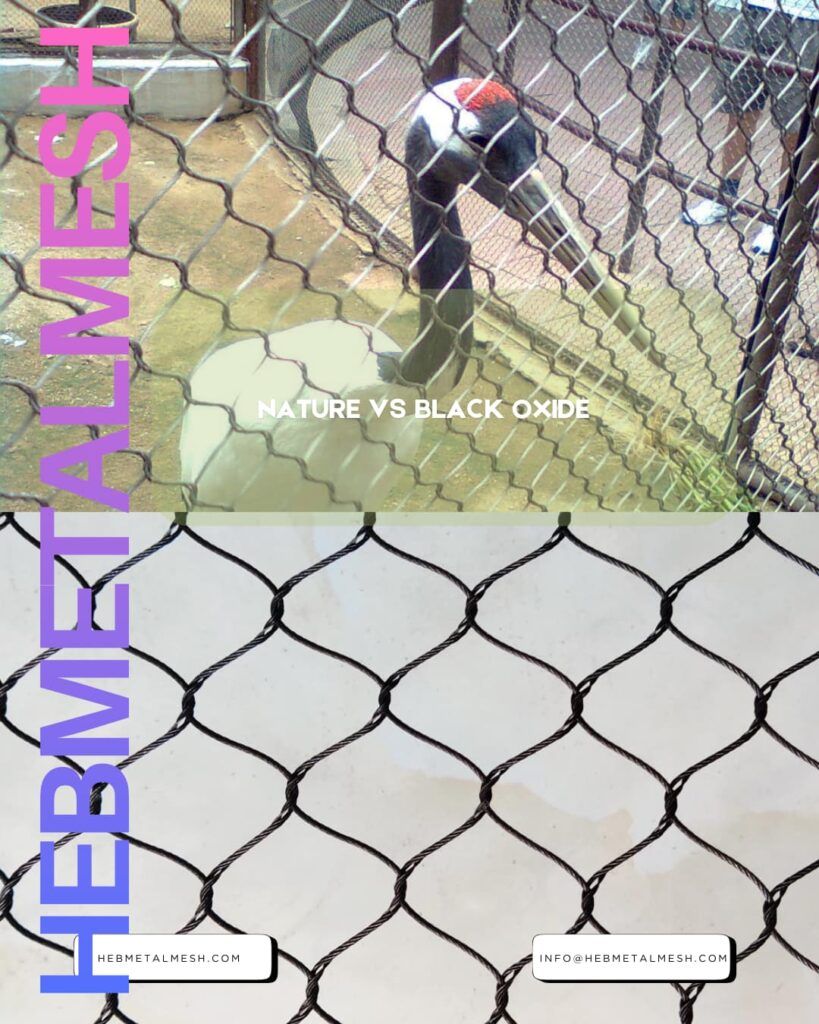
| Feature | Black Oxide Finish | Natural Silver Finish |
|---|---|---|
| Best For | Zoos, Bird Parks, Luxury Gardens | Farms, Modern Industrial Architecture |
| Visibility | Near-Invisible (High transparency) | Visible (Reflective) |
| Photography | Excellent (No glare) | Difficult (High glare) |
| Maintenance | Hides dust and dirt well | Shows grime more easily |
| Safety | Non-toxic (No peeling/chemical bond) | Non-toxic (Raw 304/316 steel) |
Pro-Tip for Your Aviary Outdoor
If your aviary outdoor is located in a high-traffic area where the public will be viewing the birds from one side only, you can save on costs by using Black Oxide on the viewing panels and Natural finish on the roof or back walls where visibility is less critical. However, for a truly seamless “open-air” feel, a full Black Oxide enclosure is the gold standard.
V. Technical Specs for Different Species
An aviary outdoor is rarely a “one-size-fits-all” construction. The physical capabilities, behavioral traits, and beak strength of different bird species dictate the specific technical requirements of your stainless steel mesh. Choosing a mesh that is too light leads to escapes or predator intrusion; choosing a mesh that is too heavy can result in a “cagey” look that obscures your view.
At Hebmetalmesh, we categorize our handwoven netting based on wire diameter (D) and aperture size (W x H). Here is how to match those specs to your specific inhabitants.
1. Small Birds: Finches, Canaries, and Softbills
For smaller species, the primary goal is containment and the exclusion of small predators like mice or snakes.
- Recommended Aperture: 0.8″ x 0.8″ (20mm x 20mm)
- Wire Diameter: 1.2mm.
- Technical Priority: High transparency. Because these birds are small, you want a fine wire that doesn’t overwhelm the visual space of the aviary outdoor.
2. Medium Parrots: Conures, Cockatiels, and African Greys
These birds possess significant “chew power” and are highly intelligent. They will test the mesh for weak points daily.
- Recommended Aperture: 1″ x 1″(25mm x 25mm) to 1.5″ x 1.5″ (38mm x 38mm)).
- Wire Diameter: 1.6mm to 2.0mm.
- Technical Priority: Tension and knot strength. The handwoven interlocking knots of Hebmetalmesh ensure that even if a bird focuses its beak on one spot, the diamonds will not slide or enlarge.
3. Large Psittacines: Macaws and Cockatoos
Large parrots have incredible bite pressure (some exceeding $500 \text{ PSI}$). They require the most rugged version of our aviary outdoor netting.
- Recommended Aperture: 2″ x 2″ (50mm x 50mm).
- Wire Diameter:2.4mm to 3.2mm.
- Technical Priority: Tensile strength. Use Grade 316 Stainless Steel for these species, as it offers the highest resistance to both physical stress and environmental corrosion.
4. Birds of Prey: Eagles, Hawks, and Owls
Raptors require large flight spaces. The mesh needs to be flexible enough to absorb the impact if a bird flies into the wall during a hunt or flight exercise.
- Recommended Aperture: 2″ x 2″ (50mm x 50mm) up to 4″ x 4″ (100mm x 100mm) for very large eagles.
- Wire Diameter:2.0mm to 3.2mm.
- Technical Priority: Impact absorption. The “spring-like” nature of handwoven mesh prevents feather damage and “keel bone” injuries that occur with rigid welded wire.
Quick Reference: Species Specification Table
| Bird Category | Common Species | Recommended Mesh (mm) | Wire Diameter (mm) |
|---|---|---|---|
| Small Birds | Finches, Budgies, Canaries | 20 x 20 | 1.2 |
| Medium Birds | African Greys, Amazons, Conures | 25 x 25 | 1.6 – 2.0 |
| Large Birds | Macaws, Cockatoos | 50 x 50 | 2.4 – 3.2 |
| Raptors | Owls, Falcons, Hawks, Eagles | 50 x 50+ | 2.0 – 2.4 |
| Waterfowl | Cranes, Flamingos, Ibises | 38 x 38 | 2.0 |
Why Customization Matters for Species Safety
In a professional aviary outdoor, you might have different species in adjacent flights. Hebmetalmesh allows you to order different specifications for different sections of your project. For example, you can use a heavy 2.4mm wire for your Macaw section and a fine 1.2mm wire for your walk-through butterfly or finch area—all while maintaining a consistent aesthetic across the entire park.
Expert Tip: When measuring for an aviary outdoor, always ensure the aperture is smaller than the width of the bird’s head. If a bird can get its head through the mesh, it is at high risk of strangulation or injury.
VI. Installation & DIY Guide
Installing an aviary outdoor can seem like a daunting engineering task, but the unique “fabric-like” properties of handwoven stainless steel mesh make it surprisingly accessible for both professional contractors and dedicated DIY enthusiasts. Because Hebmetalmesh provides customized roll sizes, the heavy lifting of cutting and resizing is already done for you.
Follow this step-by-step guide to ensure your installation is secure, tensioned correctly, and aesthetically pleasing.
1. Preparing the Frame
The frame is the skeleton of your aviary outdoor. It must be strong enough to support the weight of the mesh and the tension applied during installation.
- Material Choice: Most professional aviaries use galvanized steel pipes or powder-coated aluminum. For a more natural look, pressure-treated wood or cedar is excellent, provided the birds cannot chew through the structural posts.
- Spacing: For optimal stability, vertical posts should be placed every 6 to 10 feet.
2. The Secret to Tension: “The Diamond Orientation”
Handwoven stainless steel mesh is flexible, but it must be installed with the diamonds oriented correctly (usually vertically) to maintain structural integrity.
- Pre-Stretching: Before attaching, lay the mesh out on a clean surface. Gently pull the mesh to open the diamonds to their specified aperture (e.g., 1″ x 1″).
- Avoid Over-Tensioning: The mesh should be taut enough to prevent sagging but flexible enough to “bounce” if a bird flies into it. This elasticity is what makes an aviary outdoor safe for high-speed fliers.
3. Attachment Methods
There are three primary ways to secure Hebmetalmesh to your frame:
- Lacing Wire (Recommended): Use a thin stainless steel wire to “sew” the edge of the mesh to the frame. This creates a very clean, professional look and allows for micro-adjustments in tension.
- Stainless Steel Cable Ties: For a faster DIY installation, high-grade UV-resistant or stainless steel cable ties are incredibly effective.
- Self-Tapping Screws with Washers: If you are using a wooden frame, you can secure the mesh by using screws and wide washers every 4–6 inches.
4. Managing Seams in Large Aviaries
If your aviary outdoor requires multiple panels, you don’t need bulky connectors.
- Seamless Splicing: You can “weave” two panels together using a single strand of stainless steel wire. When done correctly, the seam becomes invisible, maintaining the “disappearing” effect of the black oxide finish.
- The 30′ x 60′ Advantage: Remember, if you order our large-format panels, you can often eliminate seams entirely on walls or ceilings.
5. Predator-Proofing the Perimeter
The base of your aviary outdoor is where most failures occur.
- The “L-Footer”: Extend your mesh 12 inches down into the ground, then bend it 90 degrees outward for another 6 inches. This “L” shape prevents foxes or dogs from digging directly under the fence.
- Concrete Curbing: For the most secure installation, bolt the bottom of the mesh directly into a concrete footer or curb.
DIY Installation Toolkit
| Tool Required | Purpose & Use Case |
|---|---|
| Wire Snips / Cutters | Essential for trimming excess stainless steel lacing wire and cleaning up panel edges after installation. |
| Pliers (Needle-nose) | Used to pull lacing wire tight during the “sewing” process to ensure the mesh is properly tensioned. |
| Measuring Tape | To ensure consistent aperture (diamond shape) spacing across the panel and verify frame dimensions. |
| Level | Crucial to verify that your frame posts are perfectly vertical before mounting the mesh to avoid warping. |
| Protective Gloves | Heavy-duty gloves are mandatory; stainless steel wire ends can be sharp during the cutting and lacing phase. |
Common Mistakes to Avoid
- Ordering the Wrong Grade: If you live within 30 miles of the ocean, always choose Grade 316 Stainless Steel for your aviary outdoor. Salt air will eventually pit Grade 304.
- Forgetting the “Safety Porch”: Never build an entry that opens directly into the aviary. Always install a double-door system to prevent accidental escapes during feeding.
- Ignoring the Ceiling: Many DIYers focus on the walls but use cheaper, weaker netting for the roof. Predators often enter from above; ensure your ceiling mesh is just as strong as your side panels.
VII. Case Studies: From Backyard Gardens to Global Zoos
The versatility of handwoven stainless steel mesh is best demonstrated through its real-world applications. Because Hebmetalmesh provides custom roll sizes and zoo-grade durability, our products are found in environments ranging from high-traffic public exhibits to intimate backyard sanctuaries.
Below are three case studies highlighting how our aviary outdoor solutions solve specific design and safety challenges.
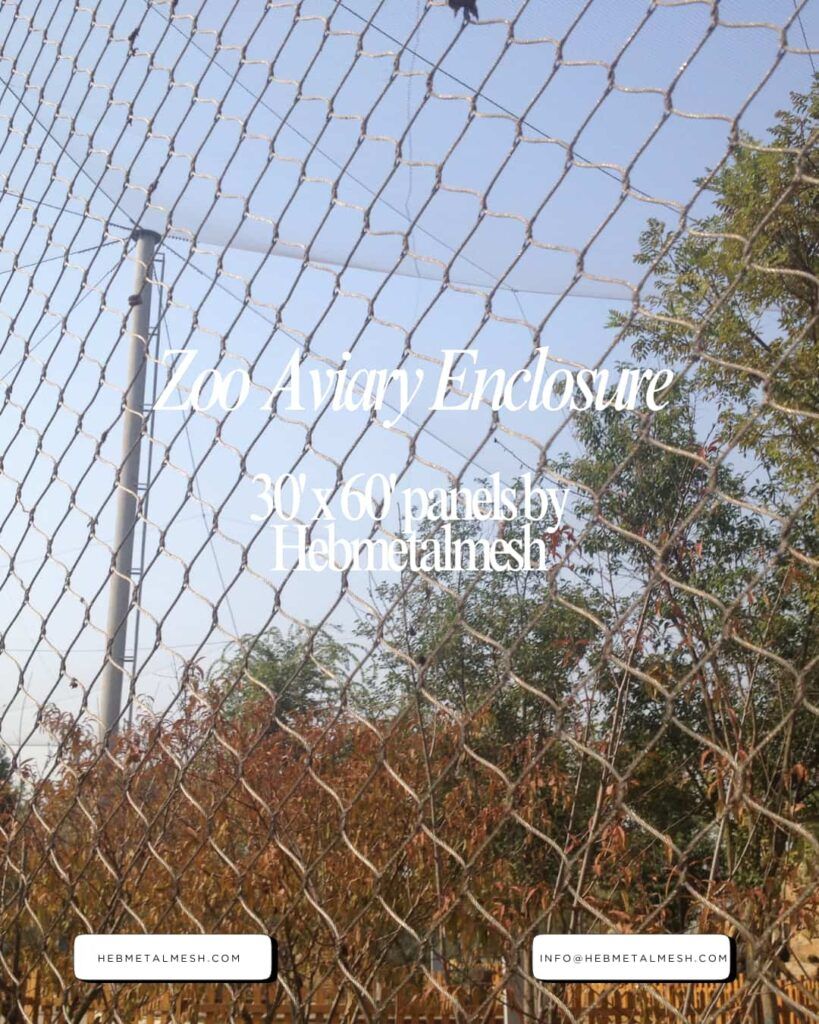
1. The Zoological Standard: Large-Scale Walk-In Aviaries
The Challenge: A major wildlife park required a massive, “open-air” enclosure for a mixed-species exhibit including cranes, peacocks, and various waterfowl. The goal was to eliminate the “caged” feeling for visitors while providing enough flight space for the birds to exhibit natural behaviors.
The Hebmetalmesh Solution: * Product: Black Oxide Stainless Steel Mesh (1.6mm wire, 50mm aperture).
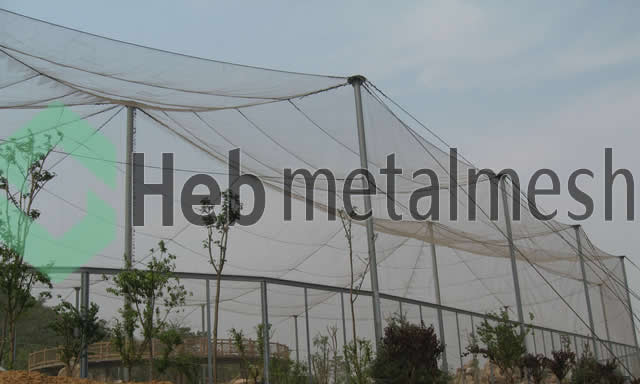
- Execution: We manufactured several 30′ x 60′ panels to cover a total area of over 3,000 square meters. By using these super-sized rolls, the construction team was able to drape the mesh over a steel-cable-stayed column system with minimal seams.
- Result: The black oxide finish made the overhead canopy nearly invisible against the sky. Visitors now walk through a seamless landscape where the barrier is felt, but not seen, and the birds enjoy a 40-foot vertical flight path.
2. The Predator-Proof Farm & Sanctuary
The Challenge: A rural bird sanctuary specializing in rescued birds of prey (owls and hawks) struggled with local predators—specifically raccoons and stray dogs—that were chewing through traditional galvanized poultry netting.
The Hebmetalmesh Solution:
- Product: Natural Finish 304 Stainless Steel (2.0mm wire, 38mm aperture).
- Execution: The sanctuary wrapped the lower 4 feet of each flight pen with our high-tensile handwoven mesh. The mesh was buried 12 inches into a gravel trench to prevent digging.
- Result: The “spring-like” flexibility of the handwoven mesh protected the raptors from “keel bone” injuries during sudden flights, while the 2.0mm steel cable proved completely impenetrable to the teeth and claws of nocturnal predators.
3. The Luxury Backyard “Garden Aviary”
The Challenge: A private collector in a coastal region wanted a small, aesthetic aviary outdoor for a collection of finches and budgies. Because the property was near the ocean, standard wire would rust within two seasons.
The Hebmetalmesh Solution:
- Product: Grade 304 Stainless Steel (1.2mm wire, 20mm aperture).
- Execution: Due to the salt-heavy air, we supplied Grade 316 mesh, which offers superior molybdenum-based corrosion resistance. The mesh was custom-cut to fit a decorative cedar frame.
- Result: Five years later, the mesh remains as bright and structurally sound as the day it was installed. The 1.2mm wire is fine enough that the owner can enjoy the vibrant colors of the finches without the “industrial” look of traditional hardware cloth.
Performance Comparison: Success by Environment
| Project Type | Key Requirement | Hebmetalmesh Spec | Proven Outcome |
|---|---|---|---|
| Public Zoo | Max Visibility | Black Oxide (1.6mm) | Invisible barrier; 30+ year service life. |
| Bird Sanctuary | Impact Safety | Natural (2.0mm) | Absorbs flight impact; prevents wing injury. |
| Coastal Home | Salt Resistance | Grade 304 SS | Zero rust in salt-air; premium aesthetic. |
| Farm / Utility | Predator Control | Natural (1.5mm – 2.0mm) | Chew-proof and dig-proof containment. |
VIII. Maintenance & Sustainability
One of the greatest advantages of choosing a Hebmetalmesh stainless steel aviary outdoor is the minimal upkeep required. Unlike wood that rots or plastic that degrades, stainless steel is a “fit and forget” material. However, a small amount of care ensures your enclosure remains pristine for decades.
1. Cleaning the Mesh
In an outdoor environment, dust, pollen, and bird droppings can accumulate.
- Simple Rinsing: For most aviaries, a high-pressure garden hose is all that is needed to clear debris.
- Deep Cleaning: If the mesh is near a road or in a high-pollen area, a mild, biodegradable detergent and a soft brush can be used. Avoid abrasive scrubbers that could scratch the black oxide finish.
2. Inspection
While the handwoven structure is incredibly resilient, we recommend a bi-annual inspection of the attachment points (lacing wire or clips). Ensure that the tension remains consistent and that shifting ground has not exposed the “predator skirt” at the base.
3. Environmental Sustainability
Stainless steel is one of the most sustainable building materials on the planet.
- 100% Recyclable: At the end of its long life (30-50 years), the mesh can be fully recycled.
- No Chemicals: Unlike treated wood or painted wire, our mesh does not leach chemicals into the soil or the birds’ environment.
10 FAQ: Everything You Need to Know About Aviary Outdoor Mesh
Grade 304 or 316 stainless steel is the gold standard. It offers the best combination of rust resistance, non-toxicity for birds, and strength against predators.
Yes. Black oxide absorbs light rather than reflecting it. This reduces glare, allowing your eyes (and cameras) to focus on the birds rather than the wire, making the mesh nearly invisible.
When properly installed, a stainless steel aviary outdoor can last over 30 years, even in harsh climates with high UV exposure or snow.
Absolutely. At Hebmetalmesh, we supply customized roll sizes tailored to your frame dimensions at no additional cost, saving you time and reducing waste.
Yes. Unlike galvanized wire which contains zinc (a cause of heavy metal poisoning), stainless steel is completely non-toxic and safe for hookbills to climb and chew.
We recommend using a mesh aperture of 1″ x 1″ (25mm) or smaller and burying the mesh at least 12 inches underground to prevent digging by rodents or foxes.
Grade 304 is excellent for most inland environments. Grade 316 contains molybdenum, making it superior for coastal areas where salt air can cause corrosion.
Yes. Because the mesh is flexible like fabric, it can be installed by DIY enthusiasts using lacing wire or stainless steel cable ties to secure it to a frame.
Yes, we can produce seamless panels as large as 30′ x 60′ (1,800 square feet), which is ideal for large zoo exhibits and commercial bird parks.
You can purchase directly from our factory via our online store for global shipping and custom specifications.
Conclusion
Building an aviary outdoor is an investment in the health of your birds and the beauty of your property. By choosing Hebmetalmesh handwoven stainless steel netting, you are opting for a product that has been tested in the world’s leading zoos and most demanding environments. From our custom sizing to our signature black oxide finish, we provide the tools you need to create a safe, invisible, and permanent sanctuary.
Ready to Build Your Dream Aviary?
Don’t settle for rusty, toxic wire. Get factory-direct pricing on the world’s finest handwoven stainless steel mesh, customized to your exact specifications.
Shop Online Now