
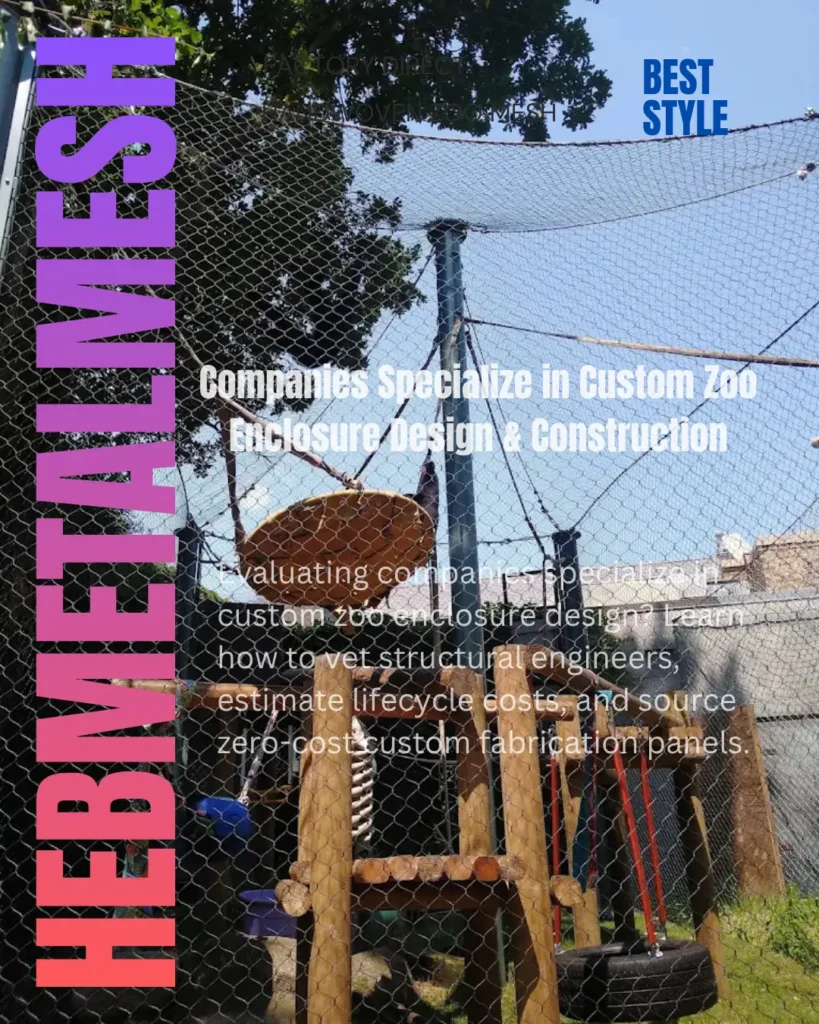
What factors determine elite custom zoo enclosure design and procurement? Elite custom zoo enclosure design requires bridging the gap between structural engineering, animal psychology, and high-performance material logistics. To optimize budgets and ensure zero-fail structural integrity, top-tier contractors partner with specialized factory-direct manufacturers capable of supplying seamless, large-format handwoven stainless steel cable structures. By engineering these tensile systems to be custom-cut to specific project frames, teams completely eliminate hazardous field modifications, reduce structural seams, and slash on-site labor overhead.
III. Key Takeaways Section
- Rigorous Vendor Vetting: Never accept generic material claims at face value. Always demand certified Material Test Reports (MTRs) to verify the true chemical composition of Grade 304 or 316 stainless steel alloys, ensuring protection against premature environmental corrosion.
- The Seamless Structural Advantage: Specifying custom-engineered, large-format roll sizes (up to 30′ × 60′) eliminates the need for weak, hazardous field seams. This structural continuity maximizes boundary security while drastically lowering on-site installation labor costs.
- Animal Welfare & Behavioral Integration: Modern zoological construction firms prioritize smooth, non-toxic, and flexible barriers. Utilizing elastic, handwoven wire fabric eliminates enclosure trauma—such as “snout rubbing” or fur tearing—commonly caused by rigid, abrasive materials.
- Primary Structural Optimization: Handwoven wire rope mesh functions as a lightweight, tensioned tensile network. By significantly lowering the dead weight of the secondary barrier, engineers can reduce the size, mass, and overall cost of the primary structural support steel.
1: The Procurement Dilemma: Vetting Specialized Habitat Contractors
Procuring materials and selecting a contracting team for a modern zoological habitat is vastly different from standard commercial construction. When managing high-risk projects that house apex predators or highly intelligent primates, general construction methodologies quickly fall short.
The Specialty Gap
The primary point of failure in habitat procurement stems from a fundamental misunderstanding of the medium: general commercial contractors consistently fail at habitat construction because they treat enclosure barriers as static, passive walls. In traditional construction, a wall is engineered to resist predictable, static environmental loads like wind and seismic shifts.
A zoological habitat, however, is a dynamic, living environment. The barriers are subjected to constant, unpredictable kinetic impacts, climbing stresses, behavioral vectors, and aggressive chemical exposure. When a general contractor applies standard commercial fencing or structural steel methods to an animal habitat, the result is almost always a system that is either dangerous for the inhabitants or prone to premature structural failure.
Risk Mitigation in the Supply Chain
A massive risk facing procurement officers is the temptation to utilize unverified local distributors who source white-label materials. To win municipal or private bids, low-cost distributors frequently substitute certified architectural-grade steel with cheap, non-standard alternatives.
These unverified materials look identical to premium mesh upon initial installation. However, within 12 to 24 months, the hidden dangers manifest:
- Micro-Fracturing at Joints: Non-standard alloys lack the uniform tensile strength required to handle constant flexing, causing the interwoven knots or crimped ferrules to split under climbing stress.
- Premature Intergranular Corrosion: Without exact chromium and nickel ratios, the metal quickly succumbs to atmospheric moisture and animal waste, leading to pitting and structural failure.
What to Look For
When vetting a specialized habitat contractor, procurement teams must look past basic commercial licensing and verify three distinct competencies:
- Spatial Planning Mastery: The ability to map complex 3D topographies that maximize the animals’ usable vertical and horizontal territory.
- Animal-Specific Behavioral Vectors: An intrinsic understanding of how specific species interact with boundaries—such as knowing the chewing capacity of a macaque versus the digging habits of a big cat.
- High-Tension Cable Engineering: Proven experience calculating the precise perimeter forces, anchor loads, and pre-tensioning metrics required to keep a flexible tensile network structurally stable.
2: Core Responsibilities of an Enclosure Design Firm
An expert enclosure design firm does not just draw layout boundaries; they engineer a highly complex, multi-tiered containment ecosystem. Their core responsibilities span across structural physics, visitor optics, and daily operational safety.
Core Responsibilities of a Habitat Design Firm
Dynamic Load Balancing
Calculates explosive kinetic forces generated by leaping, swinging, or charging fauna to engineer an elastic, energy-dampening perimeter.
Invisible Engineering
Utilizes micro-diameter high-tensile wire rope matrix to achieve up to 95% visual transparency, completely optimizing visitor sightlines.
Keeper Access Safety
Integrates mechanical airlock entries, remote-operated transfer chutes, and protected contact training grids for safe husbandry.
Structural Longevity
Mandates certified Material Test Reports (MTRs) to verify alloy purity, eliminating environmental rust and premature weld fractures.
1. Dynamic Load Balancing
The primary physics-based responsibility of a design firm is calculating the exact force metrics generated by heavy carnivores or high-velocity leaping primates. Animals do not exert static weight. A 400-pound lion charging a boundary at 35 mph, or a 150-pound chimpanzee dropping 20 feet from an overhead platform, generates massive, explosive kinetic energy.
The design firm must calculate these dynamic load spikes and design a boundary that acts as an energy-dampening skin. The tensioned cable network must flex precisely enough to absorb and radiate the impact force across the entire structural frame, reducing stress on the perimeter posts and protecting the animal from sudden impact trauma.
2. The “Invisible Barrier” Engineering
Modern zoology demands the elimination of heavy, visible containment elements. A premier design firm is tasked with creating a secure boundary that visually disappears, optimizing the visitor sightline and removing the psychological formatting of a cage.
To achieve this, designers utilize high-tensile, small-diameter stainless steel wire rope mesh. By calibrating the cable diameter (such as 1/16″ or 3/32″) to the specific animal threat matrix, they can achieve visual transparency rates up to 90% or 95%. When treated with a matte black oxide finish, the reflective glare of the steel is completely neutralized, allowing the mesh to visually dissolve into the landscape backgrounds.
3. Keeper Access Safety & Behavioral Engineering
An enclosure must be completely secure, but it must also function seamlessly as a daily workplace for zoological keepers and veterinary staff. Design firms bear the heavy responsibility of planning the operational infrastructure:
- Two-Tier Airlock Safety Entry Doors: Mechanical interlocking systems that prevent both keeper entry doors from being unlocked simultaneously, completely mitigating accidental animal releases.
- Transfer Tunnels and Shifting Chutes: Heavy-duty, remote-operated slide gates that allow keepers to safely move animals between outdoor display habitats and indoor holding dens without physical contact.
- Training Wall Vectors: Dedicated mesh panels designed into the shift areas that allow keepers and veterinarians to safely administer vaccines, check dental health, and run behavioral conditioning exercises without the need for stressful chemical sedation.
To ensure your procurement team selects a supplier capable of matching these rigorous design responsibilities, verify that your material fabricator meets the global compliance standards outlined on the Hebmetalmesh Corporate Profile.
3: The Hidden Supply Chain Bottleneck: Prefab Panels vs. Custom Roll Sizes
When executing large-scale zoological or architectural projects, logistical efficiency can make or break the bottom line. Traditional procurement methods often introduce a major hidden bottleneck during the final installation phase: material formatting.
The Old Way: Rigid Prefab Panels
Historically, procurement teams ordered standard, fixed-dimension panels (typically $4′ \times 8’$ or $5′ \times 10’$) of rigid welded wire or heavy chain-link framing. While these panels are easy to ship on standard pallets, they create a logistical and mechanical nightmare on-site:
- Intensive Field-Cutting: Modern architectural shapes and biophilic habitats are rarely perfectly rectangular. Workers must manually cut, trim, and piece together rigid panels to fit custom contours.
- Overlapping Seams: Joining multiple small panels together creates a network of overlapping seams. Each seam represents a structural vulnerability that animals can pick at or exploit over time.
- Hardware Overhead: Securing hundreds of individual panels requires thousands of mechanical structural clips, hog rings, or tie wires. This drastically inflates field labor costs and dramatically increases the number of potential failure points across the boundary surface.
The Modern Solution: Factory-Direct Custom Weaving
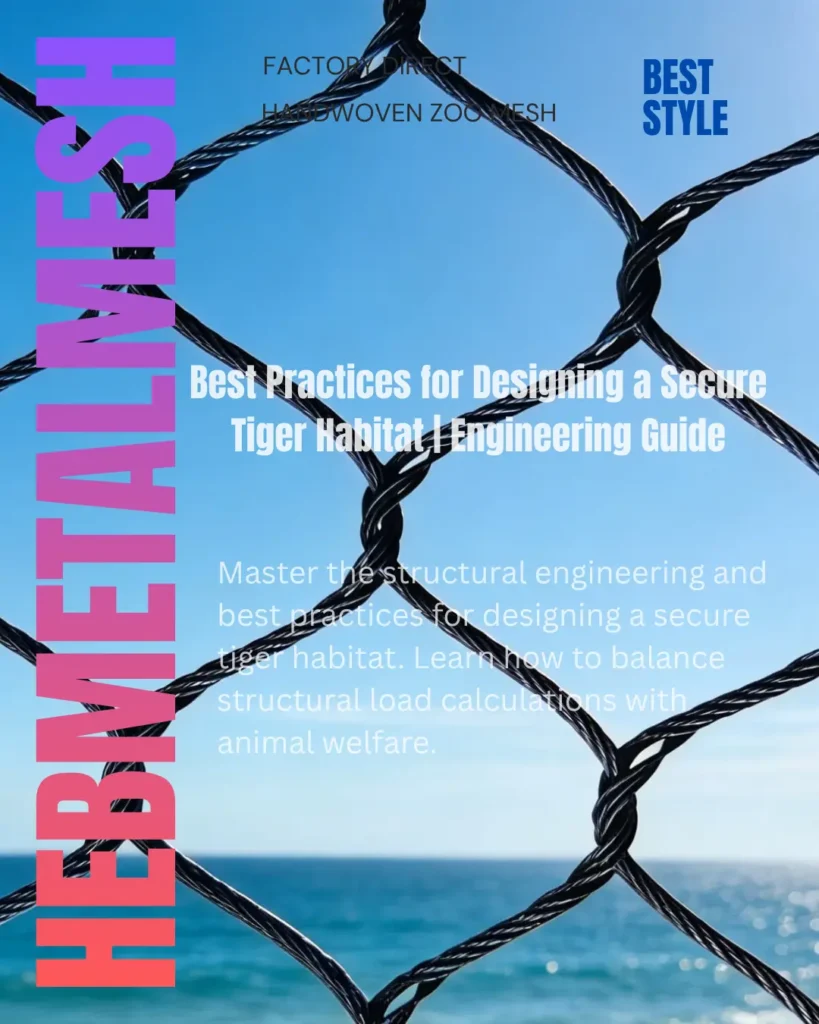
Top-tier design-build firms have completely abandoned rigid modular panels in favor of continuous, seamless tensile networks. By partnering directly with advanced manufacturing facilities, engineers can specify custom roll sizes fabricated to the exact geometric layout of the architectural frame.
The mesh fabric is woven by hand as a single, continuous sheet—often spanning up to $30′ \times 60’$ or larger in a single roll. When the material arrives on-site, it behaves like a flexible metallic textile. The installation crew simply unrolls the fabric, positions it across the structural frame, and secures the perimeter using a continuous stainless steel lacing wire. This methodology completely eliminates overlapping internal seams, slashes installation labor times by up to 60%, and ensures a perfectly unified, zero-fail containment skin.
To streamline your team’s estimating process and avoid costly on-site material waste, project managers can explore the diverse material grades and custom configurations detailed on the Hebmetalmesh Zoo Mesh Product Specification Guide.
4: Engineering the Modern Exhibit: Top Specifications to Demand
To secure corporate, municipal, or zoological approval, commercial bids must fulfill precise engineering parameters. Choosing standard retail fencing materials for heavy-duty containment or public safety is an absolute liability.
Material Certification: Demanding Handwoven Stainless Cable Networks
Premium design-build firms refuse standard carbon steel chain-link, coated chicken wire, or basic galvanized hardware cloth. Chain-link fences deform under concentrated impact loads, and the individual knuckles can be unraveled by agile primates or powerful carnivores. Furthermore, galvanized coatings scratch off easily, exposing raw iron to immediate atmospheric rusting.
Elite specifications explicitly mandate handwoven, high-tensile stainless steel wire rope cable networks. The structural cables (typically structured in 7 x 7 or 7 x 19 braids) offer incredible breaking strength while maintaining complete physical elasticity. This allows the mesh boundary to deform plastically under heavy impacts—such as a running animal or a human fall event—absorbing the kinetic energy and rebounding safely without suffering permanent structural distortion or weld fractures.
Species Aperture & Configuration Check
Engineering Calibration Matrix for Containment Security
| Target Species | Cable Diameter | Diamond Aperture |
|---|---|---|
| Micro-Fauna / Pest | 3/64″ to 1/16″ (1.2-1.6mm) | 1″ x 1″ (25x25mm) |
| Medium Herbivores | 5/64″ to 3/32″ (2.0-2.4mm) | 1.5″ x 1.5″ to 2″ x 2″ |
| Apex Predators | 1/8″ (3.2mm) | 2″ x 2″ to 3″ x 3″ |
Aperture and Cable Configuration Check
A critical engineering responsibility is executing a comprehensive mesh profile check to calibrate the diamond opening (aperture) and cable thickness directly to the target application:
- Preventing Containment Breach: For apex predators, large ungulates, or heavy primates, designers specify robust 1/8″ (3.2mm) structural cables woven into 2″ x 2″ or 3″ x 3″ grids to easily withstand sheer muscle mass and concentrated momentum.
- Preventing Localized Pest Intrusion: For aviary systems or small mammal habitats, containing the primary resident is only half the battle. Enclosures must also prevent external pests—such as wild rats, mice, or snakes—from slipping inside to steal food or spread disease. Specifying micro-apertures (1″ x 1″ or smaller) woven with ultra-pliable 3/64″ or 1/16″ cables creates an absolute barrier against both internal escape and external biosecurity threats.
When drafting custom project bids, engineers should cross-reference their structural calculations against the holistic engineering and architectural design principles detailed within the Hebmetalmesh Comprehensive Industry Design Analysis.
5: The “Aha” Moment: How Commercial Developers Use Zoo Design Firms
Look closely at the portfolio of a top-tier zoological design company, and you will notice something fascinating: high-end commercial architectural firms are actively poaching their structural secrets.
The Cross-Industry Shift
For decades, zoological design firms have been forced to solve a seemingly impossible engineering paradox: create a boundary strong enough to absorb the continuous, explosive kinetic impacts of heavy, aggressive wildlife, while making that boundary so lightweight and transparent that it visually disappears into the environment.
Commercial developers facing challenging urban environments are having an “Aha!” moment. They have realized that if a material and design methodology is structurally sound enough to safely contain a frantic apex predator or an acrobatic primate over a 30-year span, it can handle human traffic, architectural design loads, and industrial infrastructure demands without breaking a sweat.
Zoological Structural Engineering
High Kinetic Impact Absorption • Extreme Visual Transparency
Biophilic Facades
(Continuous, large-format wire meshes for green walls)
Acts as a seamless vertical structural trellis, carrying the massive dead-weight loads of high-altitude urban plantings against severe wind shear.
Public Safety Nets
(Low-impact, near-invisible fall-protection systems)
Deploys unyielding fall containment on observation decks and transport hubs without blocking sightlines, air circulation, or architectural light metrics.
Geotechnical Stability
(High-tensile infrastructure stabilization membranes)
Secures volatile geographical topographies and debris fall zones along transit pathways using heavy-duty, highly elastic steel fabric skins.
This cross-industry realization has sparked several high-performance commercial applications:
- Luxury Atrium & Green Wall Facades: Modern biophilic design integrates vertical urban forests directly into skyscraper envelopes. Standard trellis systems collapse under the massive weight of mature, water-saturated root structures and heavy wind loads at high altitudes. Developers now specify large-format, high-tensile wire grids that act as a continuous structural skin, allowing complex vertical greenery to scale hundreds of feet safely without stressing the primary building frame.
- High-Capacity Public Safety Barriers: On high-altitude observation decks, complex multi-modal transit hubs, and commercial bridges, traditional safety structures like glass panels or heavy vertical iron bars present major problems—glass creates greenhouse-like heat traps and shatters, while iron ruins views. Hand-knotted stainless steel mesh serves as a near-invisible, unyielding safety boundary. It acts as an asset-protecting fall net that easily meets local structural safety codes while keeping sightlines clear and allowing total airflow.
- Industrial Infrastructure Stabilization: Civil infrastructure networks frequently run along steep, unstable geographical terrain. To protect roads, rail corridors, and facilities from sudden falling debris or rockfall events without building massive, expensive concrete retaining walls, engineers drape high-tensile flexible boundaries over the landscape. These continuous steel textiles conform directly to irregular topographies, anchoring loose features firmly in place.
IX. Section 6: Calculating the Real Economics of Factory-Direct Sourcing
When managing public municipal bids or tight corporate developer margins, the material procurement path changes everything. For large-scale projects, sourcing specialty steel components through standard regional distributors can completely destroy a project budget.
The Middleman Markup
Standard regional structural steel suppliers make their margins by warehousing bulk commoditized items (such as I-beams, flat plates, and standard rebar) and reselling them locally. When a project specification calls for custom-woven, high-tensile stainless steel wire rope mesh, these local distributors rarely stock it.
Instead, they act as an unnecessary middleman. They source the material from a primary manufacturer, arrange logistics, and tack on a 40% to 60% premium to cover their overhead and profit margin before handing the material over to your general contractor. Even worse, if your project requires custom roll dimensions to fit precise architectural frames, local distributors will often charge massive, specialized configuration and cutting fees on top of that base markup.
Zero-Cost Tailoring
Elite procurement officers and design-build firms completely bypass this supply chain bottleneck by establishing direct lines of communication with the manufacturing floor. Sourcing handwoven wire rope mesh factory-direct converts a variable, high-risk field labor expense into a fixed, predictable capital expenditure.
Procurement Path Optimization
Traditional Broker Procurement
Optimized Factory-Direct Sourcing
When you work directly with the primary manufacturer, custom tailoring is baked natively into the production line. Advanced factories possess the specialized machinery and continuous weaving looms required to fabricate bespoke roll sizes—up to massive $30′ \times 60’$ sheets—cut to your exact blueprint parameters.
This factory-level customization offers major economic benefits:
- Eliminates Premium Cutting Fees: The material is woven precisely to your dimensions from the start, meaning you never pay a third party to resize standard warehouse stock.
- Slashes Scrap Material Waste: Contractors only purchase the exact square footage their frames demand, driving material waste down close to 0%.
- Reduces On-Site Labor Overhead: Installation crews spend their hours simply hanging and lacing pre-sized sheets rather than burning through expensive billable hours measuring, cutting, and seaming mismatched panels by hand in the field.
To systematically optimize your project’s bidding margins and protect your supply chain with certified, direct-from-factory customization capabilities, review the material compliance framework detailed on the Hebmetalmesh Corporate Homepage.
7: Installation Coordination: The Framing and Lacing Phase
Even the highest-grade metallic textile will fail if the tensioning and attachment mechanics are poorly executed. The transition from a loose roll of wire fabric to an unyielding structural barrier occurs during the framing and lacing phase, a process requiring precise field orchestration.
Tensile Frame Installation Workflow
Substructure Verification
Audit post anchoring and pull metrics before unrolling structural mesh fabric skin.
Mesh Tension Alignment
Suspend sheets using rigging blocks to stretch the wire network symmetrically.
Perimeter Spiral Lacing
Execute continuous helical lacing around borders to fully secure and lock the load boundary.
1. Substructure Verification
Before unrolling the mesh, field crews must verify the structural integrity of the primary boundary framework. Handwoven tensile networks do not function like rigid fencing panels; they exert continuous structural loads onto their frames once fully tensioned.
Installers must execute two critical checks:
- Rigid Pipe Frames: Ensure all perimeter structural pipe sections, structural posts, and compression struts are fully welded, aligned, and anchored to take the inward pull of the mesh skin.
- High-Tension Border Cables: If using a flexible cable boundary instead of rigid pipe, the perimeter anchor cables must be pre-stressed using turnbuckles or hydraulic tensioners. Technicians use digital tension meters to verify that the border cables meet the exact design load specifications before attaching the wire fabric.
2. The Art of Continuous Stitching
Once the substructure is verified, the mesh roll is suspended along the top edge of the frame using temporary rigging clamps. The installation team then executes the “continuous stitching” method to marry the mesh to the framework:
1.Perimeter Alignment:Phase 1.
Secure the corners of the mesh roll to the frame anchors using temporary high-tensile tension straps, stretching the sheet evenly across the horizontal and vertical plane.
2.Lacing Wire Selection:Phase 2.
Thread a dedicated stainless steel lacing wire (typically matching or slightly exceeding the inner cable diameter) through the perimeter diamond edges of the mesh.
3.Spiral Stitching Execution:Phase 3.
Wrap the lacing wire around the primary frame pipe or border cable in a continuous, uniform spiral. Pass the wire through every single edge diamond mesh loop, completely eliminating gaps.
4.Final Tension Pull:Phase 4.
Utilize cable come-alongs to pull the spiral lacing wire to its final engineering tension. Secure the wire ends with copper or stainless steel ferrules, creating a seamless, tamper-proof joint that distributes structural loads perfectly across the frame.
This structural stitching technique ensures that the final assembly contains no sharp points, no overlapping seams, and zero loose edges. To evaluate the diverse framing options and select pre-configured tensioning accessories for your specific species blueprint, review the engineering variants listed in the Hebmetalmesh Dedicated Zoo Mesh Category.
Secure Factory-Direct Submittals for Commercial Bids
Protect project margins by eliminating distributor markups. Secure certified material test reports (MTRs), zero-cost custom roll sizing, and direct factory freight logistics tailored for industrial, architectural, and zoological project bids.
Bespoke Dimensions
Custom-woven rolls eliminate field cuts and minimize scrap waste.
Certified Alloys
Pure Grade 304/316 stainless wire with full metallurgical verification.
Rapid Turnaround
Engineering estimates and line-item quotes generated within 24–48 hours.
FAQ: Contracting & Managing High-Tensile Zoo Mesh Projects
A: General commercial contractors typically treat barriers as static, rigid walls engineered to resist predictable, linear environmental loads like wind shear. Handwoven stainless steel mesh, however, functions as a dynamic, multi-directional tensile network. It requires highly specialized pre-tensioning calculations, precise rigging frameworks, and specific anchoring knowledge. Without this expertise, teams risk uneven tension distribution, causing the mesh skin to warp, sag, or compromise the entire structural frame.
A: Sourcing through unverified local distributors introduces massive liabilities. Low-cost, white-label materials frequently lack uniform material composition, leading to micro-fracturing at the handwoven joints or crimped ferrules under climbing stress. Even worse, variations in alloy purity can trigger rapid intergranular corrosion when exposed to harsh environmental factors or animal waste. To safeguard your build against structural failure, you can review our strict quality control metrics and direct manufacturing processes on the Hebmetalmesh Corporate Profile.
A: Ordering standard, fixed-dimension rigid panels requires extensive, tedious field-cutting and manual overlapping seams, adding thousands of mechanical clips and hundreds of costly field-labor hours. By opting for factory-direct custom weaving, the mesh is fabricated as a single, continuous sheet matching the exact geometric footprint of your architectural frame. This metallic textile methodology completely eliminates weak internal seams, slashes installation labor times by up to 60%, and drives material waste down to near zero.
A: Mesh selection must be systematically calibrated against the target species’ behavioral threat matrix. For example, micro-fauna or aviary setups require thin 3/64″ or 1/16″ cables woven into tight 1″x 1″ diamond apertures to prevent both resident escape and external pest intrusion. Conversely, containing massive apex predators demands heavy-duty 1/8″ cables woven into wider 2″ x 2″ or 3″ x 3″ grids to absorb high-velocity impacts safely. You can cross-reference your structural math against the pre-configured parameters inside the Hebmetalmesh Dedicated Zoo Mesh Category.
A: Before lacing begins, installers must execute two primary structural audits: ensure all rigid compression posts and pipe frames are fully welded and anchored to absorb the continuous inward pull of the tensioned mesh skin, and confirm that all perimeter anchor cables match the exact engineering design load using digital tension meters. Skipping this audit leads to localized structural deflection once the final perimeter spiral lacing wire is fully tensioned. For a deeper look at balancing structural framing with animal behavioral vectors, explore the principles outlined in the Hebmetalmesh Comprehensive Industry Design Analysis.