

How do you successfully source durable, secure fencing for big cat exhibits? To successfully source durable fencing for big cat exhibits, procurement teams must prioritize handwoven stainless steel wire rope mesh over rigid iron bars or traditional chain-link. Big cats—including tigers, lions, and leopards—generate massive dynamic impact forces and possess razor-sharp claws that rapidly compromise standard zinc-galvanized coatings. Engineering standards require a minimum 3/32″ to 1/8″ cable diameter using AISI 316-grade stainless steel to ensure structural resilience. Unlike rigid walls, flexible, handwoven wire fabric absorbs high-velocity kinetic impacts through geometric elasticity, distributing energy safely across the mesh surface to prevent weld failures, snapping strands, or hazardous dental injuries to the animals.
Key Takeaways
- Dynamic Shock Absorption: Apex predators strike boundaries with significant kinetic velocity. Effective fencing must utilize an elastic, flexible weave that dissipates energy through controlled structural movement, preventing the dangerous fractures common in rigid or welded-bar systems.
- Claw and Chew Resistance: Interwoven cable mesh eliminates the brittle spot-welds and microscopic gaps that big cats typically target. A high-tensile, continuous-weave design ensures there are no sharp edges or weak points for animals to unravel or destroy.
- Alloy Longevity: To guarantee a 30+ year lifecycle, procurement must specify AISI 316-grade stainless steel. This alloy is chemically formulated to resist the severe corrosion caused by prolonged exposure to outdoor elements and the high-acid organic waste prevalent in large carnivore habitats.
- Aesthetic Invisibility: Guest experience is defined by clear sightlines. Utilizing high-tensile wire mesh with professional-grade matte or black oxide finishes eliminates metallic glare, providing a nearly invisible barrier that allows for premium photography and unobstructed visibility for security monitoring.
1: The Apex Predator Physics Problem: Kinetic Energy and Shear Force
When designing enclosures for large carnivores, engineering specifications must move beyond simple weight-bearing limits and address the complex physics of explosive, dynamic kinetic energy.
The Bound Load Challenge
A 500-pound Siberian tiger or African lion hitting a perimeter boundary is not a static load. When these animals engage in a full-speed bound, they generate thousands of Newtons of dynamic force upon contact. Traditional containment systems often fail here because they are designed to resist static pressure, not high-velocity impact. An effective boundary must be designed to absorb this energy. By utilizing handwoven stainless steel wire rope mesh, the enclosure acts as a tensioned membrane that flexes upon impact, effectively dissipating the kinetic energy across the entire structural grid rather than concentrating it on a single point of failure.
The Shear and Claw Threat
Apex predators are far more destructive than standard wildlife. Unlike domestic or smaller exotic species, big cats utilize razor-sharp claws to grip, pull, and shear materials. They possess the intelligence to actively investigate their perimeter, specifically targeting structural joints, overlapping seams, and weak weld points. A boundary that appears “strong” to a human is often easily unraveled by a leopard’s paw or a lion’s claws if there are loose ends or gaps in the mesh weave.
The Psychological Element
Containment design must balance physical security with animal behavioral health. If a boundary feels unstable or creates sensory “dead zones,” it can trigger containment panic, leading to dangerous barrier-challenging behavior. Conversely, boundaries that are completely secure—and perceived as such by the animal—allow for reduced pacing and stereotypic behavior. Maintaining high visual transparency (90%+ open area) is essential here, as it allows the animal to observe its environment, reducing the desire to “test” the perimeter.
For a deeper analysis on how to balance high-tensile engineering with animal behavioral requirements, review the technical documentation available in our Hebmetalmesh Industry Deep-Dive Analysis.
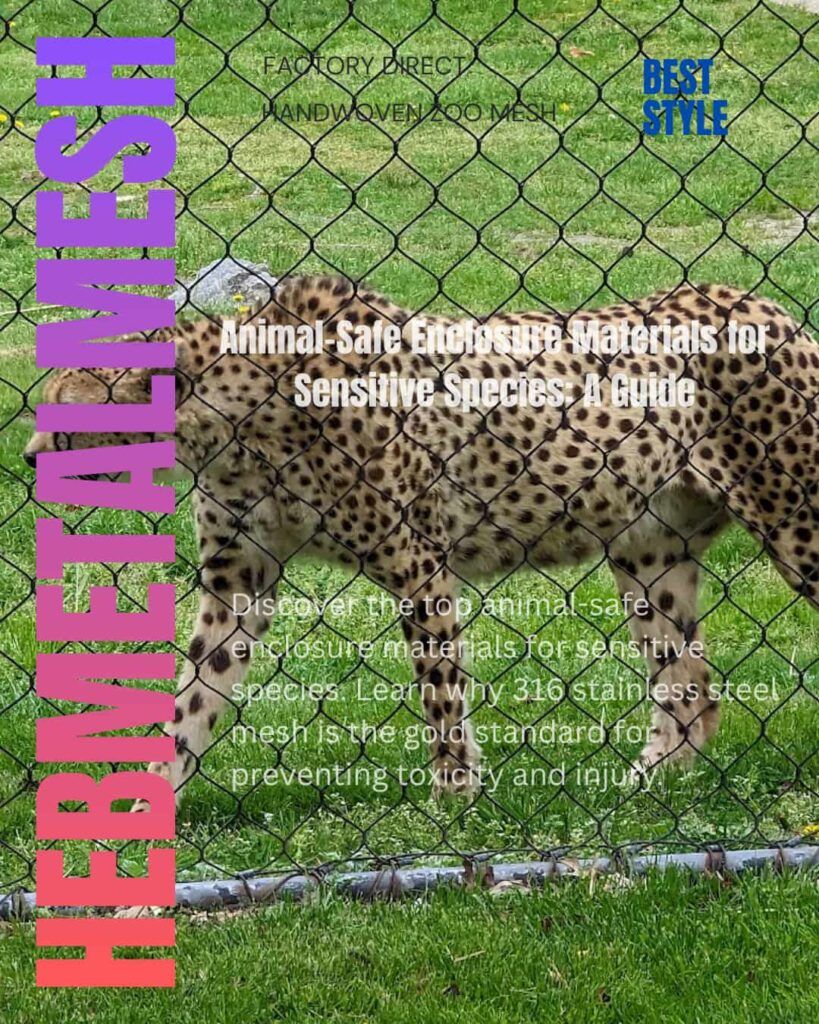
2: Evaluating Traditional Fencing Pitfalls for Large Carnivores
Many facilities rely on legacy fencing methodologies that have proven insufficient for the modern standard of carnivore management. Understanding the failure points of these traditional systems is crucial for procurement teams.
Heavy Steel Bars and Grates
While heavy iron bars provide undeniable structural strength, they are often a suboptimal choice for modern zoology:
- Aesthetic & Psychological Impact: They create an oppressive, prison-like aesthetic that negatively impacts the visitor experience.
- Physical Injury: If an animal strikes or bites the bar, they suffer severe dental trauma and facial abrasions.
- Infrastructure Costs: The immense dead-weight of heavy steel requires massive, deep-poured concrete foundations, exponentially increasing the project’s footprint and construction cost.
Standard Chain-Link Fencing
Chain-link is often the “default” choice due to its low upfront cost, but it is a total failure point for apex predators. The wire strands are easily manipulated; a big cat can use its claws to grip the top or bottom un-tensioned loops, twisting the wire to unravel the weave and create an escape gap. Under repeated paw strikes, chain-link warps and stretches, eventually leading to structural sag that compromises the integrity of the entire habitat.
Welded Wire Panels
Welded wire mesh is frequently mistaken for a high-security option, but it suffers from severe metallurgical vulnerabilities:
- The Thermal Stress Issue: The process of spot-welding creates thousands of microscopic crystallization points along the steel. These heat-affected zones are the first places where rust begins to thrive, as the molecular structure of the steel has been permanently altered.
- Impact Failure: These brittle welds are highly susceptible to snap-failure under high-velocity impact. Once a single weld joint breaks, the surrounding mesh loses its structural equilibrium, leading to a domino-effect collapse of the panel face.
To move away from these failure-prone systems, procurement managers should look at the superior load-bearing capabilities of weld-free, hand-knotted stainless steel fabric, which you can evaluate within the Hebmetalmesh Zoo Mesh Category.
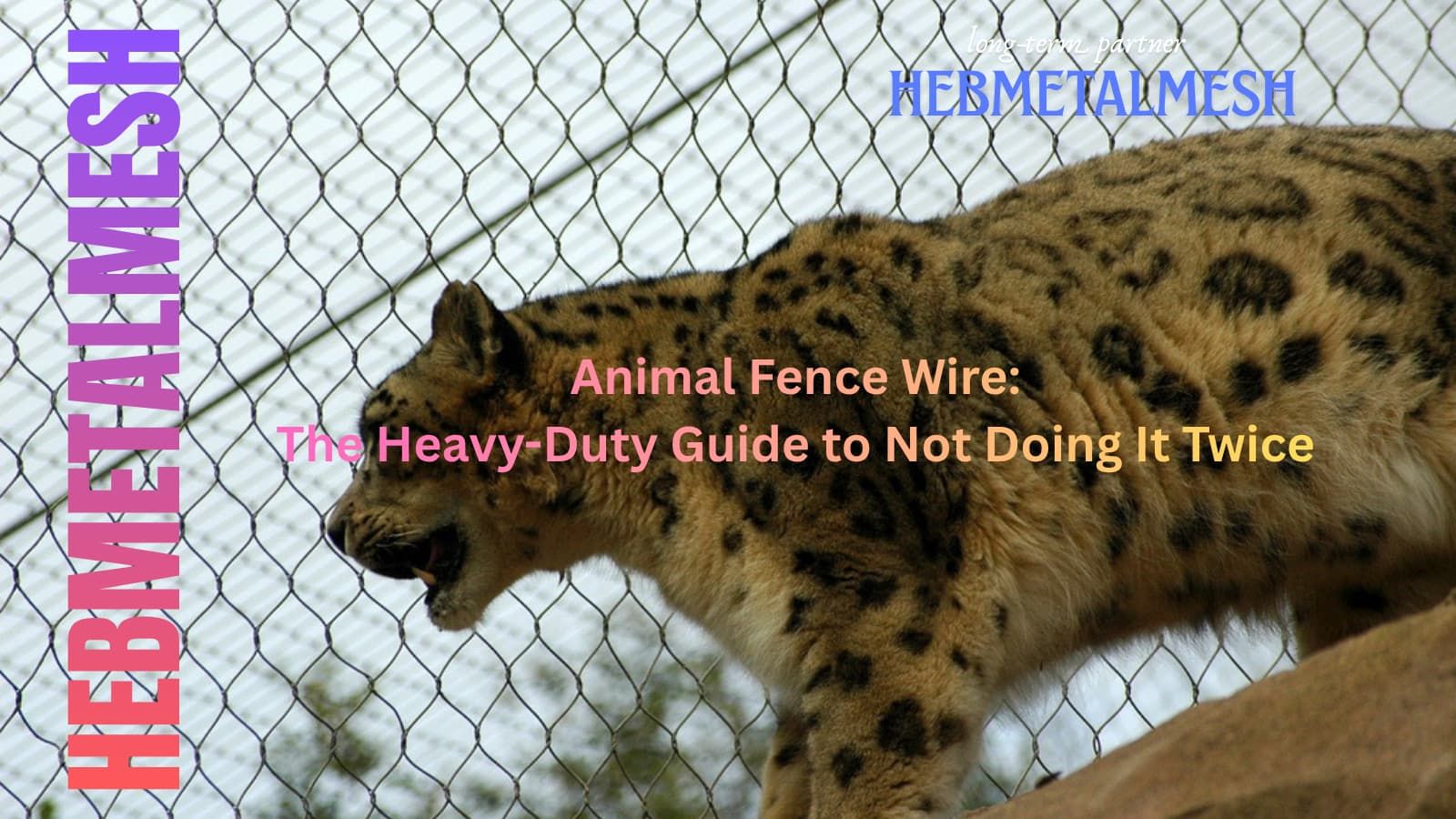
3: The Engineering Blueprint of Handwoven Stainless Mesh
The transition from rigid traditional barriers to modern tensile fabric represents a significant leap in structural engineering. Rather than resisting force, handwoven stainless steel mesh is engineered to manage it.
The Knotless Power Design
The physics of handwoven wire rope fabric relies on the diamond configuration. When a localized strike occurs—such as a tiger pouncing against a section of the mesh—the geometry of the weave forces the energy to dissipate immediately. As the cables pull against one another in the diamond pattern, they distribute the impact across the entire structural network rather than concentrating it on a single point. This “knotless” design ensures the mesh remains stable even under extreme, multi-directional stress.
The Wire Rope Core Architecture
The backbone of this performance is the wire rope construction itself. We utilize multi-strand stainless steel wire ropes—specifically the 7 x 7 or 7 x 19 structure.
- 7 x 7 Strands: Offers a perfect balance of rigidity and flexibility, ideal for vertical wall panels.
- 7 x 19 Strands: Provides an elite combination of high breaking strength and extreme flexibility, essential for large enclosures where the mesh must accommodate natural swaying or high-impact kinetic loads without structural memory loss.
To review the precise technical specifications, including strand counts, elongation tolerances, and tensile breaking ratings, visit the Hebmetalmesh Product Engineering Page.
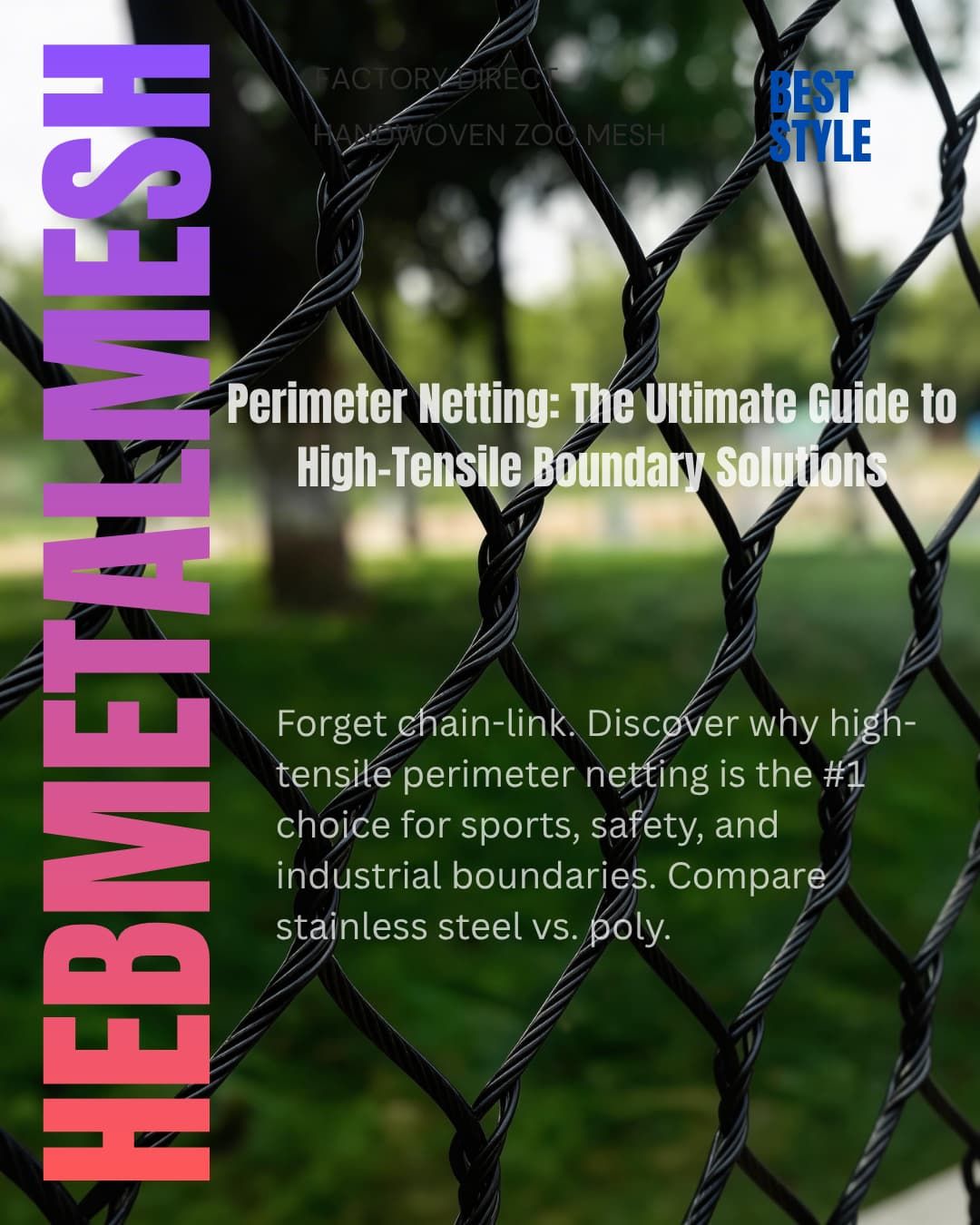
VII. Section 4: Choosing the Exact Specs for Lions, Tigers, and Leopards
Selecting the correct mesh specifications is not merely about “strength”; it is about matching the metallurgical properties to the predatory behaviors of specific species.
Tigers and Lions: The Momentum Class
For large, heavy-bodied felids like Siberian tigers or African lions, the priority is shear force management and breaking strength.
- Specification: Heavy-duty 1/8″ (3.2mm) cable thickness.
- Configuration: 2″ x 2″ or 3″ x 3″diamond apertures.This heavy-gauge cable is engineered to handle massive physical bulk and pure momentum. The 1/8″ diameter wire provides the required breaking load to safely contain animals weighing hundreds of pounds, even when they strike the boundary at full sprint.
Leopards and Jaguars: The Agile Climber Class
Leopards and jaguars require a different engineering approach. These agile predators are experts at vertical navigation and will utilize any available “grip” to scale an enclosure.
- Specification: 3/32″ or 1/8″ cable profiles.
- Configuration: Smaller aperture sizing (to prevent claw hold).Because these animals spend significant time in the canopy, high-climbing agile modules require extended overhead ceiling enclosures. By utilizing a smaller diamond aperture in conjunction with the 3/32″ or 1/8″ cable, you eliminate the “ladder” effect, preventing the cat from gaining the purchase necessary to climb to the roof or escape.
To explore species-specific material sizing, current inventory availability, and pre-engineered panel dimensions for these carnivore classes, view the options directly within the Hebmetalmesh Store Page.
5: The “Aha” Moment: Applying Big Cat Security to Commercial Human Spaces
The architectural community is increasingly recognizing that the highest standards of safety are born in the most demanding environments. When a structural containment system is certified to contain the terrifying, explosive force of a 500-pound apex predator, it ceases to be just a fence—it becomes a high-performance safety asset for critical human architectural infrastructure.
Cross-Industry High-Security Applications
By repurposing big-cat-grade, high-tensile mesh, developers and safety engineers can solve extreme-load containment challenges that traditional glass or static steel fail to address:
- Helipad Safety and Perimeter Drop Nets: Around offshore oil rigs and urban skyscraper helipads, wind shear and operational hazards are constant risks. High-tensile stainless steel netting acts as a catch-net for falling personnel or displaced equipment, providing a secure perimeter that does not warp or tear under extreme maritime conditions.
- High-Impact Anti-Vandalism Barriers: In public transit hubs and sensitive urban infrastructure, standard glass or light-duty fencing is prone to shattering. Big-cat-grade mesh provides an impenetrable, anti-vandalism skin that withstands heavy manual impacts and prevents projectiles from breaching critical structural windows or facades.
- Rockfall and Landslide Protection: For civil engineers protecting highways and mountain infrastructure, the primary threat is kinetic momentum from falling boulders. Draping high-tensile stainless steel mesh over loose slopes allows the system to absorb the impact of dropping debris, distributing the force across the entire anchor system to prevent slope failure without the mesh tearing.
6: Overcoming Environmental Corrosion (Alloy Chemistry)
In large carnivore habitats, the boundary is subjected to two relentless enemies: natural moisture and the harsh chemical cleaners used during daily washdown cycles. Standard steels, and even lower-grade alloys, will suffer from pitting corrosion long before the end of their intended service life.
The Threat of Acid Rain and Washdowns
Large carnivore facilities are high-maintenance environments. To keep habitats sanitary, staff must use high-pressure water, acidic detergents, and disinfectant washes daily. When these chemicals combine with outdoor moisture—and in some regions, acid rain—they create a corrosive cocktail that rapidly eats through the microscopic protective layers of standard carbon steel or 304-grade stainless. Once pitting begins, the mesh becomes structurally compromised, leading to microscopic cracking and potential failure points.
The 316 Advantage
For projects requiring a 30+ year service life, AISI 316-grade stainless steel is the only viable standard. This alloy is formulated with 2% to 3% Molybdenum, a critical additive that transforms the steel’s passivation layer into a robust shield. This molybdenum content completely neutralizes the pitting corrosion typically caused by prolonged contact with salt, chemical cleaners, and acidic environmental pollutants. By specifying Grade 316, you ensure that the enclosure remains chemically inert and structurally sound, regardless of how aggressively the habitat is sanitized.
To evaluate the comprehensive environmental testing data, including salt-spray test results and metallurgical certifications, visit the Hebmetalmesh Corporate Homepage.
7: Strategic Installation: Inward Angles and Seamless Lacing
The effectiveness of a big cat enclosure is defined as much by its geometry as it is by its material strength. Apex predators are master climbers, and the perimeter design must account for vertical navigation.
The Overhead Breakout Defeater
For high-agility species like leopards, jaguars, and mountain lions, a vertical wall is merely a starting point. To successfully contain these felines, procurement teams must source and install inward-facing mesh overhangs (often angled at 45 to 90 degrees).
These cantilevered mesh segments act as an “overhead breakout defeater.” Because the mesh is flexible and tensioned, a cat attempting to scale the wall encounters an unstable, inverted surface at the top. The moment the animal enters the overhang zone, the lack of a solid climbing purchase forces them to drop back into the habitat, rendering the jump-and-climb maneuver ineffective.
The Art of the Seam
A boundary is only as strong as its weakest connection. Standard retail-grade fencing often utilizes plastic zip ties or metal hog rings that snap under heavy pressure or degrade under UV exposure. Professional tensile systems eliminate these failure points through the art of the seam.
We utilize continuous stainless steel spiral lacing wires to join large, custom-cut mesh sheets. This process involves threading the lacing wire through the outermost diamond loops of two adjoining panels, effectively stitching them together into a single, seamless fabric. Because there is no hardware to break, the seam becomes the strongest part of the enclosure, ensuring that there are absolutely zero gaps or structural weak points for claws to exploit.
To determine the optimal roll dimensions and mounting hardware required for your overhead overhangs and seamless seams, explore the custom fabrication options inside the Hebmetalmesh Dedicated Zoo Mesh Category.
Request Custom Fabrication Pricing
Secure high-tensile, AISI 316-grade containment panels engineered to your precise site dimensions. Our technical team supports large-scale projects with full material test reports (MTRs), load-bearing calculations, and flat-pack logistics planning.
* Engineering turnaround typically 24-48 business hours. Global direct-to-site freight available.
FAQ: Big Cat Containment & Mesh Engineering
A: Large carnivore habitats are frequently sanitized with high-pressure water and acidic chemical cleaners, which accelerate corrosion in lower-grade steels. AISI 316 stainless steel contains 2–3% Molybdenum, providing superior resistance to pitting and environmental degradation, ensuring the enclosure remains structurally sound for 30+ years. You can view our full metallurgical testing data on the Hebmetalmesh Corporate Homepage.
A: Unlike rigid panels or chain-link, which have easily targeted welds or twistable wire, our handwoven mesh features a continuous, diamond-patterned structure. When a big cat attempts to pull or shear the mesh, the load is distributed across the entire fabric rather than focusing on a single point. This makes it impossible for an animal to unravel the weave or find a purchase point for their claws.
A: Yes. By choosing factory-direct custom roll dimensions rather than pre-packaged retail kits, you can drape the mesh to perfectly follow the contours of your site. This allows the enclosure to wind around trees and uneven topography without requiring expensive land grading or invasive site clearance. Explore how to configure your dimensions in the Hebmetalmesh Dedicated Zoo Mesh Category.
A: Absolutely. By installing inward-facing mesh overhangs (cantilevered at an angle), you create an inverted barrier. When an agile climber reaches the top of the wall, the instability of the flexible mesh overhang prevents them from finding a solid grip to pull themselves over the top, forcing them to drop back into the habitat.
A: Mechanical clips create “point-load” weaknesses that are prone to snapping under heavy impact. Our methodology uses continuous stainless steel lacing wire to “stitch” panels together. This creates a seamless, monolithic barrier that is as strong at the seam as it is in the center of the mesh sheet, effectively eliminating the primary gaps and structural weak points found in inferior containment designs.