
When evaluating the best aviary wire mesh types for outdoor bird enclosures, builders typically choose between Galvanized After Welding (GAW) wire, PVC-coated mesh, and handwoven stainless steel rope mesh. While GAW offers short-term affordability and PVC improves visibility, handwoven stainless steel rope mesh is the absolute winner for durability, providing a non-toxic, predator-proof structure lasting greater than 30 years without maintenance.
Key Takeaways
- Long-Term Structural Integrity: Standard galvanized coatings inevitably corrode, and UV rays embrittle PVC plastic over time. Pure Type 304 or 316 stainless steel cable mesh delivers permanent resistance against rust, coastal salt air, and harsh weather.
- Absolute Predator Exclusion: To secure an outdoor enclosure against highly dexterous, sharp-toothed predators like raccoons or foxes, you need high-tensile material with tight apertures (typically 1 inch or smaller) that cannot be chewed through or unraveled.
- The Paradigm Shift to Flexible Mesh: Modern aviary design has moved away from thick, rigid, boxy metal frames. Instead, architects now prefer lightweight, high-strength flexible cable fabrics that flow smoothly over living landscapes and virtually disappear from view.
- Seamless Material Selection: To see how these flexible architectural systems handle dynamic engineering loads and predator forces across real-world sanctuary layouts, check out our deep-dive tutorial on how to choose the right gauge for aviary wire mesh.
1. Introduction: The High Stakes of Outdoor Aviary Engineering
Let’s be completely honest: the elements are brutal, and local predators are far smarter than we give them credit for. Everyday weather—intense UV radiation, relentless rain, coastal salt air—works around the clock to degrade basic wire fencing. At the same time, animals like raccoons and foxes treat your perimeter like a puzzle, testing it for weak points, brittle welds, or loose seams. When traditional fencing options fail under these real-world pressures, the results are catastrophic.
That is why modern aviary design has undergone a major philosophical shift. Architects, zoos, and serious hobbyists are moving away from treating an aviary as a temporary “cage” made of cheap hardware store panels. Instead, they are designing them as long-term micro-ecosystems—structures built to endure for decades while prioritizing the biological health and physical safety of the birds inside.
If you are currently mapping out a new flight habitat, your choice of mesh is the single most critical decision you will make. To help you navigate the noise, we have put together this definitive guide outlining the best aviary wire mesh types for outdoor bird enclosures so you can build an unbreachable, beautiful, and permanent structure.
2. Material Breakdown: The Good, The Bad, & The Dangerous
To make an educated investment, you have to look past the upfront price tag and analyze how different fencing materials actually behave over years of outdoor exposure.
When it comes to durability and safety, the material you choose for your enclosure for birds is the single most important decision you’ll make—and stainless steel 304 consistently outperforms all other options.
Hexagonal Wire (Chicken Wire) — A Gardening Tool, Not Security
Hexagonal wire, commonly known as chicken wire, is excellent for keeping relaxed rabbits out of a vegetable patch, but it is a total disaster for active bird containment and predator defense. It is made from incredibly thin-gauge wire that can be sliced open easily by the teeth of a determined fox or the claws of a raccoon. Furthermore, its loose, twisted weave stretches out under tension. This leaves irregular gaps that can trap active wings or small heads, causing severe injuries. If you are serious about security, cross chicken wire off your list immediately.
Galvanized After Welding (GAW) Mesh — The Flawed Classic
Galvanized after welding (GAW) mesh has been the traditional default option for backyard aviaries for a long time. Because the iron fabric is dipped in molten zinc after it is welded, its joints have better short-term rust protection than standard utility wire.
However, GAW mesh harbors a silent, invisible killer: Heavy Metal Toxicosis (zinc poisoning). Parrots, finches, and other climbing birds use their beaks as a third foot to navigate their perimeters. As they grip the galvanized wire, their sharp beaks scrape off microscopic particles of the zinc coating. Over time, ingesting these particles damages their kidneys, destroys their nervous system, and can lead to a sudden, heartbreaking loss. If you are keeping hookbeaks or valuable breeding pairs, the chemical risk of galvanized coatings simply isn’t worth it.
PVC-Coated Wire Mesh — The Visual Illusion
At first glance, PVC-coated wire mesh looks like an excellent compromise. The black or green plastic jacket absorbs sunlight, which reduces glare and makes it much easier to see inside the enclosure.
The real problem happens hidden beneath that plastic shell. Intense outdoor UV exposure gradually makes the PVC coating brittle, causing it to crack, peel, and chip off. Once the plastic jacket cracks, rain and moisture get trapped underneath it with nowhere to go. The internal metal wire begins to rust out from the inside out, completely hidden from view. You won’t know the fence has failed until a predator applies physical pressure and the entire brittle panel collapses like paper. To understand how these material limitations dictate long-term budgeting and maintenance costs, explore our comprehensive cost comparison of aviary wire mesh products for backyard aviaries.
Handwoven Stainless Steel Rope Mesh — The Architectural Disruption
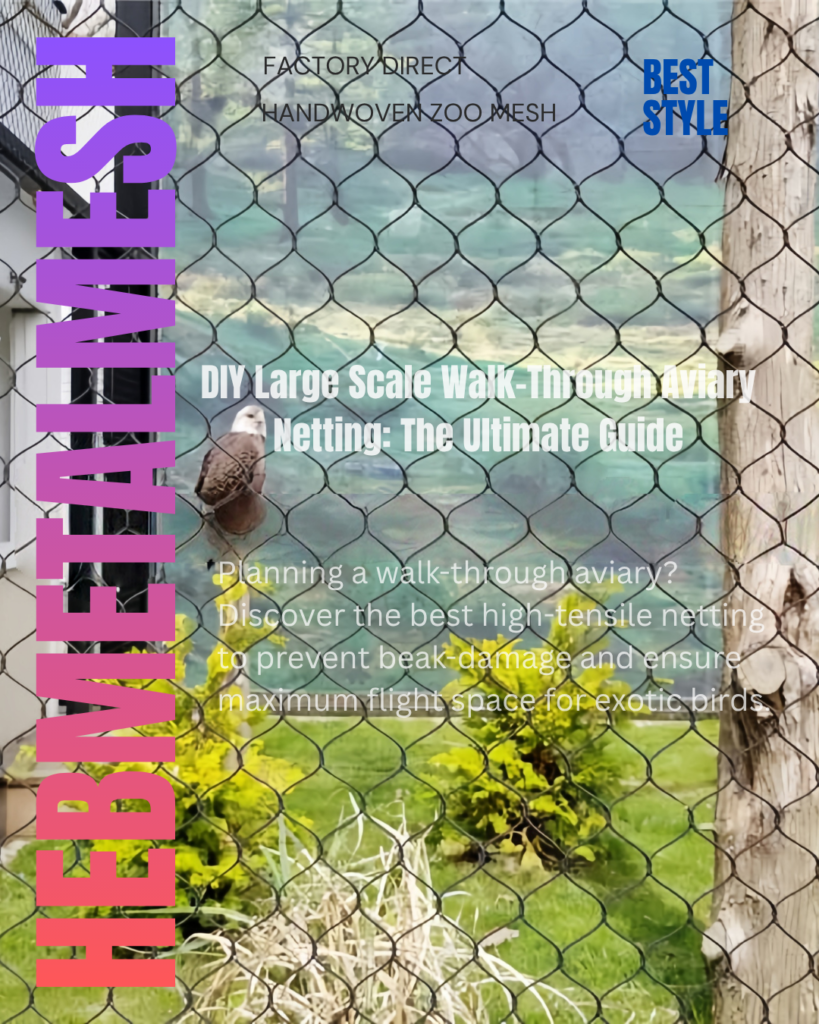
If you want to completely break free from the cycle of rusting wire, toxic coatings, and frequent structural replacements, handwoven stainless steel rope mesh is the ultimate upgrade. Woven from high-tensile Type 304 or 316 stainless steel wire cables, this material functions like an indestructible, flexible fabric.
Because it relies on pure steel alloys, there are absolutely zero zinc layers to flake off, making it entirely non-toxic for climbing birds. It possesses incredible mechanical strength while remaining remarkably thin and lightweight. It easily stops aggressive chewing, heavy snow loads, and intense predator attacks. It represents a massive leap forward in modern aviary engineering—combining industrial-grade security with a clean, professional aesthetic that lasts for decades.
Beyond basic perimeter fencing, protecting high-value roof assets—such as solar panels and ventilation shafts—requires a specialized approach; learn more about the best materials and installation techniques in our latest bird netting roof article.
3. The Psychological Elements of Enclosure Views
When building an outdoor habitat, most people focus entirely on physical containment. However, the optical relationship between the viewer, the barrier, and the birds introduces a critical psychological element that can make or break the installation.
Visual Glare vs. Clear Sightlines
Traditional galvanized wire mesh features a bright, metallic zinc surface. When sunlight hits this metal, it creates intense visual glare, bouncing light straight into the human eye. This high reflectivity creates a harsh visual barrier that forces the human eye to focus directly on the wire grid rather than on the birds inside.
This bright reflection is not just annoying for photographers and visitors; it is equally stressful for the inhabitants. In nature, birds rely on pristine sightlines to scan for aerial threats. A highly reflective, bright cage boundary limits their visibility, creating an agitated and unnatural environment.
The Physics of Sightlines: Galvanized vs. Black Oxide Mesh
The Black Oxide Disruption
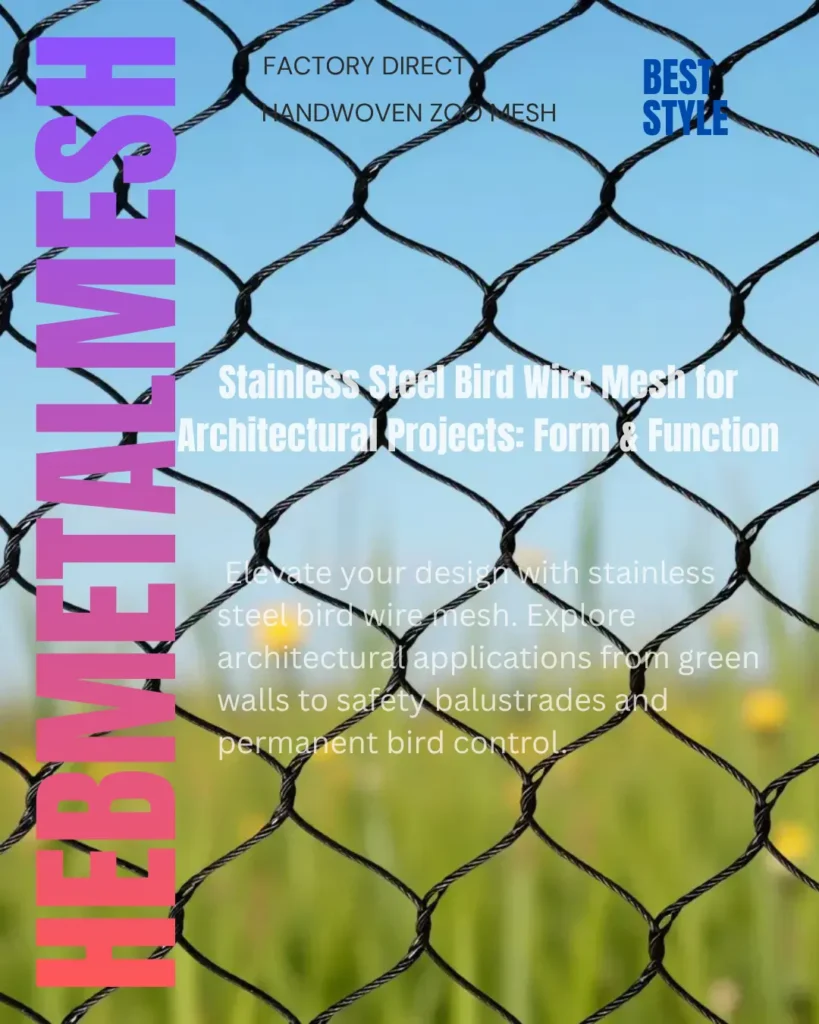
To solve this optical problem, modern high-end aviary projects utilize a matte black oxide finish on their stainless steel wire fabrics. The science behind this treatment is elegantly simple: the dark oxide layer chemically alters the steel surface so it actively absorbs light waves instead of reflecting them.
Because the dark, matte finish lacks reflectivity, the human eye naturally looks straight past the wire, focusing instead on the vibrant colors and flight movements inside the enclosure. This creates an “invisible shield” effect that provides clear sightlines for photography, improves viewing dynamics, and fosters a calmer environment for the birds.
4. Structural Flexibility: Escaping the Rigid Frame
Traditional aviary construction has long been held hostage by a significant structural limitation: geometric stiffness.
The Geometric Trap
When you build with standard welded wire mesh, you are forced to design inside a strict box. Because welded wire panels are completely rigid and flat, they dictate a layout featuring sharp 90-degree corners, flat vertical walls, and boxy, unnatural shapes.
If your property features uneven terrain, gentle slopes, or a beautiful old tree that you want to preserve, rigid panels force you into a frustrating compromise. You must either invest thousands of dollars in heavy earth-moving equipment to level the ground, or cut down the natural elements to make room for a boring, geometric cage.
Design Philosophy: Rigid Box vs. Organic Tensile Envelope
Organic Architecture & The “Aha!” Moment
Instead of forcing nature to adapt to a rigid steel cage, the perimeter fluidly conforms to your landscape. This organic design freedom is made possible by selecting a pliable, high-tensile fabric, such as the specialized stainless steel wire mesh for bird aviaries from Hebmetalmesh, which behaves like an ultra-strong structural cloth. Because this material is composed of hand-interwoven stainless steel wire cables, it gives you the creative freedom to wrap boundaries around living trees, drape panels over undulating hillsides, and fasten web structures smoothly onto custom curved steel arches.
Because this material is composed of interwoven stainless steel wire cables, it behaves like an ultra-strong structural cloth. It possesses immense tensile strength, yet it can wrap around living trees, drape over undulating hillsides, and fasten smoothly onto custom, curved steel arches. This flexibility gives you the creative freedom to design expansive, walk-in flight habitats that mimic real ecosystems. Instead of forcing nature to adapt to a rigid steel cage, the fence fluidly adapts to your landscape.
5. Structural Comparison Matrix
To help you visualize how these materials stack up when subjected to real-world outdoor conditions, we have mapped out their core performance metrics below. This matrix highlights why initial material costs can be highly deceiving when calculating the true lifetime value of your build.
| Mesh Type | Average Lifespan | Chew & Predator Resistance | Avian Toxicity Risk (Zinc) | Structural Flexibility |
|---|---|---|---|---|
|
Hexagonal Wire (Chicken Wire) | 1 – 2 Years |
Extremely Poor Easily torn |
High Risk Basic galvanization | Poor Stretches and sags |
|
Galvanized After Welding (GAW) | 3 – 5 Years |
Moderate Resists teeth, joints rust |
Fatal Threat Leads to zinc poisoning | None Strict, rigid panels |
| PVC-Coated Wire Mesh | 5 – 7 Years |
Moderate Coatings peel/chip |
Low Risk Until plastic cracks | None Strict, rigid panels |
| Handwoven Stainless Steel Mesh | 30+ Years |
Absolute Indestructible web |
Zero Risk 100% inert pure alloy |
Superior Fluid, fabric-like flex |
To prevent skin abrasions and snags during animal interaction, edge termination must be flawlessly finished; learn about the fabrication standards that eliminate these risks in our detailed zoo mesh procurement guide.
Frequently Asked Questions
Yes. Raccoons possess incredible jaw pressure and highly dexterous paws. They can easily rip apart standard hexagonal chicken wire or chew through thin-gauge plastic netting. To protect your flock from persistent mammalian predators, you must avoid weak utility screens and invest in a heavy-duty material. A resilient, high-strength boundary ensures that predators can neither chew through the physical wires nor exploit weak seam joints to force a breach.
Avian zinc poisoning, medically known as heavy metal toxicosis, occurs when climbing birds use their beaks to traverse galvanized wire mesh. Because the galvanization process coats the underlying iron with a layer of zinc, the bird’s sharp beak continuously scrapes off microscopic metal shards. Once ingested, these zinc particles enter the bloodstream, causing rapid kidney damage, severe neurological decline, gastrointestinal stagnation, and ultimately death if the toxic perimeter is not replaced with a completely inert material.
The lifespan gap between these two materials is massive. Standard galvanized wire mesh typically begins to exhibit white rust, brittle weld fractures, and surface oxidation within 3 to 5 years—especially in high-humidity regions or coastal areas prone to salt spray. Conversely, premium marine-grade stainless steel wire rope mesh is entirely rust-proof and chemically stable, maintaining its full structural integrity for greater than 30 years without requiring a single coat of protective paint or maintenance.
For an outdoor aviary housing a diverse mix of species, your mesh opening size should be dictated by your smallest bird. A maximum aperture of 1/2″ x 1/2″ (12mm) is the industry standard. This tight spacing prevents small birds like finches or lovebirds from pushing their heads through the mesh—which can lead to fatal entrapment or neck injuries—while simultaneously acting as an unbreachable barrier against small wild predators like weasels, rats, and snakes.
Rigid metal panels require perfectly flat terrain, precise square framing, and meticulous alignment, which significantly drives up your labor costs if your property has slopes or trees. On the flip side, flexible netting systems behave like a high-strength structural fabric. They arrive in highly compressible rolls that pull taut effortlessly across irregular perimeters, wrap seamlessly around living trees, and anchor smoothly to organic, curved steel arches without requiring extensive groundwork. To see how these flexible properties simplify large-scale framing, you can explore our complete overview of specialized bird netting fence and aviary mesh systems.
Stop Replacing Ruined Enclosures. Build a Permanent Legacy.
Cheap wire rusts out, flakes toxic chemicals, and puts your entire project at risk of predator breaches. Elevate your architectural design with handwoven, non-toxic, and practically indestructible stainless steel wire rope netting engineered to endure beautifully for over three decades.