
A six-foot cedar panel does one job well. It hides everything. Then the second summer comes, the stain fades, and the yard behind it feels like a room with the curtains pulled shut.
Most homeowners ask for privacy and get a wall. The view they paid for, the ridge line or the water, disappears behind boards. Light drops. Air stops moving. By August the patio runs hotter than the lawn.
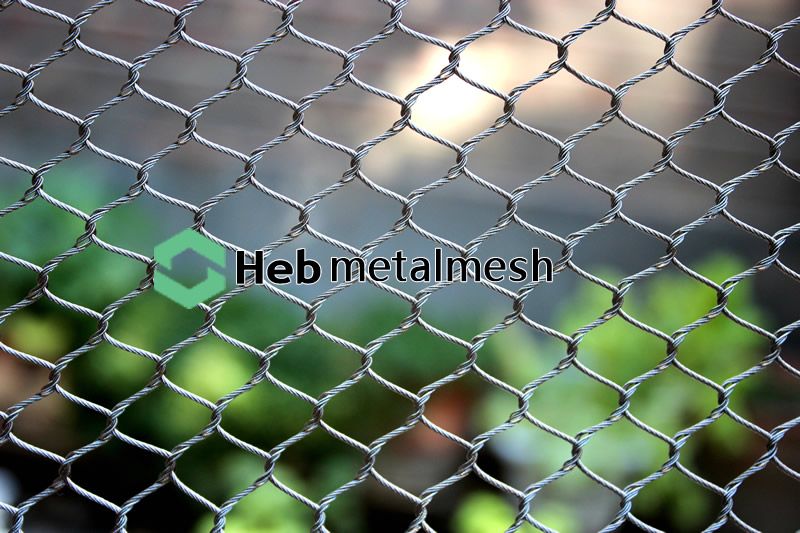
A see through backyard fence solves the opposite problem. It draws a legal boundary, keeps kids and dogs inside, and still lets your eye travel past it. Wire rope mesh does that better than most materials, because the barrier is mostly hole. A 50 mm aperture on 3 mm cable leaves about 89 percent of the panel open.
That number changes what a fence can be, and it sets the limits.
Executive Summary
A see through backyard fence trades solid privacy for sightline, daylight and moving air. Stainless wire rope mesh holds a boundary that stops dogs and kids while leaving 85 to 92 percent of the panel open, and that open area sheds the wind load which tears solid infill off its posts. The open area is measurable, not a matter of taste, and it decides both the sightline and the load.
Three numbers decide the specification: aperture, cable diameter and post spacing. A 50 mm aperture on 3 mm cable reads almost invisible past six meters and still blocks a 4-inch sphere used in pool codes. Mesh fails where a neighbor looks into your kitchen. It wins where the view is the point.
Send Us the Fence Run, Get a Panel Layout Back
Give us the length, the height and what has to stay inside. We return aperture, cable size and post spacing for your wind zone, plus a price per square meter.
Request a Fence LayoutQuick Answer
A see through backyard fence uses an open panel, usually stainless wire rope mesh, welded mesh or glass, to mark a boundary without blocking the view. Wire rope mesh suits most yards because it passes wind, needs no repainting and stays visually light at a distance. Pick the aperture by what you must keep in or out, then size posts and tension for your local wind load.
Key Takeaways
- Wire rope mesh leaves 85 to 92 percent of the panel open, so it keeps the sightline that solid infill destroys.
- A 50 mm aperture on 3 mm cable blocks a 4-inch sphere and satisfies most pool barrier codes.
- Open area cuts wind load by roughly a factor of ten against a solid panel of the same size.
- Post spacing runs near 3 m for mesh against 2.4 m for solid infill, because the panel sheds wind.
Why a Solid Fence Closes a Yard In
A solid panel answers one question and creates three. It blocks the neighbor’s window, then takes the light with it. It stops the wind at ground level, which leaves a breezy lot still and humid. And it hands every gust a sail to push against.
Homeowners notice the light first. A six-foot board fence along the south edge of a patio cuts afternoon sun by a third or more, and grass behind it thins within two seasons. A fence that lets light into the garden changes that, and moving air stops feeding moss on pavers.
Then comes upkeep. Wood wants a fresh coat every three to five years, and a fence carries more surface area than people estimate. Replacing a solid wood fence with mesh ends that cycle: the frame stays, the panel changes, and the yearly job becomes a rinse with a hose. On a frame you already own, how mesh netting compares with solid fence infill covers the load paths and fixings.
See-Through Fence Options Compared
Five materials give you a backyard fence that keeps the view. They differ in how much they hide, what they cost to own, and how long they survive weather. This backyard fencing cost breakdown covers the ownership side.
| Option | Open area | What it shows | Upkeep | Best fit |
| Stainless wire rope mesh | 85–92% | Nearly everything | Rinse yearly | Views, pools, pets, slopes |
| Welded wire mesh | 75–85% | Most of the view | Recoat if painted | Budget garden runs |
| Aluminum picket | 50–65% | Sky and distance | None | Front yards, code fences |
| Frameless glass | 95% | Everything, undistorted | Squeegee monthly | Patios, premium builds |
| Chain link | 85% | Everything, plus a grid | Vinyl skin chips | Utility boundaries |
Where wire rope mesh lands
Wire rope mesh tops that list because each panel is a woven grid of stainless cable, so the barrier is mostly air. Glass shows more, but it costs three to five times as much, needs cleaning on both faces, and kills birds.
Aperture, Cable Diameter and the Privacy Trade-Off
Three numbers decide how a panel looks and what it holds: aperture size for visual weight and containment, cable diameter for strength, post spacing for cost.
The wire rope mesh aperture and privacy trade off runs against intuition. A tighter grid puts more steel in front of your eye, so the panel reads denser from the kitchen window. Yet a 50 mm aperture still leaves 89 percent open area, and you see straight through it from four meters out.
Reading open area
Open area is simple arithmetic. Divide the aperture by aperture plus cable diameter, then square it. A 50 mm hole on 3 mm cable gives 89 percent; a 100 mm hole on 4 mm cable reaches 92 percent, a real saving where nothing small has to stay inside.
Finish matters as much as geometry. Bright stainless throws glare in low sun. A black oxide mesh for backyard fencing reads as shadow against hedge and lawn, all but vanishing at thirty meters. Powder coat holds color well inland.
When cover matters more
Where cover is the real goal, keep the mesh and add something behind it. A reed screen, horizontal slats or a fast hedge gives privacy without the wind sail of a solid panel. That pairing, a privacy screen behind a mesh fence, is how most residential jobs settle the conflict.
The animal fence mesh range runs on 7×7 strand cable in 304 and 316 stainless steel, with apertures from 50 mm to 100 mm and a breaking load that scales with cable area. A 3 mm cable carries roughly 56 percent of the load of a 4 mm one, which is why dog runs and pool barriers step up a size.
Matching the Mesh to the Job
Most backyards ask for one of four boundaries. Each pushes the specification a different way.
- Pool barrier. Many codes want 1.2 m of barrier that a 102 mm sphere cannot pass, plus a self-closing gate.
- Dog run. Go to 4 mm cable and 50 mm aperture, plus a buried apron at the base. Dogs test the bottom edge first.
- Garden boundary. A stainless steel cable mesh garden boundary can run wider at 80 mm, cost less, and carry vines without sagging.
- Backyard aviary. Small birds need 25 to 50 mm, and the roof matters as much as the walls.
A pool fence with clear sightlines earns its cost twice over. Parents watch the water from the kitchen, and the barrier still counts as one under inspection. Ask which code your inspector cites, since sphere size varies by jurisdiction.
Backyard aviaries are where mesh and wildlife meet. A wall that birds can see is kinder than glass, and the open structure lets you plant right up to the line. If you are building a flight area against an existing fence, this guide to backyard aviary mesh walks through panel and frame choices.
Bird-safe design matters on a plain garden boundary too, since a see-through barrier invites wildlife to test it. The American Bird Conservancy explains why reflective surfaces cause collisions that mesh avoids. Climbing plants on a wire mesh fence soften that edge and give small birds cover on approach.
For a balcony mesh guard for apartments, the fixing is the whole job. You are anchoring into a slab edge or parapet, not soil, and the panel must resist a point load rather than a wind sail. A modern railing built around wire mesh shows how frame and standoffs work with no ground to dig into.
Installation: Posts, Tension and Wind
Mesh fence post spacing and tensioning decide whether the panel stays flat for twenty years or ripples by the third summer.
Post spacing and footings
A mesh panel sheds most of its wind, so posts can sit near 3 m apart on a straight run, against 2.4 m for solid infill. Footings still need depth: 600 to 800 mm in firm soil, wider in sand. Let the concrete cure before you pull tension, or the posts will lean and stay leaned.
Tensioning order
Tensioning follows a fixed order, and a skipped step shows up as a sag you cannot remove later.
- Set corner and end posts first, brace them, then string a line between them.
- Run the tension wire or border cable along the top and bottom edges.
- Hang the panel loose, with every swaged ferrule seated in its clip.
- Pull tension at the turnbuckles in quarter turns, working from the middle outward.
- Check the sightline down the run, then lock the turnbuckles and trim the tails.
Wind load
Wind pass through fence design is the quiet advantage. A solid panel of 1.8 m by 30 m presents about 54 square meters of sail; the same run in 89 percent open mesh presents about 6. That gap decides whether a storm takes the fence or just moves the branches.
Where there is no room for posts, mesh can hang between masonry walls on wedge anchors and standoff brackets, kept 40 mm clear so water runs behind the panel. The panel and frame hardware for containment fences handles that edge fixing as well as round posts.
Height Rules and Sight Triangles
Height is a permit question before it is a design question. Most US jurisdictions allow 1.8 to 2.0 m at the rear and side of a lot, and 1.2 m in front. Fence height rules for a corner lot go further, because two frontages meet.
That sight triangle, usually 7.5 to 9 m back from the intersection, is where a see-through panel earns a variance. A solid fence inside it gets rejected; a mesh panel at the same height often passes, since the sightline stays open.
Small lots feel height more than large ones. A solid fence around a 6 m wide yard turns the space into a corridor. A see through fence for a small yard keeps the neighbor’s wall visible but distant, and the plot reads wider than it measures.
Keeping It Clear Over Ten Years
Stainless in a backyard needs almost nothing, and the one failure people report is cosmetic.
Tea staining on outdoor stainless steel mesh looks like rust and is not. Rain carries dust, pollen and iron particles onto the cable, and those deposits bloom into a brown film within a season. The steel underneath stays intact. Wash it off with mild detergent once a year, twice near a highway.
Skip chlorine, muriatic acid and wire brushes. Pool chemicals and masonry cleaners attack the passive layer that makes the alloy stainless, and a steel brush leaves free iron that will rust for real. Inspect twice a year along the base and at every ferrule. The stainless mesh maintenance routine sets out the cleaning order and the passivation step for coastal yards.
Cost, Lead Time and What to Send for a Quote
Mesh prices per square meter and frames price separately, so two quotes for the same yard rarely compare. Panels ship crated, rolls coiled, and freight can exceed the panel gap on a short run.
Send four things and the quote comes back clean:
- Total run length and height.
- A plan or photo showing corners, gates and slopes.
- What has to stay inside: dogs, children, deer, birds.
- Your postcode, so salt exposure and wind load get priced in.
FAQ
Yes, and it is often the cheapest run on the property. Use wedge anchors with standoff brackets at 600 mm centers, and leave a 40 mm gap so water drains behind the panel. Check both walls at the anchor line, because old mortar will not hold a tensioned panel.
A 50 mm square aperture passes it, and a 100 mm aperture fails, because the sphere slips through. The 50 mm grid is the usual choice for pool work. Confirm the code your inspector applies, since some jurisdictions also test the gap under the panel.
A 1.8 m by 30 m run in 3 mm cable lands near 60 to 80 kg of mesh, plus frame and crating. That ships on a standard pallet to a residential address. Ask for liftgate delivery if you have no forklift.
Black oxide is a chemical conversion on the wire, not a coating, so it does not peel or chalk. It lightens slightly in strong UV over eight to ten years. Powder coat holds color longer but can chip at cut ends.
Ready to Price the Run You Actually Have?
Send the length, height, slope and what has to stay inside. You get a panel layout, the aperture and cable we recommend, and a delivered price.
Get My Fence Quote