Introduction: The Quest for the Ultimate Enclosure Solution
What is the most durable, safe, and versatile flexible netting on the market today? For decades, professionals responsible for the design, construction, and management of modern zoological exhibits and wildlife parks have grappled with this critical question. The integrity of an animal enclosure is not merely a matter of structural safety; it is the cornerstone of animal welfare, public protection, and long-term financial sustainability.
The challenges inherent in contemporary animal enclosure mesh design are complex and multifaceted. Architects and facility managers must balance the need for absolute containment strength against the requirements of aesthetic appeal and visitor experience. The enclosure must withstand the forces of nature, resist determined animals, ensure visitor safety, and offer a clear, unobstructed view of the habitat—all while maintaining a cost-effective operational life cycle.
While the term “flexible netting” is broad, encompassing everything from garden trellis and agricultural screens to protective wrapping for machinery, the requirements for zoological, wildlife park, and sanctuary applications are in a league of their own. A temporary, low-cost solution simply cannot be entrusted with containing a powerful primate, a large cat, or a flock of valuable exotic birds.
This article serves as the definitive guide for discerning professionals, drawing a clear line between generic flexible materials and the specialized, high-performance solutions required by the industry. Our thesis is simple: for demanding, mission-critical applications like zoo mesh and large-span aviary netting, a single material stands alone in performance, safety, and longevity. We introduce Hebmetalmesh (Shijiazhuang Netting Trading Co., Ltd), a global specialist manufacturer of handwoven stainless steel flexible netting, presenting it as the superior, professional-grade solution that meets and exceeds the stringent demands of modern exhibit design.
Part 1: Understanding Flexible Netting – A Broad Market Overview
Before examining the specialized requirements of the zoological world, it is essential to understand the general landscape of pliable containment materials. The broad category of flexible netting refers to any mesh-based material characterized by its ability to bend, conform, wrap, or stretch over three-dimensional shapes without permanent loss of structural integrity.
What is Flexible Netting? Definition and Core Characteristics
At its core, flexible netting is defined by its geometry—typically a woven, knotted, or interlocking pattern—which allows it to achieve a crucial balance between tensile strength (the force required to pull it apart) and adaptability (its pliability and formability).
Key Property: The primary distinguishing factor of true flexible netting used in construction is its capacity to absorb load and distribute stress across its entire structure, conforming to complex structures like domes or parabolic curves far more effectively than rigid, planar materials.
Common Types of Flexible Netting (As Seen in Search Results)
When conducting general research for “flexible netting,” the market presents a diverse, but often inappropriate, range of options for heavy-duty applications. Understanding the limitations of these common types is the first step toward specifying the correct solution for animal enclosures.
1. Polyethylene/PVC Netting (Plastics)
This is the most common and lowest-cost type encountered in search results, primarily used in gardening, plant support, debris containment, and temporary fencing.
- Pros: Extremely cheap, lightweight, easy to cut and install.
- Cons: Highly susceptible to UV degradation, quickly becomes brittle and cracks, possesses very low tear strength, and is entirely unsuitable for high-containment or permanent wildlife applications. Its short lifespan makes it a poor investment for large facilities.
2. Nylon/Polyester Mesh (Fiber/Rope)
These are synthetically produced nets, often knotted or knotless, used in sports barriers (like golf cages), debris protection, or as lightweight shade covers. Some low-security aviaries may employ them.
- Pros: Good strength-to-weight ratio, available in various colours, and relatively inexpensive initially.
- Cons: These fibrous materials can be easily chewed or gnawed through by many animals (especially rodents and primates), leading to immediate containment failure. They can also be abrasive to animal skin and feathers, and they suffer from stretching and sagging over time, requiring continuous maintenance and re-tensioning.
3. Knotted/Knotless Rope Netting (Polypropylene/Manila)
Typically thicker, rope-based netting used extensively for play structures, adventure parks, and climbing nets where human interaction and safety are primary concerns.
- Pros: Very high overall bulk strength, excellent for creating load-bearing climbing structures.
- Cons: The large knot size and material thickness often significantly obstruct visitor viewing. It is highly susceptible to UV damage and moisture absorption (if natural fiber is used), and, crucially for containment, the knots can loosen and shift under continuous stress, altering the mesh size and integrity.
4. Rigid Wire Mesh (Hardware Cloth, Chicken Wire)
While technically a mesh, these are often considered rigid due to their manufacturing process (welded or twisted, not woven). They are commonly made of galvanized steel or sometimes aluminum.
- Pros: Highly rigid, very effective against small pests, and provides an immediate physical barrier.
- Cons: Galvanization quickly fails in humid or coastal environments, leading to unsightly and unsafe rust and corrosion. Welding creates sharp burrs and weakens the material. Its lack of true flexibility means it cannot conform to complex geometries without being cut and seamed, introducing multiple failure points.
This overview clearly illustrates that the general market for flexible netting prioritizes low cost and temporary use. When measured against the decades-long demands of zoological institutions, these materials invariably fall short.
Part 2: The Critical Limitations of Common Netting for Zoological Applications
The stakes in animal enclosure design are too high for compromise. Choosing the wrong material based on initial low cost inevitably leads to excessive long-term maintenance, safety risks, and operational headaches. This section details why standard flexible netting solutions fail to meet the standards required for the modern zoo.
Why Standard Flexible Netting Fails for Zoos and Aviaries
The modern facility requires a heavy-duty, permanent solution. Standard netting materials are simply not designed for this environment.
The 5 Key Failure Points:
1. Durability & Weathering: The Environmental Toll
Most plastics (Polyethylene, PVC) become brittle and weak when exposed to prolonged ultraviolet (UV) radiation, high ozone levels, and fluctuations in temperature. Nylon and polyester materials similarly lose tensile strength when exposed to sunlight and moisture. In contrast, a permanent installation needs a material that is virtually impervious to environmental degradation. Failure to choose a resilient material means expensive, disruptive, and continuous replacement cycles, leading to a high total cost of ownership.
2. Animal Safety & Welfare: Abrasion and Ingestion Risks
Animal welfare is paramount. Standard nettings pose several immediate hazards:
- Sharp Edges: Cut or broken plastic netting leaves razor-sharp edges that can injure animals, particularly birds’ feet and wings, or primates’ hands.
- Ingestion Risk: Fibrous nets (nylon, rope) can be chewed into pieces and ingested by animals, leading to potentially fatal digestive tract blockages.
- Abrasions: The texture of some plastic and rope meshes can be abrasive, causing feather damage in birds or skin irritation in active climbing species.
3. Containment Strength: Inadequate Tensile Capacity
Heavy-duty flexible netting is required to contain powerful animals. Materials like PVC or standard nylon lack the necessary tensile strength to resist the consistent, concentrated force exerted by strong climbing species, such as Orangutans or Snow Leopards, or the sudden impact load of larger animals. A containment barrier must be able to withstand dynamic loading without tearing, stretching to the point of structural failure, or allowing animals to find a foothold or escape route.
4. Security & Vandalism: Low Breach Resistance
In public-facing enclosures, security extends beyond internal containment; it includes resistance to external threats like vandalism. Standard plastic or fibrous nets are easily breached with simple tools (knives, wire cutters). This lack of security poses a significant threat to animal safety and public trust. A professional zoo mesh solution must present a formidable barrier that is difficult and time-consuming to tamper with.
5. Aesthetics & Visibility: Obstructing the View
Visitor experience is vital to a zoo’s mission and revenue. Cheap netting tends to look utilitarian, sags noticeably over time, and requires thicker strands or larger knots to achieve minimal strength, severely obstructing the view. A premium animal enclosure mesh should be nearly invisible, allowing the visitor to feel fully immersed in the habitat and focus entirely on the animals.
Part 3: The Superior Solution: Handwoven Stainless Steel Flexible Netting
The inherent limitations of plastics, fibers, and rigid wire fundamentally disqualify them from use in professional zoological construction. The answer to the industry’s demand for durability, safety, aesthetics, and structural integrity is found in one material: handwoven stainless steel flexible netting.
Stainless Steel Flexible Netting: The Gold Standard for Animal Enclosures
The specification of stainless steel flexible netting—specifically the premium handwoven cable mesh offered by specialists like Hebmetalmesh—is recognized globally as the professional answer to containment and safety challenges. This material provides the necessary balance of extreme strength and artistic formability.
Why Stainless Steel is Unbeatable:
Unmatched Durability: Decades of Service Life
The material composition is crucial. Hebmetalmesh uses high-grade 304 and 316 stainless steel flexible netting. The 304 grade offers excellent general corrosion resistance, while the 316 grade (marine grade) includes molybdenum, providing superior resistance to chlorides and acids—making it ideal for coastal regions, high-humidity habitats, and aquatic animal enclosures (resisting salt spray and chlorine effects). This material resists UV degradation, extreme temperatures (from arctic cold to desert heat), and environmental fatigue, guaranteeing a service life measured in decades, not years.
Inherent Safety: Smooth, Non-Toxic, and Non-Abrasive
Unlike standard wire mesh, which is often spot-welded and prone to sharp edges, Hebmetalmesh’s cable mesh is entirely handwoven. This specialized process eliminates sharp burrs and produces a smooth, seamless crossover point between the cables. This creates a soft, tactile surface that is non-abrasive, making it exceptionally safe for sensitive species. It is non-toxic, non-leaching, and is the preferred material for modern aviary netting to prevent foot and beak injuries.
True Flexibility & Formability: Design Freedom
This material redefines flexibility. Handwoven stainless steel flexible netting can be precisely stretched and tensioned to conform to complex, three-dimensional curves, domes, tunnels, and unique free-form shapes. It maintains structural integrity when wrapped over irregular landscapes or organic structural elements, offering architects unparalleled freedom in designing dynamic, engaging habitats. This formability is impossible to achieve with rigid, pre-fabricated panels.
High Tensile Strength: Secure Containment
The cable-based structure of this heavy-duty flexible netting provides immense tensile strength. Depending on the specified cable diameter (e.g., 1.2mm to 4.0mm) and mesh aperture, the material can securely contain even the largest and most powerful animals, including big cats, large primates, and bears. Its ability to absorb and distribute impact load across the entire panel surface is crucial for preventing breach in high-stress enclosures.
Long-Term Value: Lowest Total Cost of Ownership
While the initial investment in premium stainless steel flexible netting is higher than in plastics, the long-term economic argument is overwhelmingly in its favor. With a lifespan exceeding 50 years and requiring virtually no routine replacement due to weathering or corrosion, the material offers the lowest total cost of ownership (TCO) across the project’s lifetime. The elimination of costly, disruptive replacement projects quickly justifies the initial expenditure.
Aesthetic Excellence: The Invisible Barrier
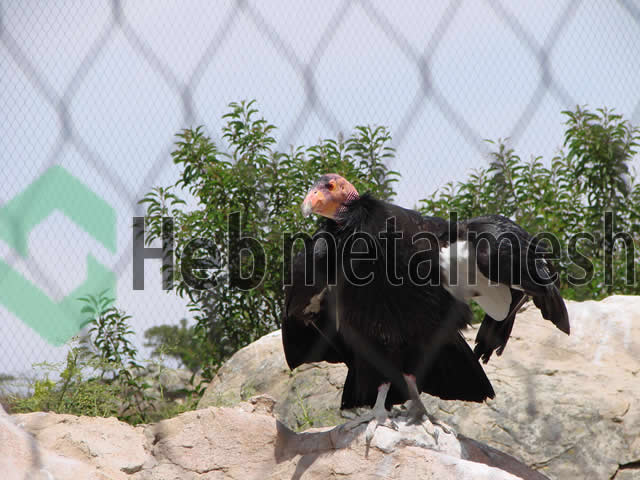
The most appreciated feature by visitors and designers alike is the material’s near-invisibility. The thin, high-strength stainless steel cables create a light, transparent, diamond-patterned barrier that virtually disappears at a distance, particularly when placed against natural backgrounds. This ensures an unobstructed viewing experience, enhancing the visitor’s connection to the animals and maximizing the impact of the exhibit’s design.
Key Applications Showcase (Embedding Our Keywords):
- Zoo Mesh & Primate Enclosures: Used for creating expansive, climbable dome structures and tunnels that provide enrichment and containment for high-activity species like gibbons and gorillas. The cable strength ensures security while the flexibility allows for organic, tree-like structures.
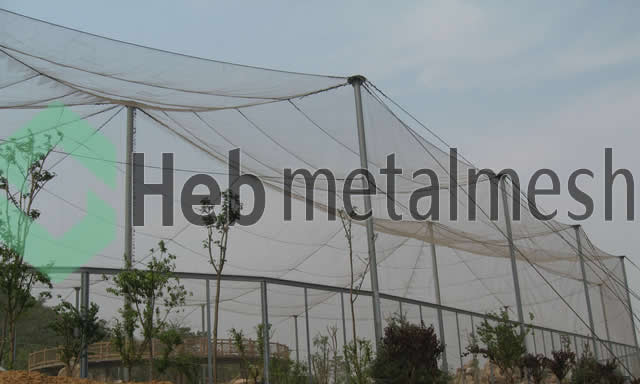
- Aviaries and Bird Netting: Used as lightweight, large-span roofing for free-flight aviaries. The small, smooth aperture sizes, often down to 20mm x 20mm, safely contain the smallest birds while providing a clear flight path and preventing bird strikes on the perimeter.
- Big Cat Enclosures & Perimeter Fencing: Specified in thicker cable diameters for high-security, climb-resistant barriers capable of withstanding the focused power of tigers, lions, and leopards.
- Aquatic Animal Enclosures: The 316 marine-grade stainless steel flexible netting is essential for barriers and secondary protection around pools, salt-water exhibits, and exhibits involving corrosive environments.
- Interactive Animal Encounters: Provides safe, durable barriers for close-up viewing decks and feeding stations, allowing maximum proximity without compromising public or animal safety.
Part 4: The Hebmetalmesh Difference: Crafting the Premier Enclosure Solution
In the niche market of specialized zoological containment, not all stainless steel mesh is created equal. The material specification, manufacturing process, and engineering support are what separate a generic stainless steel product from a professional-grade solution designed for the specific rigors of animal habitats.
Not All Stainless Steel Mesh is Created Equal
When sourcing stainless steel flexible netting, facility managers must look beyond the generic material type and scrutinize the method of fabrication. The difference between a machine-welded product and a handwoven cable system is the difference between a high-maintenance fence and a permanent structural solution.
Our Manufacturing Excellence – Shijiazhuang Netting Trading Co., Ltd (Hebmetalmesh):
Handwoven Craftsmanship: Superior Flexibility and Strength
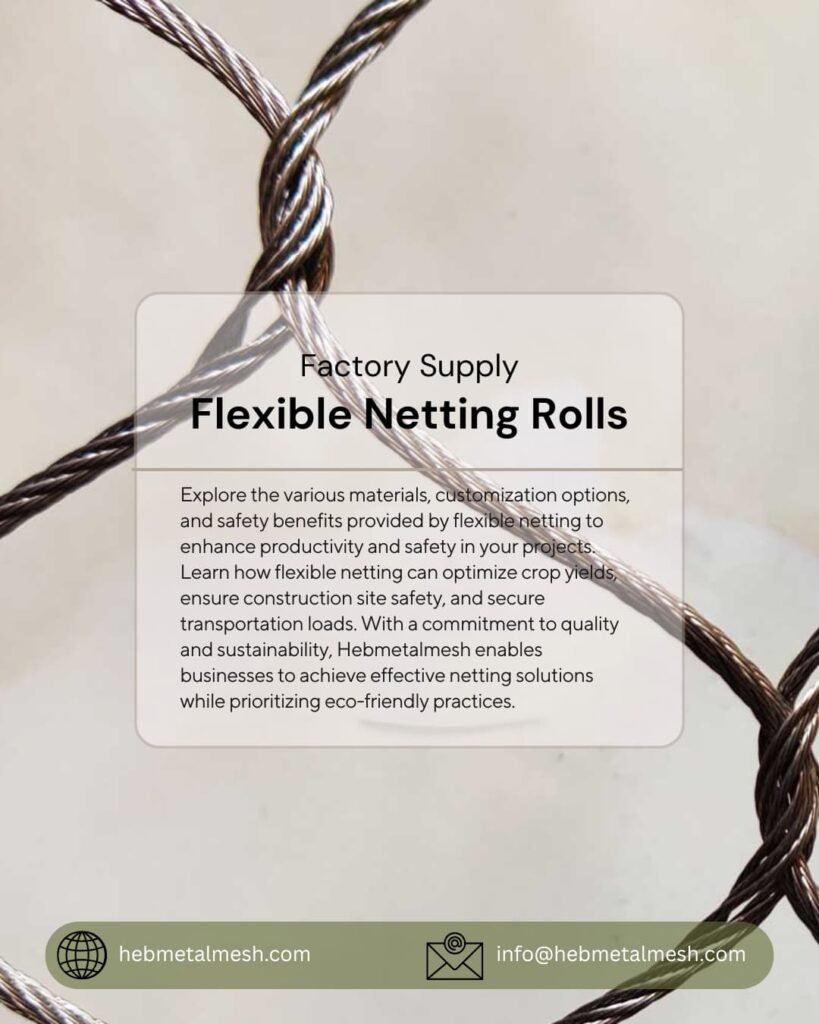
Hebmetalmesh specializes in the unique, ferrule-secured, handwoven technique. Unlike rigid, welded mesh (which is prone to structural failure at the weld points under load), the handwoven process uses stainless steel wire rope cables that are secured at the intersection points by stainless steel ferrules. When stretched, this diamond-patterned mesh operates as a seamless membrane. It is this unique construction method that provides the material with its incredible load-bearing capacity and its ability to absorb and dissipate kinetic energy without permanent deformation or structural failure.
Material Purity: The Foundation of Longevity
We commit only to the use of high-grade 304 or 316 stainless steel flexible netting. Every batch is sourced to ensure purity and chemical composition adherence, guaranteeing the specified resistance to corrosion and environmental factors. This commitment to quality ensures that the structural integrity of the heavy-duty flexible netting will not degrade, even in the most challenging tropical or marine park environments.
Custom Engineering: Precision for Complex Projects
Modern enclosure design is rarely rectilinear. Architects demand bespoke solutions. Hebmetalmesh excels in custom engineering, offering the ability to produce any mesh size, cable diameter, and panel dimension required to exact project specifications. Whether you need a 2.4mm cable with a 50mm aperture for a large primate or a 1.6mm cable with a 25mm aperture for precise aviary netting, we manufacture the panel to your needs. This eliminates unnecessary seaming and cutting on site, streamlining installation and increasing the overall security of the animal enclosure mesh.
Total Project Support: From Concept to Completion
Our role extends beyond manufacturing. We provide full-spectrum project support, including detailed design consultation, load calculation assistance, technical drawings, and comprehensive installation guidance. This holistic approach ensures that the specified zoo mesh solution integrates seamlessly with the primary support structure and meets all local safety and engineering codes.
Direct Comparison Table: Hebmetalmesh vs. Common Alternatives
This table underscores the material superiority and long-term cost-effectiveness of professional-grade stainless steel flexible netting.
| Feature | PVC Netting | Nylon Mesh | Galvanized Wire Mesh | Hebmetalmesh Stainless Steel |
|---|---|---|---|---|
| Material | Plastic (Polyethylene/PVC) | Synthetic Fiber (Nylon/Poly) | Mild Steel (Zinc Coating) | High-Grade 304/316 Stainless Steel |
| Manufacturing | Extruded/Woven | Knotted/Knotless | Welded/Twisted | Handwoven, Ferrule Secured |
| Expected Lifespan | 2 – 5 years | 5 – 10 years | 5 – 15 years (Corrosion Risk) | 50+ years (Decades) |
| Animal Safety | Risk of sharp edges, ingestion | Risk of ingestion, abrasion | Risk of sharp burrs, cuts | Smooth, non-toxic, non-abrasive |
| Flexibility | Low to Moderate (Stretches) | High (But Sags) | Very Low (Rigid Panels) | Exceptional (3D Formability) |
| Tensile Strength | Very Low | Moderate | Moderate (Weak at welds) | Very High (Cable-Dependent) |
| UV Resistance | Poor (Degrades rapidly) | Poor to Moderate | Excellent | Excellent (Impervious) |
| Aesthetics/Visibility | Poor (Thick, saggy, high visibility) | Moderate (Distorts easily) | Good (But reflects light) | Nearly Invisible (Maximum clarity) |
| Cost Over 10 Years | High (Due to replacement) | Medium-High (Due to maintenance) | Medium-High (Due to corrosion) | Lowest Total Cost of Ownership |
Part 5: Key Considerations for Specifying & Purchasing
For procurement officers, facility directors, and lead architects, the process of specifying and purchasing heavy-duty flexible netting must be diligent. The goal is not to find the cheapest initial price, but to secure the safest, most durable, and most compliant solution.
How to Choose and Source the Right Flexible Netting for Your Project
The most critical step is acknowledging that a zoological enclosure is a life-safety structure, not merely a fence. The choice of material and supplier must reflect this importance. When you are ready to move from general research on flexible netting to specifying a professional zoo mesh solution, use the following checklist.
5 Essential Questions to Ask Your Supplier:
- What is the exact material specification (e.g., 316 stainless steel)?
- The Answer: The supplier must be able to confirm the specific grade (304, 316) and diameter of the cable, and the material of the ferrule. Avoid suppliers who only list “stainless steel” generically. For humid or coastal regions, 316 is often the non-negotiable standard.
- What is the manufacturing process (handwoven vs. welded)?
- The Answer: Demand handwoven cable mesh. Welded mesh is cheaper but lacks the necessary flexibility and structural resilience for dynamic containment structures. The handwoven process confirms the superior engineering required for animal enclosure mesh.
- Can you provide project-specific load calculations and engineering data?
- The Answer: A professional supplier will provide engineering data proving the breaking load of the specific cable/aperture combination you require. They should be able to assist in calculating the wind load and animal impact loads relative to your structural design, ensuring compliance.
- Do you offer custom fabrication and technical drawings?
- The Answer: Since complex shapes are standard in modern design, a supplier must be able to fabricate large, custom panels to specific dimensions and angles, minimizing waste and installation complexity on-site.
- Can you supply references from similar zoological projects?
- The Answer: Proof of performance is key. Look for suppliers, like Hebmetalmesh, who specialize in and have a successful history of providing stainless steel flexible netting for world-class zoos, aviaries, and sanctuaries.
Navigating the Market: Specialization is Key
Generic online searches for “flexible netting suppliers” will yield results focused on agricultural, debris, or consumer-grade products. These companies are neither equipped nor specialized in zoological standards.
The procurement process must prioritize specialization in animal enclosure mesh. It is crucial to work with a manufacturer like Hebmetalmesh (Shijiazhuang Netting Trading Co., Ltd), whose entire focus is the production of high-specification, durable materials for zoos and wildlife parks.
Conclusion: Investing in Legacy
The decision between generic, low-cost flexible netting and professional-grade stainless steel flexible netting is a decision between short-term cost savings and long-term legacy. For mission-critical applications—those entrusted with the safety of animals, the protection of the public, and the integrity of a world-class exhibit—only the best materials and craftsmanship will suffice.
The handwoven stainless steel solutions from Hebmetalmesh offer unparalleled safety, resistance to all environmental factors, and an aesthetic that enhances the visitor experience by virtually disappearing into the habitat. By investing in this superior zoo mesh, facility managers are not simply buying a barrier; they are investing in reduced maintenance costs, enhanced longevity, and a commitment to the highest standards of animal welfare.
We invite you to consult with the experts at Hebmetalmesh (Shijiazhuang Netting Trading Co., Ltd) for your next zoo, aviary, or sanctuary project. Our engineering team is ready to discuss your custom specifications for heavy-duty flexible netting and assist in designing an enclosure that will endure for generations.
Visit https://hebmetalmesh.com for case studies and to contact our engineering team.
Frequently Asked Questions About Flexible Netting
A: For permanent, heavy-duty outdoor applications like zoos and large aviaries, 316 marine-grade stainless steel handwoven netting offers the greatest durability. It is impervious to UV damage, highly resistant to corrosion (especially in coastal areas), and can last for over 50 years, significantly outlasting plastic or nylon alternatives.
A: Yes, when handwoven correctly. The specialized construction process, like that used by Hebmetalmesh, eliminates sharp edges and produces a smooth, non-abrasive surface. The flexibility prevents impact injuries, and the material is non-toxic, making it the preferred choice for modern aviary netting and sensitive animal enclosure mesh applications to prevent foot and beak injuries.
A: Its inherent flexibility allows it to absorb wind loads and dissipate energy across the entire structure. Unlike rigid panels that create high-stress points, the cable mesh system moves minimally with the wind, preventing catastrophic failure or permanent deformation, making it far superior to standard plastic netting in high-wind areas. Proper engineering of the support structure (masts and tensioning) is crucial for optimal performance.
A: Absolutely. Handwoven stainless steel flexible netting is uniquely formable and can be fabricated to fit complex, three-dimensional shapes, including domes, tunnels, parabolic curves, and irregular geometric forms. This capability offers architects and designers unparalleled freedom to create dynamic, natural-looking animal habitats that blend seamlessly with the landscape.
A: Professional-grade zoo mesh must be sourced from specialized manufacturers. It is crucial to work with a supplier, such as Hebmetalmesh, that focuses on zoological applications, understands the engineering requirements of animal containment and safety, and offers custom fabrication services, rather than relying on generic, off-the-shelf products.