
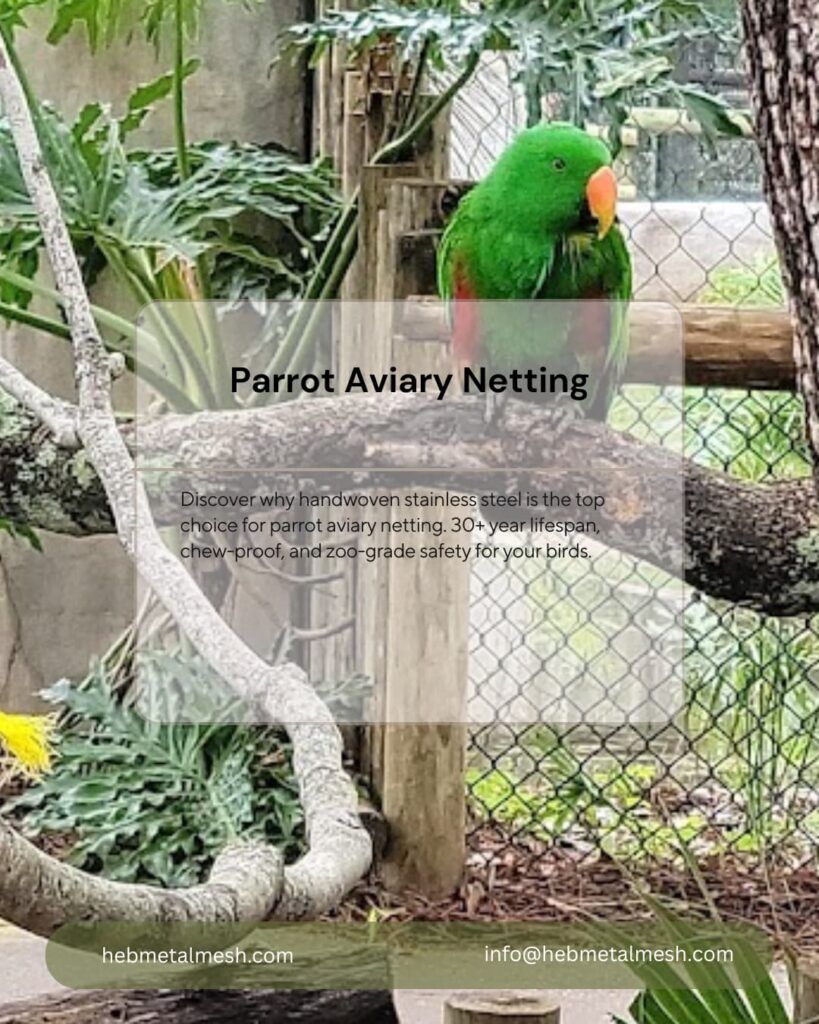
Introduction: The Critical Choice for Your Parrot’s Safety and Well-being
For any parrot owner, the aviary is more than just an enclosure; it is a sanctuary. It is the space where your feathered companion experiences the sun, the wind, and the freedom of flight. However, the integrity of that sanctuary rests entirely on one single decision: your choice of parrot aviary netting.
When you begin your search for “aviary netting for sale,” it’s easy to be swayed by the low price tags and immediate availability of plastic or nylon nets. On the surface, they look like a bargain. But for a parrot—a creature defined by its powerful beak and inquisitive nature—these materials represent a ticking clock. Plastic nets are prone to chewing, UV degradation, and seasonal brittleness. A single weakened strand can lead to a heartbreaking escape or a serious entanglement injury.
The frustration many owners face, reflected in countless searches for “suppliers near me” or “reviews of heavy-duty netting,” is the overwhelming sea of mediocre options. You want a permanent solution, not a recurring maintenance task.
This guide explores why handwoven stainless steel mesh has become the professional-grade industry standard for zoos, sanctuaries, and serious aviculturalists. We will break down the technical specifications, compare materials, and show you how to specify the perfect netting for your specific parrot species.
What is the best netting for a parrot aviary?
For permanent, safe outdoor enclosures, handwoven stainless steel mesh is the industry standard. Used globally by professional zoos and conservation sanctuaries, it offers unmatched durability, is 100% chew-proof, and boasts a lifespan of over 30 years, ensuring your parrot’s safety against both escape and external predators.
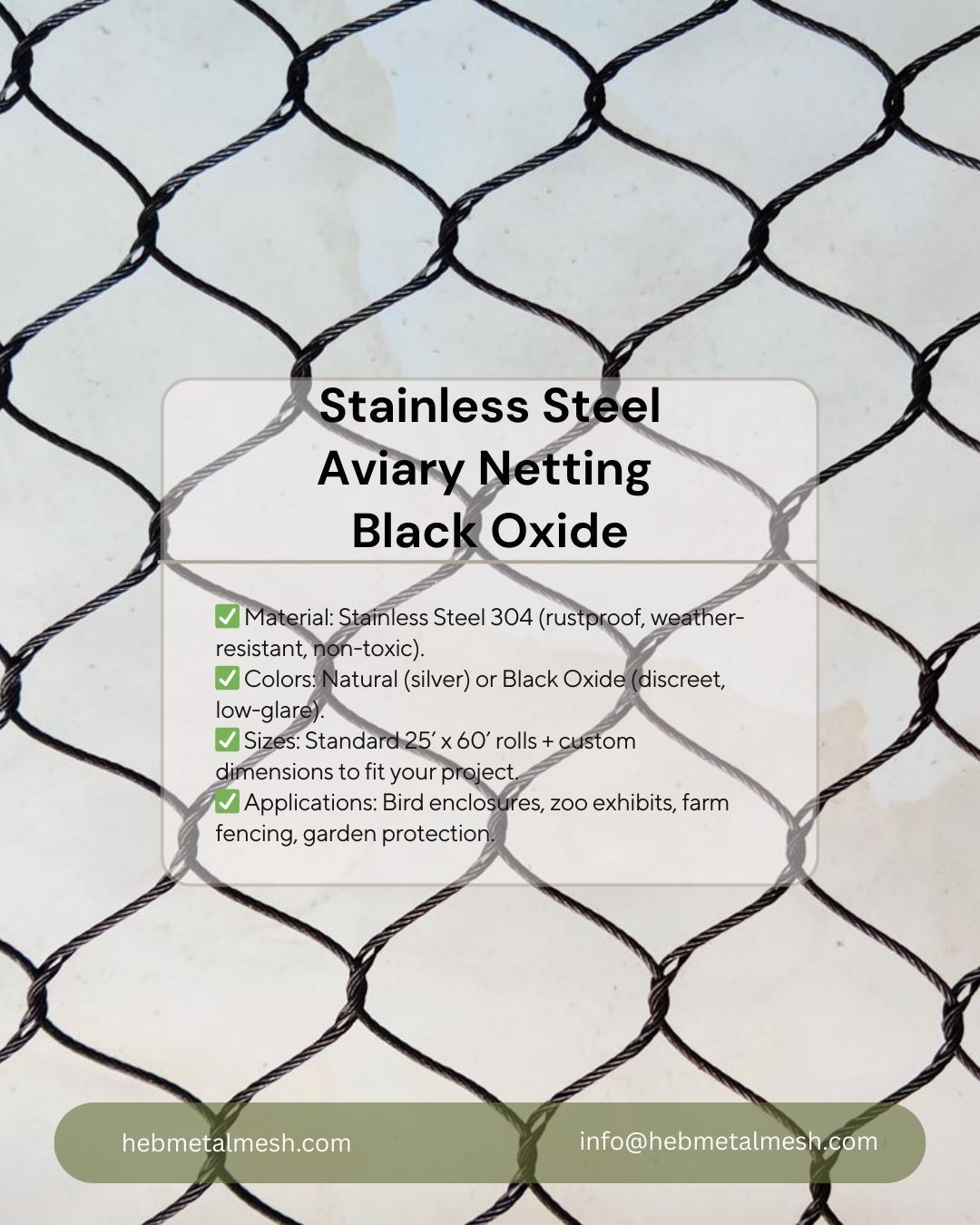
BestSeller: Premium Parrot Aviary Netting | Heavy-Duty 1″ Stainless Steel Zoo Mesh | 25ft x 60ft Rolls
Looking for the ultimate security for your valuable parrots and exotic birds? Our premium Parrot Aviary Netting is the industry-standard choice for zoos, aviaries, breeders, and sanctuaries demanding uncompromising safety and durability. This is not lightweight netting—it’s heavy-duty 1″ x 1″ Stainless Steel 304 Zoo Mesh, engineered to last a lifetime and withstand the strongest beaks, claws, and weather conditions.
Crafted from Type 304 Stainless Steel, this mesh offers superior corrosion resistance, ensuring it won’t rust or degrade, even in coastal or humid environments. The 1/16″ (16 gauge) wire thickness provides exceptional strength, creating a formidable barrier against predators while safely containing even large macaws, cockatoos, and other powerful parrots. The 1-inch mesh size is the ideal balance, preventing escape and injury, allowing for clear visibility, and maintaining excellent airflow and light penetration for a healthy bird environment.
Product Specifications at a Glance:
- Material: Premium Stainless Steel 304 (AISI 304)
- Mesh Size: 1 inch x 1 inch (25.4mm x 25.4mm)
- Wire Diameter: 1/16 inch (16 Gauge)
- Roll Size: 25 feet wide x 60 feet long (standard roll)
- Available Colors: Nature (silver metallic) or Black Oxide for reduced glare and a more natural aesthetic.
- Price: $5,830.00 per standard roll.
- Customization: Full customization of roll dimensions, wire gauge, and mesh size is available to fit your exact project requirements.
Why Choose Our Stainless Steel Aviary Mesh?
✔ Predator & Escape-Proof: The strongest available for parrot enclosures.
✔ Weather & Rust Resistant: 304 Stainless Steel ensures longevity.
✔ Safe for Birds: Smooth, welded construction prevents injury.
✔ Low Maintenance: Requires no painting or seasonal treatment.
✔ Versatile: Perfect for walk-in aviaries, flight cages, zoo exhibits, and garden enclosures.
Ideal For: Large Parrot Aviaries, Zoo Bird Exhibits, Wildlife Rehabilitation Centers, Breeding Facilities, and Secure Outdoor Bird Enclosures.
Order Your Professional Aviary Solution Today!
Invest in permanent peace of mind for your flock. Each 25ft x 60ft roll provides extensive coverage for major projects. Contact us for custom size quotes and technical support.
Ready to build the safest aviary? Get your heavy-duty parrot aviary netting now and build an enclosure that endures.
Brand: Hebmetalmesh
Shop Now: https://hebmetalmesh.com/store/handwoven-1-inch-stainless-steel-mesh-25-x-60-rolls-nature-and-black/
Chapter 1: Beyond the Search Bar – Understanding Your Parrot Aviary Netting Options
Choosing the right material requires moving past marketing jargon and looking at the physics of avian containment. Parrots are unique among birds; they don’t just sit in an enclosure—they interact with it using a “third hand”—their beak.
Subsection 1.1: The Limitations of Common Alternatives (Polyethylene/Nylon Nets)
Many commercial suppliers offer “High Density Polyethylene” (HDPE) or knotted nylon nets. While these might suffice for soft-billed birds or temporary garden protection, they often fail the “parrot test.”
- The Chew-Through Risk: Species like Macaws, Cockatoos, and even smaller Conures possess incredible bite force. Plastic netting can be frayed and bitten through in hours. This doesn’t just lead to escapes; it creates small plastic fragments that can be ingested, leading to heavy metal poisoning or intestinal blockages.
- UV Degradation: Even products marketed as “UV-stable” eventually succumb to the sun. In high-UV environments, the chemical bonds in plastic break down, making the net brittle. A net that was strong last summer might snap like a cracker this winter.
- Weathering Vulnerability: Plastic nets are lightweight. While this makes installation easy, it makes them vulnerable to “point loading” from hail, heavy snow, or falling debris. Once a single knot fails, the structural integrity of the entire panel is compromised.
Subsection 1.2: The Professional Standard: Handwoven Stainless Steel Mesh
When you look at modern exhibits at the San Diego Zoo or the Smithsonian National Zoo, you won’t see plastic mesh. You will see handwoven stainless steel.
- Construction: Unlike welded wire (which can snap at the joints) or plastic (which can be cut), handwoven mesh uses a “knot-and-twist” construction. This allows the mesh to be incredibly flexible while remaining virtually indestructible.
- Material Integrity: Usually crafted from AISI 304 or 316 grade stainless steel, this mesh does not rust, corrode, or require toxic coatings to survive the elements.
- The 30-Year Rule: While the initial investment is higher, the “cost per year” of stainless steel is significantly lower than plastic, which requires replacement every 2 to 5 years.
Chapter 2: The Technical Deep Dive – Metallurgy and Strength
To understand why stainless steel is superior, we must look at the science behind the mesh. At Hebmetalmesh, we prioritize the metallurgical integrity of our products to ensure they meet the rigorous demands of aviculture.
2.1 AISI 304 vs. AISI 316: Which Do You Need?
Not all stainless steel is identical. The grade you choose depends entirely on your geographical location.
- AISI 304 (Standard Grade): Containing 18% chromium and 8% nickel, this is the most common grade. It offers excellent corrosion resistance for most inland environments. It is the “workhorse” of the aviary industry.
- AISI 316 (Marine Grade): This grade includes molybdenum, which provides superior resistance to chlorides (salt). If your aviary is within 5 miles of the ocean, AISI 316 is mandatory to prevent “tea staining” or pitting corrosion.
2.2 Break Strength and Cable Construction
Our handwoven mesh is made from 7×7 or 7×19 strand cable. This multi-strand construction is what gives the mesh its flexibility and extreme tensile strength.
| Cable Diameter | Structure | Min. Breaking Load (kg) | Recommended Parrot |
|---|---|---|---|
| 1.2 mm | 7 x 7 | 102 kg | Budgies, Cockatiels |
| 2.0 mm | 7 x 7 | 256 kg | Greys, Amazons, Small Macaws |
| 3.2 mm | 7 x 19 | 620 kg | Hyacinth Macaws, Large Cockatoos |
This means a single 2.0mm strand can hold the weight of several adult humans. When woven into a mesh, the combined strength is exponentially higher, making it impossible for a bird to “burst” through the netting.
Chapter 3: Why Hebmetalmesh Handwoven Stainless Steel is the Top Choice
Subsection 3.1: Engineered for Maximum Parrot Safety
Safety in an aviary isn’t just about containment; it’s about preventing injury within the space.
- Smooth, Abrasion-Free Surface: Traditional welded wire mesh often has sharp “nibs” or jagged edges at the weld points. Parrots, who love to climb the walls of their aviary, can suffer foot pad lacerations or beak chips on these edges. Handwoven mesh is physically smooth at every intersection.
- Non-Toxic & Chemically Inert: Parrots “mouth” their environment. Galvanized wire carries the risk of zinc poisoning. Plastic carries the risk of microplastic ingestion. Stainless steel is the most bio-compatible material available.
- Flexibility & Impact Absorption: If a bird is spooked and flies into a rigid metal panel, the impact can be fatal. Handwoven mesh has a natural “give” or spring-like quality. It absorbs the energy of the impact, acting like a safety net.
Subsection 3.2: Unmatched Durability for Heavy-Duty and Outdoor Use
- Weatherproof Performance: Whether you are dealing with salt spray or freezing winters, stainless steel mesh remains unchanged. It withstands hurricanes and heavy snow loads that would collapse a plastic-covered frame.
- Zero Maintenance: You never need to paint, seal, or treat our mesh. It doesn’t trap dirt like knotted nylon. A quick rinse with a garden hose is all it takes to keep the aviary looking brand new for decades.
Chapter 4: The Predator Protection Factor
An aviary isn’t just to keep parrots in; it’s to keep predators out. Many owners overlook this until it’s too late.
4.1 Keeping Out Raccoons and Foxes
Raccoons are notoriously clever. They can easily rip through plastic netting or reach through wide-spaced bars to grab a sleeping bird. The 1″ x 1″ (25mm) handwoven mesh is small enough to prevent a raccoon from reaching its hand inside effectively, and the stainless steel is impossible for them to tear.
4.2 Snake and Rodent Control
While 1″ mesh keeps out large predators, users in areas with high snake populations or mice may opt for a dual-layer system. A smaller 1/2″ mesh at the base (bottom 3 feet) can prevent ground-dwelling pests from entering, while the 1″ stainless steel mesh handles the main enclosure strength.
4.3 Birds of Prey
Hawks and owls often “strike” at aviaries. Plastic netting can stretch or tear during a high-speed raptor strike. Stainless steel mesh remains rigid enough to deflect the predator while the “give” mentioned earlier protects your parrot if it’s on the other side of the impact.
Chapter 5: The Specifier’s Guide: Choosing the Right Mesh
Subsection 5.1: Matching Mesh Size to Bird Species
| Parrot Type | Recommended Mesh Size | Wire Rope Diameter |
|---|---|---|
| Small | 3/4″ x 3/4″ | 1.2mm – 1.5mm |
| Medium to Large | 1″ x 1″ | 2.0mm |
| Extra Large | 1.5″ x 1.5″ or 2″ x 2″ | 2.4mm – 3.2mm |
Subsection 5.2: Your Customization Checklist
- Measure Your Frame: Calculate total surface area + 10% overage.
- Choose Your Grade: 304 for inland, 316 for coast.
- Choose Your Finish: Nature (Silver) or Black Oxide (Lower visibility).
- Plan Your Attachment: Tube frame vs. Timber frame.
Chapter 6: Step-by-Step Installation Guide
Installing handwoven mesh is different from installing rigid panels. It requires a tensioning mindset.
Phase 1: Frame Preparation
Ensure your frame (Steel or Timber) is structurally sound. For large aviaries, we recommend a steel pipe frame with a minimum diameter of 1.5 inches.
Phase 2: The Perimeter Cable (The “Hanging” Method)
- Install stainless steel eyelets or eye-bolts every 12-18 inches along your frame.
- Thread a 3mm or 4mm stainless steel perimeter cable through the eyelets.
- Use turnbuckles at the corners to apply tension to the perimeter cable.
Phase 3: Lacing the Mesh
- Roll out your mesh. It will be “diamond” shaped.
- Use stainless steel lacing wire (usually 1.0mm) or “C-clips” to attach the edge of the mesh to your perimeter cable.
- Start from the top corners and work your way down, ensuring even tension.
Phase 4: Final Tensioning
Once the mesh is laced, tighten the turnbuckles on your perimeter cable. The mesh will pull taut, creating a beautiful, professional, and secure finish.
Chapter 7: Financial Analysis – The True Cost of Aviary Ownership
Many buyers are deterred by the upfront cost of stainless steel. Let’s look at a 10-year projection for a standard 10′ x 10′ x 8′ aviary.
| Feature | Plastic Netting (Nylon/HDPE) | Hebmetalmesh Stainless Steel |
|---|---|---|
| Initial Cost | $150 – $300 | $1,200 – $1,800 |
| Lifespan | 2 – 4 Years | 30+ Years |
| Replacement Frequency | 3-4 times in 10 years | 0 times |
| 10-Year Material Cost | $600 – $1,200 | $1,200 – $1,800 |
| 10-Year Labor Cost | High (Repeat installs) | Low (One-time install) |
| Safety Risk | High (Chew/UV failure) | Zero |
| Property Value | Decreased (Worn look) | Increased (Pro-grade) |
When you factor in the value of your parrot (which can live 50-80 years) and the risk of loss, the “expensive” stainless steel option is actually the most frugal choice you can make.
Chapter 8: Answering Your Top Questions (FAQ)
Stainless steel rope mesh is generally considered the superior choice for parrot aviaries due to its durability, safety, and visibility. However, the optimal material depends on factors such as parrot size, climate, and budget.
Proper installation is crucial for a secure enclosure. Ensure a tight fit, use high-quality fasteners, and consider overlapping netting at corners. For detailed instructions, consult installation guides or seek professional help.
Regular inspections are essential for identifying potential issues early on. Check the netting for damage, wear, and loose attachments at least once a week.
To clean your aviary netting, use a mild detergent solution and a soft brush. Rinse thoroughly to remove any soap residue. Avoid using harsh chemicals that could damage the netting.
A: Handwoven stainless steel mesh. Plastic coatings on galvanized wire eventually crack and peel under UV stress, and pure plastic nets degrade. Stainless steel is an alloy; its UV resistance is a fundamental physical property of the metal itself.
A: No. Even a Hyacinth Macaw with a beak pressure of 1,200 psi cannot bite through a 2.0mm or 3.2mm stainless steel cable. The material is too hard and the circular profile of the cable prevents them from getting a “cutting” grip.
A: Yes. Unlike paint or powder coating, black oxide is a chemical conversion process that changes the surface layer of the steel. It does not flake, peel, or chip, so there is no risk of your bird ingesting toxic paint flakes.
A: Yes. Unlike paint or powder coating, black oxide is a chemical conversion process that changes the surface layer of the steel. It does not flake, peel, or chip, so there is no risk of your bird ingesting toxic paint flakes.
Conclusion: Invest in Peace of Mind for Decades
Your parrot’s aviary is more than an enclosure; it is an investment in their longevity. While temporary solutions like plastic netting might seem appealing today, they cannot offer the long-term safety and aesthetic beauty of handwoven stainless steel.
By choosing a material that is chew-proof, UV-impervious, and smooth to the touch, you are moving away from a cycle of “fix and replace” and into a world of “install and enjoy.”
Ready to build a sanctuary that lasts a lifetime?
- Ready to Buy? Browse our 1″x1″ Stainless Steel Mesh Rolls – Custom cut to your dimensions.
- Need a Specialist? Contact our Engineering Team for a direct quote on your custom project.
Hebmetalmesh: 20 Years of Global Expertise in Stainless Steel Zoo Mesh and Parrot Containment Solutions.
Its nice, want to try, pls contact me