
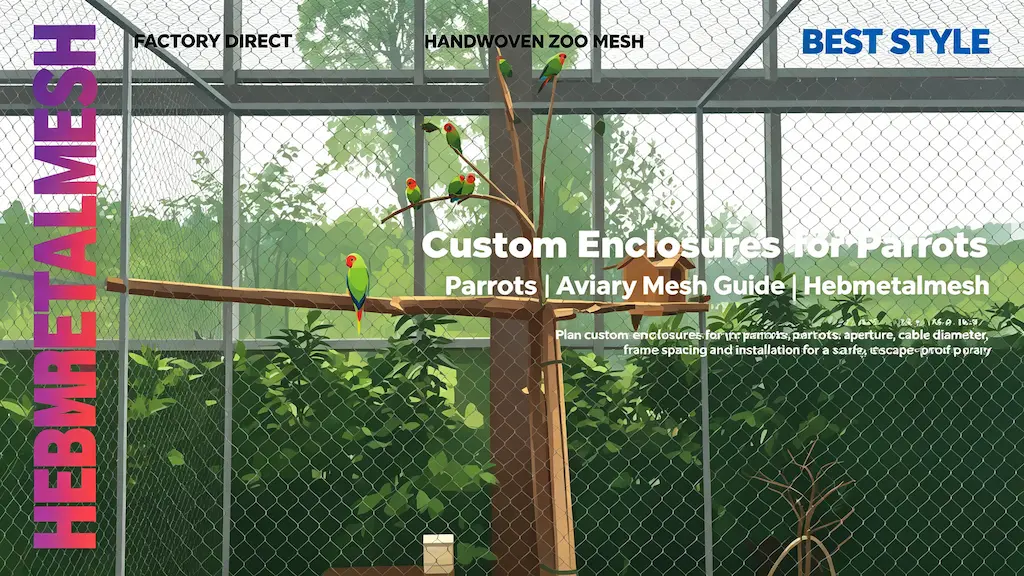
Most parrot escapes, and a large share of the foot injuries seen in pet birds, trace back to one decision made too late in the project: the mesh. Custom enclosures for parrots are not cages scaled up. They are structures designed backwards from the bird — aperture first, then cable diameter, then frame, then doors and siting. A generic roll of “bird netting” rarely survives a determined cockatoo, and it almost never matches the foot geometry or bite force of the species inside. The sequence below is the one zoo architects, sanctuary keepers and serious hobbyists use, with the concrete numbers that make a parrot aviary safe rather than merely attractive.
Executive Summary
Custom enclosures for parrots are built around three measurements: aperture matched to the bird’s head width, cable diameter matched to its beak, and panel span matched to the frame. A small bird such as a budgerigar or lovebird is well served by 1.2 mm rope woven at a 20 mm aperture (HM1220); a large macaw or cockatoo needs 2.4 mm rope at a 38 mm aperture (HM2438) to resist beak force and stop toes slipping through. Stainless steel SS304 covers inland installations, while SS316 with molybdenum resists salt air at coastal zoos. Hand-woven panels reach 9 m × 18 m, which removes most mid-span posts and the weld points that corrode first. The reference specification is the netting for parrots product page product page.
Quick Answer:
A safe parrot enclosure is sized from the bird outwards. Choose an aperture narrower than the species’ head width so it cannot push through; keep rope diameter heavy enough that a beak cannot fatigue a single strand; and set frame spacing so the mesh never sags into a foothold. For most pet and sanctuary parrots that means 1.2–1.6 mm rope at a 20–25 mm aperture, and 2.0–2.4 mm rope for macaws and cockatoos. Stainless steel, rather than galvanized wire, is the default for a structure expected to last decades.
Key Takeaways
- Size the aperture to the bird’s head, not to the aviary: too wide invites escape, too narrow wastes material and daylight.
- Cable diameter sets bite resistance — 1.2 mm suits small parrots, 2.0–2.4 mm suits large cockatoos and macaws.
- SS304 (18% Cr / 8% Ni) is the inland default; SS316 adds molybdenum for coastal salt exposure.
- Panels up to 9 m × 18 m cut the number of mid-span supports, and with them the corrosion points that fail first.
- Budget a planning range of $10–22/m² for aviary-grade mesh, then confirm final pricing against aperture and panel count.
The husbandry thinking behind these figures is set out by conservation bodies such as the World Association of Zoos and Aquariums (WAZA), whose welfare guidance on flight space informs the recommendations below.
Why a Custom Build Beats a Standard Cage
Pre-manufactured cages are designed around a shipping carton, not a bird: dimensions follow freight economics, bar spacing is a compromise across dozens of species, and the wire is often thin enough that a bored parrot works a bar loose in a few seasons.
Custom enclosures for parrots planning starts with the space you actually have. A garden corner, a warehouse bay or a rescue-centre block each impose different constraints, and a bespoke structure can exploit the full envelope instead of sitting inside it. Full-height flight becomes possible, service access lands where a keeper needs it, and enrichment — swing mounts, foraging stations, natural branch perches — can be positioned rather than improvised.
This is where custom enclosures for parrots design pays for itself: a layout drawn around the keeper’s routine and the bird’s climbing habits avoids the retrofits cheaper builds accumulate.
Matching Aperture and Cable Diameter to the Species
Two numbers decide containment. The first is aperture — the opening between strands. It must be narrower than the bird’s head at its widest point, because a parrot tests every gap with its skull first. The second is rope diameter, which governs how long a beak needs to cut a single strand.
| Species class | Typical examples | Aperture | Rope Ø | HM code |
| Very small | budgerigar, lovebird, parrotlet | 20 mm | 1.2 mm | HM1220 |
| Small–medium | cockatiel, conure, caique | 25 mm | 1.6 mm | HM1625 |
| Medium–large | African grey, Amazon, eclectus | 38 mm | 2.0 mm | HM2038 |
| Large | macaw, cockatoo | 38 mm | 2.4 mm | HM2438 |
Three failure modes explain the table. An over-wide aperture lets a bird push its head through and then panic, which is how shoulder injuries happen. An aperture wide enough for a foot to enter but not withdraw cleanly is the classic cause of foot injury. And thin wire invites beak wear to accelerate until a strand parts; thicker rope spreads the same bite force across more metal. For a custom parrot housing design, the honest rule is that the mesh should look slightly heavier than necessary. Parrots are destructive by temperament, and a structure that survives that temperament has margin. Even a fairly sedate psittacine housing unit benefits from a long flight line, and the mesh weight that supports a longer span is the same weight that resists the bird — so choosing parrot housing mesh is a structural decision, not a cosmetic one.
Materials: Stainless Steel Rather Than Galvanized
The default for a long-life parrot enclosure is stainless steel rope mesh. SS304, with roughly 18% chromium and 8% nickel, resists atmospheric corrosion for decades inland. SS316 adds molybdenum and is the correct choice within a few kilometres of salt water, where chloride attack pits lower grades.
Galvanized wire is cheaper, and on garden netting it is a reasonable trade. In a parrot aviary it is a weaker bet. A coating that is damaged — and a beak will damage it — exposes bare steel that rusts from within; a coating applied as galvanized after welding is more uniform, but the zinc itself can be ingested as birds nibble, and zinc intake is a recognised concern in psittacine diets. Stainless has no coating to strip, which is why it is the specification most requested from any serious custom enclosures for parrots supplier.
Two finishes are common. Bright or “Nature” finish is the polished look used on public exhibits; black oxide is a matte dark finish that reads as nearly invisible against foliage. Comparing grades is quick once you read the spec sheets: the 304 vs 316 cable mesh comparison sets out the chemistry, and the galvanized vs stainless steel cable mesh comparison shows where the cost difference lands over a service life. If plastic mesh is also on the table, the rope mesh vs plastic netting guide is the better read, since the two materials fail in very different ways.
Frame, Span and the Details That Fail First
Rope mesh is flexible, and that flexibility is an asset — a bird striking the wall of a flight aviary deforms the mesh rather than the frame. But flex also means frame spacing governs how a panel behaves under load. Set supports too far apart and the netting sags into a curve a parrot can climb, or into a pocket where a beak finds leverage.
Hand-woven panels up to 9 m × 18 m are the practical maximum, and using the full panel cuts the number of intermediate posts — every mid-span connection being a potential corrosion point and snag. When a panel must be split, the splice should follow the weave rather than cross it, and the fixing should leave a consistent air gap tolerance between mesh edge and frame: a tight edge traps debris and chafes, while an over-loose edge lets a beak work at the anchor.
The parts that fail first are almost always the same three: the roof edge, which takes the most wind uplift; the gate frame, which takes the most daily abuse; and the ground line, which takes the most moisture. A concrete plinth under the perimeter, or a buried skirt for soil-footed enclosures, removes the ground-line problem entirely.
For anyone building a parrot flight aviary from scratch, the sensible order is: pour the perimeter, set the posts to the chosen span, hang the full panels, then fit gates and service doors last. A flight aviary for parrots built in that sequence needs far less on-site adjustment than one where the frame is fabricated before the mesh is chosen. A reputable parrot flight aviary supplier will send the panel drawing alongside the mesh, so the two arrive compatible. Aperture and gauge selection for the smallest species is covered in more detail in the best gauge aviary wire mesh guide for small parrots.
Doors, Siting and Biosecurity
The most useful single detail in a parrot aviary is a safety entrance: two doors in series, with room between them for a person to stand clear. Without it, every routine task — feeding, cleaning, catching up a bird — becomes an escape risk. A service corridor takes the idea further and lets a keeper work without entering the flight at all. It is also the detail most often missing from a first bespoke parrot housing build, and the one users most often ask about at the netting for parrots product page.
Siting drives several decisions at once. Orient the longest axis to give morning sun and afternoon shade, leave a solid shelter wall on the prevailing weather side, and plan drainage so the floor never holds standing water. A covered section a bird can retreat into also reduces feather plucking — a behaviour as often a symptom of a stressful or under-stimulating space as of illness. Birds that came through a rescue parrot situation are frequently the most sensitive to layout, which is why a sanctuary aviary is usually designed with extra refuges and a quieter aspect.
Custom enclosures for parrots installation is straightforward when that sequence is respected: panels arrive tensioned to the frame, gates hang on pre-set posts, and the structure is checked for sharp edges and loose anchors before the first bird goes in. The smooth surface of stainless rope sheds droppings and dust with little effort, which is why the material holds up in high-traffic psittacine aviary settings.
Cost, Timing and What a Project Includes
Custom enclosures for parrots cost varies with three variables: total mesh area, rope diameter and finish. As a planning range, aviary-grade stainless rope mesh sits around $10–22/m² depending on specification. Frame, footings, gates and installation are separate line items, and on a small build they can exceed the mesh itself.
For custom enclosures for parrots price, the useful comparison is cost per square metre of enclosed surface, not cost per panel — a larger panel spreads the same fitting cost over more area. A custom enclosures for parrots factory that also does the weave can quote mesh and edge finishing together, which removes the mismatch that appears when frame and netting come from different suppliers.
Timing is typically 2–4 weeks for production once the drawing is approved, plus 2–6 weeks for transit. Any custom parrot housing supplier quotation should carry the aperture, cable diameter, panel dimensions and edge type in writing; if one of those four is missing, the enclosure has not really been specified yet.
FAQ
The aperture must be narrower than the bird’s head at its widest point, and narrow enough that a foot cannot slip in and catch. In practice: 20 mm aperture with 1.2 mm rope for very small parrots, 25 mm with 1.6 mm rope for cockatiels and conures, and 38 mm with 2.0–2.4 mm rope for greys, Amazons, macaws and cockatoos.
It is a compromise. Once the coating is damaged it exposes steel that rusts from within, and zinc can be ingested as birds nibble at it. Stainless steel rope mesh has no coating to strip and is the safer long-term specification for any enclosure a parrot inhabits daily.
Treat the roof as the highest-load edge: tension panels fully, fix them at close centres along the ridge and eaves, and avoid any overlap that creates a loose lip. A fully tensioned single panel, rather than a lapped one, is the reliable answer.
Yes. Two doors in series — a safety entrance — is the most effective escape control in any aviary, and it costs little to include at the design stage. Retrofitting one to a finished enclosure is far more disruptive.
An indoor unit suits smaller parrots, but ventilation and flooring need attention: airflow should be designed rather than left to chance, and the floor should tolerate daily washing. Indoor builds also benefit from full-spectrum light to offset reduced natural exposure.
Inland, SS304 rope mesh commonly performs for 30 years or more, with frame and fixings the limiting factor rather than the mesh. Coastal installations should move to SS316, and even then the fasteners deserve the same grade as the netting.