
Most people arrive at versatile mesh from the wrong end. They have four or five jobs to cover — a vegetable bed to keep birds off, a boundary to make harder to climb, a balustrade infill to specify, and an animal run to enclose — and they want one product that answers all of them. There is such a product, but it is not versatile because it is a compromise. It is versatile because it ships as a wire mesh roll: a pliable sheet of interwoven steel wires wound onto a spool, which can be unrolled along uneven ground, cut to length on site, and re-tensioned around obstacles that would defeat a rigid panel. The material ladder underneath that format — galvanized steel mesh, PVC-coated mesh and stainless steel mesh — is what decides how long each job lasts.
Executive Summary
The roll format, not the alloy, is what makes one mesh serve so many duties: a versatile mesh sheet can be unrolled, cut and fixed on site, so the same construction covers a garden screen and a zoo perimeter without a second production run. What changes between those jobs is service life, and service life is set by the material. Galvanized steel mesh is the budget answer for dry, inland work and needs its zinc checked; PVC-coated mesh buys color and a barrier against abrasion but fails at the first deep nick, where moisture reaches the steel core; stainless steel mesh has no coating to breach, because its corrosion resistance belongs to the alloy itself. The selection sequence is therefore fixed: duty first, then site exposure, then material, then mesh aperture and wire diameter, then roll size. As a planning range, aviary-grade material runs $10 to $22 per square meter and carnivore-grade panels $20 to $38. The reference specification is the animal fence mesh product page.
Need one mesh that has to work in several places?
Send the duties, the openings and the site exposure. We will return the material, mesh aperture, wire diameter and roll size that covers all of them, with a planning range per square meter.
Request a versatile mesh quotationQuick Answer:
For a mixed-duty project, versatile mesh usually means a handwoven stainless steel roll in grade 304 or 316, with mesh apertures from 20 mm to 102 mm, wire diameters from 1.2 mm to 3.2 mm, and panels woven to order up to roughly 9 m by 18 m. Stainless answers the widest range of duties because its strength sits in the wire and its corrosion resistance sits in the alloy: no coating to chip, no polymer to embrittle, and a 2.0 mm rope in a 40 mm opening that carries a small-primate enclosure while reading almost invisible at five meters. Choose galvanized where the duty is short and the site is dry, PVC-coated where color and rigidity matter more than longevity, and stainless wherever replacement means scaffolding, a closed exhibit or a safety review.
Key Takeaways
- The roll is the format that makes mesh versatile: cut on site, it follows terrain, corners and openings that a rigid panel cannot.
- Service life is set by the material family, not by the weave pattern — galvanized, PVC-coated and stainless sit in three different bands.
- Specify the clear opening you will accept, because the gap between wire surfaces, not the nominal aperture, is what contains or excludes.
- Grade 304 covers inland sites; grade 316 adds molybdenum for coastal air, de-icing salt and pool surrounds.
- Lifetime cost inverts the price ranking often enough that the cheapest roll is rarely the cheapest installation.
The worldstainless corrosion guide explains why the last point holds: stainless steel is considered “self-healing” because “its surface naturally forms a thin, invisible chromium-rich oxide layer that continuously regenerates when exposed to oxygen.”
Why the Roll Format Is What Makes Mesh Versatile
A rigid panel is sized in a factory and installed as delivered; a versatile mesh roll is sized on site. That single difference explains most of the format’s reach. A roll travels as a coil, so freight volume drops against pre-framed panels, and the installer — not the mill — decides where a run starts and stops. Unrolled along a slope, cut around a gatepost, folded into a corner or doubled over a vulnerable groundline, the same versatile wire mesh roll absorbs the geometry of the site instead of forcing the site to match it. On long runs and retrofit work it is also the only format that can be joined without a visible seam on the frame. The mesh in rolls ordering guide covers roll length, roll width and lead time, which is the next question once the material is settled.
Three Versatile Mesh Materials, Three Service Lives
Three versatile mesh materials cover most versatile mesh applications, and they are not three prices for one product — they are three different answers to the same question about time.
| Family | Outdoor service life | Strength source | Typical failure mode |
| Galvanized steel mesh | 5 to 15 years | Zinc coating over steel | Coating consumed, then red rust |
| PVC-coated mesh | 5 to 10 years | Polymer skin over a core | Nicked coating, core rusts inside |
| Stainless steel mesh | 30 years and up | The wire itself | None in normal service |
Galvanized steel mesh is the right buy while the duty is short and the site is dry, but its life is the life of its zinc, and a cut edge carries no coating at all. PVC-coated mesh buys color and a softer surface, and it hides a low-carbon core that starts rusting the moment the skin is breached. Stainless steel mesh removes that failure class: the wire is the structure and the alloy is the protection. The welded versus woven comparison settles the construction question that runs alongside the material one.
Reading a Duty Backwards into Aperture and Wire
The opening is a containment number, not a cosmetic one. Mesh aperture — the center-to-center distance between wires — runs from 20 mm to 102 mm in this range, and the clear opening between wire surfaces is what actually stops a body, so a 40 mm aperture woven from 2.0 mm wire leaves roughly a 38 mm gap. Set it from the smallest animal that must not pass, not the largest one on display. Wire diameter sets the load path and the span: 1.2 mm suits garden screens and bird work, 2.0 mm carries small-primate exhibits and moderate wind, and 3.2 mm is the high-tension specification for long runs and exposed facades. Panels are woven to order up to about 9 m by 18 m, and the SKU codes read directly — HM32102 is 3.2 mm wire in a 102 mm opening, HM1625 is 1.6 mm in a 25 mm opening. Standard versatile mesh sizes track those two numbers; everything else is customization.
Gardens, Ground and Pest Exclusion
For versatile mesh for gardens the deciding factor is not strength but the size of the gap and the depth of the burial. A garden brief excludes rather than contains, so the aperture shrinks and burial depth matters more than tensile strength: a fine panel set 150 mm into the soil and turned outward stops burrowing animals that would walk straight under a surface-fixed roll. The deer fence wire guide works the groundline detail through for one specific pest. Galvanized steel mesh is defensible for a seasonal kitchen garden; the moment the structure becomes permanent — a fruit cage, a trellis wall, a windbreak that must not shred — stainless steel mesh takes over, because a small-aperture stainless panel also resists the rodents and chewers that treat polymer as food. A versatile mesh sheet cut from a roll is what makes that upgrade affordable on an awkward plot.
Security, Architecture and Industry
Split the duties and the material choice stops being a compromise. A versatile mesh for security fencing is judged on cut resistance and anti-climb geometry, and because a woven stainless panel shifts load to the surrounding wires when one is cut, it does not unzip. A versatile mesh for architecture is judged on the other axis entirely — finish, glare and shadow line — and there stainless earns its premium on appearance as much as on service life, the argument a mesh guardrail carries into a design review. In industry the same roll guards moving machinery while keeping the machine visible to a supervisor, and it contains stored goods without blocking airflow: one roll, three briefs, no second supply chain. What changes is the aperture, the wire diameter and the alloy, and those three numbers are what the specification has to fix.
Animal Enclosures, Aviaries and Zoos
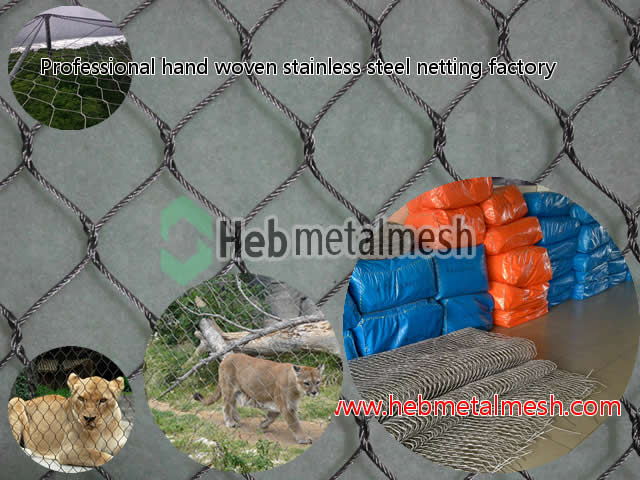
Animal work combines every requirement above. A versatile mesh for animal enclosures has to hold a valuable or dangerous animal, keep the visitor sightline open, and survive a thirty-year horizon with no option to close the exhibit. The specification starts from the smallest body that must not pass and the largest load the panel will see; aviary work commonly sits between 20 mm and 50 mm, small-primate exhibits around 40 mm, and large-mammal enclosures between 50 mm and 102 mm. Stainless rope mesh meets all three because success is judged through it as much as on it — a 2.0 mm rope reads almost invisible at five meters. The animal fence mesh range covers every aperture from 20 mm to 102 mm, and the same product page carries the HM codes used for ordering.
Alloy and Corrosion: Where 316 Earns Its Premium
Grade 304, with roughly 18 percent chromium and 8 percent nickel, is the general-purpose alloy and the correct default for inland sites. Grade 316 adds molybdenum, which buys resistance to pitting from chlorides — coastal air, de-icing salt, pool surrounds and chemically active industrial atmospheres. That is a service-life decision rather than a price decision, because a 304 panel that pits at year eight has cost more than a 316 panel that simply stays. The 304 and 316 cable mesh comparison works the chemistry through in detail. Grade selection also drives detail selection: terminations you can inspect, anchors that drain, and no crevice that holds standing water against the wire, because corrosion needs a place to start before it needs a reason. Corrosion resistance is a property of the alloy, but it is maintained — or lost — by the detailing around it.
Writing a Specification a Mill Can Quote
A versatile mesh specification that a mill can quote against needs six things: the clear opening and its tolerance, the wire diameter, the alloy and finish, the roll size with edge termination, the anchoring and tensioning detail, and the load case the mesh must survive. Written that way, versatile mesh price becomes comparable between suppliers, because a quote that omits the wire diameter or the edge detail is not cheaper — it is a different product. Expect wire diameter to drive cost first, aperture second and roll size third, with volume barely mattering, and plan for fixings and edge hardware to add 10 to 20 percent on top. Choose a versatile mesh supplier the way you would choose an engineer: ask for the weave tolerance as a range, a retained master sample and a material certificate tied to a heat number. That certificate matters more to versatile mesh durability than any datasheet, and no versatile mesh installation outlives a badly detailed edge.
Ready to stop buying a different mesh for every job? Send the duties, the openings and the site exposure, and our engineers will return one material recommendation, a cutting list and a planning-range quotation — contact the team.
Frequently Asked Questions
A pliable sheet of interwoven steel wires supplied as a roll, so it can be unrolled, cut and fixed on site rather than installed as a rigid panel. The versatility comes from the format plus the material ladder, not from a single compromise specification.
Handwoven stainless steel mesh, in grade 304 inland and grade 316 near the coast. It has no coating to breach, so its corrosion resistance and tensile strength are the same at a cut edge as in the middle of the panel.
Set the aperture from the smallest animal that must not pass, then size the wire to the span and the load: 1.2 mm for light garden and bird work, 2.0 mm for small-primate exhibits, 3.2 mm for long runs and exposed facades.
Usually per square meter, and always in freight, because a coil ships far denser than framed panels. The saving is real only if the roll size suits the job — order too wide and the offcut eats the gain.
Yes, at the same aperture and grade, which is the point of specifying by duty first. Where the two duties need different gap sizes, buy two rolls rather than accepting a compromise aperture on either.