
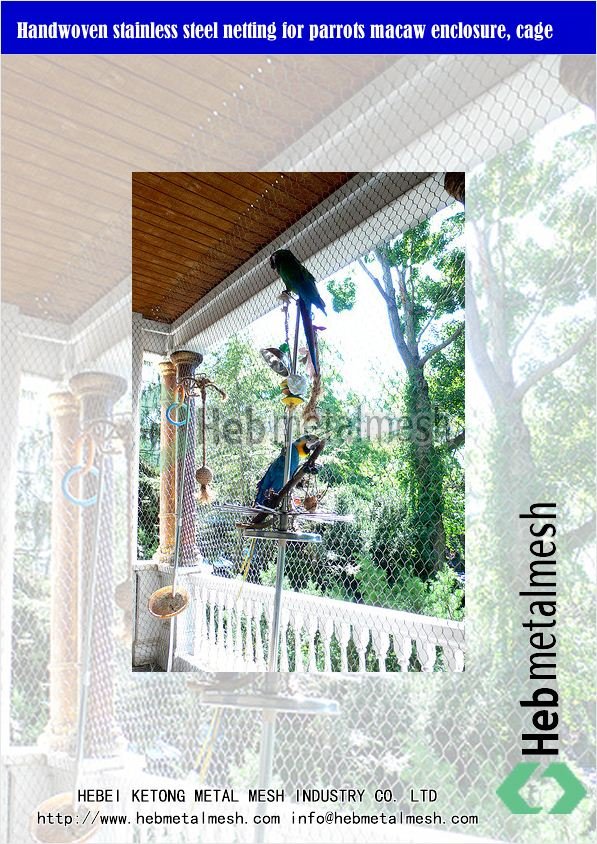
Large aviary planning is a sequence, not a shopping list. Settle the species and the required flight length first, fix the site and the climate strategy second, and specify the enclosure skin last, because the mesh has to satisfy every decision made before it. Run the order that way and a 400 m² walk-through aviary is still serviceable at fifteen years old. Run it backwards and the cheapest netting on the quote quietly becomes the most expensive line in the budget.
Executive Summary
A large aviary is decided by four numbers: the flight length the species actually uses, the wind load the frame carries, the aperture that keeps birds in and predators out, and the replacement interval of the enclosure skin. Get those right and the rest — planting, perching, roof, keeper routes — becomes detailing rather than risk. Most projects overspend on the skin twice: once on a coated mesh, again on the labour to replace it. Woven stainless steel rope mesh removes the second payment, because there is no coating to flake and no repainting cycle to fund. The reference specification is the aviary netting product page product page.
Planning a Large Aviary? Start With the Skin
Send us the enclosure footprint, the bird list and the climate. We return an aperture, rope diameter and panel layout for each zone, with a custom price, inside 24 hours.
Request My Free Quote →Quick Answer:
Large aviary planning runs in one order: species and flight length, then site, then structure, then mesh. As a starting figure, allow roughly 1 m² of floor per small bird in a mixed collection, and treat long-winged species separately — a macaw, hornbill or crane needs a flight of at least 15 m before it flies rather than hops. Size the mesh last, but never choose it on unit price alone; on a large enclosure the skin is the component most likely to be replaced first.
Key Takeaways
- Length before height. Birds fly along an enclosure far more than they fly up it, so buy horizontal metres first.
- Aperture is a species decision. 25 mm keeps finches in, 38 mm suits conures and ducks, 51 mm suits macaws, 76 mm suits a walk-through flight, 102 mm suits large perimeter runs.
- Grade follows the site, not the catalogue. 304 for inland air; 316 within about five miles of salt water, chlorine or constant wash-down.
- Price the mesh over 30 years. A cheaper coated skin is usually the more expensive enclosure once replacement labour is counted.
- Draw the service routes now. Keeper access, quarantine space and animal dividers are cheap on paper and painful to retrofit between tensioned panels.
The welfare framework most collections work to is published by the World Association of Zoos and Aquariums, which treats enclosure design as part of animal welfare rather than as a construction afterthought.
Large Aviary Species Selection Sets the Flight Envelope
Species selection decides the enclosure’s proportions before any drawing is made, and it is the decision owners most often take last. Three parameters follow from the bird list: the length of the flight, the aperture, and the height at which the frame must absorb impact.
Small passerines and finches fly in short bursts and use structure densely, so a long, planted flight serves them better than a tall cube. Parakeets and conures fly faster and turn harder, putting load into the frame at mid-height. Macaws, hornbills, toucans and cranes fly on a long axis and land heavily, so their enclosures need length, a clear flight line and a skin that flexes on contact instead of a rigid grid a wing can strike. A mixed collection should be planned as separate flights or as one volume with internal dividers, because one compromise size under-serves the long-winged birds and overspends on the small ones.
Large Aviary Site Selection, Ventilation, and Climate Control
Large aviary site selection has three jobs: light, shelter and drainage. Birds need direct sun for part of the day, but a site that bakes under a low roof all afternoon drives heat stress in summer. The workable compromise is morning sun with afternoon shade from planted cover or a shelter belt of trees set back from the enclosure. That belt also cuts prevailing wind, which matters once panels reach 9 m × 18 m and start acting as sails.
Large aviary ventilation follows from the same drawing. Air has to move across the volume and leave at the top, so the roof line and the planting plan are decided together. In hot, humid climates an open ridge and deep shade do most of the work; in cold climates the priority reverses and the design has to keep the flight dry and out of the wind. Large aviary climate control is therefore a passive design question before it is an equipment question; only afterwards do heating or misting earn a place in the specification.
How Much Flight Space Makes an Aviary “Large”?
When planning a large aviary, work from behaviour rather than a headline figure. A finch flitting between feeders covers a few metres at a time; a long-winged bird flying a straight line covers twenty. Vertical space is easier to build than horizontal space, but it is the wrong thing to buy first — birds fly across an enclosure far more than they fly up it.
A workable large aviary build plan starts with the flight corridor. Mark the longest clear line the site allows, then hang every other element off it. Keep that corridor free of perches and furniture, and build feeding and inspection stations to one side so they do not break it. This single decision does more for the birds than any increase in height, and it costs nothing at planning stage. You have reached genuine large aviary flight space when a bird can accelerate, turn and land without shortening its flight — in practice, from about 100 m².
Large Aviary Materials Guide: Choosing the Enclosure Skin
This large aviary materials guide treats the mesh as a structural component rather than a farm product, because on a large enclosure the skin is what the weather acts on.
| Material | Corrosion behaviour | Bird safety | Outdoor service life | Typical fit |
| Galvanised welded wire | Zinc coating consumed first | Zinc ingestion risk in parrots | 8–15 years, less on coasts | Low-cost, short-horizon enclosures |
| Nylon or plastic netting | UV degradation and stretch | Safe, but sags and frays | 5–10 years | Temporary or low-impact flights |
| SS304 woven rope mesh | Whole-wire corrosion resistance | Smooth; no zinc, no sharp ends | 30+ years inland | Most inland aviaries |
| SS316 woven rope mesh | Molybdenum resists chlorides | Smooth; no zinc | 30+ years coastal | Coastal and wash-down sites |
The comparison is examined in our guide to galvanised versus stainless mesh, while the case against plastic alternatives is set out in the notes on rope mesh versus plastic netting. For a coastal site the grade question is answered separately in the guide to 304 versus 316 stainless cable mesh.
Two parameters do the real work. Rope diameter carries the load: in 7×7 construction a 3.2 mm rope breaks at roughly 7 kN, while a 2.4 mm rope reaches about 4.4 kN — far beyond anything a bird imposes, so the panel is rarely the failure point and the detailing usually is. Aperture sets species fit and the predator barrier at the same time. A 25 mm weave keeps finches in and stops rodents and small snakes; a 51 mm weave contains a macaw but not a rat, so an aviary that must exclude ground predators uses the fine weave low down and the coarse weave higher up.
Large aviary predator protection is mostly an aperture-and-perimeter problem rather than a strength problem. Set the lower 600 mm against a solid plinth or a buried apron so nothing digs under the wire, and close the roof as carefully as the walls, because owls and raptors hunt from above. Weight matters too: a 3.2 mm, 38 mm panel weighs roughly 2 kg per square metre, while a 1.2 mm, 20 mm panel is about 0.6 kg per square metre — a real difference when the roof is carried on the same frame.
Large Aviary Multi Level Design, Perch Layout, and Natural Planting
Large aviary multi level design converts floor area into usable territory. Birds occupy volume in layers, and a flat flight with one row of perches uses perhaps a quarter of the space the frame already encloses. Platforms, staggered perch runs, raised feeders and a planted slope give the birds choices about height, cover and distance, which is what keeps a large collection calm.
A deliberate large aviary perch layout separates three functions that are usually confused: perches for sleeping, for waiting and for display. Sleeping perches should be high, sheltered and away from the public edge; waiting perches sit near feeders and water; display perches belong on the open flight line and must never block the corridor.
Large aviary natural planting does four jobs at once: shade, cover, foraging and humidity control. Use non-toxic species, plant in containers or root barriers where birds will graze the ground bare, and leave a planted strip along the windward edge — cover close to a wall gives shy birds somewhere to retreat, the cheapest welfare improvement available in a large aviary.
Large Aviary Roof Design, Structural Support, Budget Planning, and Maintenance
Large aviary roof design is where wind load gets settled. A partial membrane roof over the feeding area and keeper route gives shade, rain cover and a dry working zone without turning the enclosure into a greenhouse. The open section should then be sized so that air leaving the ridge is not obstructed, and the roof frame should be tied back into the perimeter posts rather than carried on the mesh itself.
Structural support follows one principle: the mesh spans, the cables carry, the frame anchors. Woven panels are hung as an interlocked mesh surface between tensioned perimeter cables, and the technique is described in the notes on hanging bird netting with rope mesh. Every panel needs a defined mooring point at each corner. Rope termination is where most installations get sloppy — a thimble-and-clamp end is quick but weak, so a pressed swage fitting is used where load enters the frame. Turnbuckle tensioning then takes up the slack and lets a keeper re-tension a panel after a hot summer without re-weaving anything. Where panels meet, panel splicing along a shared cable avoids the long unsupported edge that otherwise drums in wind.
Large aviary budget planning is where the 30-year view beats the invoice view. As a planning range rather than a quotation, aviary-grade stainless rope mesh typically lands between $10 and $22 per square metre before frames and installation, and frame, footings and roof commonly cost as much again as the skin. The two decisions that move the total most are the number of separate panel lines — every extra post line and return adds structure — and the grade. A coastal site that specifies 304 to save money usually pays it back in replacements within a decade.
The large aviary maintenance schedule is short, and that is the point. Stainless rope mesh is inspected, not recoated: walk the perimeter twice a year, check every swage and mooring point for movement, re-tension the turnbuckles after the first summer, and clear the gutters and roof section before the wet season. Galvanised mesh adds a recoating cycle to that list, and every recoating cycle is a day the enclosure is out of service. The full aviary netting range covers the panel and roll formats these schedules are built on.
Frequently asked questions
A walk-in or walk-through flight enclosure sized for free movement rather than display — broadly 100 m² and upward, with a corridor long enough for the species to fly instead of hop. Size matters less than the clear flight line.
About 1 m² of floor per small bird is a workable starting figure for a mixed collection. Long-winged species should be planned separately, on flight length.
25 mm for finches and small parakeets, 38 mm for conures and ducks, 51 mm for macaws, 76 mm for a general walk-through flight, and 102 mm for large perimeter runs.
Over a 30-year horizon, usually yes. Stainless resists corrosion through the whole wire, so it has no recoating cycle and no replacement interval driven by a consumed zinc coating.
304 for inland, dry or humid sites. Specify 316 within about five miles of salt water, and for enclosures that are washed down regularly or sit near pool and seawater systems.
Panels are typically two to four weeks from order, plus two to six weeks of transit depending on destination. Frame and groundworks usually set the programme, so order mesh once the panel schedule is frozen.
Ordering mesh for a large aviary
Send the footprint, the bird list, the climate and the panel schedule. That is enough to recommend the aperture, rope diameter and layout for each zone, and to weave panels that arrive sized and ready to tension.
Request a large aviary netting quotation from Hebmetalmesh and the panels ship cut to the drawing.
Hebmetalmesh — Shijiazhuang Netting Trading Co., Ltd, No.386 Zhaiying Street, Shijiazhuang, Hebei, China. info@hebmetalmesh.com