
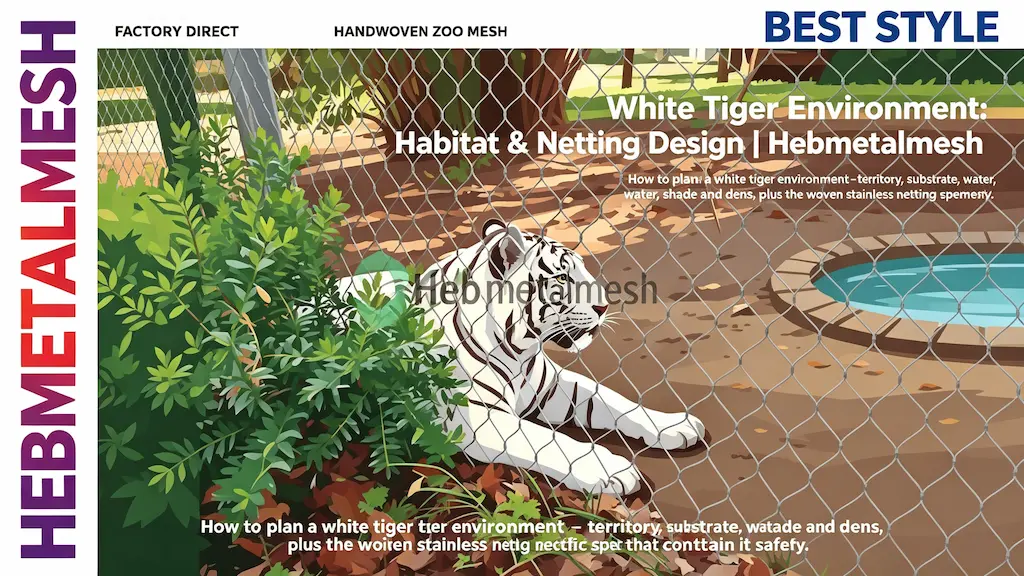
A tiger does not experience its enclosure the way a visitor does. It reads the ground under its feet, the water it can walk into, the shade it can reach at noon and the den it can retreat to when it wants to be unseen. White tiger netting is only the visible edge of that environment — the part that holds the animal in and the weather out. Everything inside that edge decides whether the tiger stays calm or paces.
So plan the inside first and size the mesh last. That order also makes the netting decision easier to justify to a client, a curator or a planning authority.
Executive Summary
Send the site plan, the climate and the number of animals, and we will size the panels to the environment you are building. Aperture, rope diameter and panel size follow from the enclosure plan — not the other way around. Contact Hebmetalmesh
A white tiger netting design begins with a welfare question rather than a materials question: what does this animal do across a day, and what must the enclosure provide so that it can do those things safely? Answer that, and the territory, the water, the shade and the den fall into place, and the netting becomes a straightforward specification. Skip it and the enclosure becomes a box with a good fence around it. The reference specification is the tiger enclosure netting product page.
Quick Answer:
Plan a white tiger environment around four zones — a large dry territory with a substrate gradient, a pool with a shallow entry, a shaded resting area, and a den the animal can withdraw into. Contain all four with woven stainless rope mesh: 76 mm aperture in 3.2 mm rope (HM3276) for the long outdoor runs, 50 mm in 3.2 mm (HM3250) where a tiger works the mesh at keeper distance, and 38 mm in 3.2 mm (HM3238) on dens, holding and any panel within reach of a paw. Carry every panel on a tensioned perimeter cable between posts set no more than 3 m apart, and specify SS304 inland and SS316 where the site is coastal or washed down.
Key Takeaways
- Design the inside first. Territory, water, shade and den decide welfare; the mesh only contains it.
- One white tiger is not a species. It is a recessive colour variant of the Bengal tiger, so plan to ordinary tiger standards.
- Space is the first welfare variable. A territory that allows normal ranging prevents more problems than any enrichment schedule.
- Water and shade are not decoration. A pool the animal can enter and a shade structure it can reach change its behaviour across the whole day.
- Every panel within arm’s reach needs a finer weave. Close-range panels are where a paw does damage.
The welfare framework most zoos work to is set out by the World Association of Zoos and Aquariums, which treats enclosure design as part of animal welfare rather than as a construction afterthought.
What a white tiger actually needs from its environment
A white tiger is not a separate species. It is a Bengal tiger carrying a recessive gene that suppresses the orange pigment, and it is effectively absent from the wild. Almost every white tiger alive is in captivity, and many carry the health problems that come with close inbreeding. That has a practical consequence for design: there is no “white tiger standard”. The animal is a tiger, and the environment should meet the requirements any tiger enclosure would, with extra attention to animals that may already be compromised. That reframing also stops a design drifting towards spectacle, because a white tiger territory design is judged by how much normal tiger behaviour it permits in a day — walking a long route, climbing, entering water, marking, resting in cover, and choosing when to be visible.
Territory, substrate and the long view
Space is the variable that cannot be retrofitted. Plan it generously, because extending walls and moving fences later costs more than ground costs now.
The substrate gradient matters as much as the area. A single flat surface gives the animal nothing to choose between and drains badly. A better plan layers free-draining sandy ground on the high side, a firmer compacted area near the den and the service route, and planted or rockwork sections that break sightlines and give the tiger somewhere to be partly hidden. On a slope, a deliberate drainage fall away from the den keeps the ground dry through the wet season, which is when most enclosure problems surface.
A white tiger conservation netting project is usually attached to a breeding story, and that affects the plan. Breeding pairs need to be separated and reintroduced without moving through a shared corridor, so the territory has to be divisible — a decision much cheaper on paper than after the posts are in. For that reason a white tiger breeding mesh divider is usually rated to the same specification as the outer perimeter, not a lighter internal screen. White tiger climbing mesh deserves its own thought too: any platform within jumping distance of a wall changes the effective height of that wall, so climbing furniture and perimeter height have to be designed together.
Water, shade and thermal comfort
Water does two jobs in a tiger enclosure, and only one of them is for the animal. The pool is also where a visitor most wants to look, which means it tends to be over-designed for the view and under-designed for the use.
Design the pool for entry. A pool depth that starts at a shallow shelf and falls away gradually lets the animal walk in and out under its own control; a hard vertical edge and a uniform depth are harder for an older or heavier animal to use safely. The pool edge is a containment detail as well — an animal standing in water can still reach up, so any panel above a pool belongs to the fine-weave, close-range part of the specification.
Shade is the other half of the problem. Thermal comfort in a tiger enclosure is largely about having somewhere to go at the hottest part of the day, and a shade structure over a resting platform and reachable ground does more than one over an empty corner. In a hot, humid climate shade, water and airflow work together; in a cold one the same logic runs in reverse and the den becomes the animal’s refuge.
Dens, night quarters and the breeding detail
The den is where an environment succeeds or fails quietly. It is the space the animal chooses when it wants to be out of view, and an enclosure without a credible retreat produces an animal that never fully relaxes.
A white tiger night den should be secure, dry and softly lit, with a den box the animal can enter and turn around in, plus a service route that lets keepers clean and feed without opening the animal into the territory. Because dens bring people and cats close together, this is exactly where a paw can reach through a panel — which is why den and holding panels are specified in the finer weaves, and why a white tiger netting specification for dens should never simply repeat the outer perimeter. Shift and holding areas belong to the same system: an animal moved between den, holding yard and territory should never share a corridor with a keeper, so the plan needs interlocked doors rather than a single gate.
Containment: choosing and placing the mesh
The visible containment layer is white tiger netting, and it is worth choosing as a building component rather than a farm product. Woven stainless rope mesh is a smooth, weld-free panel that carries load into a tensioned perimeter cable, gives an unobstructed view and does not corrode at the joints.
A workable woven white tiger netting specification follows one rule: the farther a panel sits from the animal, the wider the aperture it can use. Rope diameter carries the load, and a 3.2 mm rope in 7×7 construction breaks at roughly 7 kN — far more than a tiger applies — so the panel is rarely the weak point; the details are. Material grade depends on the site rather than the animal: SS304 for a dry inland enclosure, SS316 where the site is coastal, humid or heavily washed down. The reasoning is set out in our guide to 304 versus 316 stainless cable mesh, and the same logic governs a project weighing galvanised against stainless mesh.
Two containment details are specific to the environment. Where water forms a boundary, a white tiger moat barrier — mesh or concrete set below the water line and above the animal’s reach — closes the one edge a pool otherwise opens. Where the public looks directly at the animal, a white tiger viewing mesh panel takes the fine weave, because a close viewing panel is also a close contact panel; where a facility prefers a viewing glass window on the main public line, the mesh stops short of the glass and picks up above it, an arrangement covered on the tiger enclosure netting page. White tiger park fencing follows the same rule set at scale, with the coarse weave on the outer perimeter and the fine weave on every visitor- or keeper-facing panel. Our overview of better zoo enclosure barriers explains how that choice affects welfare and the visitor’s sightline.
Cost, ordering and installation
Cost is driven by total panel area, rope diameter and aperture, plus the frame that carries it. As a planning range rather than a quotation, carnivore-grade stainless white tiger netting typically lands between $20 and $38 per square metre before frames and installation, and on a typical project the frame and footing work is a meaningful share of the installed total. Buying the outer runs at 76 mm and spending the finer weave only on dens, gates and viewing panels usually costs no more than a uniform specification and performs better, because the expensive weave ends up where the animal actually reaches it.
Ordering direct from the white tiger netting factory keeps the panel schedule under one specification, which matters when a project mixes three apertures and two grades on one site. Panels are woven to size, so white tiger netting installation is largely a matter of tensioning rather than cutting. On white tiger netting price, the biggest swing is not the weave but the frame and the number of separate panels: every extra post line, gate and return adds structure, and structure is where a budget moves. A stainless steel rope mesh application review is worth reading if the same site also includes aviaries or primate areas, since the detailing is shared. Panels are typically two to four weeks from order plus two to six weeks for export transit.
Frequently asked questions
It is the whole enclosure an animal lives in — territory, substrate, water, shade, den and the containment around them — rather than the fence alone. The mesh matters, but the environment decides welfare.
No. It is a Bengal tiger with a recessive colour gene and is effectively absent from the wild. Plan to ordinary tiger standards, with extra care for animals that may carry inbreeding-related health issues.
76 mm in 3.2 mm rope for long outdoor runs, 50 mm for yards and gates, and 38 mm for dens, holding and any panel within reach of a paw. The closer the animal, the finer the weave.
A pool the animal can enter and leave safely supports normal behaviour and helps with thermoregulation in hot climates. Design it with a shallow shelf and a gradual pool depth rather than a hard-edged uniform basin.
Because people work close to the animal there. Den and holding panels are within paw reach of keepers, so they take the fine weave even when the outer run is specified at 76 mm.
As a planning range, carnivore-grade stainless rope mesh runs about $20 to $38 per square metre before frames and installation. The frame, the number of panels and the grade move the figure.
Ordering white tiger netting
Send the site plan, the climate, the number of animals and the panel schedule. That is enough to recommend the aperture, the rope diameter and the panel layout for each zone, and to weave panels that arrive ready to tension.
Request a white tiger netting quotation from Hebmetalmesh and the panels ship sized and documented.
Hebmetalmesh — Shijiazhuang Netting Trading Co., Ltd, No.386 Zhaiying Street, Shijiazhuang, Hebei, China. info@hebmetalmesh.com