n the modern landscape of zoological management and wildlife conservation, the philosophy of primate containment has shifted dramatically. We no longer speak of “cages”; we speak of “habitats.” For zoo managers, sanctuary operators, and architectural designers, the primary objective is to create environments that are safe, stimulating, and naturalistic—environments that prioritize animal welfare while simultaneously enhancing the educational and visual experience for visitors.
The design and construction of a world-class monkey habitat represent a complex intersection of behavioral biology, structural engineering, and aesthetic design. Primates are among the most demanding residents of any facility; their high intelligence, remarkable physical strength, and nimble dexterity require containment solutions that are far more sophisticated than standard fencing.
The core challenge for facility managers lies in sourcing materials that can withstand the relentless curiosity of primates without compromising the visual integrity of the exhibit. For decades, industry professionals have turned to specialized manufacturers like Hebmetalmesh (Shijiazhuang Netting Trading Co., Ltd) to solve this puzzle. By providing high-tensile, handwoven stainless steel mesh solutions, Hebmetalmesh has become the backbone of secure and beautiful primate enclosures globally. This guide serves as a comprehensive resource for professionals navigating the complexities of selecting, designing, and sourcing commercial-grade monkey habitats.
1. Understanding Monkey Habitat Requirements: Safety, Enrichment & Durability
Before selecting a mesh or a framework, one must understand the biological and physical demands of the species in question. A monkey habitat is more than a boundary; it is a 24-hour living space that must facilitate a wide range of natural behaviors.
The Unique Challenges of Housing Primates
Primates possess a combination of traits that make them “escape artists” and “destruction testers.”
- Intelligence: Monkeys will actively look for weaknesses in a structure, such as loose bolts or gaps in the mesh.
- Strength: Even small species have surprising pound-for-pound strength, capable of pulling at wires or pushing against panels with significant force.
- Dexterity: Primate fingers are designed for manipulation. If a mesh aperture is large enough for a finger to wrap around but small enough to snag a joint, it becomes a safety hazard.
Key Components of a Successful Habitat
A holistic habitat design incorporates several layers:
- The Structural Framework: The “skeleton” of the habitat, typically made of heavy-duty steel or specialized timber, which must support the weight of the mesh and the dynamic loads of jumping animals.
- Cladding and Mesh: The “skin” of the enclosure. This must provide 100% containment while remaining as transparent as possible.
- Perching and Climbing Structures: Essential for arboreal species to utilize vertical space.
- Shelter and Retreat: Privacy zones where animals can escape the public eye or inclement weather.
- Environmental Enrichment: Integrated features such as puzzle feeders, water elements, and varying textures that stimulate cognitive health.
Why Material Choice is Critical
When evaluating containment materials, the industry typically compares three options: galvanized steel, powder-coated steel, and stainless steel.
- Galvanized Steel: While cost-effective initially, it is prone to “white rust” and eventually red rust, especially in humid or tropical zoo environments. It can also be abrasive to primate hands.
- Powder-Coated Steel: Offers better aesthetics but the coating often chips or peels under the constant friction of climbing and cleaning, leading to corrosion and potential ingestion of paint chips by the animals.
- Stainless Steel: This is the gold standard for primate habitats. It is non-toxic, offers immense tensile strength, and is virtually immune to the corrosive effects of animal waste and cleaning chemicals.
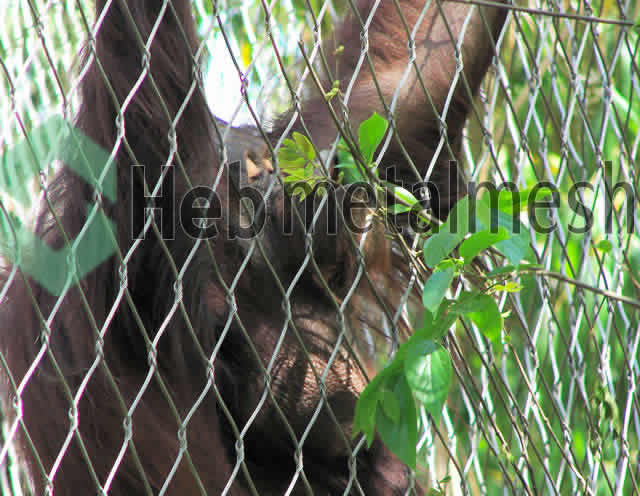
Hebmetalmesh specializes in this superior material, offering high-tensile, handwoven stainless steel mesh. Unlike rigid welded wire, this handwoven netting is flexible, allowing it to absorb the impact of a leaping primate without deforming or breaking. It is available in natural and black oxide finishes, ensuring that the material lasts for decades while maintaining a premium appearance.
2. Best Enclosures for Monkey Habitats: A Commercial Buyer’s Guide
Choosing the right enclosure style depends on the species’ size, social structure, and whether the exhibit is intended for public walkthroughs or distant viewing.
Walk-In Aviaries for Smaller Primates
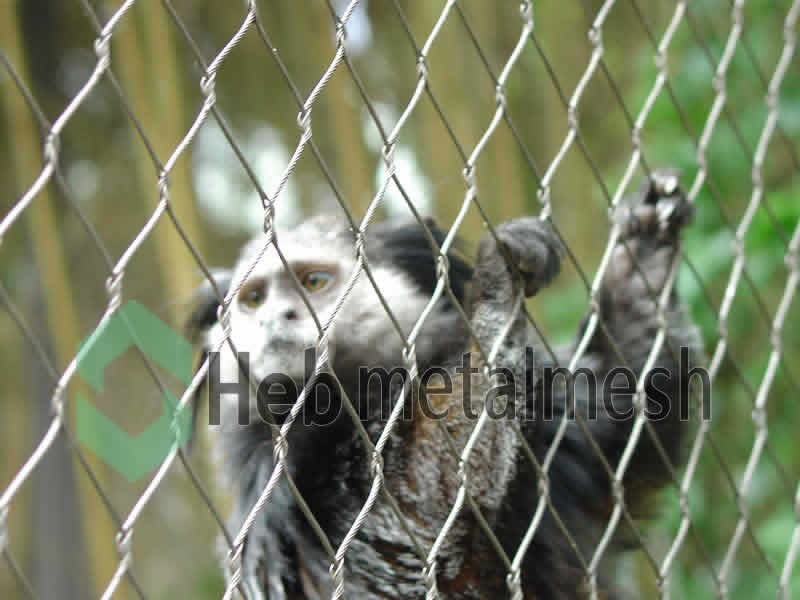
For smaller species like Tamarins, Marmosets, or Squirrel Monkeys, walk-in aviaries are increasingly popular. These designs allow visitors to enter the habitat (often through a double-door airlock system).
- Design Considerations: The mesh must be fine enough to prevent the smallest primates from escaping but open enough to allow airflow and light.
- Specifications: Typically, a lighter wire diameter (e.g., 1.2mm or 1.6mm) with a smaller aperture (e.g., 25mm x 25mm) is used to ensure small fingers cannot be caught.
Large Outdoor Enclosures for High-Energy Species
For Macaques, Capuchins, and Baboons, the enclosure must handle much higher kinetic energy.
- Cantilevered Designs: Many modern zoos use “overhang” or cantilevered mesh tops to prevent climbing escapes while keeping the top open to the sky.
- Perimeter Fencing: High-tensile stainless steel mesh is used as a vertical barrier, often tensioned between heavy steel posts or integrated into rockwork.
Hybrid Indoor/Outdoor Habitats with Transfer Systems
A professional facility requires the ability to move animals between indoor holding areas and outdoor exhibit spaces. This is where the flexibility of mesh becomes a logistical asset. Custom mesh rolls from Hebmetalmesh are frequently used to create “transfer tunnels” or “chutes” that are lightweight yet secure, allowing for the easy creation of guillotine doors and flexible tunnel systems.
The Critical Role of Mesh as the “Secure Skin”
The mesh is the most visible and vital part of the enclosure. At Hebmetalmesh, we supply the foundational safety layer. Our customized handwoven stainless steel netting rolls, with maximum roll sizes up to 30′ x 60′, allow for seamless, secure spans with minimal joins—a key safety and aesthetic feature for top-tier zoos. By reducing the number of seams, you reduce the number of potential failure points and create a more “invisible” barrier that doesn’t distract the visitor from the animals.
BestSeller: Monkey Habitat | Zoo-Grade 304 Stainless Steel Netting| 1.5″ x 1.5″ Mesh | Hebmetalmesh
Construct a safe, secure, and long-lasting monkey habitat with professional-grade materials trusted by zoos, wildlife sanctuaries, and expert animal care professionals. Our Monkey Habitat Mesh is engineered specifically for the demanding requirements of primate enclosures, combining superior strength, animal safety, and environmental resilience.
Crafted from heavy-duty Stainless Steel 304, this mesh provides exceptional resistance to corrosion, rust, and the elements, ensuring your habitat structure stands the test of time with minimal maintenance. The 1.5″ x 1.5″ diamond mesh pattern with a 1/16″ (1/14″) wire thickness is the ideal specification for primate environments. It offers excellent visibility for observation while preventing small fingers and toes from getting caught, a critical safety feature for any ethical monkey habitat.
Why Choose Our Mesh for Your Monkey Habitat Project?
- Zoo-Grade Security & Safety: The optimal mesh size protects both animals and handlers, preventing injuries and unauthorized access.
- Unmatched Durability: Stainless Steel 304 ensures superior performance in all weather conditions, resisting corrosion from outdoor exposure and cleaning agents.
- Professional Specifications: Each roll measures 30 feet wide by 60 feet long, providing ample coverage for large enclosures, partitions, or roofing with fewer seams.
- Aesthetic Flexibility: Choose between a natural Nature finish that blends into environments or a sleek Black Oxide coating for enhanced contrast and a modern look.
- Built for Longevity: Outlasts and outperforms standard galvanized or powder-coated meshes, providing a permanent solution for your monkey habitat infrastructure.
- Customization Available: Need a specific size or configuration? Contact us for tailored solutions to meet your exact project blueprints.
Ideal for new construction, renovations, or reinforcing existing structures, this mesh is versatile for walls, ceilings, climbing structures, and protective barriers within the monkey habitat.
Product Details:
- Product Name: Monkey Habitat | Zoo-Grade Mesh
- Material: Stainless Steel 304
- Mesh Size: 1.5″ x 1.5″
- Wire Thickness: 1/16″ (1/14″)
- Roll Size: 30 feet x 60 feet
- Color: Nature or Black Oxide
- Price: $3,980.00 per roll
- Customized Sizes: Available upon request
Invest in the well-being of your primates and the professionalism of your facility. Choose Hebmetalmesh for your monkey habitat enclosure needs.
Order your professional monkey habitat mesh today and build with confidence.
https://hebmetalmesh.com/store/1-5-x-1-5-diamond-holes-30-x-60-rolls-natures-or-black-oxide/
3. Where to Buy Naturalistic Monkey Habitat Kits and Components
Sourcing for a commercial primate project usually follows a “Spectrum of Customization.” While small-scale hobbyists might look for off-the-shelf cages, professional sanctuaries and zoos require a mix of local fabrication and specialized global sourcing.
The “Kit” vs. “Custom-Designed” Spectrum
Most commercial projects are not “kits” in the traditional sense. Instead, they are “component-based custom builds.”
- Structural Steelwork: Usually fabricated by a local contractor based on architectural drawings.
- Primary Cladding Mesh: This is the most specialized component. It cannot be found at a local hardware store and must be ordered from experts.
- Recommendation: For the mesh, you can order industry-standard customized rolls directly from our online store at Hebmetalmesh.com/store/.
Creating a “Naturalistic” Look with Materials
A common complaint among zoo designers is the “shimmer” of standard stainless steel, which can look industrial and create glare. To solve this, Hebmetalmesh offers a Black Oxide finish. This chemical process darkens the surface of the stainless steel without compromising its structural integrity. The result is a mesh that visually “recedes” into the background, allowing the greenery, rockwork, and the monkeys themselves to take center stage. For modern, “high-tech” designs, the natural stainless finish remains a popular choice for its clean, architectural aesthetic.
4. How to Order a Custom-Built Monkey Habitat: A Step-by-Step Process
How to Order a Custom-Built Monkey Habitat: A Step-by-Step Process? Ordering a custom containment solution, particularly for a sanctuary or a new zoo wing, requires a disciplined approach to ensure the safety of the animals and the longevity of the investment.
- Step 1: Initial Consultation & Habitat Design
Before any wire is woven, the facility must work with architects and primate consultants. This stage defines the “envelope” of the habitat—how much vertical space is needed, what the footprint will be, and how the mesh will interact with ground-level concrete or rock features.
- Step 2: Technical Specifications and Material Selection
Not all mesh is created equal. When you work with Shijiazhuang Netting Trading Co., Ltd, our engineers consult on mesh tensile strength, wire diameter, and aperture size tailored to your species and frame design. For example, a Gibbon enclosure requires a different wire diameter than a Marmoset aviary due to the immense swing force (brachiation) of the larger species.
- Step 3: Quotation and Lead Time
Once the each panel dimensions are finalized, we provide a detailed quotation. Because our mesh is handwoven by skilled craftsmen, lead times are an essential factor in project planning. Shipping via sea or air is coordinated to match the on-site construction schedule.
- Step 4: Fabrication and Installation Support
The mesh arrives in rolls, customized to the exact dimensions specified. We provide guidance on the necessary hardware—such as ferrules, tension cables, and specialized clips—to ensure the mesh is installed with the correct tension.
Case Study Snippet: A prominent wildlife park recently required a complex, curved enclosure for a group of Spider Monkeys. The design involved irregular shapes that made standard panels impossible to use. We supplied custom-sized, handwoven rolls in black oxide that matched the complex CAD drawings precisely. This allowed the installers to drape and tension the mesh over the organic curves of the frame, significantly simplifying the labor on-site and resulting in a stunning, seamless finish.
5. Guide to Setting Up Indoor & Outdoor Habitats with Commercial Products
Setting up a habitat requires different strategies depending on the environment.
Indoor Enclosure Focus
Inside a building, ventilation and hygiene are paramount.
- Drainage: The mesh must be installed in a way that allows for high-pressure hosing without trapping debris in the joints.
- Integration: Stainless steel mesh can be integrated directly into masonry walls or glass viewing panels using custom-fitted U-profiles.
Outdoor Enclosure Focus
Outdoor environments introduce “Environmental Loading.”
- Wind and Snow: The mesh must be rated for wind loads. In colder climates, the “ice load” (the weight of ice clinging to the wire) must be calculated to prevent the roof from sagging or collapsing.
- UV Resistance: Unlike plastic-coated meshes which degrade under the sun, 316-grade stainless steel is unaffected by UV radiation.
Installation Best Practices
- Tensioning: A “loose” mesh is a dangerous mesh. It must be tensioned correctly to prevent animals from getting limbs caught in sagging folds.
- Hardware Compatibility: Always use stainless steel hardware with stainless steel mesh to prevent “galvanic corrosion.”
Why Choose Hebmetalmesh for Your Primate Habitat Projects?
With decades of experience supplying zoos, wildlife parks, and conservation farms globally, Shijiazhuang Netting Trading Co., Ltd understands the stakes of primate containment.
- Direct Factory Pricing: We are the manufacturer. By cutting out the middleman, we provide premium 316-grade stainless steel mesh at a price point that makes large-scale sanctuaries viable.
- Unmatched Customization: We don’t just sell standard sizes. Whether you need a 2-foot strip for a transfer tunnel or a 60-foot roll for a canopy, we manufacture to your exact project needs.
- Product Assurance: Every roll is a product of handwoven craftsmanship, subjected to rigorous quality control to ensure that every knot and every ferrule is secure.
Ready to Specify Mesh for Your Project? Visit our main site at https://hebmetalmesh.com to see our extensive project portfolio, or go directly to our online shop at https://hebmetalmesh.com/store/ to inquire about custom roll sizes and our signature black oxide options.
Frequently Asked Questions (FAQs)
A: For permanent, commercial primate habitats, 304 stainless steel is the industry best practice. It is incredibly strong, resistant to corrosion from waste and weather, and non-toxic. Handwoven stainless mesh offers a unique combination of flexibility and durability that rigid materials lack.
A: Specialized manufacturers like Hebmetalmesh supply customized handwoven stainless steel netting rolls directly to zoos and fabricators worldwide. You can order standard or custom sizes through their online store or contact them for a custom quote based on architectural drawings.
A: A black oxide finish applied to stainless steel mesh creates a dark, low-reflective surface. This allows the mesh to visually recede, making the plants and animals within the exhibit stand out. It is the preferred choice for high-end “immersion” exhibits.
A: To minimize seams and simplify installation, Hebmetalmesh offers large format rolls up to 30 feet by 60 feet. However, one of our primary strengths is customization; we can produce almost any dimension to fit your specific design requirements.
A: The process typically involves: 1) Finalizing the habitat design with architects, 2) Specifying the technical requirements (wire diameter and aperture) for the species, 3) Requesting a quote from a specialist supplier like Hebmetalmesh, and 4) Coordinating with a local fabricator for the frame and installation.
A: Absolutely. Handwoven stainless steel mesh is ideal for walk-in aviaries. It provides excellent containment for species like tamarins or marmosets while being light enough to create complex, spacious shapes that enhance the visitor’s feeling of being “inside” the habitat.
Conclusion
Investing in a properly designed and sourced monkey habitat is an investment in the future of your facility. It is a commitment to the welfare of the primates, the safety of the staff and visitors, and the long-term operational efficiency of the zoo or sanctuary.
The containment material is the single most critical component of the enclosure. By choosing a partner like Hebmetalmesh (Shijiazhuang Netting Trading Co., Ltd), you are selecting a material that has been proven in the most demanding environments on earth. Our handwoven stainless steel mesh provides the transparency designers crave and the security managers require.
Contact us today to discuss your specific monkey habitat project requirements. Whether you are in the early design phase or ready to order your mesh rolls, our team of experts is here to ensure your primate habitat is a world-class success.