
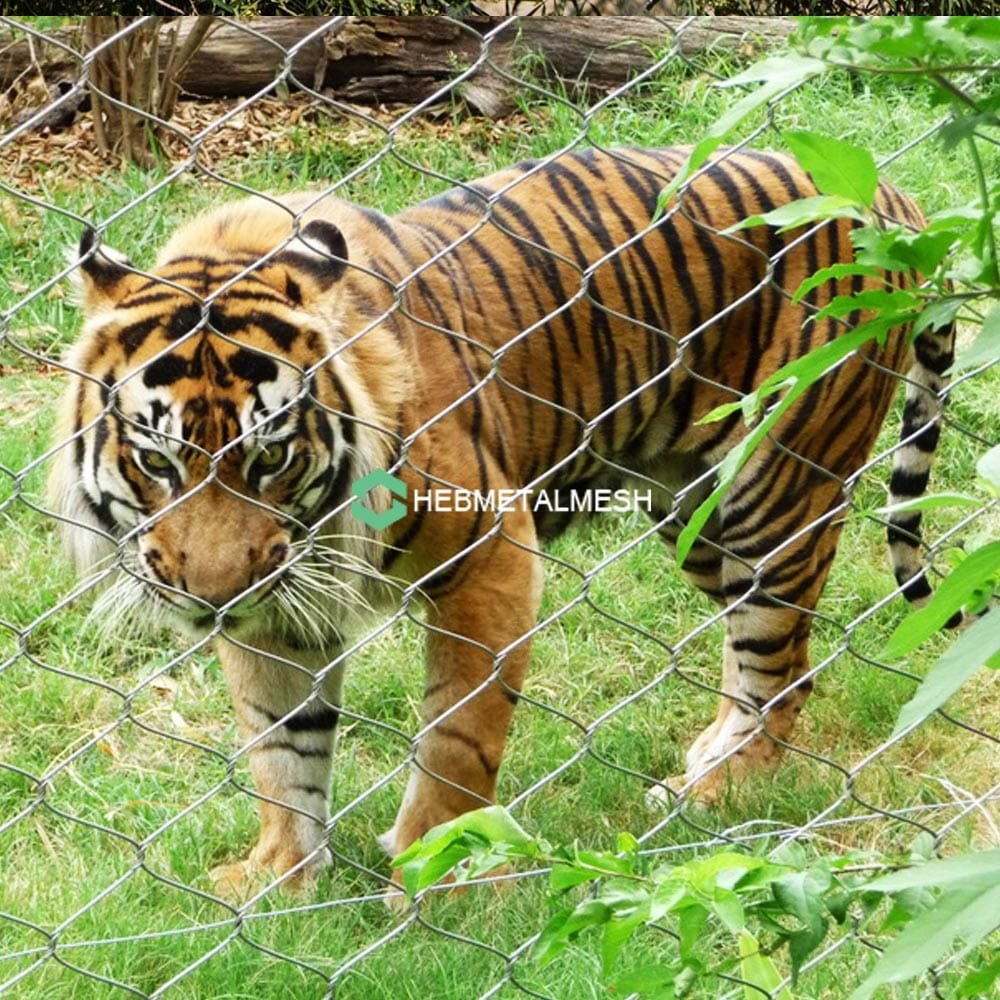
A tiger does not test a fence by walking into it. It tests the boundary line — the corner where two runs meet, the gate jamb, the ground line where soil meets steel. Tiger boundary fencing is therefore a perimeter problem before it is a mesh problem. The panel is normally the strongest element in the system, and the failures happen at the joints, the frame, and the detail where the fence meets the ground.
Executive Summary
Send the perimeter length, the corner layout and the ground conditions before you ask for a price. Frame spacing, anti-dig detail and gate interlock decide whether a tiger fence holds, and we weave panels to your boundary. Contact Hebmetalmesh
Boundary fencing for tigers is designed around escape behaviour rather than around strength in the abstract. A tiger pushes at a gate, climbs a corner and digs where the ground is soft; each of those is a separate design case with its own detail. Get the material, the frame and the ground line right and the perimeter behaves as one barrier. Get one of them wrong and the perimeter becomes a set of strong panels joined by a weak point. The reference specification is the tiger enclosure netting product page.
Quick Answer:
Tiger boundary fencing is specified by tension and geometry, not by panel thickness alone. Use 76 mm aperture in 3.2 mm rope (HM3276) for the main perimeter of a tiger run, 50 mm in 3.2 mm (HM3250) for paddocks and yards where an animal works the mesh directly, and carry every panel on a tensioned perimeter cable between posts set no more than 3 m apart. Add a buried apron or a concrete toe wall along the ground line, interlock the gates, and specify SS304 inland and SS316 where the boundary is coastal or washed down.
Key Takeaways
- The panel is rarely the failure. Corners, gate jambs and the ground line are where tiger perimeters give way.
- Frame spacing sets the load. A tensioned panel transfers load into posts and cable, so spacing is a structural decision.
- The ground line needs its own detail. An anti-dig apron or toe wall closes the one gap a tiger will actually exploit.
- Gates must interlock. A single gate is a corridor a keeper and a tiger can share; a double gate removes that risk.
- Grade and documentation go together. Request the mill test report with the quotation, not with the complaint.
Where the boundary forms part of a managed collection, the World Association of Zoos and Aquariums guidance is the benchmark most facilities work to, and it treats perimeter design as part of animal welfare rather than as a construction afterthought.
What a tiger boundary actually has to do
A tiger’s escape attempt is not random. It is concentrated where the enclosure geometry changes: a corner it can wedge a shoulder into, a gate it can work loose, a low point under the mesh where the ground softens after rain. A tiger boundary fencing design that answers those three cases answers almost everything else.
Jump height is the first number a project asks for and the least useful on its own. A tiger can clear several metres vertically, which is why a perimeter is normally carried to a height that removes the incentive to jump rather than to a height that merely exceeds a recorded leap. An anti-climb overhang or an inward return at the top is what turns a tall fence into a non-jumping one, and a smooth, weld-free woven panel gives no toehold on the climb itself.
The third design case is the ground. A tiger escape barrier is only as good as its ground line, and the cheapest way to lose a perimeter is to leave the base of the mesh resting on soil. Tiger boundary netting that meets a buried apron or a concrete toe wall is a closed barrier; netting that floats above soft ground is an invitation.
Choosing the material: chain link, electric or woven stainless
Three materials dominate a tiger boundary fence, and they are not equivalent.
| Option | Strength | Visibility | Ground detail | Longevity |
| Chain link | High on straight runs | Moderate | Needs a separate skirt | 10–15 years |
| Electric | Deterrent only | Full | Needs a full barrier | Depends on power |
| Woven stainless rope mesh | High | Full | Integral with the frame | 25–30 years |
For a tiger run fence on a long straight boundary, chain link is inexpensive and strong, but it is the panel that most often fails at a corner or a vandalised section and it still needs a separate bottom detail. Electric fencing is a deterrent layered on top of a barrier, never a barrier on its own. Woven stainless rope mesh behaves like a building component: a smooth, weld-free panel that carries load into a tensioned cable, gives a clear view, and does not corrode at the joint. Our guide to better zoo enclosure barriers sets out how that choice affects welfare and the visitor’s view.
Where a yard is worked by the animal at close range, the specification moves to a finer weave and heavier rope. Tiger yard fence and tiger paddock fencing panels usually take a 50 mm aperture for exactly this reason, so that a paw cannot work the weave. Specified this way, the system becomes a genuine tiger boundary barrier rather than a strong panel with soft edges.
Frames, corner posts and the tensioned cable
A woven panel is only as rigid as the frame that holds it. The load path runs from the mesh, into a perimeter tensioned cable, and from there into posts and footings, and that chain is where a tiger perimeter fails if anything does. Posts set no more than 3 m apart — closer at corners — keep any single span from deflecting enough for an animal to work the mesh away from the frame.
The corner post deserves more attention than it usually gets. A corner is where two tensioned spans meet, so it carries the load of both, and it is the point an animal is most likely to test. Specifying a heavier section, a deeper footing and a diagonal brace at every corner costs less than discovering the load path on a loaded fence. The same rule applies to any tiger perimeter fence that turns a bend: the turn is a structure, not a joint.
Cable, fittings and turnbuckles are part of the boundary specification rather than consumables. A panel that is hung rather than tensioned will sag, and a sagging panel is one an animal can push. Footing design goes with post spacing: a post carrying a tensioned span in soft ground needs a deeper, wider base than the same post in rock, and a perimeter that ignores the difference will lean within a season. Where the boundary crosses a grade change — a slope, a bank or an uneven run — the frame has to step with the ground rather than follow it, because a panel laid along a slope cannot be tensioned evenly.
Closing the ground line: anti-dig apron and toe wall
Digging is the failure that no amount of panel strength prevents, because it happens beneath the barrier rather than through it. The detail that closes it is an anti dig apron: mesh laid horizontally below the surface and turned into the fence line, so an animal excavating under the boundary meets buried mesh instead of open soil.
Where the substrate is soft, a concrete toe wall is the more permanent answer, and it doubles as the plinth the panel is fixed to. On a tiger perimeter barrier built on made ground or fill, the apron depth is set by how easily the material moves rather than by a standard figure, and a site that drains poorly needs the apron deeper than a site on rock. On a tiger park fencing project that crosses several ground types, it is worth treating each change of substrate as its own detail rather than carrying one apron depth across the whole perimeter. Our overview of stainless steel rope mesh applications covers the same principles across other zoo building types.
Gates, keeper safety and the double gate
Every gate in a tiger perimeter is a deliberate interruption in the barrier, so it is also the point that has to be designed twice. A gate interlock — an arrangement in which the inner gate cannot open until the outer one is closed — is what stops a keeper ever sharing a corridor with the animal. On a tiger safety fencing job this is a welfare requirement as much as a security one: a keeper who feels exposed works differently, and the animal reads that.
A tiger containment fence built with a double gate and a service gate gives a facility three separate routes, and each can be tested without disabling the others. A tiger compound fence with only a single gate, by contrast, forces the whole perimeter to be opened at once every time an animal is moved. Interlocks can be mechanical, keyed or procedural, but the sequence has to be written down and posted at the gate, because an interlock that depends on memory is not an interlock. The gate frame is where the mesh most often works loose, so it is worth specifying a heavier section and a replaceable panel rather than one welded in place.
Grade, cost and ordering
Woven stainless rope mesh for a tiger boundary follows the grade logic used across the range: SS304 for a dry inland site, SS316 where the boundary is coastal, humid or cleaned. The comparison is set out in our guide to 304 versus 316 stainless cable mesh, and the same reasoning applies when a project weighs galvanised against stainless mesh.
Cost is driven by perimeter length, rope diameter, aperture and the frame that carries it. As a planning range rather than a quotation, tiger-grade stainless rope mesh typically lands between $20 and $38 per square metre before frames and installation, and on most boundaries the frame is a significant share of the installed total — footing depth and post spacing are cost decisions as much as structural ones. A boundary that mixes 76 mm panels on long runs with 50 mm panels at yards and gates usually costs no more than a uniform specification and works better, because the fine weave is spent where an animal actually reaches it. Our standard range sits on the tiger enclosure netting page.
Panels are woven to size, typically two to four weeks from order plus two to six weeks for export transit, and arrive with the mill documentation attached.
Frequently asked questions
Tiger boundary fencing is the perimeter system that encloses a tiger run, paddock or park — the mesh panels plus the frame, the tensioned cable and the ground-line detail that together form a closed barrier.
There is no single figure. A perimeter is normally carried high enough to remove the incentive to jump, with an anti-climb overhang or inward return at the top. Height matters less than closing the corners and the ground line.
Yes. A 3.2 mm rope in 7×19 construction carries about 7 kN, and at 76 mm aperture with posts at 3 m the panel is far stronger than any load a tiger applies. The joints and gate details are the weak points.
An anti-dig apron — mesh buried below the ground line and turned into the fence — or a concrete toe wall. The depth is set by the substrate rather than by a standard figure.
As a planning range, tiger-grade stainless rope mesh runs about $20 to $38 per square metre before frames and installation. Perimeter length, rope diameter, aperture and frame spacing move the figure.
Woven panels are typically two to four weeks from order, plus two to six weeks transit for export. Standard rolls ship sooner; custom panel sizes take the longer end.
Ordering tiger boundary fencing
Send the perimeter length, the corner layout, the ground conditions and the panel schedule. That is enough to recommend an aperture, a rope diameter, a frame spacing and a ground-line detail, and to weave panels that arrive ready to tension.
Request a tiger boundary fencing quotation from Hebmetalmesh and the panels ship sized and documented.
Hebmetalmesh — Shijiazhuang Netting Trading Co., Ltd, No.386 Zhaiying Street, Shijiazhuang, Hebei, China. info@hebmetalmesh.com