
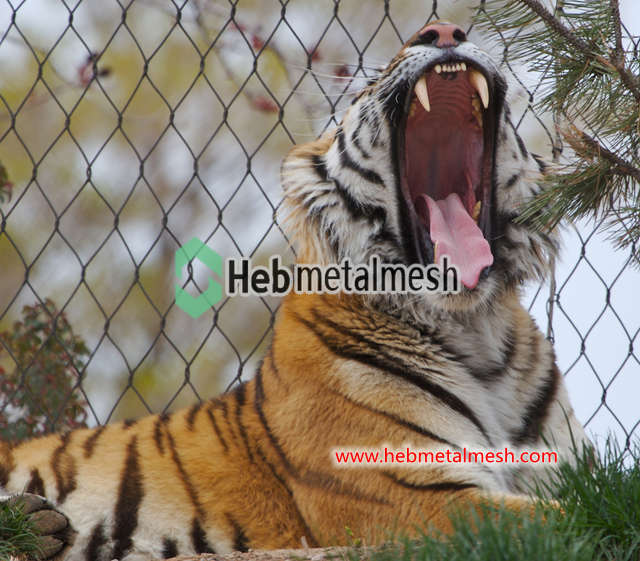
Tiger house mesh is not the same specification as the mesh on the public side of an exhibit. A tiger house is the indoor half of a tiger enclosure — the dens, the holding pens and the connecting passages where an animal is locked in overnight, shifted between yards and managed by keepers at close range. Tiger house mesh is the material doing that work, and it is asked to do what the exhibit face never does: hold a big cat within arm’s reach, shrug off years of scent marking and clawing, and stay safe for the paw that tests it every day.
Executive Summary
Send the house layout, the panel spans and the species before you ask for a price. A night den, a shift corridor and a roof panel need three different specifications, and we weave to your dimensions. Contact Hebmetalmesh
A tiger house is a building, so the netting inside it is specified like a building component — for the span it crosses, the void it fills and the animal that presses against it. Three things decide the order: aperture sized to the paw, rope diameter sized to the span, and a grade matched to how wet the house is and how it is cleaned. Get those right and the panels outlast the paint. The reference specification is the tiger enclosure netting product page.
Quick Answer:
Tiger house mesh is chosen by paw size and panel span, not by the tiger’s weight. Use 38 mm aperture in 3.2 mm rope (HM3238) for a den where a keeper passes within reach, 50 mm in 3.2 mm (HM3250) for holding pens and day housing, and the coarser 76 mm in 3.2 mm (HM3276) only on an exhibit face or a high panel the animal cannot reach. Specify SS304 for a dry inland house and SS316 where the house is hosed down with chlorinated water or sits near a coast, and request the mill test report before the crate ships.
Key Takeaways
- Size the weave to the paw, not the body. A 38–50 mm aperture stops a paw; a 76 mm opening is a handling risk in a house, even though it is correct on an exhibit face.
- A tiger house is a building envelope. Tiger house roof mesh carries wind uplift, so rope diameter follows span rather than the animal.
- Dens and corridors are different problems. A den is small and dark; a shift corridor is long, and its purpose is to keep keepers out of reach.
- Fittings fail before rope does. An aluminium ferrule on stainless rope corrodes early; specify stainless ferrules and swaged ends.
- Grade is a documentation decision. A 201-grade substitution is invisible on the wire and only shows up on paper.
Where a house supports a managed breeding or reintroduction programme, the World Association of Zoos and Aquariums standards are the benchmark most collections design to, and they treat holding space as part of animal welfare rather than as back-of-house storage.
What a tiger house is, and why the mesh is different
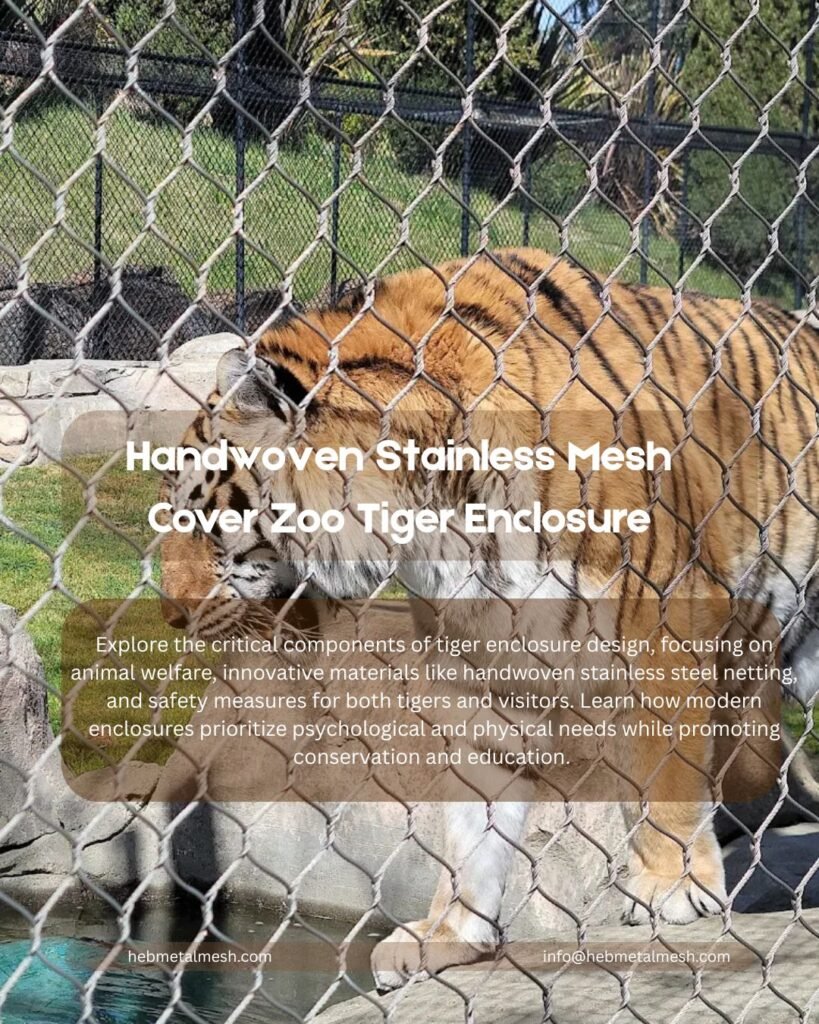
A tiger house covers the working half of a tiger enclosure: the dens an animal is locked into overnight, the pens it is moved through, and the corridors that connect them to the exhibit. It is the part visitors rarely see, and the part where keepers and tigers share the smallest distance.
Tiger house design therefore starts with the animal’s routine rather than the visitor’s view. Where is the tiger shut in while a yard is cleaned? How does it move from one yard to the next without passing through a space a keeper also occupies? Tiger house construction turns those answers into a set of surfaces: solid walls and a roof over the dens, a meshed face on the pens, and a meshed gate wherever the animal is shifted through.
The distinction that matters is that a house panel is not an exhibit panel. On a public exhibit face a 76 mm aperture is normal — it is strong, it spans well, and the animal is metres from anyone. Inside a house, where a keeper walks past a tiger at close range and a paw can reach the weave, the same 76 mm opening is a handling hazard. Tiger housing mesh is specified finer than the enclosure it serves, and getting that one decision wrong accounts for most of the house enquiries we see.
Aperture and rope: sizing the weave to the paw
Aperture inside a tiger house is set by paw safety, not by body mass. A tiger’s forepaw is broad, but the dimension that decides the specification is what a paw can push through and what a claw can hook. On a woven panel a claw that hooks the weave pulls against the rope instead of tearing free, so the aperture stays well below a paw width.
| Area of the house | Aperture | Rope diameter | Typical code |
| Night den, keeper passes close | 38 mm | 3.2 mm | HM3238 |
| Holding pen and day housing | 50 mm | 3.2 mm | HM3250 |
| Long wall or wide roof panel | 50 mm | 3.2 mm | HM3250 |
| Cubs, or a small cat in the collection | 38 mm | 3.2 mm | HM3238 |
| Exhibit face (for contrast, not for houses) | 76 mm | 3.2 mm | HM3276 |
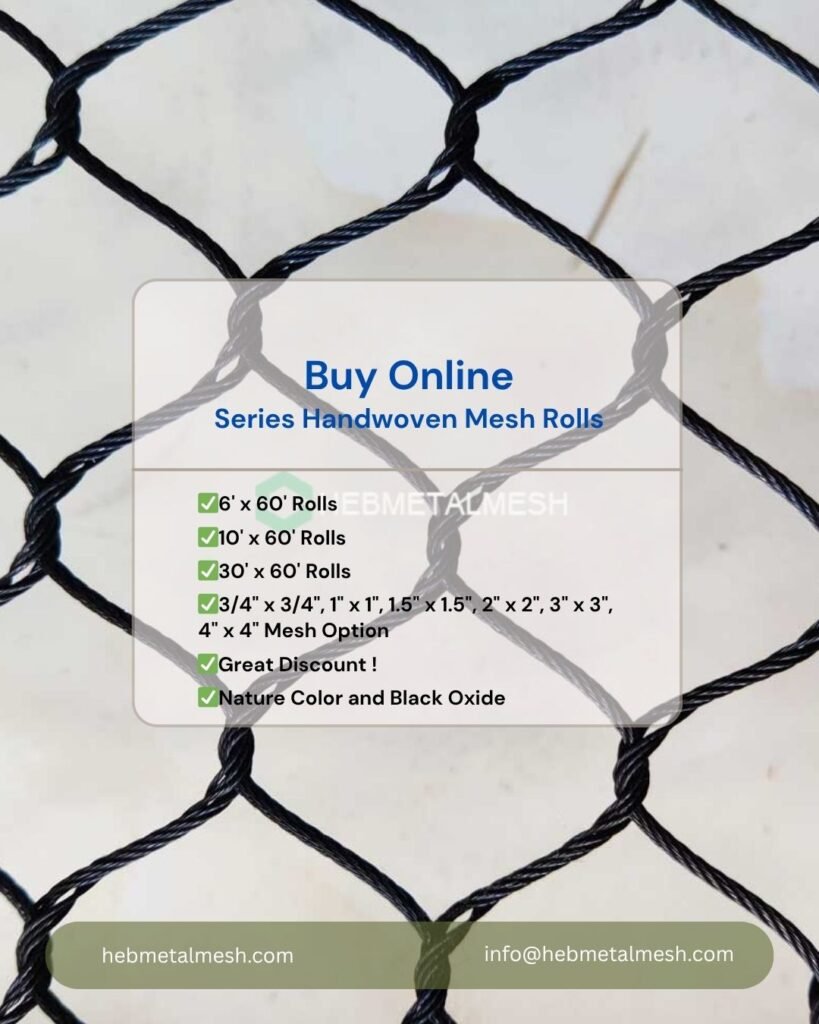
A woven panel has no welds, cut ends or sharp terminations, which is what protects a paw pushing against it and a claw raking across it. A tiger proof mesh also has to be a genuine tiger escape proof mesh: the weave, the perimeter cable and the frame together resist a determined animal, and the weakest link is rarely the mesh — it is the fixing and the detail at the gate jamb. A 3.2 mm rope in 7×7 construction carries roughly 7 kN, and at 50 mm centres that is far beyond the load a tiger can generate against a properly tensioned panel.
Grade, fittings and the paperwork that protects you
Woven tiger house mesh is a permanent component, so the grade is chosen once and lived with for 25 to 30 years. SS304 is the correct default for a dry, inland house. SS316 adds molybdenum and is the right answer wherever chlorinated wash-down water, coastal air or urine sits on the wire — which covers far more houses than most projects assume. The split is set out in our guide to 304 versus 316 stainless cable mesh, and the same reasoning applies when a project weighs galvanised against stainless mesh.
Claw damage is concentrated, not uniform. Repeated raking leaves polished patches where the wire works hardest — usually the lower 1.5 m of a wall and the strip beside a shift gate. Those abrasion points are where to look at every service, and recording them turns a visual check into a useful maintenance history.
The fitting detail catches people out more often than the rope does. A stainless rope closed with an aluminium ferrule forms a galvanic couple, and the joint corrodes long before the wire does, so specify stainless ferrules and swaged ends as part of the specification rather than a consumable. Ask for the mill test report covering grade and rope construction with the quotation: a 201-grade substitution performs differently within a few years and can only be caught on paper.
Ventilation, roof span and the building envelope
A tiger house is a humid building by definition. Big cats urinate at height, houses are hosed down, and the wash water has to leave. Tiger house ventilation mesh keeps air moving without letting the animal or a bird through, and it usually sits high on a gable or clerestory where it is out of reach. A ventilation aperture there can be coarser than a contact panel — 50 to 76 mm is adequate if the opening is genuinely unreachable — but the panel still has to be carried by a building frame rather than a post line.
Tiger house roof mesh is the panel that most often surprises a project. A roof over a pen or a corridor takes wind uplift and, in cold regions, snow load. Roof span between supports is what sets the rope diameter, not the animal: 3.2 mm rope at 50 mm centres spans further and sags less than 2.4 mm rope under the same load, so a panel supported on four edges only should be specified on the wide side.
Humidity control and a drainage channel along the base of each meshed wall stop standing water from sitting against the frame. Tiger house wall mesh is normally fixed to a plinth at floor level so wash-down water runs into the channel instead of pooling at the foot of the panel. Our overview of stainless steel rope mesh applications covers the same principles across other zoo building types, and our guide to better zoo enclosure barriers explains how a barrier choice affects both welfare and the keeper’s working day.
Dens, shift corridors and keeper access
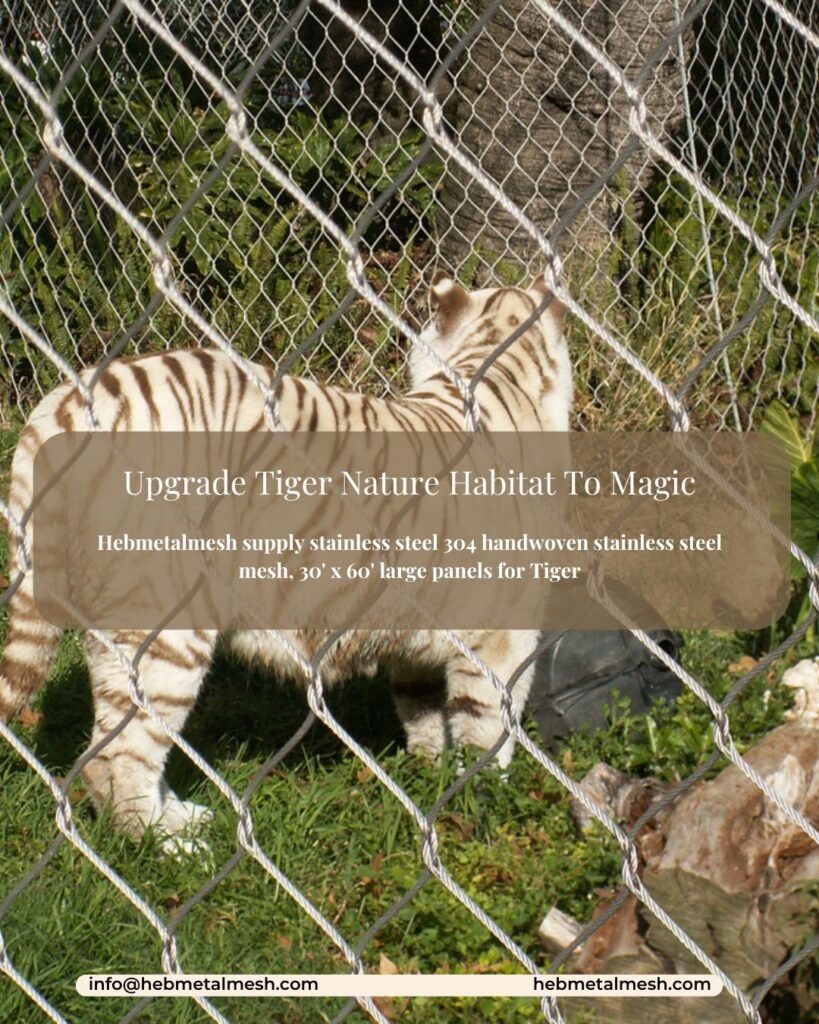
The shift corridor is the backbone of a tiger house. It is the passage an animal moves along between dens and yards, designed so a keeper can open and close gates without ever sharing a space with the tiger. That means the corridor face is meshed, the gates are meshed, and the operating side stays behind a second barrier. Tiger house mesh installation in a corridor is a sequence rather than a single job: set the frame, tension the perimeter cable, hang the panel, then confirm that every gate edge closes against the mesh with no gap a paw can reach through.
Dens are the opposite problem — small, warm, dark and heavily used, where the animal is calm but close. A den carries the finest tiger house netting in the building, and it is the panel most likely to be worked by claws at the door frame. Fixing the mesh to a steel sub-frame rather than directly to masonry keeps both panel and frame serviceable, and lets a damaged section be replaced without disturbing the walls. For the wider case for woven systems in holding and exhibit buildings, see our note on the benefits of mesh enclosures.
Price, lead time and ordering
Tiger house mesh price follows four variables: rope diameter, aperture, panel size and grade. Fine 2.4 mm mesh at 38 mm aperture carries far more wire per square metre than 3.2 mm mesh at 76 mm, so the finest specification is rarely the cheapest. As a planning range — not a quotation — tiger-grade stainless rope mesh typically lands between $20 and $38 per square metre.
Tiger house mesh cost is also driven by how much of the order is woven to size. A tiger house mesh supplier who weaves to your dimensions removes the cutting, dressing and re-clamping that stock panels otherwise need on site. A full tiger house mesh specification is easiest to get right when it is sent as a schedule rather than a message: list each opening, its width and height, its height above floor level, whether it is a contact panel or out of reach, and the grade. Our standard range sits on the tiger enclosure netting page.
Woven panels are typically two to four weeks from order, plus two to six weeks for export transit; custom sizes take the longer end of that range, while standard rolls ship sooner.
Frequently asked questions
Hand-woven stainless steel rope mesh used for the indoor half of a tiger enclosure — dens, holding pens, shift corridors and roof or wall panels. It is a flexible woven panel, not a welded grid, specified by aperture, rope diameter and grade.
Use 38 mm where a keeper passes within reach, 50 mm for holding pens and day housing, and 76 mm only where the panel is out of reach. A house is always specified finer than the exhibit face it serves.
Yes. A 3.2 mm rope in 7×7 construction carries about 7 kN, and at 50 mm centres the panel is stronger than any load a tiger can apply. The failure points are the fixings and the gate details.
SS304 for a dry inland house; SS316 wherever the house is washed with chlorinated water, sits near a coast, or holds animals that urinate heavily at height.
As a planning range, tiger-grade stainless rope mesh runs about $20 to $38 per square metre. Rope diameter, aperture, panel size and grade move the figure, and large roof panels sit at the upper end.
Woven panels are typically two to four weeks from order, plus two to six weeks transit for export. Custom panel sizes take the longer end; standard rolls ship sooner.
Ordering tiger house mesh
Send the house layout, the species being housed, the panel schedule and the heights above floor level. That is enough to recommend an aperture, a rope diameter and a grade, and to weave panels that arrive ready to tension with the mill documentation attached.
Request a tiger house mesh quotation from Hebmetalmesh and the panels ship sized and documented.
Hebmetalmesh — Shijiazhuang Netting Trading Co., Ltd, No.386 Zhaiying Street, Shijiazhuang, Hebei, China. info@hebmetalmesh.com