
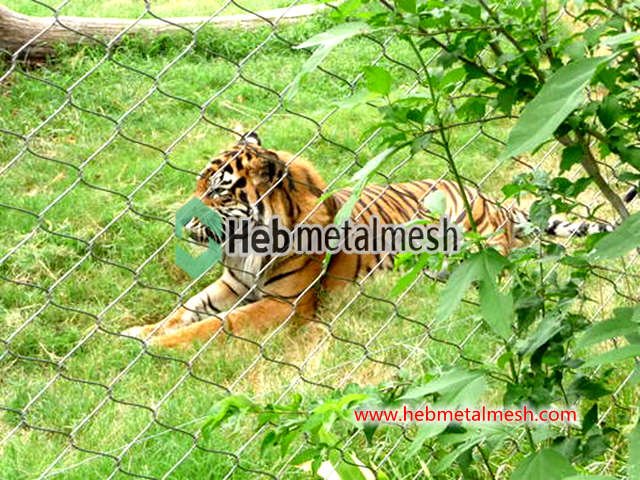
A tiger enclosure is not held together by the mesh on the drawing. It is held together by the specification behind it — the aperture that a paw cannot pass, the rope diameter that survives a landing from height, and the alloy that is still there after twenty wet winters. Buy tiger wire mesh on price alone and the second cost arrives later, as an escape, an injury, or a re-mesh of the whole exhibit.
This page is a procurement guide, not a species guide: what a tiger netting supply order should contain, how a stainless hand-woven panel differs from a welded or chain-link tiger fence net, and how to compare two suppliers quoting the same job. The reference specification is the tiger enclosure mesh product page.
Executive Summary
Quote the exhibit, not the roll. Send species, dimensions, climate and expected service life. We return mesh codes, panel sizes, a fixing schedule and a delivered planning figure. Contact Hebmetalmesh
Tiger enclosures fail at their details: a weld that cracks under repeated claw shear, a fixing of the wrong alloy that bleeds rust into the panel, a joint that becomes a paw hold. A correct tiger netting specification answers four questions — aperture, rope diameter, alloy grade and panel size — and a good tiger containment supply then delivers them as a system with the cable, ferrules and tensioners that belong to that panel.
Quick Answer:
Tiger netting for a permanent enclosure is hand-woven stainless steel rope mesh, specified as 3.2 mm rope at 50-76 mm aperture (HM3250 or HM3276) for adult tigers, with 50 mm used where paw spread or cub containment demands a tighter opening. Use SS304 inland and SS316 for coastal, tropical or chlorinated sites. Panels are woven to order up to about 9 m × 18 m, which keeps joints to a minimum, and delivery for a full exhibit typically runs 2-4 weeks ex-works plus 2-6 weeks transit. That is what to write on the enquiry before you ask for a tiger netting supply price.
Key Takeaways
- Aperture is a biology number, not a cost lever. It is set by cub size and paw spread, not by what is cheapest to weave.
- Rope diameter is the strength decision. 3.2 mm rope carries roughly 7 kN per strand in a 7×7 construction; 2.4 mm about 4.4 kN.
- Ask for the mill report. EN 10204 3.1 is the only reliable evidence that the delivered alloy is 304 or 316 and not a lower-grade substitute.
- Buy the system, not the cloth. Cable, ferrules, tensioners and fixings decide whether the panel holds tension for thirty years.
- Match the fixing to the rope. A dissimilar metal at a joint starts a corrosion cell that looks like a mesh failure but is not.
Wild tiger populations and the enclosure standards that protect them are documented by the International Union for Conservation of Nature, whose species assessments are the usual reference point for exhibit planning.
What “tiger wire mesh” and “tiger fence net” really mean
The two phrases are used loosely, and they describe very different products. A tiger fence net is usually a welded or chain-link product: wires crossed and fixed, or links interlocked, then coated. A tiger wire mesh, in the sense a zoo actually buys, is hand-woven stainless steel rope mesh — individual ropes woven at each cross point with no weld and no coating to fail.
The difference shows up under load. A welded panel has a weld at every intersection, and each weld is a stress riser where a fatigue cycle can begin. A tiger testing the same corner for years applies claw shear to a single point, thousands of times, and a cracked weld then unzips along the line. A woven panel has no weld to crack. The rope itself moves at the cross point, which spreads the load and gives the mesh its fatigue life.
Woven mesh also lets a keeper see through the enclosure. At 50-76 mm aperture the panel is nearly invisible from three metres, which is why zoos use it on the public side and reserve welded or chain-link products for service areas and perimeter works where nobody is watching and replacement is easy. That distinction — exhibit versus service area — is the single most useful idea in buying tiger containment wire.
Specifying the mesh: aperture, rope diameter and alloy
A tiger netting specification is three numbers in a fixed order.
Aperture is decided by the smallest animal that will ever be inside. A cub passes a head through an opening that an adult would barely notice, and an animal that can pass its head will eventually pass its shoulders. For adult tigers, 76 mm at 3.2 mm rope (HM3276) is the working standard; 50 mm at 3.2 mm (HM3250) is used where a tighter opening is wanted for cubs or where a paw must not reach the public line. Anything above 76 mm belongs on a large-perimeter hoofstock job, not a tiger exhibit.
Rope diameter carries the load, and it is chosen for dynamic load rather than body weight. A tiger dropping from a platform onto the mesh concentrates its whole mass on one or two ropes; a 3.2 mm rope rated near 7 kN per strand, in a 7×7 construction of 49 wires, is the standard. The opening area matters as much as the strand: a wider aperture gives a longer unsupported span, so aperture and diameter are tuned together, not chosen separately.
Alloy grade decides whether the exhibit is still safe in its third decade. SS304 (18% chromium, 8% nickel) is correct inland. SS316 adds molybdenum and is the right choice for coastal air, tropical humidity, and any enclosure hosed down with chlorinated water. This is where ss304 tiger netting ends and ss316 begins, and it is the most common place a project saves money now and pays for it later.
| Parameter | Standard specification | Notes |
| Aperture, adult tigers | 50 mm or 76 mm | Cub or public-line work goes to 50 mm |
| Rope diameter | 3.2 mm | ~7 kN per strand, 7×7 construction |
| Alloy | SS304 inland / SS316 coastal | Chloride decides |
| Panel size | Up to 9 m × 18 m | Fewer joints, faster installation |
| Service life | 25-35 years | Alloy and site dependent |
What a tiger netting supply order should include
A tiger containment supply that arrives as loose rolls of cloth is a supply failure waiting to happen. A complete order should list six items.
| Item | What to specify | Why it matters |
| Mesh panels | Code, aperture, alloy, woven size | The only irreplaceable part |
| Perimeter cable | Diameter, alloy, length | Carries the panel’s edge load |
| Ferrules and sleeves | Same alloy family as rope | Stops galvanic corrosion at joints |
| Tensioners | Turnbuckle or equivalent | Lets the panel be re-tensioned after settling |
| Fixings | Bolt grade, spacing, alloy | Anchor spacing sets point-load behaviour |
| Drawings | Panel layout and tensioning order | Removes site cutting and guesswork |
Two of those items are cheap and two are not, and buyers get them backwards. Ferrules and fixings are a small share of the invoice and the usual cause of a rust line or a slack panel; custom tiger netting woven to the exhibit’s real dimensions costs more per panel and saves the site labour, the waste, and the cut edge that ends up on the public side. Ordering by an enclosure specification sheet rather than a verbal description is what makes two quotes comparable.
Breeding and holding areas deserve the same care as the main exhibit. Tiger holding netting, transfer squeeze cage panels and shift-cage fronts take the most abuse in the building because that is where animals are moved, darted and handled. Specify the same alloy and a tighter aperture in those areas, and expect the fabric to be worked harder than the exhibit itself. The same specification holds for a tiger sanctuary mesh package or tiger reserve fencing; a tiger reserve netting job simply adds panels, not new rules.
Lead time, packing and how to compare a supplier
Lead time on custom panels is a production figure, not a warehouse figure. Typical tiger net supply and tiger netting supply runs 2-4 weeks ex-works from confirmed drawing, plus 2-6 weeks transit by sea for export orders, and the clock starts when the panel drawings are approved, not when the enquiry is sent.
Packing matters more than most buyers expect. Panels are shipped rolled or folded on pallets with edge protection; unprotected edges arrive with bent strand ends that have to be cut back on site, and every cut end is a contamination point. Ask how the panels are packed, and ask for the packing list to match the panel drawing.
When comparing a tiger netting supply price, strip the quote back to comparable items:
- Alloy and evidence. Does the price include an EN 10204 3.1 mill report, or only a certificate of conformity? The former names the heat and its chemistry.
- Panel size versus roll size. A quote by weight of mesh is not comparable with a quote by woven panel. Convert both to the exhibit area.
- What is excluded. Cable, ferrules, tensioners and fixings are sometimes omitted to make a headline price look lower.
- Terminology discipline. “Tiger fence net” and “tiger wire mesh” in a quotation mean nothing until the alloy, aperture and diameter are written down. If a supplier cannot state all three, the quote is not yet a specification.
A tiger netting supply factory that weaves in-house can also weave around a corner post or a door frame, which removes the most failure-prone joints from the job. Where an exhibit has an irregular plan, custom tiger netting to the actual geometry is usually cheaper overall than a roll of standard mesh cut and joined on site.
Installation, tensioning and long-term performance
Tiger netting installation follows the same order on every job, and skipping a step is how a panel ends up slack.
- Set the frame plumb and brace it before the mesh arrives.
- Draw the perimeter cable first, so the panel has an edge to load against.
- Hang the panel slack, working outward from the centre of the sheet.
- Tension the field last, and re-tension once at twelve months after the frame settles.
Tension is a welfare item as well as a structural one. A slack panel deflects under a leap distance the animal would not otherwise reach, and a paw spread against a loose opening is how a foot is caught. A correctly tensioned panel barely moves under an adult tiger, and it returns to shape after every impact.
The long-term enemy is corrosion rather than mechanical failure. A corrosion cell forms wherever two dissimilar metals meet in the presence of moisture, which is why ferrules and fixings must belong to the same alloy family as the rope. In a coastal or tropical site, SS316 panels on 304 fixings will fail at the fixing while the panel is still perfect. Specifying the whole assembly in one grade removes the problem before it starts.
A last point on safety features that sit outside the mesh itself. A double-door or safety standoff arrangement at every keeper entry, a squeeze cage or darting port that lets a vet work without a direct line to the animal, and a transfer route that keeps staff out of the enclosure during a shift are all designed around the mesh layout. Getting the tiger exclusion mesh right makes those features possible; getting it wrong means the keeper is always working at the edge of a risk.
Frequently Asked Questions
Hand-woven stainless steel rope mesh, 3.2 mm rope at 76 mm aperture (HM3276), or 50 mm (HM3250) where cubs or the public line require a tighter opening. Welded and chain-link products belong on service areas.
As a planning range, expect roughly $20-38 per square metre for carnivore-grade stainless rope mesh before framing, cable and installation. Compare whole-life cost, not purchase price.
SS304 inland; SS316 wherever chloride is present — coastal air, tropical humidity, or chlorinated wash-down. SS316 is the correct choice for any enclosure washed frequently.
About 2-4 weeks ex-works from approved drawings, plus 2-6 weeks transit for export. The production clock starts when the panel drawings are signed off, not when the enquiry is sent.
Ask for an EN 10204 3.1 mill test report naming the heat and its chemistry. It is the only practical way to confirm 304 or 316 and to catch a lower-grade substitution.
Up to about 9 m × 18 m woven to order, which reduces joints and speeds installation. Fewer joints means fewer weak points and fewer paw holds.
Send the exhibit plan, get a marked-up specification. Share dimensions, species, climate and service-life target. We return mesh codes, panel sizes, a fixing schedule and a delivered price. Request a quote from Hebmetalmesh
Hebmetalmesh weaves stainless rope mesh to order for tiger exhibits, holding areas and wildlife reserves. For material selection, see our 304 versus 316 guide and the galvanised versus stainless comparison; for heavy-duty grades and barrier layout, see heavy-duty 304 and 316 and zoo enclosure barriers, with the HM3276 and HM3250 product pages for the working tiger codes.