What is the best wild life fence? The best wildlife fence is made from handwoven stainless steel cable mesh. It offers superior durability (30+ years), high impact resistance for large animals, and visibility control with black oxide finishes. For professional applications like zoos or deer prevention, choose 304 or 316 grade stainless steel netting with custom-sized panels to eliminate installation waste.
The best wildlife fence solutions utilize handwoven stainless steel netting for its superior strength, flexibility, and longevity. Unlike rigid welded wire, handwoven mesh absorbs impact, is corrosion-resistant (SS304/SS316), and can be customized to massive panel sizes (up to 30′ x 60′) for zoo enclosures, aviaries, and rural property protection. Professional factory-direct options from Hebmetalmesh provide cost-effective, high-tensile barriers that ensure both animal welfare and human safety.
I. Introduction: The Evolution of Wildlife Protection
Choosing a wild life fence is no longer just about keeping animals in or out; it is about engineering a safe environment that balances visibility, animal welfare, and long-term structural integrity. Whether you are managing a world-class zoo, a sprawling rural estate, or a high-end garden, the “one-size-fits-all” approach to fencing often leads to costly failures and safety risks.
In the past, fencing was viewed as a consumable—a product that would naturally rust, break, or degrade over a five-year cycle. Modern conservation and property management have shifted this paradigm. Today, the focus is on “permanent infrastructure.” This transition has led to the rise of stainless steel wire cable mesh as the gold standard.
At Hebmetalmesh, we have spent years perfecting the art of the handwoven stainless steel netting roll. As a professional factory, we understand that a wildlife fence must withstand extreme environmental pressure, high-impact animal strikes, and the test of time. Our mission is to provide customized, factory-direct solutions—specifically our signature stainless steel wire cable mesh—that outperform traditional galvanized or plastic alternatives in every measurable metric: tensile strength, transparency, and durability.
II. The Science of Materials: Why Stainless Steel Handwoven Mesh?
To understand why a wild life fence made of handwoven stainless steel is superior, one must look at the metallurgy and the physics of the weave.
1. Grade 304 vs. Grade 316 Stainless Steel
At the Hebmetalmesh factory, we primarily utilize two grades of stainless steel:
- AISI 304: This is the standard “18/8” stainless steel. It is excellent for most inland wildlife applications, providing high resistance to oxidation and manageable costs.
- AISI 316: Known as “Marine Grade,” this alloy contains molybdenum. This is critical for wildlife fences located near the ocean. Salt spray causes “pitting” in lower-grade steels; 316 resists this corrosion, ensuring the fence remains structurally sound for decades in harsh salt-air environments.
2. The Physics of the Handwoven Diamond Weave
Traditional fencing is welded. When a 500lb elk or a startled tiger strikes a welded fence, the impact is concentrated on a single weld point. If the weld snaps, the fence unzips.
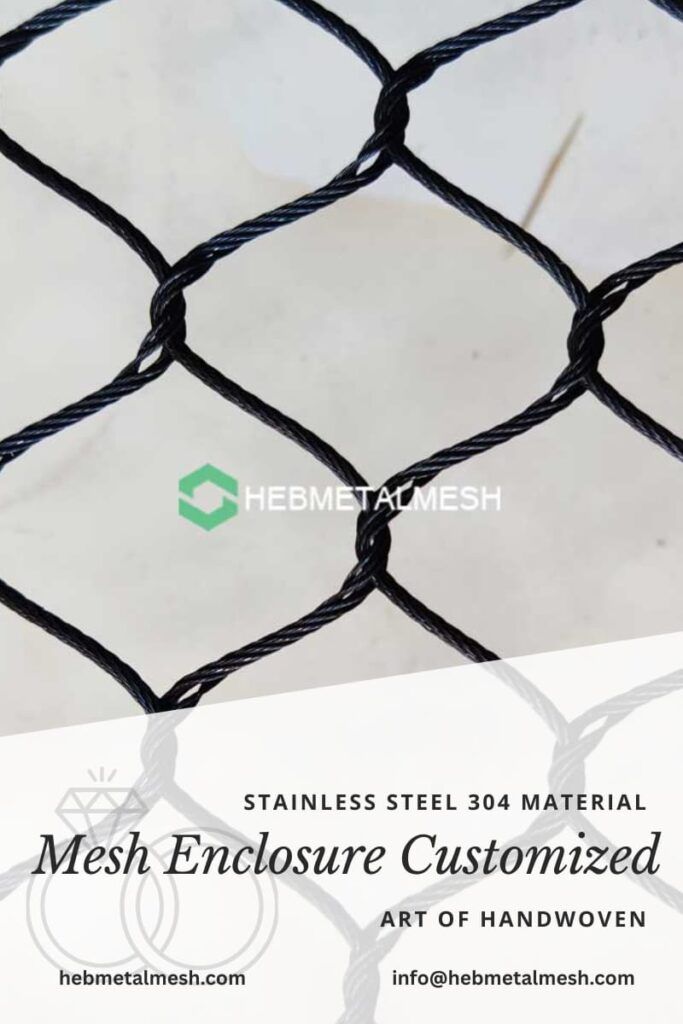
In contrast, our handwoven netting uses a “knotted” or “interwoven” structure. The diamond mesh allows the load to be distributed across several crossing wire ropes. This “energy dissipation” is the same principle used in safety nets for construction. The fence doesn’t just block the animal; it catches and redirects the energy, protecting both the animal from injury and the fence from structural failure.
III. Best Wildlife Fence Options for Protecting Gardens
Protecting a garden from local wildlife requires a delicate balance between a secure barrier and an attractive landscape. Many homeowners settle for temporary solutions that fail within a single season, leading to repeated costs and frustration.
1. Plastic and Poly Mesh (Temporary)
Lightweight and inexpensive, plastic mesh is often used for seasonal vegetable patches. However, it is easily breached by chewing rodents or determined deer and quickly degrades under UV exposure. In a professional landscape, plastic mesh is a liability, not a solution.
2. Galvanized Welded Wire (Intermediate)
Standard galvanized fencing is a common choice but prone to rust at the weld points. Over time, the silver finish becomes an eyesore, and the rigid structure can snap under the pressure of a large animal strike. Furthermore, the zinc coating can flake off, which is a potential ingestion hazard for animals.
3. Handwoven Stainless Steel Netting (The Permanent Solution)
For those seeking a “set-and-forget” solution, Hebmetalmesh handwoven netting is the premium choice.
- Invisible Aesthetics: Our Black Oxide option is a game-changer for garden design. The matte black finish absorbs light rather than reflecting it. This makes the fence virtually disappear against green foliage, preserving your view while providing maximum security.
- Small Animal Protection: With customizable aperture sizes (mesh holes), we can manufacture mesh tight enough to keep out rabbits, squirrels, and groundhogs while maintaining a sleek, modern look.
- Climbing Support: For gardeners, our mesh serves double duty as a high-strength trellis for climbing plants like clematis or ivy, which can further blend the fence into the natural environment.
IV. Wildlife Fence Designs Effective for Deer Prevention
Deer are among the most persistent challenges for property owners. A “wild life fence” designed for deer must account for their incredible jumping ability, their specialized hooves, and their tendency to charge when startled.
The 8-Foot (2.4m) Standard
White-tailed deer and mule deer can easily clear a 6-foot fence from a standing start. To truly protect a rural property or orchard, an effective deer prevention design must reach a height of at least 8 feet. Hebmetalmesh can produce rolls and panels that meet these height requirements in single, seamless pieces. This eliminates the “horizontal seam” found in stacked 4-foot rolls, which is where deer typically find a way to squeeze through.
Sightlines and Accidental Strikes
Deer have poor depth perception. A thin, silver wire can be invisible to them, leading to accidental collisions that break the wire. By using our 2.0mm to 2.4mm wire diameter mesh, the structure is substantial enough for the deer to see, yet fine enough to be aesthetically pleasing.
The “Angled Top” Strategy
For high-security areas, some rural properties employ an “outward-canted” top. By angling the top 2 feet of the Hebmetalmesh netting at a 45-degree angle toward the outside, you create a psychological barrier that deer are extremely hesitant to jump, as they cannot gauge the landing.
V. How to Choose the Right Wildlife Fence for Rural Properties
Rural properties face a unique set of variables: varying terrain, harsh weather, and a wider variety of wildlife ranging from predators like coyotes to large foragers like elk.
1. Assessing the Terrain: The Flexibility Factor
Rigid panels (like chain link or welded panels) are notoriously difficult to install on slopes. They require “stepping,” which leaves large triangular gaps at the bottom—perfect entry points for coyotes or foxes. Hebmetalmesh rolls are inherently flexible. They can be tensioned across uneven ground and “racked” to follow the natural contours of a hillside. This creates a continuous, gap-free barrier that is essential for predator control on rural farms.
2. Predator Protection (Coyotes, Wolves, and Bears)
For rural properties protecting livestock:
- Bite Resistance: Stainless steel is one of the few materials that can withstand the persistent gnawing and biting of canines.
- Climb Prevention: A small mesh aperture (e.g., 1.5″ x 1.5″) makes it difficult for predators to gain a foothold, preventing them from climbing over the top.
- Weight and Strength: Our 3.2mm wire option provides the heavy-duty strength required to deter black bears and other large North American predators.
3. Cost-Benefit Analysis: The “Lifetime” Fence
While the initial cost of stainless steel netting is higher than galvanized wire, the ROI (Return on Investment) is significantly better.
- Maintenance: Stainless steel requires zero painting, zero rust treatment, and zero tensioning adjustments once properly installed.
- Longevity: A standard wire fence may need replacement every 5-7 years. A Hebmetalmesh stainless steel fence is designed to last 30 to 50 years. When you factor in the labor costs of repeated replacements, stainless steel is the most economical choice over a 15-year period.
VI. Industrial Applications: Zoo Enclosures and Habitats
Zoo enclosure design has evolved from “cages” to “naturalistic habitats.” The goal is to provide a barrier that is invisible to the human eye but impenetrable to the animal.
1. Large-Scale Habitats and the 30′ x 60′ Panel
Modern zoo design favors “immersion.” Our ability to manufacture massive panels up to 30′ x 60′ (approx. 9m x 18m) is a major advantage for zoo architects.
- Reduced Infrastructure: Larger panels mean fewer vertical support posts. This results in a cleaner look and lower material costs for the framing.
- Seamless Construction: No vertical or horizontal joints mean there are no weak points for an animal to exploit with its claws or teeth.
2. Species-Specific Requirements
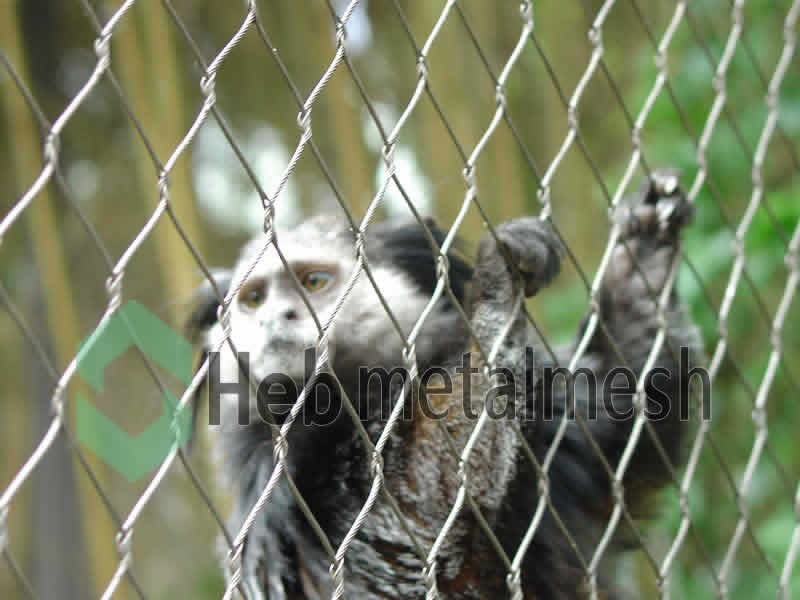
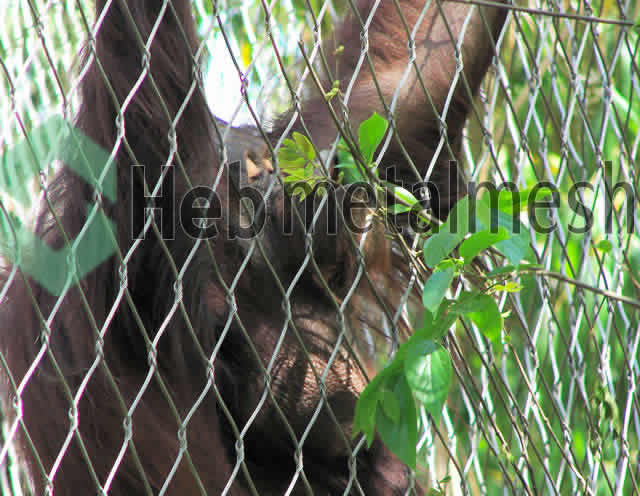
- Primate Exhibits (Orangutans, Chimpanzees): Primates are incredibly dexterous and strong. They will find and pick at any sharp edge. Our handwoven mesh is perfectly smooth. There are no “burrs” or sharp wire ends that can cut a primate’s hands. We recommend a 2.4mm wire with a tight 1″ or 2″ mesh.
- Big Cat Habitats (Tigers, Lions): These animals require extreme tensile strength. We provide heavy-duty 3.2mm wire mesh. The flexibility of the mesh is vital here; if a 400lb tiger leaps against the fence, the mesh flexes to absorb the impact, preventing the animal from sustaining a concussion or broken bones.
- Aviaries (Eagle, Falcon, and Songbird): For birds, the mesh must be light enough to be suspended over large spans but strong enough to keep out local predators. Our 1.2mm or 1.6mm “Fine Mesh” is the standard for walk-through aviaries globally.
VII. Black Oxide: The Science of “Invisibility”
One of Hebmetalmesh’s most popular options for wild life fence applications is our Black Oxide treatment.
What is Black Oxide?
Unlike paint or powder coating, which sits on top of the metal and can flake off, Black Oxide is a chemical conversion coating. It is the result of a chemical reaction between the iron on the surface of the stainless steel and the oxidizing salts. This creates a magnetite ($Fe_3O_4$) layer on the surface.
Why use it for Wildlife?
- Light Absorption: Stainless steel is naturally reflective. In a zoo or a scenic garden, the “glint” of the sun off the wire draws the eye to the fence. Black oxide absorbs 90% of light, allowing the eye to focus through the fence on the animals or the garden.
- UV Stability: Paints fade and crack under the sun. Black oxide is UV-stable and will maintain its deep matte black finish for decades.
- Animal Welfare: Some species are stressed by bright, reflective surfaces. A matte black barrier is more “natural” and helps keep animals calm.
VIII. Customization: No Additional Cost for Custom Sizes
The traditional fencing industry is built on “waste.” If you have a project that requires a 12-foot high fence and the supplier only sells 10-foot or 20-foot rolls, you are stuck with expensive scrap.
The Hebmetalmesh Advantage: We weave every order to the customer’s exact dimensions. Whether you need a small 4′ x 10′ panel for a backyard chicken coop or fifty 30′ x 60′ panels for a new zoo exhibit, we manufacture to your specifications.
- Zero Waste: You only pay for the square footage you actually use.
- Reduced Labor: Your installation team doesn’t have to spend hours cutting and trimming on-site.
- Structural Integrity: Factory-finished edges are significantly stronger than field-cut edges.
IX. Comparison: Handwoven Netting vs. Welded Wire Mesh
| Feature | Handwoven SS Netting (Hebmetalmesh) | Welded Wire Mesh | Chain Link Fencing |
|---|---|---|---|
| Durability | 30+ Years (No Rust) | 5-10 Years (Rusts at welds) | 10-15 Years (Galvanized) |
| Impact Resistance | Very High (Flexible/Absorbs) | Low (Rigid/Brittle) | Moderate (Deforms easily) |
| Customization | Infinite (Any panel size) | Limited to standard rolls | Standard roll widths |
| Aesthetics | Premium (Near-invisible) | Industrial | Obstructive |
| Animal Safety | High (No sharp edges) | Moderate (Sharp welds) | Low (Can trap limbs) |
| Maintenance | None Required | High (Patching rust) | Moderate (Tensioning) |
X. Where to Buy Wildlife Fencing Materials Near Me?
The common search query “wildlife fencing near me” often leads to local retailers that stock agricultural-grade fencing. While suitable for basic cattle containment, these products are rarely sufficient for specialized wildlife needs or high-end residential protection.
Global Shipping from the Factory
Because Hebmetalmesh is a specialized manufacturer, we ship directly from our factory to your location.
- To the USA: We regularly ship to project sites in California, Texas, Montana, and Florida.
- To Europe & Australia: Our logistics network ensures that our customized rolls arrive at your site in professional-grade packaging, ready for installation.
Direct Online Ordering
For standard projects, you can browse and purchase directly from our store: https://hebmetalmesh.com/store/. For bespoke zoo designs or massive rural estates, we provide a full engineering consultation via our website contact forms.
XI. Comprehensive Installation Guide
A wild life fence is a system, not just a material. Proper installation is critical to the performance of the stainless steel netting.
1. Framework Selection
We recommend using stainless steel tubing or high-tension galvanized steel posts. For the most aesthetic “invisible” look, use a Perimeter Cable System. This involves stretching a 6mm or 8mm stainless steel wire rope between heavy-duty corner posts. The Hebmetalmesh netting is then laced to this cable.
2. The Art of Lacing
Our mesh is joined to the frame using “Lacing Wire.” This is a smaller diameter stainless steel wire that is wrapped around the frame and through each diamond of the mesh.
- Pro Tip: Ensure the lacing wire is the same grade (304 or 316) as the mesh to prevent galvanic corrosion.
3. Tensioning Requirements
The mesh should be tight but not “over-stressed.” Properly tensioned handwoven mesh will have a slight “spring” to it. This elasticity is what allows it to survive a bear strike or a falling tree limb without breaking.
4. Ground Security (Anti-Digging)
To prevent coyotes or wild boars from digging under the fence:
- Vertical Burial: Bury 12-24 inches of mesh vertically into a trench.
- The “L-Footer”: Lay 2 feet of mesh horizontally on the ground facing the outside and secure it with sod staples. Grass will grow through the mesh, anchoring it and creating a “mat” that animals cannot dig through.
XII. Case Study: Hebmetalmesh in Action
Project: The Mountain Lion Habitat
A wildlife park needed a barrier that could withstand the vertical leap of a cougar while allowing visitors to photograph the animals without seeing a “cage.”
- Solution: We provided 2.0mm Black Oxide Mesh with a 2″ aperture.
- Result: The matte finish allowed for crystal-clear photography. Despite the cats frequently jumping against the mesh, it has remained perfectly tensioned for 5 years and counting.
Project: The Coastal Vineyard
A rural vineyard in a coastal region was losing 20% of its crop to deer and was seeing rust on its galvanized fences within 24 months.
- Solution: SS316 Handwoven Netting customized to follow the steep slopes of the vineyard.
- Result: Zero rust after 4 years, and deer incursions were reduced to zero.
XIII. Frequently Asked Questions (FAQ)
A: Yes. Unlike galvanized mesh, there are no toxic coatings that can flake off. The smooth handwoven knots prevent skin abrasions and feather damage in birds.
A: Small garden projects can be DIY-installed with basic tools. However, for large zoo enclosures or 8-foot deer fences, we recommend a professional fencing contractor. We provide detailed installation manuals for all orders.
A: Generally, rain is sufficient to keep the mesh clean. In dusty environments or near the sea, a simple rinse with fresh water once a year will maintain its luster and longevity.
A: No. Because it is a chemical conversion, it is integrated into the metal. It is highly resistant to scratching and weather.
XIV. Conclusion: The Hebmetalmesh Commitment
Investing in a wild life fence is a significant decision. It is an investment in the safety of your property, the welfare of the animals you care for, and the long-term value of your land. By choosing handwoven stainless steel netting from Hebmetalmesh, you are choosing a partner with the engineering expertise and manufacturing power to deliver a world-class solution.
Our factory-direct model ensures you receive the highest quality materials without the retail markup, and our commitment to customization means your project will be as unique as the landscape it protects.
Take the Next Step:
- Explore our full technical specs: Hebmetalmesh Official Website
- Start a small project today: Visit our Online Store
- Consult with an Engineer: Contact us for custom sizes and project-specific advice.