
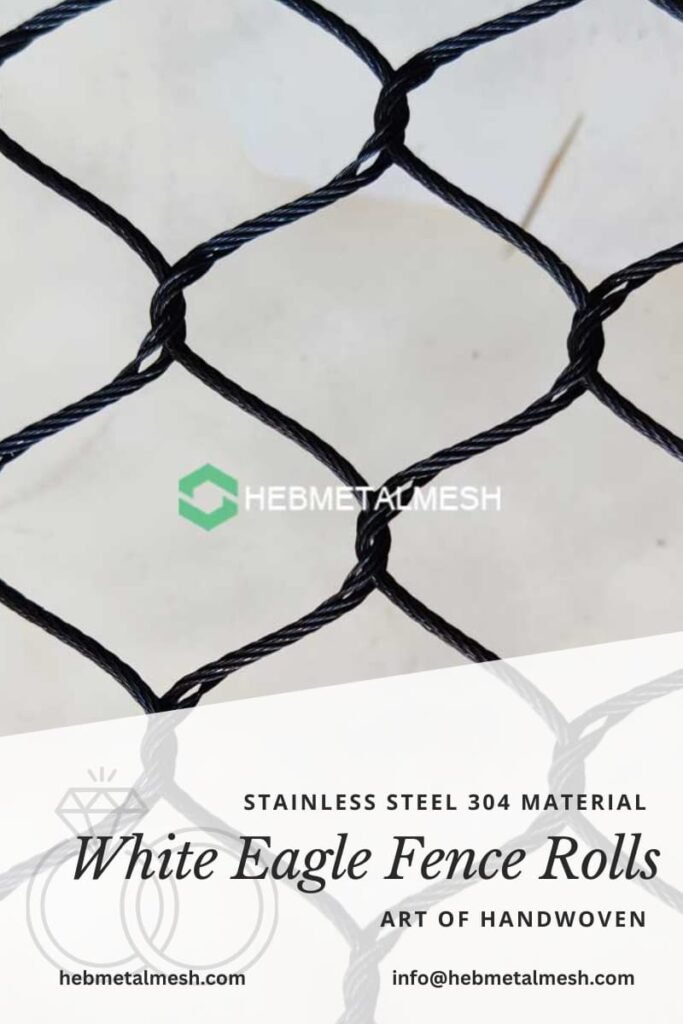
A keeper once asked why two eagles in the same building needed different panels. Both were bald eagles. Both came through the same rehab intake. One was a ten-pound male with a six-foot span, the other a fourteen-pound female carrying eight feet of wing. Same species, same room, and a panel that suited one bird and not the other.
That is the trap in the phrase white eagle fence. It sounds like one product built for one bird. In practice the white head is a five-year marker, and a bird on either side of it can differ by four pounds and two feet of wingspan. A fence has to satisfy both ends of that range, or it satisfies neither.
This guide works through what changes with the bird — flight volume, perch load, water, and the corrosion that follows a fish diet — and what stays fixed no matter which eagle you house.
Executive Summary
A white eagle fence is specified from the bird, not from a catalog page. Adult bald eagles carry a wingspan of six to eight feet and a body weight of ten to sixteen pounds, and those figures climb with latitude. Juveniles under five years are smaller, mottled, and easy to confuse with golden eagles, which is why mixed-age housing needs a spec that covers the heavier end. Three numbers do most of the work: aperture tight enough to keep a claw from wedging, cable heavy enough to absorb a strike without permanent set, and an anchor grid that carries perch load and wind load together. The rest is detail — water access, salt exposure, and the inspection routine that catches a failing fitting before a bird finds it.
Housing eagles of different ages in one building?
Send the heaviest bird you will ever house, plus the building envelope. We return aperture, cable diameter, anchor grid, and the wind figure for each panel.
Quick Answer
A white eagle fence for adult bald eagles uses 2″ x 2″ aperture, 1/8″ cable, and anchors on a 4 to 5 ft grid. Juveniles under five years can take a tighter 1″ panel with 3/32″ cable. Always size the structure for the heaviest bird the facility will ever house, not the one it holds today.
Key Takeaways
- The white head appears at about five years, so a “white eagle” and a juvenile of the same species can differ by four pounds.
- Wingspan runs six feet for males and eight feet for females, and northern birds run heavier still.
- Aperture protects the claw. Cable diameter absorbs the strike. Treat them as separate decisions.
- A fish diet puts the lower mesh in a splash zone, so specify the alloy for that zone rather than for the weather.
- Perch load and wind load share the same anchor. Design them together or one will fail the other.
- Fittings fail before mesh does. Inspect twice a year and log what you find.
The White Head Is a Five-Year Marker
The white head and white tail belong to a mature adult. Bald eagles reach that plumage around five years of age, and until then they carry mottled brown and white feathers that make juveniles easy to mistake for golden eagles. Our golden eagle fencing notes cover the bird juveniles get confused with. This matters for a white eagle fence because the two age classes are not the same engineering problem.
A juvenile is smaller and lighter. Its strike is weaker. An adult female is the load case that governs the whole structure, and she is the bird most facilities forget when they order panels for the bird currently in the cage.
Two Mass Classes, One Enclosure
Treat every eagle building as though it will eventually hold an adult female. Rehab intake and breeding programs both shuffle birds between spaces, and a panel ordered for a ten-pound male will not forgive a fourteen-pound female in year three. If the building genuinely will never hold an adult, a lighter spec is defensible — but write that assumption down, because staff turnover erases it fast.
Wingspan Sets the Volume, Not the Width
Most enclosure drawings start with floor area. That is the wrong measurement for a bird that hunts on the wing. Eagle flight aviary dimensions are governed by the arc the bird needs to turn inside, and turn radius scales with span, not footprint.
A female with eight feet of wing needs a working volume roughly twice the size that suits a six-foot male. Squeeze that volume and the bird stops flying. It perches, waits, and loses condition while the enclosure looks perfectly adequate on the plan.
Measuring by Flight Arc
Take the wingspan, multiply by three, and use that as the minimum clear dimension in the direction of flight. Then check vertical clearance, because an eagle gains height fast when it launches from a high perch. A raptor enclosure built to the horizontal number alone will have a bird that clips the roof.
Wire rope mesh helps here. It spans wide openings without the intermediate framing that chain link needs, so the clear volume stays clear. The eagle enclosure netting sized for the span is ordered by clear opening rather than roll width, so the drawing gets the volume it asks for.
What the Mesh Actually Carries
The perimeter panel on an eagle building is not the part that fails first. Perches, nest platforms and landing shelves take the concentrated loads, and they transfer those loads into anchors that were often sized for a fence. The eagle containment mesh specifications page lists the wire and ferrule grades that match each load case.
Eagle perch load capacity is usually quoted as a static figure. That is not how a bird uses a perch. It lands with momentum, shifts weight while feeding, and launches with a downward push that multiplies its body mass several times over.
The same applies to an eagle landing zone mesh under a favored perch. Droppings, fish scraps and wet feathers land there, and the panel takes repeated impact on a permanently damp surface.
| Element | Governing load | Aperture | Cable | Anchor grid |
| Perch limb | Landing impact at 4x body mass | 2″ x 2″ | 1/8″ | 4 ft |
| Flight wall | Strike plus claw contact | 2″ x 2″ | 1/8″ | 5 ft |
| Overhead roof | Wind uplift plus strike | 2″ x 2″ | 1/8″ | 4 ft |
| Nest platform | Wet nest mass, static | 2″ x 2″ | 3/16″ | 3 ft |
| Isolation cage | Low energy, high visibility | 1″ x 1″ | 3/32″ | 4 ft |
Two adjustments cover most builds. Go up one cable size wherever a bird lands, even if the rest runs lighter. And never reduce the anchor grid on a perch support to save steel — that is where load is concentrated and repeated.
Aperture and Claw Risk
Aperture is the dimension that decides whether a bird gets hurt. An eagle claw can pass through an opening that its body cannot, and a foot that goes through and does not come back out is how toes and tarsi break.
This is why eagle mesh aperture size is an animal welfare question before it is a cost question. The larger the opening, the cheaper the panel and the higher the risk. There is no version of that trade that ends well for the bird.
Eagle claw injury mesh prevention comes down to three habits:
- Keep climbing and landing surfaces at 2″ x 2″ or tighter.
- Drop to 1″ x 1″ wherever a bird grips rather than lands.
- Check that the aperture stays square after tensioning, because a stretched diamond opening is wider than the spec sheet says.
Water, Fish, and Salt
Eagles eat fish, and fish means water, and water means splash. That drives corrosion in a way weather alone does not.
Eagle enclosure water access is usually designed for the bird — a pool deep enough to bathe, with a perch overlooking it. What gets missed is the mesh behind and below it. An eagle bathing pool enclosure sits in a permanent splash zone of chlorides, organic waste and constant dampness.
Standard stainless steel 304 handles most outdoor zoo conditions well. In a splash zone with salt or heavy organic load, the alloy choice deserves a second look, because eagle mesh salt air corrosion starts at welds and cut ends before it shows on the wire face.
Three details decide how long that zone lasts:
- Specify the alloy by exposure, not by price. Coastal facilities and saltwater pools sit in a different category from inland fresh water.
- Seal or cap cut ends. A raw cut is where corrosion begins.
- Keep fish waste off the panel. A wash-down routine does more for mesh life than a heavier gauge.
The U.S. Fish and Wildlife Service species profile notes that fish are a staple food and that bald eagles will also scavenge and steal catches. A feeding station placed away from the mesh keeps most of that mess off the panel.
Comparing White Eagle Fence Options
Four materials turn up in eagle buildings. They are not interchangeable, and the differences show up under repeated impact rather than on day one.
| Option | Aperture control | Strike behaviour | Splash-zone corrosion | Panel weight |
| Chain link | Fixed at 2″, no tighter | Local deformation, stays bent | Zinc coating fails at cut ends | Heavy |
| Welded wire | Fixed grid, welds crack | Weld fracture under repeat impact | Thin coating, rust at joints | Medium |
| Nylon netting | Knots slip, aperture drifts | Elastic return, but UV degrades | Not rated for wet zones | Light |
| Stainless rope mesh | Specified to the inch | Elastic recovery, no permanent set | 304 or 316 rated | Light |
Chain link fails an eagle building for one reason: it cannot go tighter than 2 inches, and the claw risk lives below that number. Welded wire holds a tighter grid but cracks at the welds when a heavy bird hits the same spot repeatedly.
Nylon is light and cheap and works for short-term rehab. It does not belong over a permanent collection bird in a wet climate.
Ferrule mesh and handwoven rope mesh both recover their shape after impact, which is why most permanent raptor buildings end up there. The eagle enclosure netting range covers the aperture and cable combinations in the table above, cut to the frame rather than to a stock roll.
Anchors, Wind, and Tension
Eagle enclosure wind load rarely gets its own line on a drawing, and it should — a tall flight wall is a large sail area. Wind and perch load also meet at the same anchor, so design one without the other and the fitting becomes the weak link.
Eagle enclosure anchor spacing follows the load, not the frame spacing. A 4 ft grid suits most perch supports, 5 ft suits flat wall panels, and the roof needs its own check because uplift pulls against everything else on the structure.
Eagle netting installation tension decides whether any of that holds. Work in two passes — a light pass to position the panel, then a final pass to load it. Panels pulled to full tension in one go drag the frame out of square.
Sequence the work like this:
- Set and brace the frame before any panel goes up.
- Hang the panel with temporary ties and check the diagonal.
- Tension in two passes, working from the centre outward.
- Re-check aperture square at every frame line.
- Torque anchors last, after the panel has taken its load.
Rehab Birds and Release Candidates
A rehab cage is a different building from a permanent exhibit, and the spec should say so. Eagle rehabilitation cage mesh needs visibility and quick cleaning more than a thirty-year service life.
Use a tighter aperture and a lighter cable. Keep the panel smooth on the inside face, because a bird that has already been injured does not need a second event during recovery. Plan the release door before the cage goes up — retrofitting an opening into a tensioned panel is far harder than framing it in.
Facilities that run both rehab and permanent housing should keep the two specs separate. Merging them gives a cage overbuilt for recovery and underbuilt for a resident adult, and blurs the line between a release candidate and a bird that stays for life — a distinction that matters to any wildlife conservation program.
The Inspection Routine
An eagle enclosure inspection checklist is short, and most of it is about fittings rather than mesh. Rope mesh rarely fails first; terminations, thimbles and anchor plates do.
Walk the enclosure twice a year, and after any storm event:
- Run a gloved hand along the lower three feet of every panel. Broken wires show up as a catch before they show up visually.
- Check every ferrule and swaged end for slippage marks. Mark the wire at the ferrule with paint so movement is visible next time.
- Look at anchor plates for elongation of the bolt holes, not just for loose nuts.
- Test the aperture square at three points per panel.
- Photograph anything you flag. A dated photo turns a judgement call into a record.
A replacement panel has to match the original grades, which is easier when the spec is filed with the drawing.
Choosing the Panel
Good bald eagle enclosure design starts with the heaviest bird and works backward. Decide the mass class, then the volume, then the aperture, then the cable, then the anchors. That order gives every later decision a reason.
A white headed eagle aviary that skips that step ends up overbuilt in one place and thin in another.
Two paths cover most projects. A permanent exhibit for adult birds goes to ferrule or handwoven rope mesh at 2″ aperture and 1/8″ cable, with anchors on a 4 to 5 ft grid and the alloy chosen for the water exposure. A rehab or short-stay cage goes lighter, tighter and more visible.
Either way, the bird sets the numbers, not the catalog. The eagle flight aviary build notes cover how those numbers translate into framing.
Budget comes last, once aperture and cable stop moving. The wire rope mesh cost breakdown shows where the number lands after that.
Get the eagle spec settled before the frame goes up.
Send the building envelope and the heaviest bird you house. We will return aperture, cable diameter, anchor grid and the wind figure for each panel, sized for the adult rather than the juvenile.