
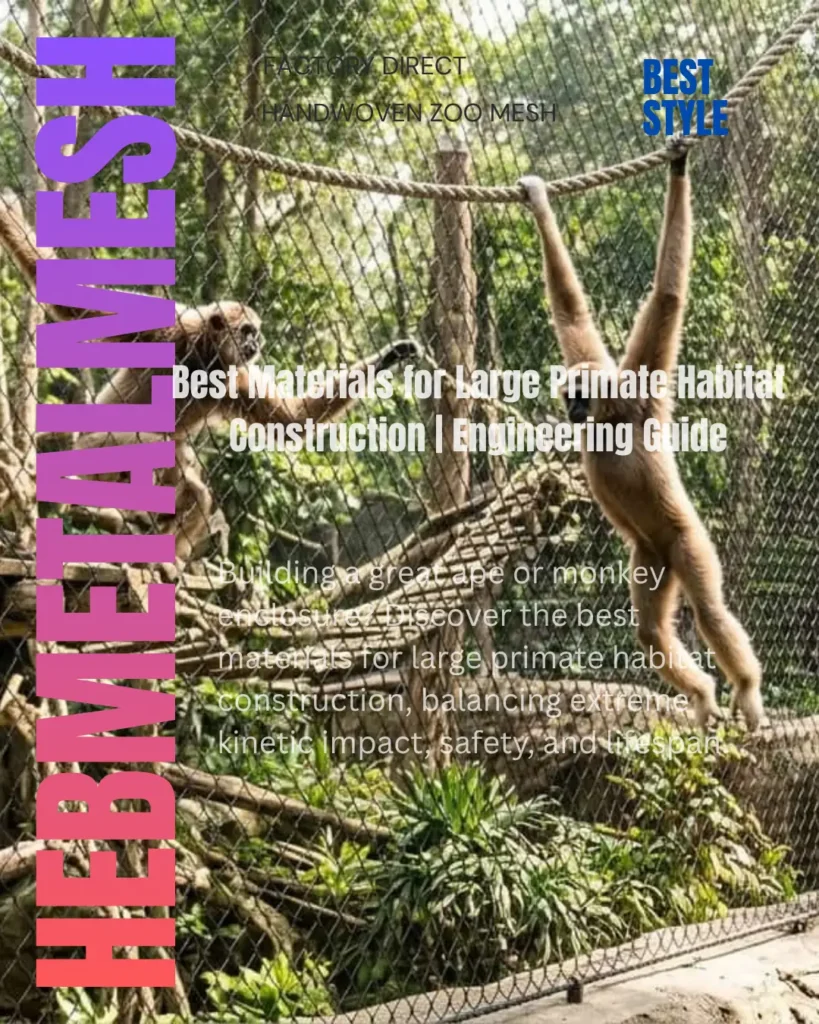
Buying gibbon enclosure mesh is not a roll-and-price decision. Gibbons are the only apes that move by brachiation — full-body swings from arm to arm — so every meter of mesh inside their enclosure takes a concentrated load that no welded or woven wire fence was designed for, and every meter of the boundary is a potential escape route for an animal with hands like a locksmith. The correct supplier, therefore, is not the cheapest roll seller but the factory that certifies rope construction, aperture, and breaking strength for an arboreal primate exhibit, then weaves panels to your drawing. This guide is written for zoo architects, keepers, and procurement teams: it covers the specification that matters, the audit questions that separate real manufacturers from traders, and the realistic 2026 cost of a gibbon enclosure mesh supply contract.
Executive Summary
Gibbon enclosures fail in two ways, and both are supplier problems. The first is under-specification: mesh woven from thin cable at a wide aperture that lets an adult gibbon grip the crossing points, bend them, and open a gap over months of daily testing. The second is over-specification disguised as quality — paying zoological-grade prices for panels whose only difference is a brand stamp. A competent gibbon mesh supplier solves both by quoting against a written spec: rope diameter 2.0–3.2 mm, aperture sized below the gibbon’s grip capability (typically 51–76 mm for adults), SS304 or SS316 wire, hand-woven crossings with no weld to fatigue, and panels continuous up to 9 × 18 m so the swing space is not interrupted by splices. Expect to validate material certificates, request enclosure mesh samples, and inspect panel weight and weave consistency before any container ships. Planning prices for gibbon-grade rope mesh run $18–38 per square meter depending on rope and grade, with factory-direct contracts typically 15–25% below distributor quotes. The reference specification is the gibbon enclosure fence netting mesh product page.
Quick Answer: What Should a Gibbon Enclosure Mesh Supplier Provide?
Quick Answer: A serious gibbon mesh supplier provides hand-woven stainless steel rope mesh in documented codes — rope diameter 2.0–3.2 mm, aperture 51–76 mm for adult gibbons, SS304 or SS316 — cut as custom panels up to 9 × 18 m, with material certificates, a woven sample swatch, and a factory-direct price. Avoid any supplier that cannot state the breaking strength of the rope and the exact alloy.
Three things separate a mesh factory from a mesh trader. A factory can name the wire construction (typically 7×7 or 7×19 rope), issue mill certificates tracing the SS304 or SS316 heat, and weave panels to your aperture and panel size rather than selling fixed rolls. A trader can only resell. Because gibbon welfare and keeper safety both ride on the boundary, the supplier question is really a specification question: the mesh must match the animal, and the paperwork must match the mesh.
Key Takeaways
- Specify before you shop. Aperture, rope diameter, and alloy written into your RFQ eliminate 90% of supplier confusion.
- Adult gibbons need 51–76 mm aperture mesh — small enough to deny their grip, large enough to brachiate through visually.
- Verify with a sample, not a brochure. Request a swatch, measure the aperture, weigh the panel, and pull the rope.
- Factory-direct cuts 15–25% off typical distributor pricing for the same HM code.
- Welfare and escape are the real specs. The mesh must survive decades of brachiation load while staying climb-proof at the boundary.
Zoo standards for gibbon housing exist because these animals injure themselves against badly designed barriers. The husbandry guidance behind modern gibbon mesh specifications is maintained by the world’s zoological associations, including the World Association of Zoos and Aquariums , whose members publish the enclosure data this guide draws on.
Why Gibbons Are the Hardest Enclosure Animal to Mesh
Gibbons brachiate: they swing hand-over-hand through the canopy at speeds that put continuous dynamic load on every anchor point they touch. In an enclosure, that behavior translates into three engineering facts:
- Load is dynamic, not static. A swinging adult gibbon loads the mesh at the end of each arc. A hand-woven rope crossing distributes that load across neighboring crossings; a welded joint concentrates it and eventually fatigues.
- Hands are the escape tool. A gibbon can grip, pull, twist, and open almost anything a human can. The mesh aperture must be small enough that no crossing point offers a two-hand grip — this is why 51–76 mm is the working range for adults, and why fine-mesh “monkey mesh” below 30 mm is used where infants are housed.
- Swing space is non-negotiable. Gibbons need unimpeded horizontal and vertical movement, so the swing clearance along every brachiation path must stay free of splices. Only continuous custom panels up to 9 × 18 m provide that clearance.
The practical consequence: a gibbon mesh supplier must think in terms of rope mesh performance, not fencing rolls. Every decision — rope diameter, crossing weave, tensioning edge rope, and panel size — is a structural one.
What to Specify: The Gibbon Enclosure Mesh Specification
Aperture and Rope Diameter
| Enclosure population | Aperture | Rope Ø | Recommended code |
| Infants / juveniles present | 25–45 mm | 2.0 mm | HM2038 (2.0/38) |
| Adult gibbons, mixed exhibit | 51 mm | 2.0 mm | HM2051 (2.0/51) |
| Adult gibbons, active group | 76 mm | 3.2 mm | HM3276 (3.2/76) |
| Outdoor island / climber mesh | 76–102 mm | 3.2 mm | HM32102 (3.2/102) |
The gibbon mesh aperture for adult gibbons sits in a narrow band: large enough that the animal can see through and brachiate naturally, small enough that a hand cannot close around a crossing and gain purchase for sustained pulling. Rope diameter follows load: 2.0 mm rope suits sheltered indoor groups, while 3.2 mm rope is the default for outdoor islands where wind, climbing structures, and multiple animals load the same panel.
Alloy, Construction, and Finish
- SS304 (18% Cr / 8% Ni) is the standard indoor and sheltered-exhibit grade.
- Gibbon mesh 316 stainless grade adds molybdenum for chloride resistance and is the responsible choice for outdoor exhibits, coastal zoos, and humid tropical regions — where gibbon ranges naturally sit.
- Rope construction 7×7 or 7×19: 7×19 is more flexible and resists fatigue under repeated flexing, which suits brachiation contact points.
- Finish: natural mill for most exhibits; black oxide where the mesh must visually disappear against dark vegetation or nighttime viewing.
Every gibbon mesh wire rope diameter has a published breaking strength; ask for it per code and confirm the weave’s crossing method. Hand-woven rope mesh has no welds and no mechanical joints — the same construction that has contained large carnivores in zoos for decades.
How to Vet a Gibbon Mesh Supplier: The Audit Checklist
Not every company that sells “stainless steel mesh” can supply zoo-grade rope mesh. For institutional buyers, the shortlist narrows fast: gibbon mesh suppliers for zoos must document material, weave, and gibbon mesh safety compliance in writing. Use this checklist on any shortlisted supplier:
- Ask for the mill certificate. A factory traces the heat of every coil of SS304 or SS316 it weaves. If the supplier cannot produce material certificates, the alloy claim is unverified.
- Request gibbon enclosure mesh samples before ordering. A genuine sample swatch lets your team measure aperture, weigh a known area, flex the weave, and check the rope lay. Traders rarely send cut-to-spec swatches because they have no weaver.
- Audit the weave. Ask how crossings are made (hand-woven loops, not staples), how edge ropes are tensioned, and how panel weight is controlled. A factory audit — in person or by video — should show weaving looms and QC stations, not a warehouse of imported rolls.
- Confirm custom panel capability. Zoos need custom gibbon mesh panels in nonstandard widths, full-height runs, and odd geometries. A supplier that only cuts rolls to length cannot build a brachiation space without splices.
- Get lead time and volume terms in writing. Gibbon mesh supplier lead time for woven-to-order panels typically runs 3–6 weeks from drawing approval, plus shipping; confirm this before budgeting a construction window.
Zoo procurement teams that follow this audit rarely regret it. The same discipline — sample first, audit second, buy third — is how accredited facilities buy all their exhibit mesh.
Panel Sizes, Weights, and What They Tell You
Gibbon mesh panel sizes and weights are a fast integrity check. Mesh is priced per square meter and sold by weight per panel, so an underweight panel means undersized rope or stretched aperture:
- HM2051 (2.0/51): roughly 0.8–1.0 kg/m²
- HM2076 (2.0/76): roughly 0.7–0.9 kg/m²
- HM3276 (3.2/76): roughly 1.4–1.8 kg/m²
- HM32102 (3.2/102): roughly 1.1–1.4 kg/m²
Weigh your sample swatch, scale it to a square meter, and compare it with the supplier’s stated panel weight. A discrepancy above 5% is a red flag, not a rounding error. Consistent weave, even apertures, and a clean edge rope are the visible signatures of zoo standard gibbon mesh.
The full dimensional and breaking-strength tables for every code are maintained on the gibbon enclosure fence netting mesh core page, which is the reference the rest of this supplier guide points back to.
What a Gibbon Enclosure Mesh Contract Costs
Budget with two numbers: material per square meter and installed area. Current planning ranges (material, ex-works):
| Code | Typical role | Planning price |
| HM2038 (2.0/38) | Juvenile-safe indoor mesh | $16–22/m² |
| HM2051 (2.0/51) | Standard adult exhibit | $18–24/m² |
| HM3276 (3.2/76) | Outdoor island mesh | $24–32/m² |
| HM32102 (3.2/102) | Climber structure mesh | $22–30/m² |
A typical adult gibbon exhibit — roughly 600 m² of boundary and climber mesh at HM3276 — carries a gibbon enclosure mesh cost estimate of $15,000–19,000 in material. Gibbon mesh factory direct price on that volume typically lands 15–25% below a distributor quote for the identical code, because the factory quote removes the middle layer.
Three cost traps to avoid: paying zoological pricing for unspecified alloy (demand the SS304/SS316 heat trace), paying for over-wide panels you do not need, and ignoring freight — woven rope mesh ships by volume, so panel nesting and container loading affect landed cost as much as the unit price.
Installation: Why the Crew Matters as Much as the Mesh
Even the correct mesh fails when tensioning is wrong. Gibbon mesh is installed as a tensioned membrane, not a stretched fence: the tensioning edge rope carries the load, hog rings tie the mesh to it on a fixed grid, and the panel is pulled to a defined tension so it flexes under an impact and returns. Work with a gibbon enclosure mesh installation crew that has built primate exhibits before — tension specification, corner detailing, and climbing-structure attachment are where escape-proofing is won or lost.
Two installation rules specific to gibbons: never attach climbing mesh so tightly that a swinging animal hits an unyielding surface (the mesh must give), and keep all fixings on the outside of the enclosure where hands cannot reach them.
FAQ
Ask for mill certificates, a cut-to-spec sample swatch, custom panel capability, and written lead times — then audit the weave. The supplier that documents all five is a factory; one that cannot is a trader.
51–76 mm for adults, sized so a hand cannot close around a crossing point. If infants or juveniles are housed, drop to 25–45 mm so small hands cannot grip at all.
Yes. Humid, tropical, and coastal conditions corrode 304 over time at rope crossings. The gibbon’s natural range is exactly such a climate, so SS316 is the defensible specification outdoors.
Material plans at $16–32/m² depending on rope diameter and aperture; a typical adult exhibit of 600 m² costs roughly $15,000–19,000 in mesh before posts, tensioning, and installation.
Woven-to-order panels typically take 3–6 weeks from drawing approval, plus freight. Ordering standard codes against an existing drawing shortens this substantially.
Most serious factories can: the same rope mesh family covers gibbon islands, monkey exhibits, and lemur enclosures. See the gibbon barrier stainless steel mesh guide for the design-side companion to this supplier checklist, and the primate cage material guide for cross-species comparison.
Final Word
A gibbon mesh supplier is only as good as the specification it quotes against. Write the aperture, rope diameter, alloy, and panel size into your RFQ; demand certificates, a sample, and proof of custom weaving; and price by code, not by brand. Do that, and the enclosure you build will still be holding the same gibbons — safely, and on the same panels — decades after the invoice is paid.